





About this worksheet
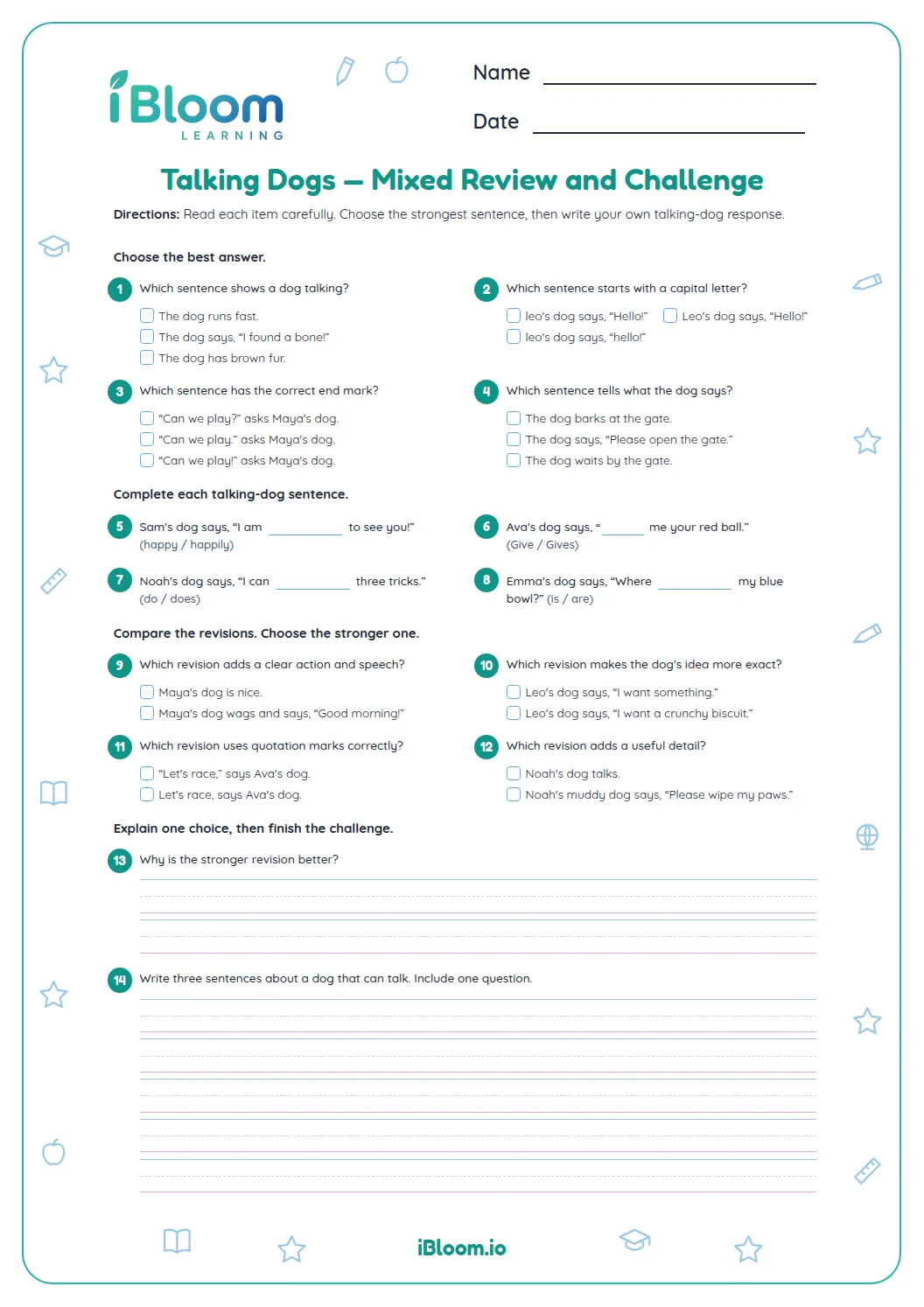
This Grade 1 writing page builds a story from the page’s own idea: Buddy is a talking dog at the park who says “I can help!” and feels excited. Children choose story details, complete two short blanks, and write two brief events. The separate key gives sample responses for open writing.
Aligned to CCSS W.1.3
How does the talking dogs practice begin?
Part A introduces Buddy, a talking dog at the park. Learners choose Buddy’s name, words, setting, and feeling. These choices give the later writing prompts a shared character and setting.
What will learners practice next?
Part B fills in two details, and Part C asks children to choose a sentence and Buddy’s words. Part D asks what Buddy might do next. For example, question 9 offers “Buddy runs to help a friend” as a next event.
- 1Buddy runs to help a friend.
- 2Buddy says, “I can help!”
How can families check the answers?
Part E has two short extended responses: write a next event and add a detail about Buddy at the park. The key offers examples, while a child may write a different event that fits the character and setting.
How to use this worksheet
- 1Read the directions and look at the first example.
- 2Work through each part in order.
- 3Say the rule or clue aloud before answering.
- 4Check responses with the separate answer key.
Common mistakes and quick fixes
The mistake
Rushing past a key clue in the prompt.
The fix
Read the whole prompt again and point to the clue.
The mistake
Guessing without checking the skill rule.
The fix
Name the rule, then compare it with the answer.
The mistake
Skipping a correction after checking the key.
The fix
Rewrite the response accurately before moving on.
Curriculum alignment
This worksheet practices talking dogs through the examples and responses on the sheet.
Write events in order, add a detail, use time words, and give the story an ending.
On this sheet: Questions ask learners to practice talking dogs using the printed items.
Show the official wordingHide the official wording
Write narratives in which they recount two or more appropriately sequenced events, include some details regarding what happened, use temporal words to signal event order, and provide some sense of closure.
What to practice next
Make more practice
Further reading
Questions parents and teachers ask
Who is Buddy in this worksheet?
Buddy is the talking dog at the center of this Grade 1 writing prompt. The questions place him at a park, where he says “I can help!” and feels excited. Children use those details as a starting point, then add their own next event and a detail about Buddy.
What will my child write?
Most questions are short choices or fill-ins about Buddy, his words, the park, and how he feels. Two extended responses ask the learner to write a next event and add a detail. The separate answer key gives samples for those open responses.
Does the page ask children to write a whole story?
No. The page breaks the talking-dog idea into quick choices, two fill-ins, and two short writing prompts. A child can decide what Buddy does next and add a detail about the park. The answer key provides sample responses, while other ideas can also fit.
Is an answer key included?
Yes. The separate key marks the correct story choices, supplies the two missing words, and gives sample responses for the extended writing prompts. A learner’s own event or detail may differ from the sample if it fits Buddy and the park setting.
How can I help my first grader get started?
Read the choices aloud and let the learner choose details about Buddy before writing. Ask what Buddy might do after saying “I can help!” Then invite one short next event and one detail about the park. The key can help you discuss a response without requiring identical wording.