



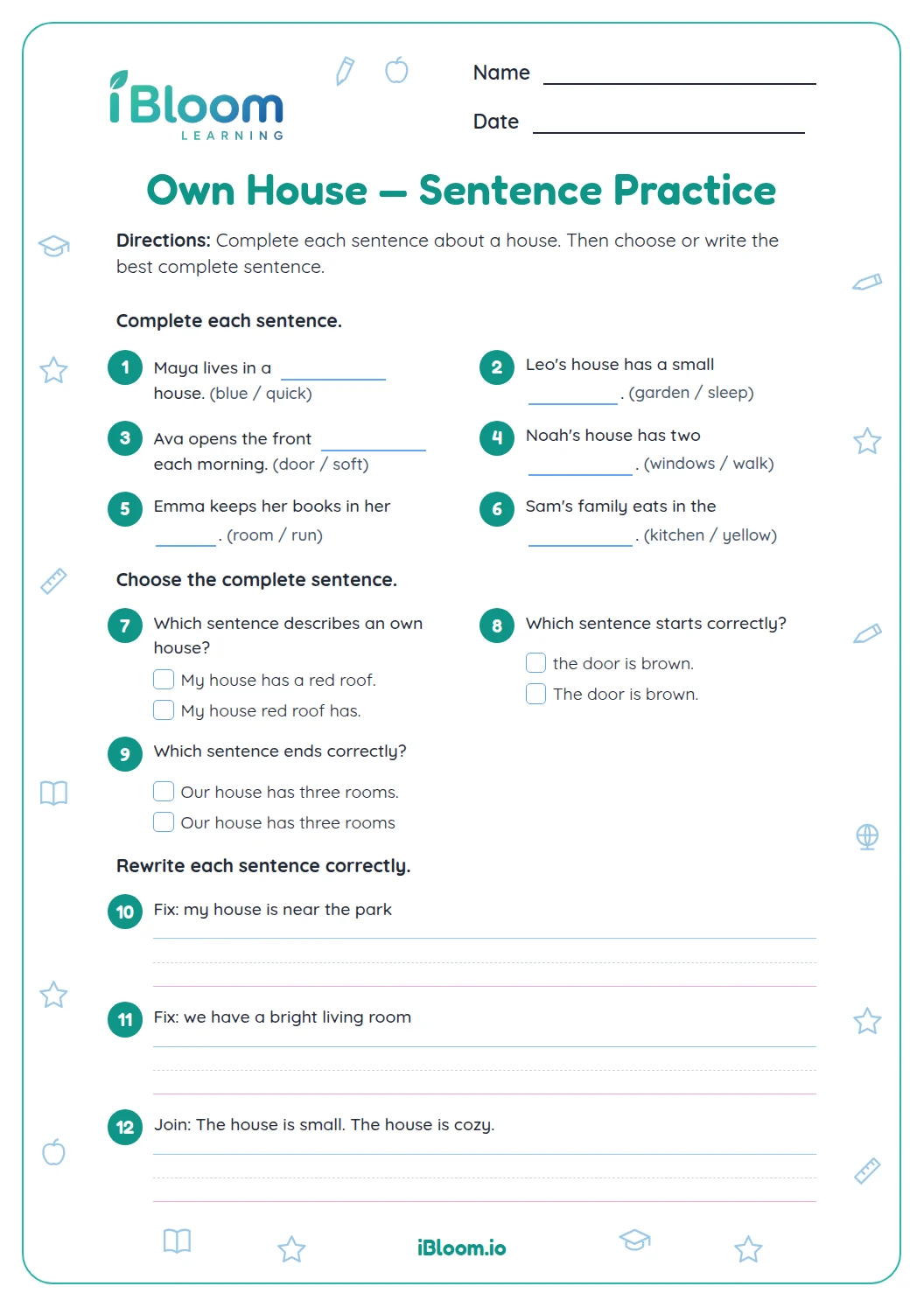
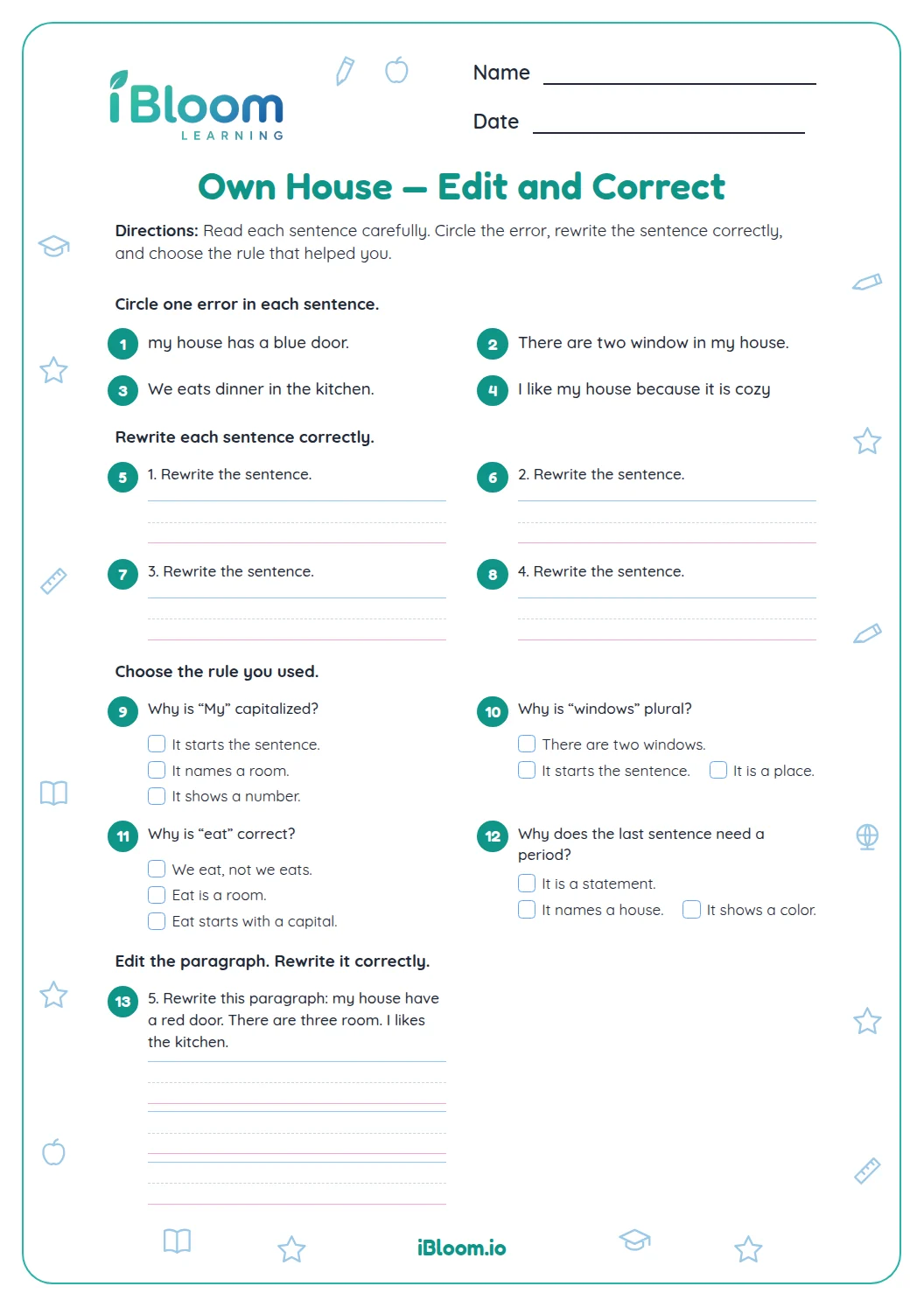


About this worksheet
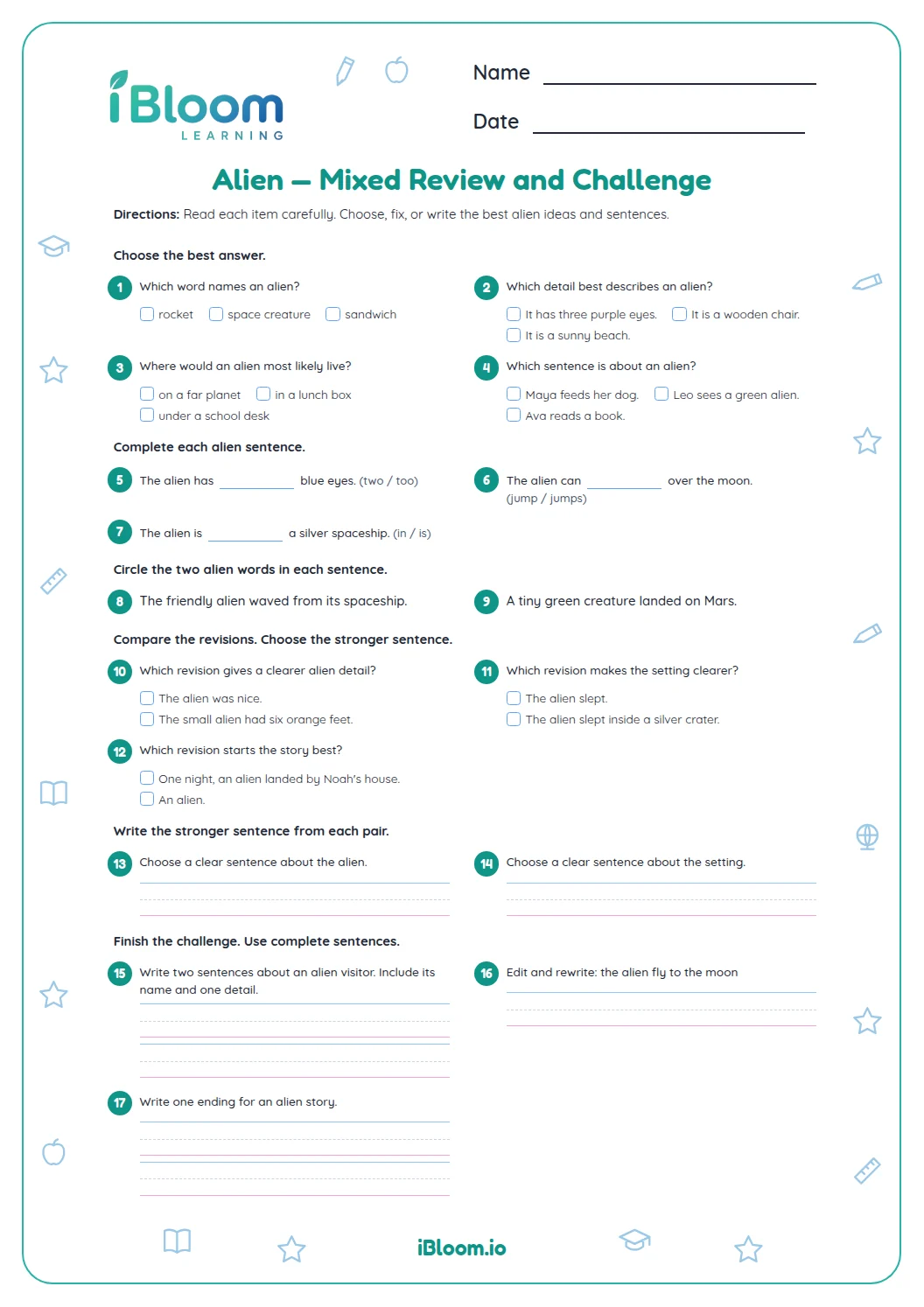
This free Grade 1 worksheet uses an imagined alien to practice complete sentences. Children choose sentence purposes, finish sentence frames, check capitals and end marks, then write two short original sentences. It practices CCSS L.1.1j and L.1.2b; a separate key models the fixed answers and sample writing.
Aligned to L.1.1j and L.1.2b
What kinds of sentences appear?
The first twelve items ask children to recognize statements, questions, polite requests, and excited sentences, or to complete a thought. The examples keep an imaginary alien as their subject.
How can a child write a complete alien sentence?
Questions 13 and 14 ask for one short original sentence each. A name or action works when it expresses a complete thought.
- 1Prompt: Introduce your alien by name.
- 2Sample: My alien is named Zib.
- 3Check for a capital and end mark.
How do end marks match sentence purpose?
Statements use a period, questions use a question mark, and an excited statement may use an exclamation point. The polite request begins with Please.
How to use this worksheet
- 1Read the whole sentence before choosing.
- 2Ask whether it tells, asks, or requests.
- 3Check the first word for a capital.
- 4Choose an end mark that fits.
- 5Write a complete thought for each final prompt.
Common mistakes and quick fixes
The mistake
Leaving out the action in “The tiny alien…”
The fix
Add a predicate that tells what the alien does.
The mistake
Using a period after a direct question.
The fix
End a question with a question mark.
The mistake
Writing “blue” as a complete sentence.
The fix
Add who or what is blue and a verb.
Common Core alignment
Write and expand complete sentences about an imagined alien.
On this sheet: Children describe an alien, write actions, combine ideas, and create a question and a request.
Show the official wordingHide the official wording
Produce and expand complete simple and compound declarative, interrogative, imperative, and exclamatory sentences in response to prompts.
Choose end marks for statements, a question, a request, and an excited sentence.
On this sheet: Every response is a complete sentence with an end mark suited to its purpose.
Show the official wordingHide the official wording
Use end punctuation for sentences.
What to practice next
Make more practice
Further reading
Questions parents and teachers ask
How many questions are on the sheet?
There are 14 questions: twelve choices or sentence completions and two original writing prompts. The answer key marks each fixed choice and gives one possible sentence for each open response. Accept another complete sentence that follows the prompt.
Does my child need to copy the sample alien?
No. The samples model complete thoughts, but children can invent a different alien name, color, or action. Check that each sentence answers its prompt and includes a capital and suitable end mark. The alien’s details may be entirely their own.
Which punctuation marks appear?
The questions include periods, a question mark, and an exclamation point. Children match the mark to the purpose: a statement tells, a question asks, and an excited sentence shows strong feeling. Read the sentence aloud to hear its purpose.
How can I help with sentence completion?
Read the incomplete sentence aloud and ask what information is missing. For “The tiny alien ___,” a word such as “waves” completes the thought; a place phrase by itself does not. This helps a child check that the sentence says something complete.
What is included in the answer key?
The key marks each fixed choice and gives sample answers for the two original writing prompts. Accept other sentences that make sense, follow the prompt, and use sentence conventions. Use the examples to discuss what makes each thought complete.