





About this worksheet
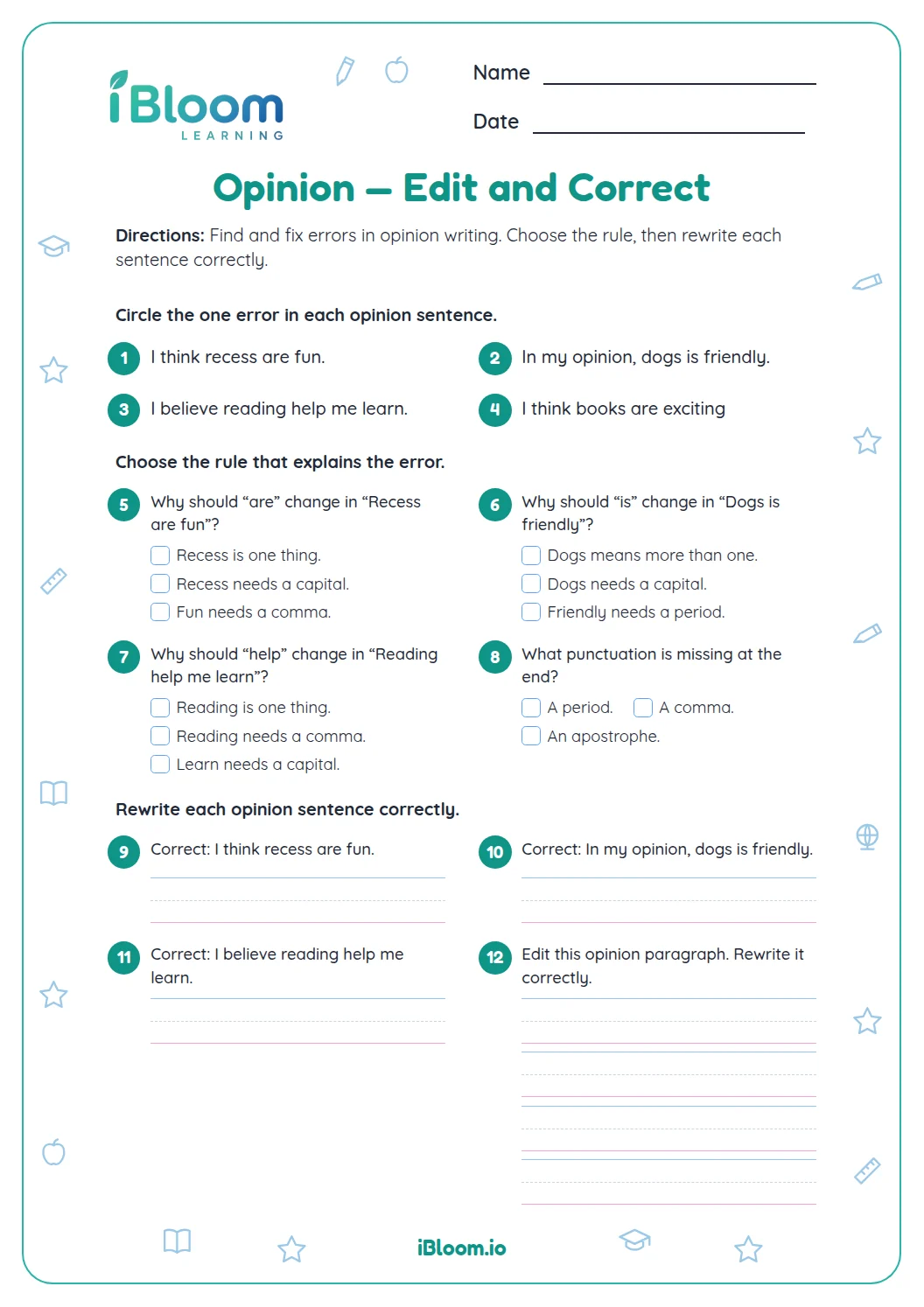
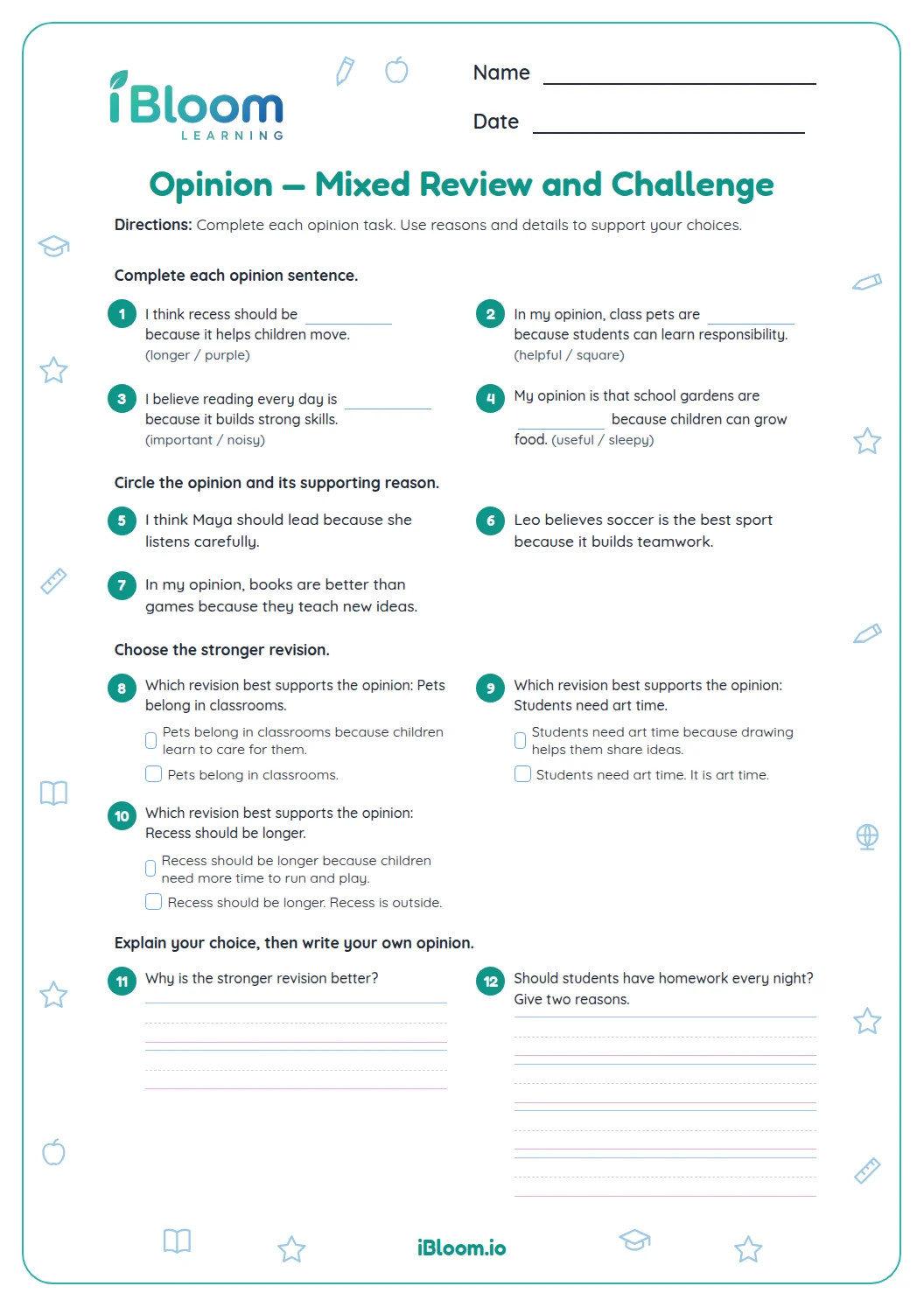
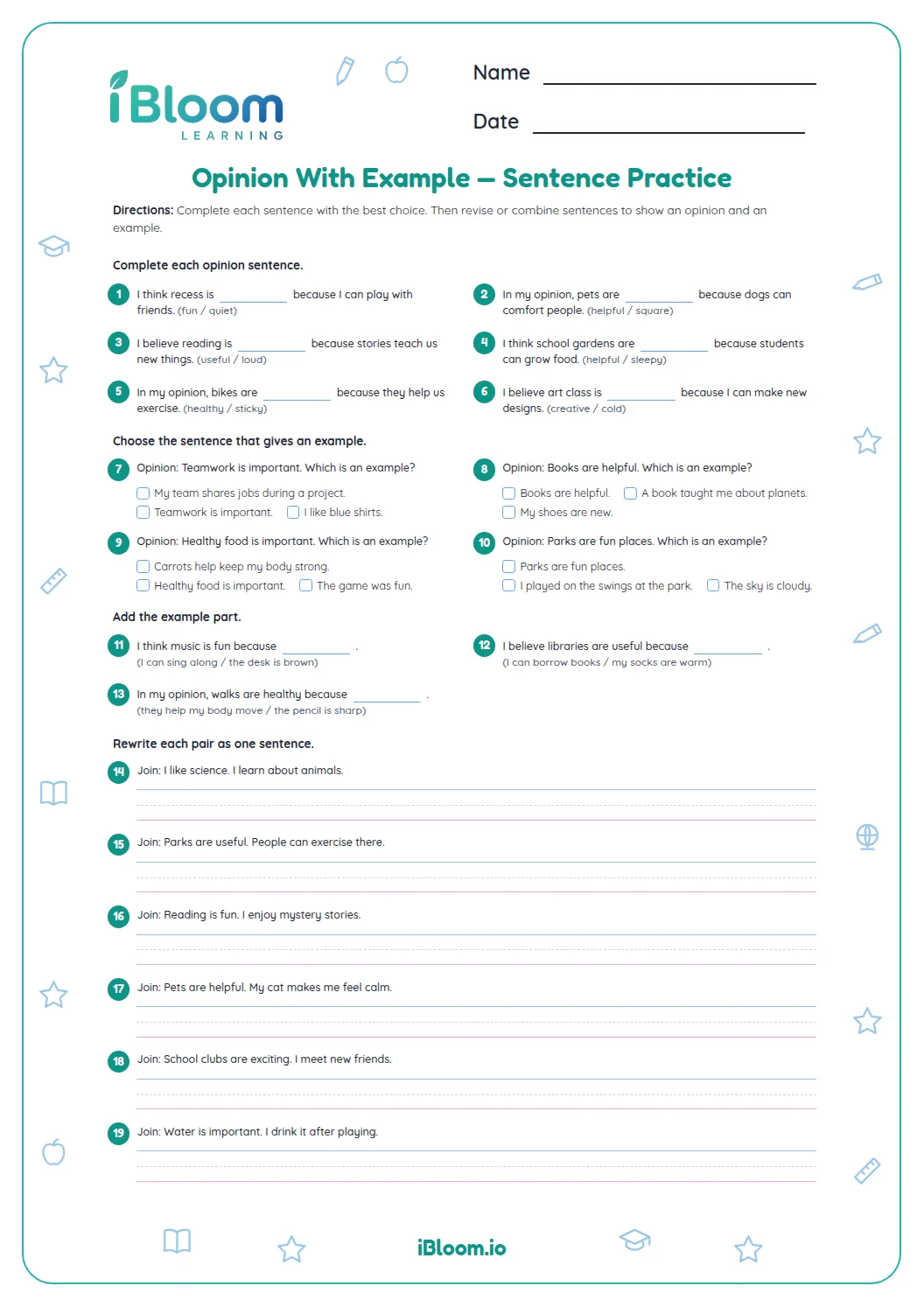
This free Grade 2 worksheet helps children recognize the building blocks of an opinion paragraph. Students distinguish an opinion from a fact, select reasons that support a point of view, notice linking words such as because, and choose a fitting conclusion. Three short writing prompts let them try an opinion, a reason, and a closing sentence. A separate answer key includes model responses for open-ended items. The page practices CCSS.ELA-Literacy.W.2.1.
Aligned to W.2.1
How can children spot an opinion?
An opinion tells what a writer thinks or prefers. A fact is something that can be checked. Students look for both the wording and the meaning instead of relying on a signal phrase alone.
- 1“I think recess is the best part of the day.”
- 2“I think” signals a point of view.
- 3“Best” expresses a preference, not a checkable count.
- 4So the sentence gives an opinion.
What makes a reason fit an opinion?
A reason explains why someone holds an opinion. It should connect to the topic, rather than merely state another fact. Questions about a class garden, library time, and a nature walk ask students to find that connection.
How do linking words connect ideas?
Words such as because join an opinion and a reason. In “I like art because I can make new things,” the second part tells why the writer likes art.
What does a conclusion do?
A concluding sentence gives an opinion paragraph closure. It can remind the reader of the writer’s view and signal that the reasons have been shared. The writing prompts practice the opinion, reason, and ending one at a time.
How can I use this worksheet?
- 1Read each statement all the way through before labeling it.
- 2Ask whether the sentence can be checked or expresses a preference.
- 3For a reason choice, connect it directly to the stated opinion.
- 4Look at how because links a view with its explanation.
- 5Choose an ending that returns to the topic.
- 6Use the key’s samples as models; a child’s wording may vary.
Common mistakes and quick fixes
The mistake
Treating a sentence as an opinion just because it begins “I think.”
The fix
Check whether the main idea expresses a belief or preference.
The mistake
Choosing a true fact that does not support the stated opinion.
The fix
Ask how the reason explains why the writer holds that view.
The mistake
Ending with a detail that does not wrap up the point.
The fix
Write a final sentence that returns to the opinion or says why it matters.
Curriculum alignment
Students recognize the parts that help an opinion paragraph make its point.
Identify a topic, opinion, supporting reasons, linking words, and a concluding statement.
On this sheet: The items ask students to recognize opinion, reason, linking word, and conclusion parts, then write short examples.
Show the official wordingHide the official wording
Write opinion pieces in which they introduce the topic or book they are writing about, state an opinion, supply reasons that support the opinion, use linking words (e.g., because, and, also) to connect opinion and reasons, and provide a concluding statement or section.
What to practice next
Make more practice
Further reading
Questions parents and teachers ask
What is an opinion sentence?
An opinion sentence tells what someone thinks or prefers. Phrases such as “I think” or “I believe” can signal a point of view, but students should also consider the whole sentence. The first questions contrast opinions with facts that can be checked.
How is a fact different from an opinion?
A fact can be checked with evidence, such as the number of days in a week. An opinion expresses a belief or preference, such as which lunch tastes best. This worksheet asks students to sort examples of both kinds of statements.
What makes a reason support an opinion?
A supporting reason explains why the writer holds the opinion. If the opinion is that a class should have a garden, watching seeds grow is connected to that idea. Students practice choosing reasons that directly match the stated point.
What does a linking word do?
A linking word connects an opinion with its reason or connects ideas in the paragraph. The worksheet uses because in short, familiar examples so children can see how it explains why the writer has an opinion. It helps readers connect an idea to the explanation that follows, so the relationship between the two parts is easy to understand.
What belongs in a concluding sentence?
A conclusion gives the paragraph a clear ending and can restate the writer’s view. It should fit the topic and signal that the opinion has been explained. The worksheet includes choices for selecting an ending that wraps up an idea.
Do children have to write a full paragraph here?
No full paragraph is requested. This page focuses on recognizing the parts of opinion writing and then writing one opinion, one supporting reason, and one closing sentence. Those short responses let students practice each part clearly. The key’s examples show one possible response, while other clear sentences that match the prompt are also suitable.