


About this worksheet
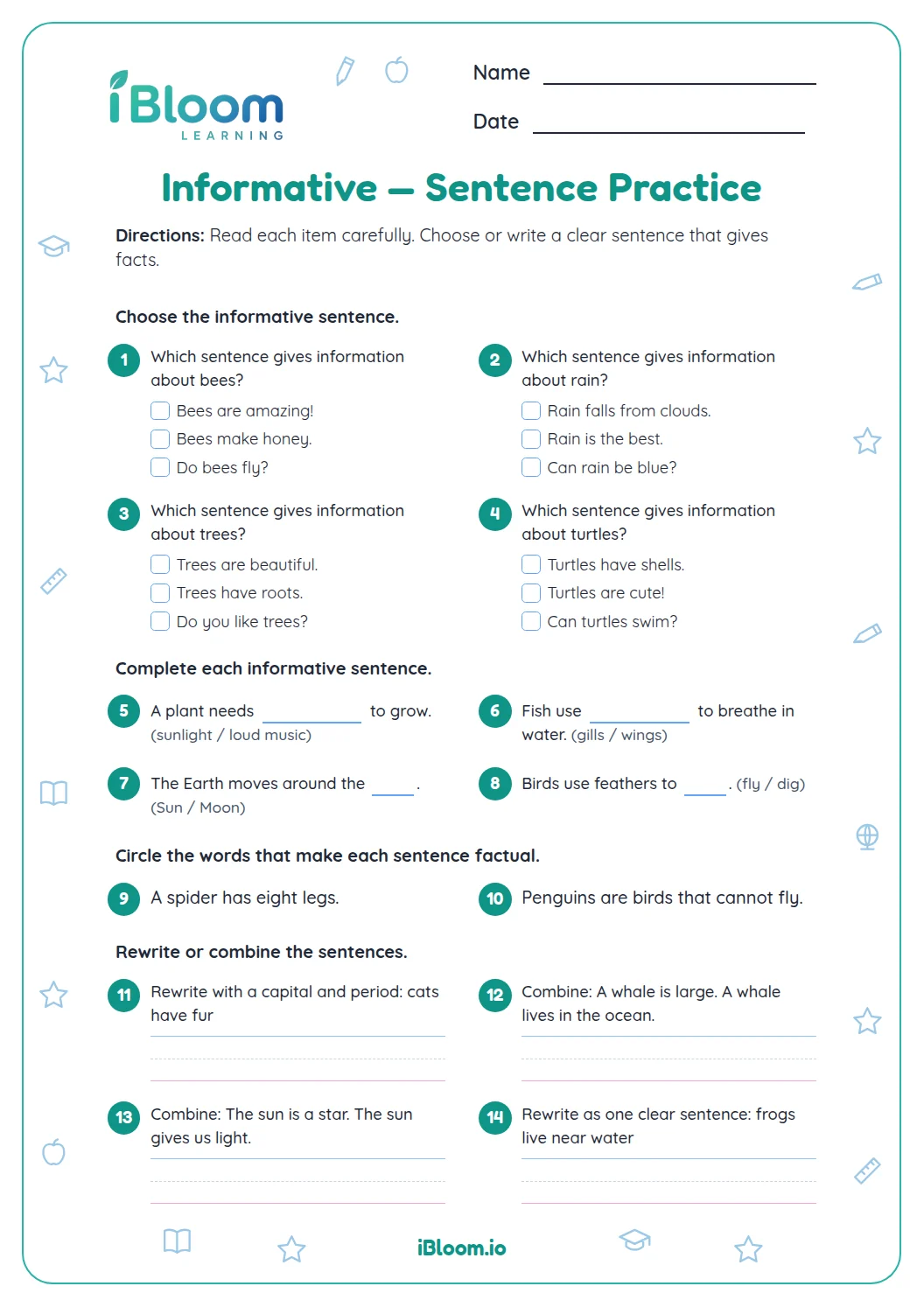
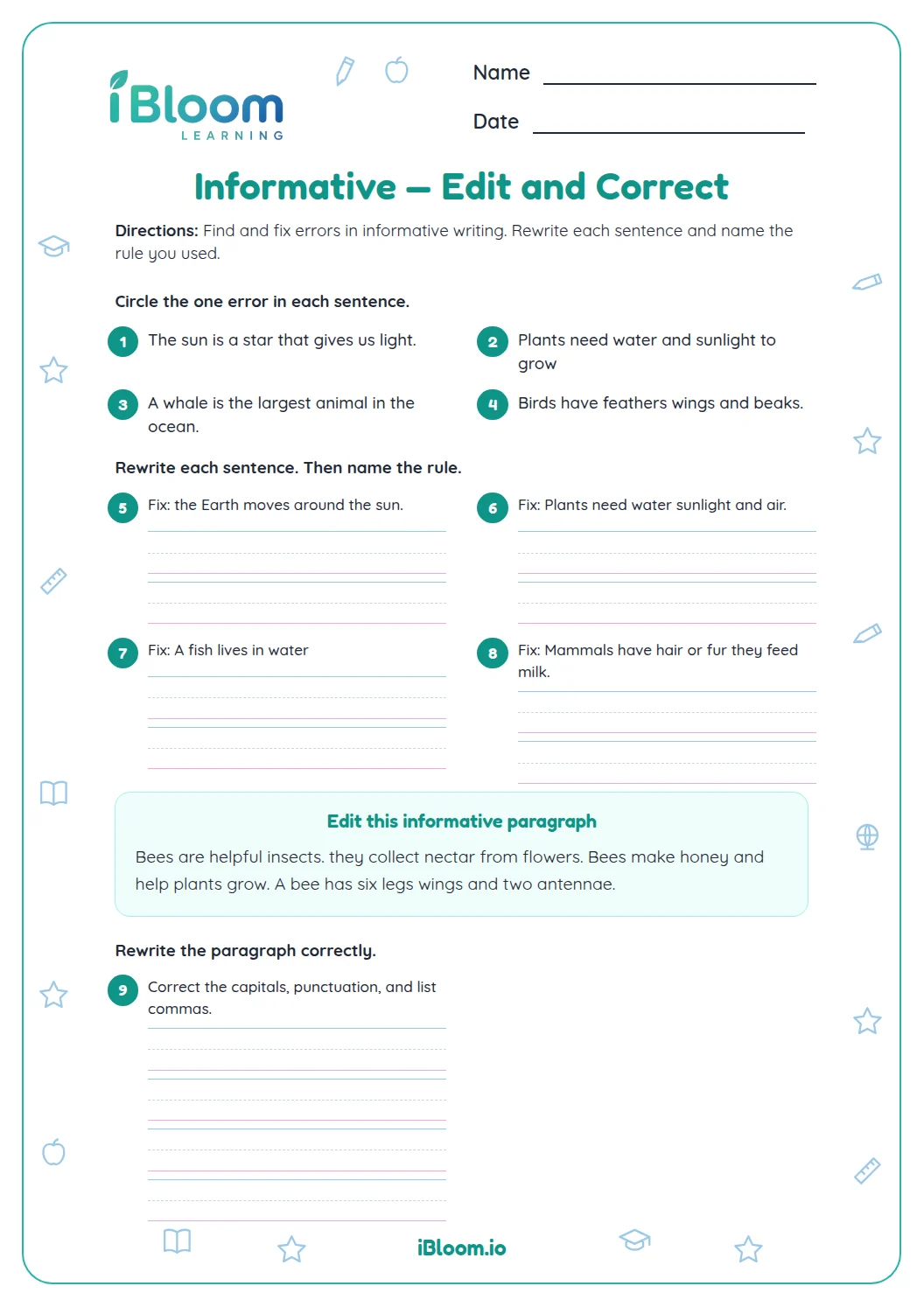
This free Grade 2 worksheet helps children revise telling sentences so a reader can picture what is happening. Students choose concrete actions and sense details, then complete seven vivid sentences and rewrite a short telling paragraph. The examples move from feelings to familiar scenes such as a rainy walk, a puppy, soup and other familiar scenes. The practice supports Common Core W.2.5 by asking writers to strengthen writing through revision and editing. A separate key gives the right choices and explanations through sample wording.
Aligned to W.2.5
What does show, don’t tell mean?
A telling sentence names an idea: “The puppy was tired.” A showing sentence adds an action a reader can picture: “The puppy curled up and closed its eyes.”
Part A asks children to notice the difference. Part B adds fitting detail words, and Part C rewrites a telling paragraph with picture-making details.
- Part A: choose the sentence with a picture-making detail
- Part B: complete seven sentences with vivid detail words
- Part C: rewrite a telling paragraph
How can a detail improve a sentence?
Start with the idea the writer wants to share. Then add an action, sound, sight, taste, touch or smell that fits. The detail should show the idea instead of repeating it.
- 1Telling: “Kai was hungry.”
- 2Sample revision: “Kai’s stomach rumbled as he watched the toast pop up.”
- 3The rumble and toast give the reader clues about Kai’s hunger.
Which details fit the moment?
The final paragraph asks children to keep the idea that Emma is excited about a race, then show that excitement with actions or details. A sample answer appears in the key; another clear revision can work too.
Ask whether the sentence gives a reader something to imagine seeing, hearing, feeling, tasting or smelling.
How to use this worksheet
- 1Read the short directions under each part.
- 2In Part A, ask which sentence gives a picture rather than naming a feeling.
- 3For Part B, keep the original idea and add a fitting action or sense detail.
- 4In Part C, cross out edits that merely repeat the telling word.
- 5Use the key to discuss more than one possible revision.
Common mistakes and quick fixes
The mistake
Adding an unrelated detail to make a sentence longer.
The fix
Choose an action or sense detail that supports the original idea.
The mistake
Replacing a feeling with a new feeling word, such as “happy” with “glad.”
The fix
Show what the person does or says when feeling that way.
The mistake
Treating one sample revision as the only possible answer.
The fix
Accept another clear, relevant detail that lets a reader picture the idea.
Common Core alignment
This page practices the listed grade-level skill through short, checkable examples.
Revise and edit writing with guidance and support.
On this sheet: Part B revises telling sentences, and Part C edits them by choosing more vivid details.
Show the official wordingHide the official wording
With guidance and support from adults and peers, focus on a topic and strengthen writing as needed by revising and editing.
What to practice next
Make more practice
Further reading
Questions parents and teachers ask
What does show, don’t tell mean?
A telling sentence names an idea, such as “The puppy was tired.” A showing sentence gives a clue the reader can picture, such as the puppy curling up and closing its eyes. The worksheet compares both kinds, then gives children practice adding an action or sense detail.
Can my child write a different answer from the answer key?
Yes. The written section has sample revisions rather than one required sentence. Accept a response that keeps the original idea and adds a clear, fitting action or sense detail. The final multiple-choice section has one best answer for each question, which the key identifies.
How many questions are included?
There are 14 questions in two parts: six sentence choices and eight missing detail words. Students first recognize vivid details, then complete concise sentence edits. The worksheet and key are rendered as two rendered pages total. The separate key lists each choice and the word that completes each sentence.
What can we practice after this page?
Ask your child to write a short moment from a story and add one detail that shows what a character does, hears or feels. Then reread the sentence and check whether the detail fits. This extends the revision practice into a piece of writing with a beginning, middle and end.