
About this worksheet
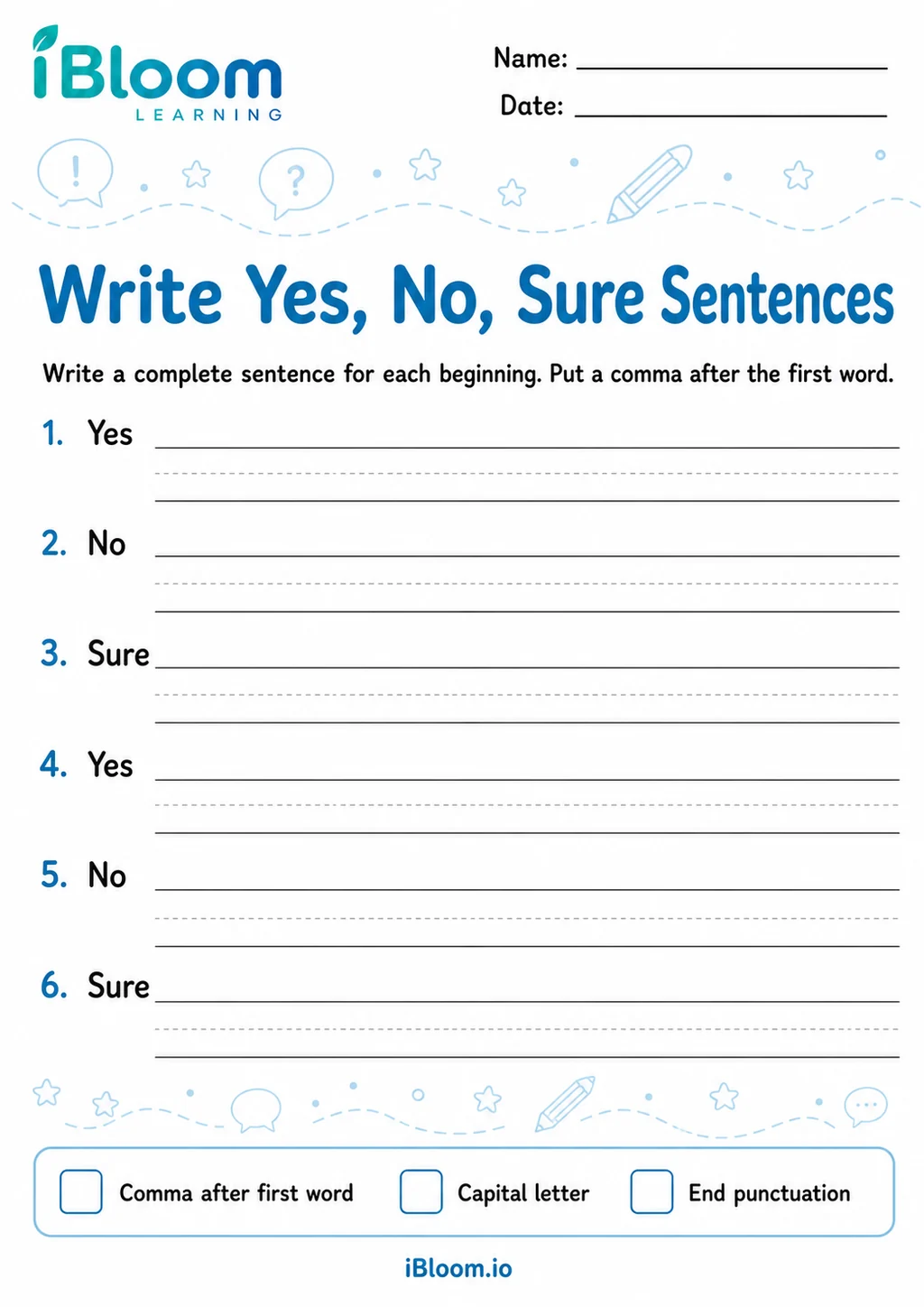
This Grade 2 printable worksheet practices the comma that follows an opening Yes, No, or Sure. Part A asks learners to compare two versions of eight sentences; Part B gives eight more sentences to rewrite with the comma in place. The answer key shows the correct sentence for each item. This work supports standard English punctuation and fits the Grade 2 conventions focus in Common Core L.2.2.
Aligned to L.2.2
Where does the comma go?
When Yes, No, or Sure begins a sentence as a response, put a comma after that word. Leave a space after the comma before writing the rest of the sentence.
How can a learner check the punctuation?
Read the sentence aloud and pause briefly after the response word. The comma belongs at the pause, before the next word.
- 1Yes I can bring the book.
- 2Pause after Yes.
- 3Write a comma after Yes.
- 4Answer: Yes, I can bring the book.
What is on the worksheet?
Part A has eight multiple-choice items with one correctly punctuated sentence in each pair. Part B gives eight different unpunctuated sentences to rewrite. The opening word changes among Yes, No, and Sure.
How to use this worksheet
- 1Read the whole sentence before choosing.
- 2Notice the opening response word.
- 3Pause after Yes, No, or Sure.
- 4In Part A, choose the sentence with the comma at that pause.
- 5In Part B, rewrite the full sentence and add the comma.
- 6Read the sentence again and check the space after the comma.
Common mistakes and quick fixes
The mistake
Putting the comma after the next word.
The fix
Say the first word and pause; place the comma immediately after that word.
The mistake
Leaving out the space after the comma.
The fix
Write one space between the comma and the next word.
The mistake
Changing the sentence while adding punctuation.
The fix
Copy the sentence carefully and change only the punctuation mark.
Common Core alignment
This practice connects the worksheet activities to the following standard.
Use standard punctuation when writing these short sentences.
On this sheet: Learners recognize and write standard punctuation in sentences beginning with Yes, No, or Sure.
Show the official wordingHide the official wording
Demonstrate command of the conventions of standard English capitalization, punctuation, and spelling when writing.
What to practice next
Make more practice
Further reading
Questions parents and teachers ask
Where does the comma go after Yes, No, or Sure?
Put the comma right after the opening response word, then leave a space before the rest of the sentence. For example, write “Yes, I found my book.” The first eight questions ask learners to recognize the correct version; the next eight ask them to rewrite it.
What is included in the guided practice?
There are 16 questions in two parts. Part A has eight pairs of sentences for learners to choose from. Part B has eight different sentences to rewrite with the comma in the correct place. The answer key gives the corrected sentence for every item.
Why are some sentences about books, buses, and pets?
Every example gives a short, familiar sentence so the learner can focus on punctuation. The words and topics change across questions, while the task stays consistent: place a comma after Yes, No, or Sure at the beginning of a sentence.
How should I help if my child omits the comma?
Ask the learner to pause after saying Yes, No, or Sure aloud, then point to the pause and add the comma before continuing. Have them reread the whole sentence to check that the comma follows the opening response word.
Does the answer key show complete sentences?
Yes. It lists the corrected sentence for each question. For Part B, the answer key labels each response as a sample because handwriting may vary, while the sentence wording and comma placement remain clear and consistent. The key also shows where the comma belongs.
How long does this worksheet take?
Most learners can work through the 16 short items in about 15 minutes. If the punctuation pattern is new, read a few Part A choices aloud first, then invite the learner to explain where the pause belongs before starting Part B.