
About this worksheet
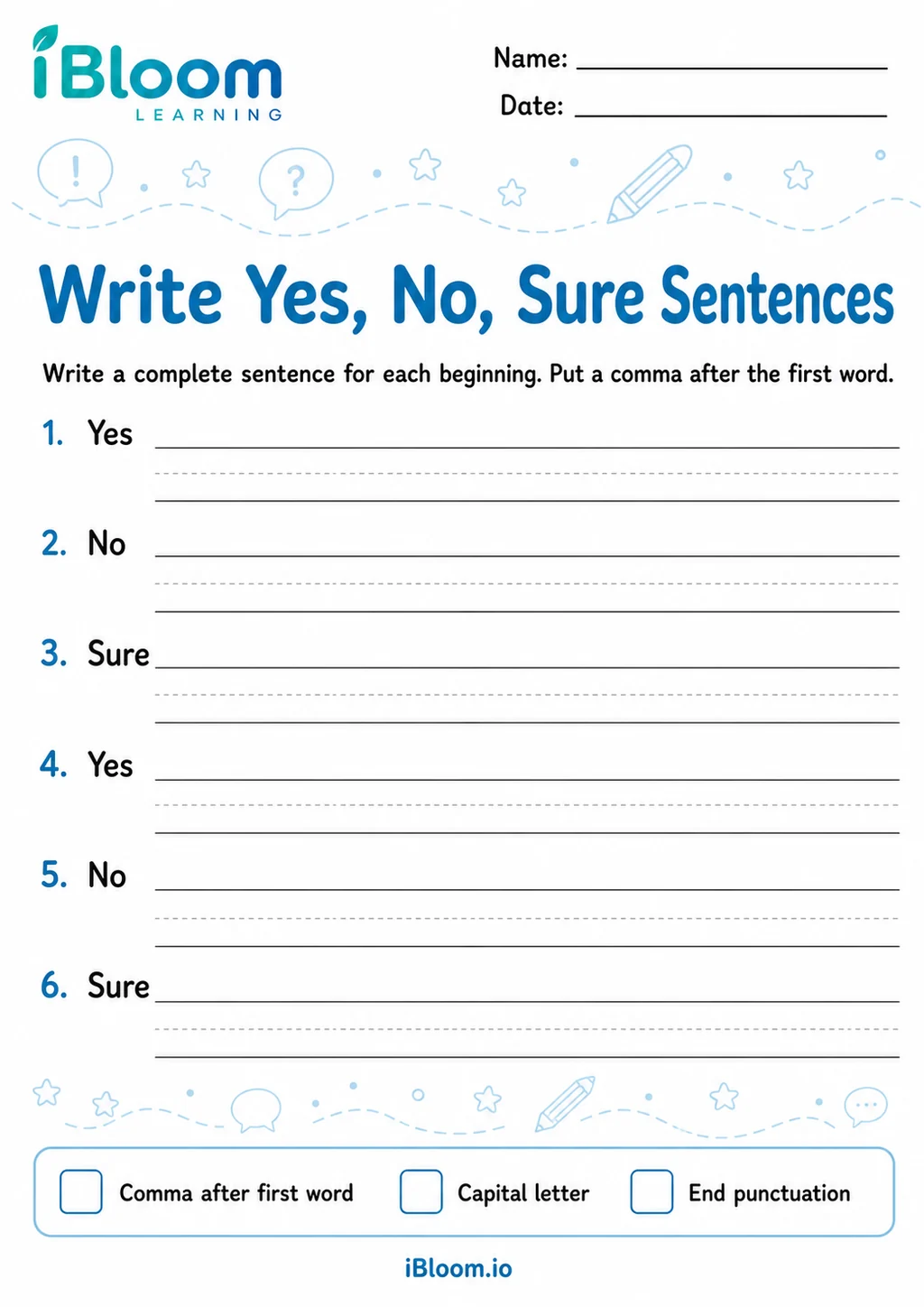
This free printable Grade 2 grammar worksheet practices the comma after an opening Yes, No, or Sure. Children choose correctly punctuated sentences, rewrite six sentences with missing commas, and write three complete replies of their own. Each opening word appears in every part, giving children repeated practice with the same punctuation pattern. The 12 questions support Common Core L.2.2 through using punctuation and capitals when writing. The answer key includes corrected sentences and sample replies for the open-ended questions.
Aligned to L.2.2
Where should the comma sit?
When Yes, No, or Sure introduces a reply, place a comma directly after that word. The rest of the reply continues on the same line. A period belongs at the end of the complete sentence.
Part A presents three choices for each reply. Read all the words first, then check the comma’s position.
How do children rewrite the sentences?
Part B gives six complete sentences with the opening comma missing. Children copy each sentence, adding the comma after its first word. Keep the capital letter at the beginning and the period at the end.
- 1Original: Yes I like apples.
- 2Opening reply word: Yes
- 3Corrected sentence: Yes, I like apples.
What makes a complete reply in Part C?
Part C asks children to answer three familiar questions about reading, a pet, and putting toys away. Each prompt names the required opening word. Children add a comma and continue with a complete thought.
For the question about reading, “Yes, I can read with you.” is one possible answer. The key offers examples; another sensible sentence using the required opener and punctuation also works.
How to use this worksheet
- 1Read “Yes, I can help.” aloud and point to the comma after Yes.
- 2Let your child select the three correctly punctuated replies in Part A.
- 3In Part B, copy the words and add one comma after the opening response.
- 4Read each Part C question aloud, then have your child say a reply before writing it.
- 5Check the first word, comma, complete thought, and period in each reply.
Mistakes to check together
The mistake
Putting the comma after I or we.
The fix
Find the opening Yes, No, or Sure and move the comma directly after it.
The mistake
Replacing the comma with a period and leaving a lowercase next sentence.
The fix
Keep the reply together: “No, it is not mine.”
The mistake
Writing only “Sure,” for an original reply.
The fix
Continue with a complete thought, such as “Sure, I can help you.”
Common Core alignment
Use a comma after an opening Yes, No, or Sure when writing sentences.
On this sheet: Children edit and write complete sentences with a capital, an opening-word comma, and a period.
Show the official wordingHide the official wording
Demonstrate command of the conventions of standard English capitalization, punctuation, and spelling when writing.
What to practice next
Make more practice
Further reading
Questions parents and teachers ask
Which opening words does this worksheet practice?
The sheet practices Yes, No, and Sure as opening response words. Each appears once in the choice section, twice in the rewrite section, and once in the original-reply section. Children can compare the same comma pattern across all three words while keeping the rest of each sentence simple.
Do children copy the whole sentence in Part B?
Yes, children rewrite the whole sentence and add the missing comma. Copying gives them a chance to keep the opening capital and final period as well. Ask them to point to the added comma afterward so you can see that they placed it immediately after the response word.
Are the answers to Part C all the same?
No, the final three replies can vary. Each must begin with the word named in its prompt, place a comma after that word, and continue as a complete sentence. The answer key gives samples, but a different sensible reply with the same punctuation pattern is also correct.
Can I help my child compose the last three replies?
Yes, you can read the question and invite your child to say a reply aloud before writing. Repeat the child’s sentence slowly while they write it. Then have them check the opening word and comma themselves, keeping the punctuation decision in the child’s hands.
What should I check besides the comma?
Check that the first word begins with a capital, the reply makes a complete thought, and a period ends the sentence. In Part B, the supplied words should stay in order. In Part C, focus on a sensible response and the required opening word as well as the punctuation.