






About this worksheet
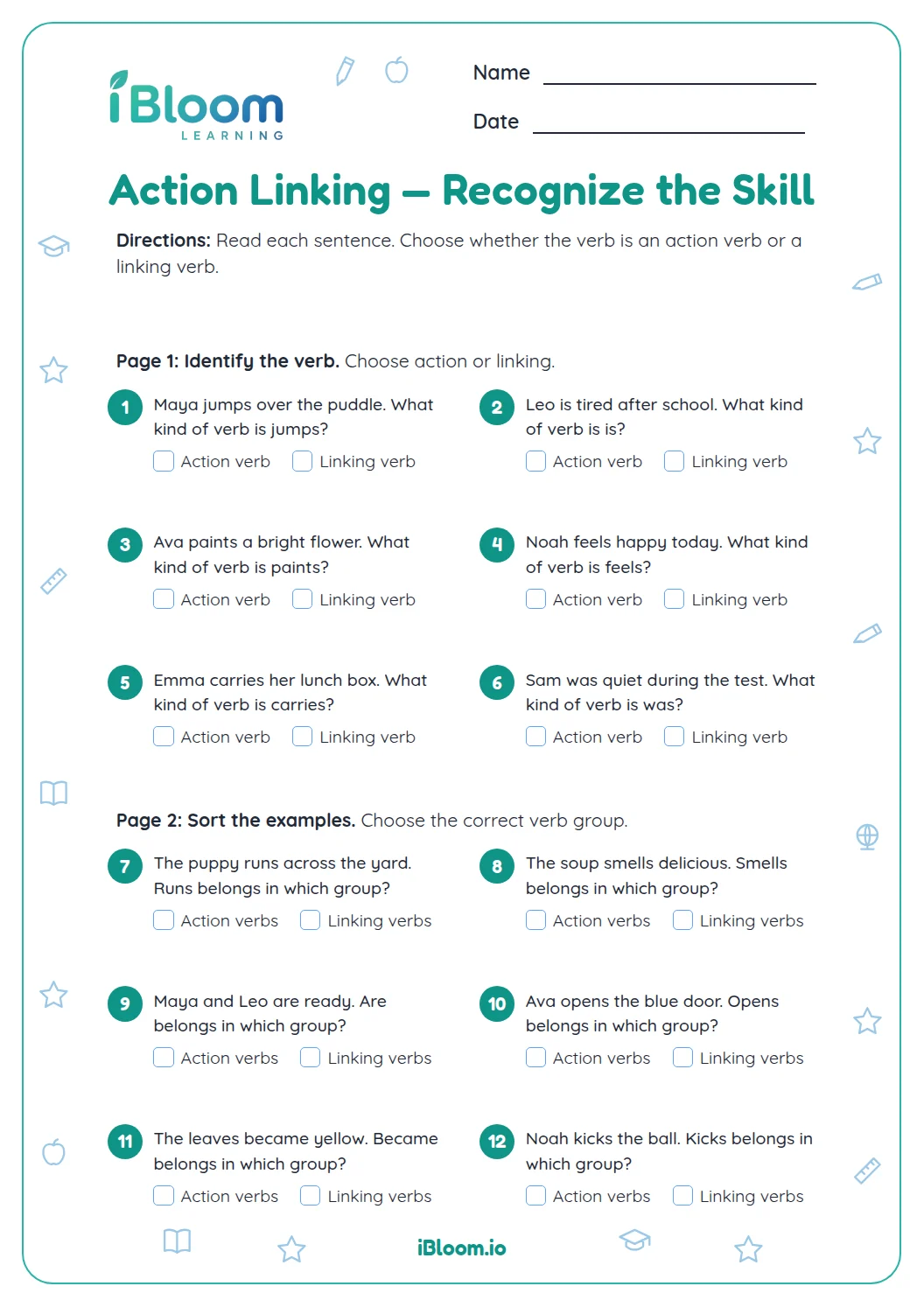
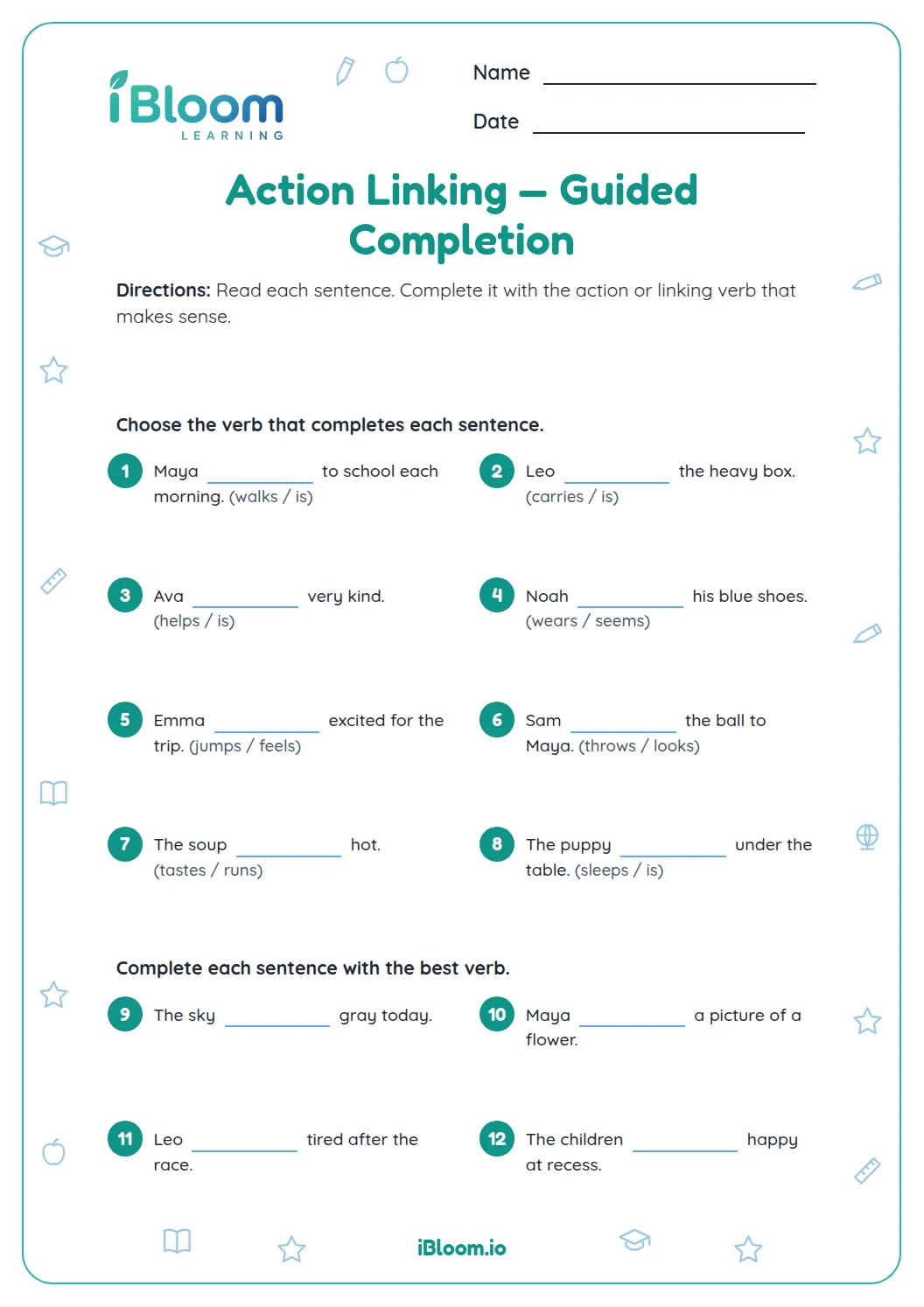
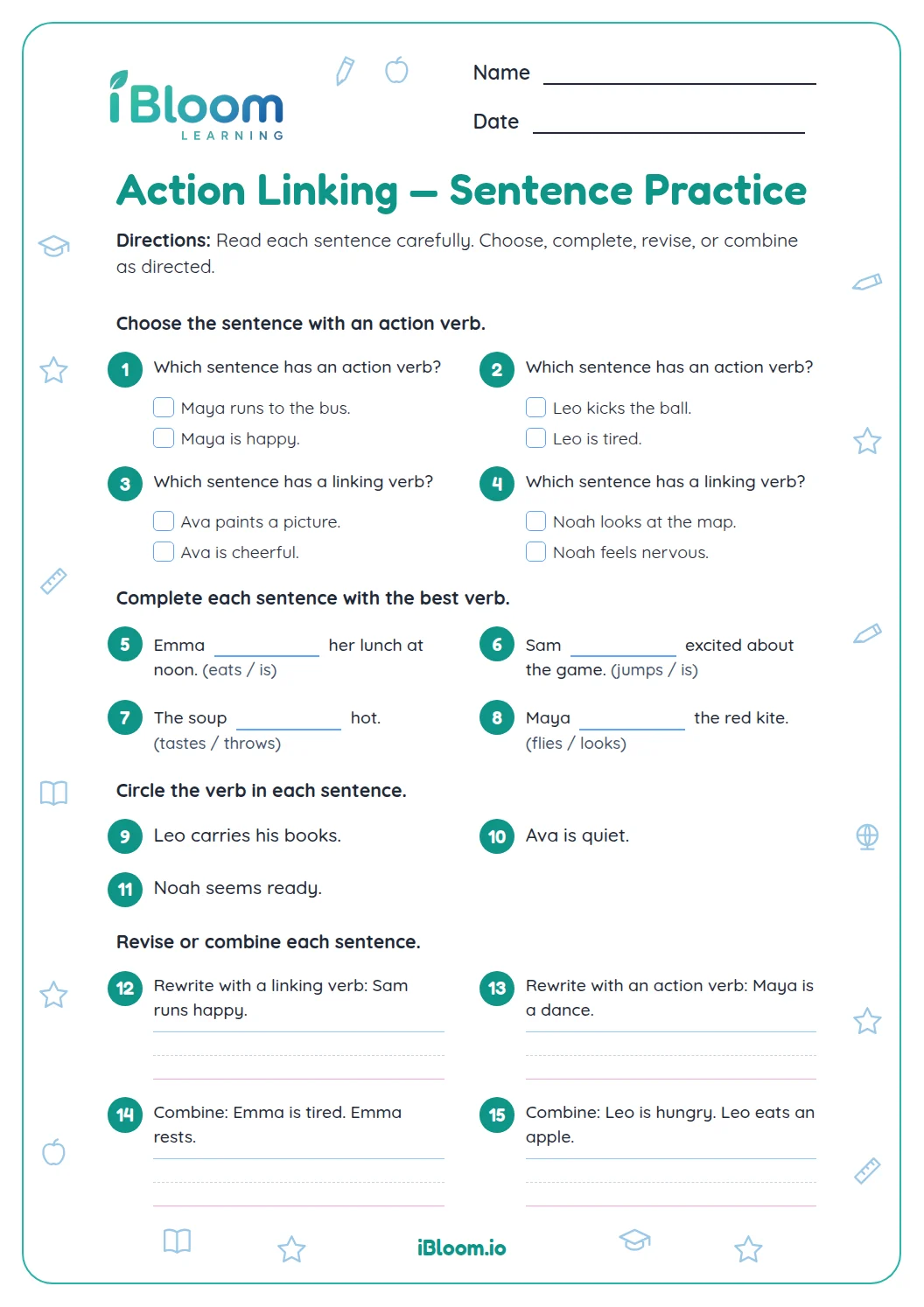
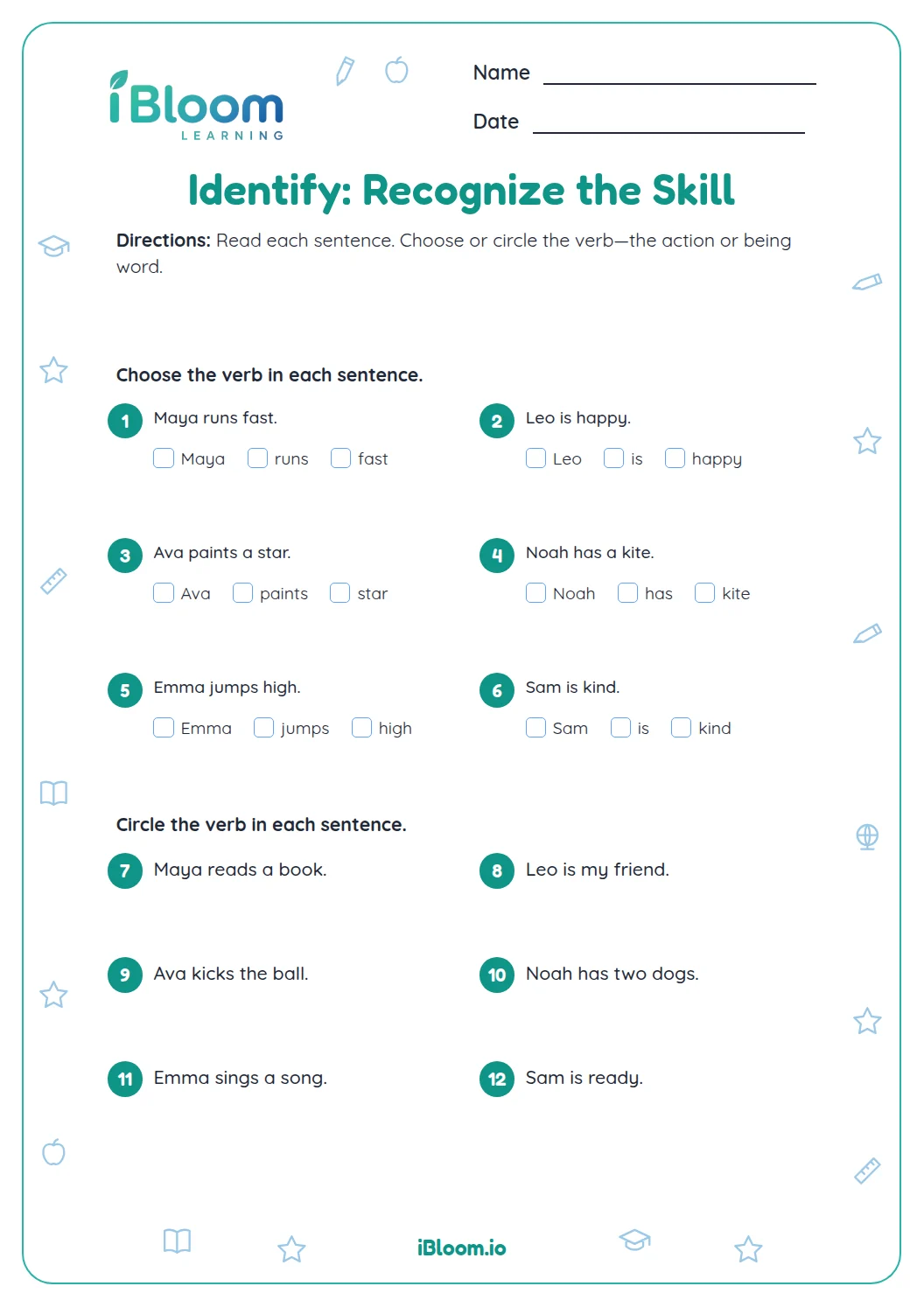
This Grade 2 worksheet moves from identifying action and linking verbs to choosing and using them. Part A has six sentences to label, Part B has four verb choices, and Part C asks for four sentences, including two rewrites that use action verbs. The answer key offers sample responses for the writing. The sentence-writing and revision prompts align with CCSS L.2.1.f.
Aligned to L.2.1.f
What are the three parts of the worksheet?
Part A asks students to mark each verb as action or linking. In Part B, they choose a verb that makes the sentence work, including hid in “The puppy ___ under the table.” Part C moves into writing: students create two sentences and change two linking-verb sentences to show an action.
- Part A: 6 action-or-linking labels
- Part B: 4 verb choices
- Part C: 4 written sentences or revisions
How can a student tell action and linking verbs apart?
An action verb tells what the subject does: Omar kicks the ball. A linking verb connects the subject to a description or identity: The soup smells delicious. Some verbs can play either role, so check how the word works in its sentence.
- 1Omar kicks the ball. Kicks tells what Omar does: action.
- 2The soup smells delicious. Smells links soup to delicious: linking.
How can students revise a linking-verb sentence?
Keep the subject, then choose an action the subject could perform. “The kitten is sleepy” can become “The kitten yawns.” The new verb should show something happening, rather than merely describe the subject.
How should the written answers be checked?
The key gives sample sentences, not the only possible wording. A response works when its verb matches the direction and the sentence is complete. For the two revisions, make sure the new verb shows an action by the original subject.
A simple routine for verb practice
- 1Read the entire sentence and find its subject.
- 2Ask whether the verb tells what the subject does or links it to a description.
- 3In Part B, try both choices and keep the one that fits the meaning.
- 4For each Part C prompt, write a complete sentence that follows the direction.
- 5Check the key and discuss any response whose verb role is unclear.
Common verb mix-ups
The mistake
Calling smells an action in “The soup smells delicious.”
The fix
Here smells connects soup with the description delicious, so it is linking.
The mistake
Calling every is a linking verb without checking the sentence.
The fix
Ask what follows is: a description or identity linked to the subject usually signals linking use.
The mistake
Changing the subject while revising “The flowers smell sweet.”
The fix
Keep the flowers as the subject and add an action they can do, such as “The flowers attract bees.”
Curriculum alignment
The sentence prompts practice writing and revising complete sentences.
Produce and revise complete simple and compound sentences.
On this sheet: Part C asks students to write complete sentences and revise two sentences while keeping the subject and changing the verb.
Show the official wordingHide the official wording
Produce, expand, and rearrange complete simple and compound sentences (e.g., The boy watched the movie; The little boy watched the movie; The action movie was watched by the little boy).
What to practice next
Make more practice
Further reading
Questions parents and teachers ask
What is an action verb?
An action verb tells what the subject does. In “Omar kicks the ball,” kicks names an action. Part A includes clear examples such as birds building nests and a person carrying books; students mark each verb as action or linking before applying verbs in their own sentences.
What is a linking verb?
A linking verb connects the subject to a description or name. In “The soup smells delicious,” smells links soup to delicious rather than describing an action. The worksheet also uses is, looks, and feels in linking examples, where the word after the verb describes the subject.
Can a verb be action or linking?
Yes. A verb’s job depends on its sentence. Smells is linking in “The soup smells delicious,” but action in “The dog smells the soup.” This worksheet uses clear examples so children can decide from the subject and the words that follow.
What does Part C ask students to write?
Part C has four prompts: write an action-verb sentence, write a linking-verb sentence, and revise two linking-verb sentences to use actions. The answer key gives sample responses. Other complete sentences are acceptable when they follow the requested verb type.
Why is hid one of the verb choices?
Hid is the past-tense form of hide. In “The puppy hid under the table,” it completes the sentence with an action verb in the past tense. Students use the sentence context to choose it over is, which does not fit the action described.