




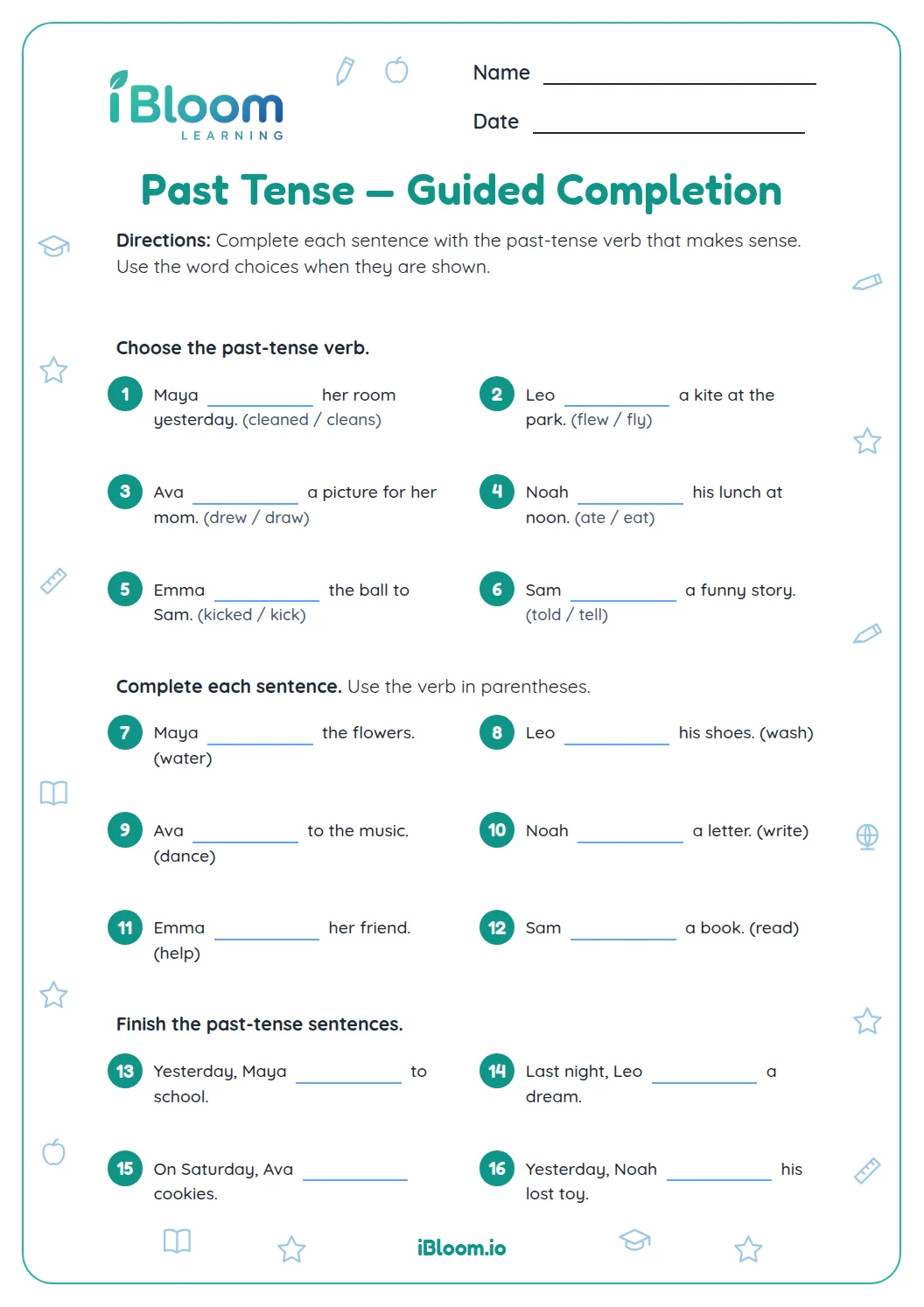


About this worksheet
This Grade 2 printable contains 16 questions about verbs. Children identify action verbs in sentences, choose or supply verbs that complete a thought, change a verb to past tense, and write their own examples. Four parts move from recognition to use, with a separate answer key and sample wording. The past-tense item practices CCSS L.2.1.d.
Aligned to L.2.1.d
How can you spot a verb?
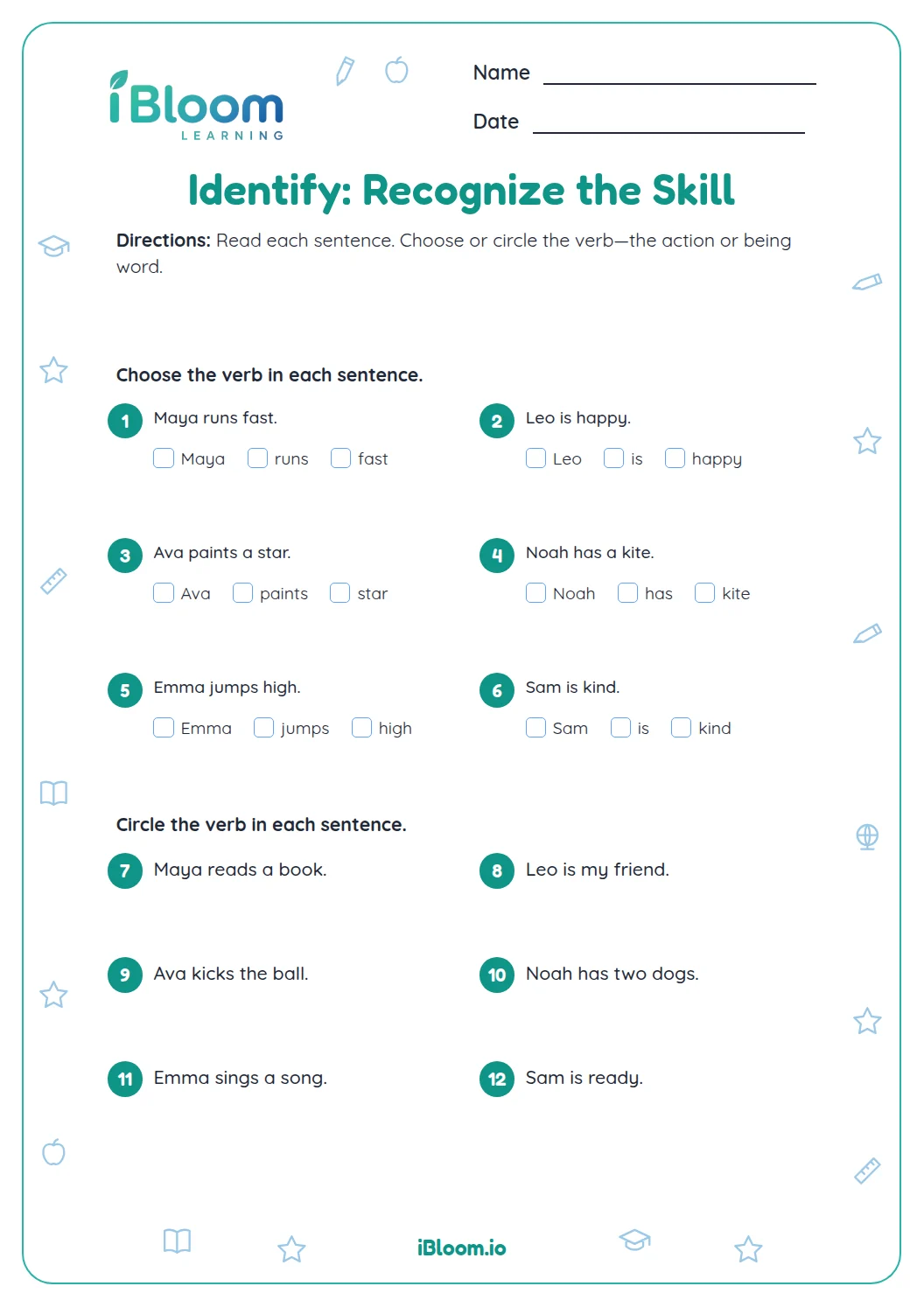
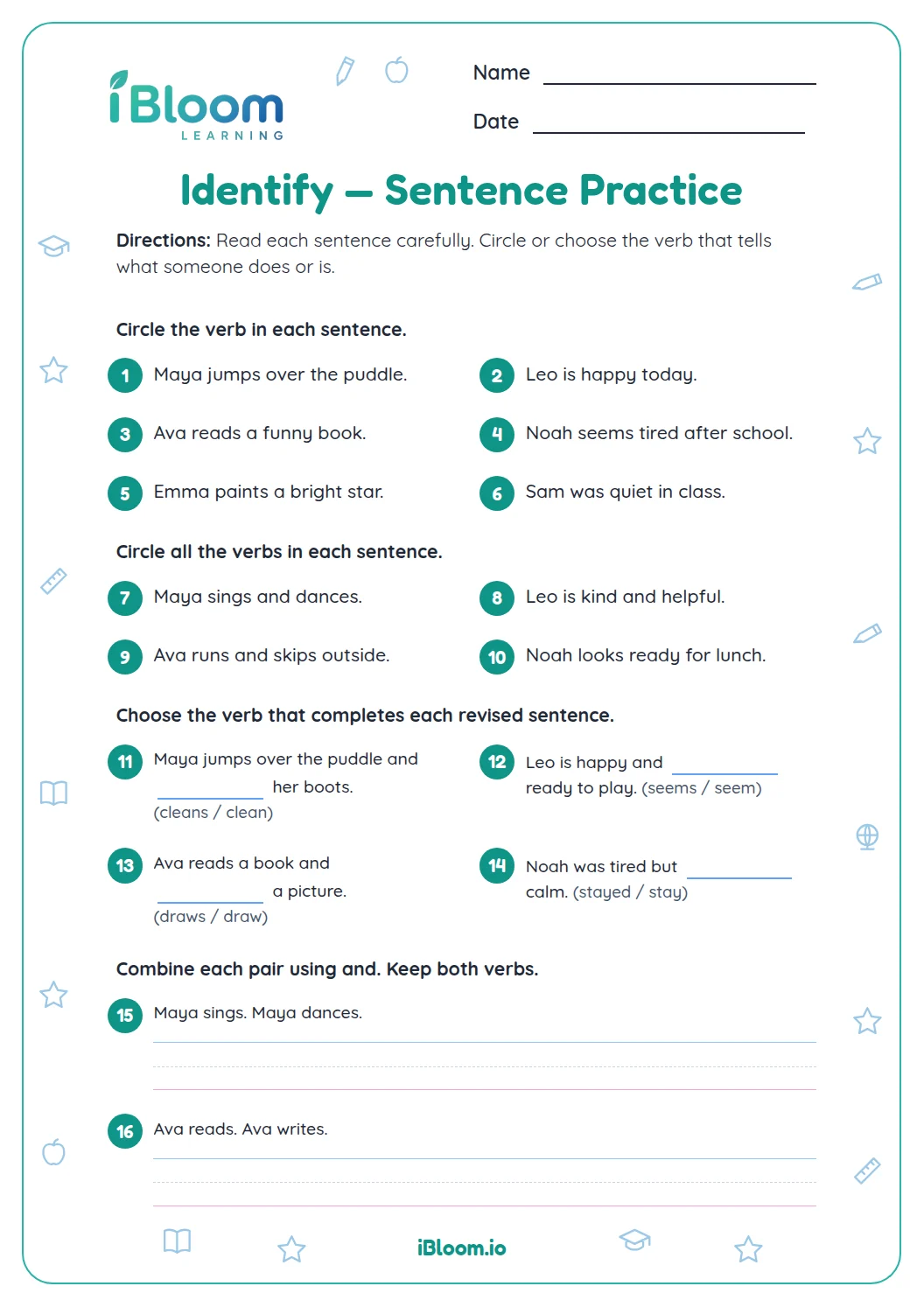
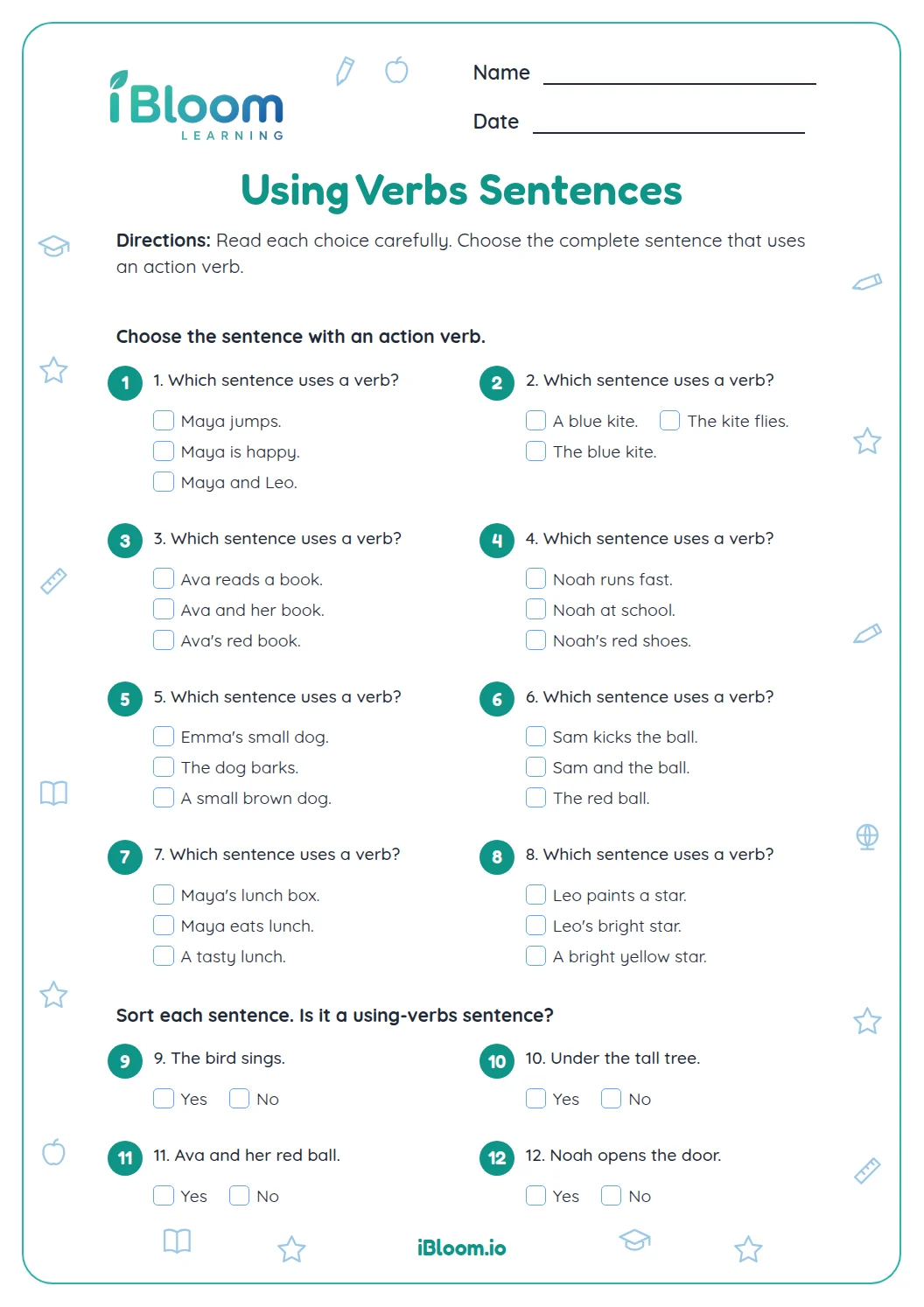
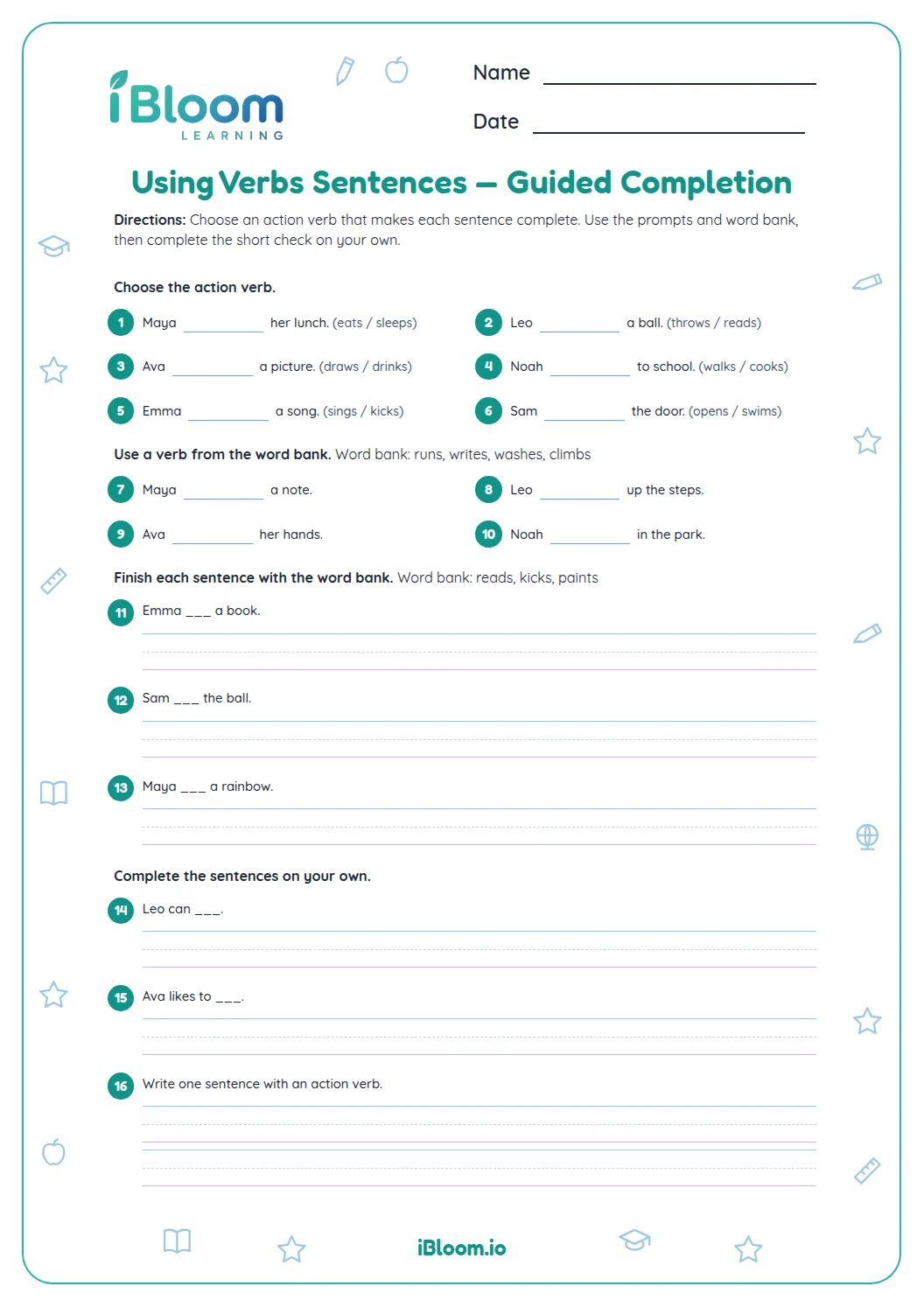
Part A has six multiple-choice items for identifying verbs. Part B has four sentence completions. Part C asks children to choose a verb that completes a sentence. Part D asks children to write a sentence, change a verb to past tense, and identify or supply verbs.
- 1Question 13: Change “The cat purrs” to tell about yesterday.
- 2Yesterday places the action in the past.
- 3Change purrs to purred: “The cat purred.”
What practice is on the sheet?
Part A has six multiple-choice items for identifying verbs. Part B has four sentence completions. Part C asks children to choose a verb that completes a sentence. Part D asks children to write a sentence, change a verb to past tense, and identify or supply verbs.
How can you check whether a verb fits?
Read the whole sentence with the verb in place. Check that it tells an action or state and that the sentence makes sense. For the yesterday prompt, make sure the verb form shows past time.
How to use this identifying and using verbs in sentences worksheet
- 1Read each Part A sentence and choose the word that names an action or state.
- 2Complete the sentence blanks in Part B with verbs that make sense.
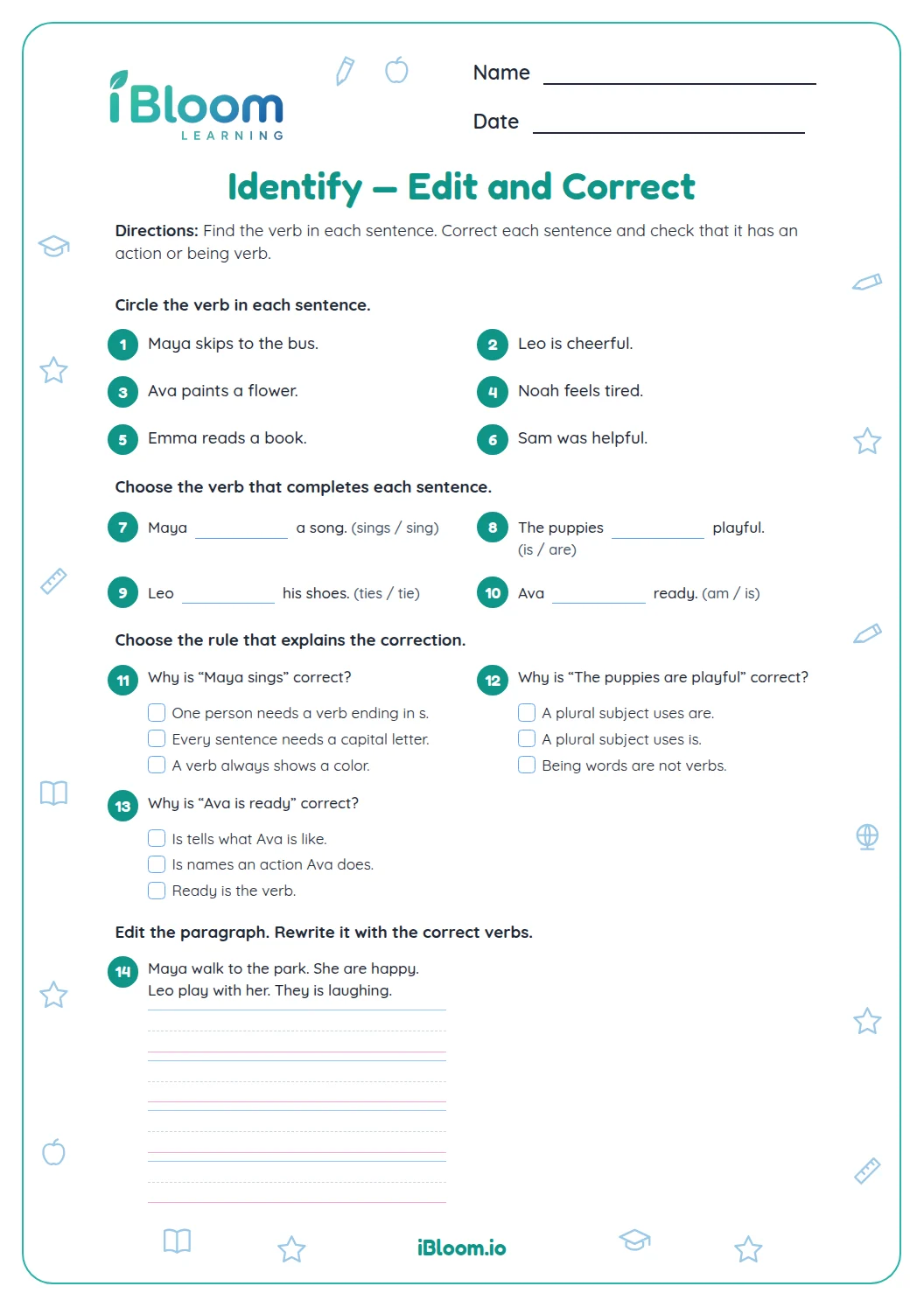
- 3Choose the verb that fits the sentence in Part C.
- 4Use verbs in your own writing and follow the tense clues in Part D.
- 5Check the key, accepting other clear and correct sentences where answers can vary.
Common identifying and using verbs in sentences slips and fixes
The mistake
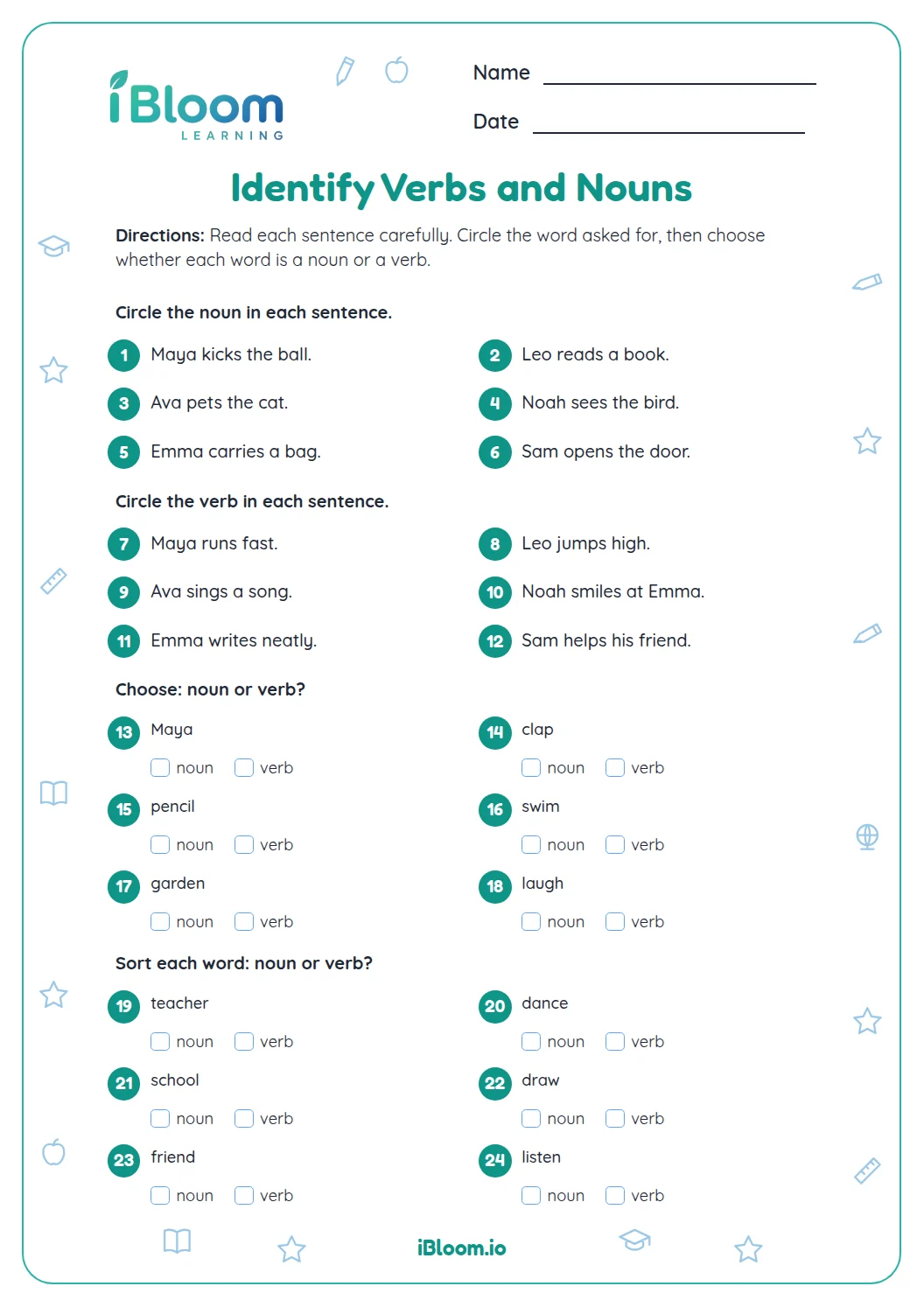
Choosing a noun instead of the verb.
The fix
Ask what the person, animal, or thing does; that action word is the verb.
The mistake
Filling a blank with a word that does not fit the sentence.
The fix
Read the whole sentence aloud with the word inserted.
The mistake
Leaving a present-tense verb unchanged after “yesterday.”
The fix
Change the verb to a past form, as in purrs → purred.
Common Core alignment
These questions practice the listed Common Core skill.
Change “purrs” to “purred” to describe an action from yesterday.
On this sheet: Change “purrs” to “purred” to describe an action from yesterday.
Show the official wordingHide the official wording
Form and use the past tense of frequently occurring irregular verbs (e.g., sat, hid, told).
What to practice next
Make more practice
Further reading
Questions parents and teachers ask
What is a verb?
There are 16 questions in four parts. Six ask children to identify verbs, four focus on sentence completions, one asks them to choose a verb in context, and five ask for written use or application. The answer key provides examples for responses that can vary.
How does the worksheet build verb practice?
It starts with choosing a verb from a sentence, then asks children to complete sentences with verbs. The final part applies the skill in writing, including changing “The cat purrs” to a sentence about yesterday. Learners also identify and supply verbs in context.
Can more than one answer fit a blank?
Yes. Some sentence-completion prompts accept more than one sensible verb, such as a verb that tells what players do toward a goal. The key provides one example; accept another verb if it fits the sentence and the requested form.
How many questions are included?
There are 16 questions in three parts. Six ask children to identify verbs, five focus on sentence completions, and five ask for written use or application. The answer key provides examples for responses that can vary, including original sentences.
Why does question 13 use “yesterday”?
The word yesterday signals that the action happened in the past. Children change “The cat purrs” to “The cat purred,” using a past-tense form. This item connects verb recognition with writing about an earlier event, and practices changing a verb to match the time clue.
How should we check written answers?
Check that each response follows the direction and uses a verb correctly. For original sentence writing, the answer key is a model rather than the only possible answer. For question 15, accept two plausible actions a bird can do, such as fly and perch.