






About this worksheet
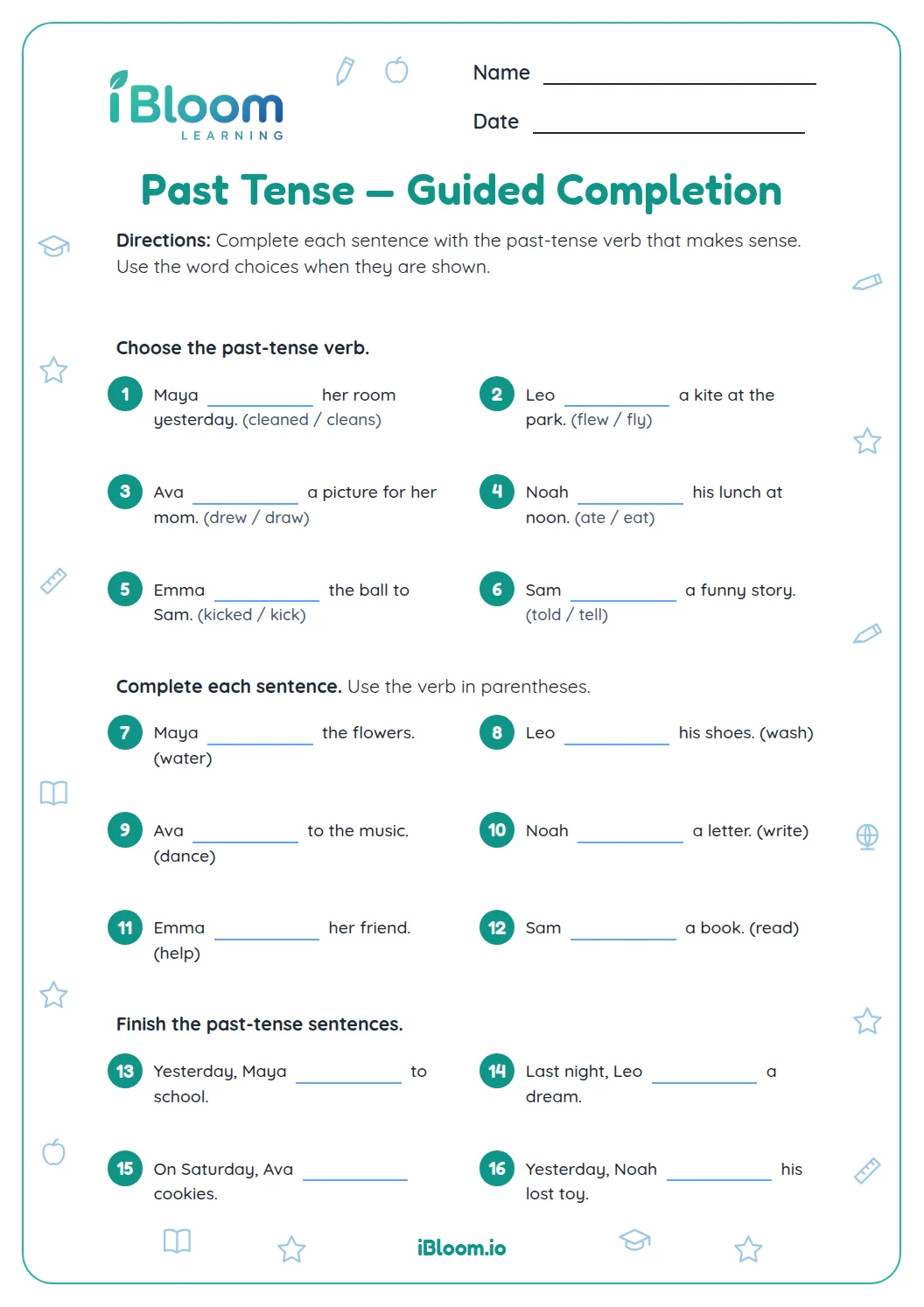
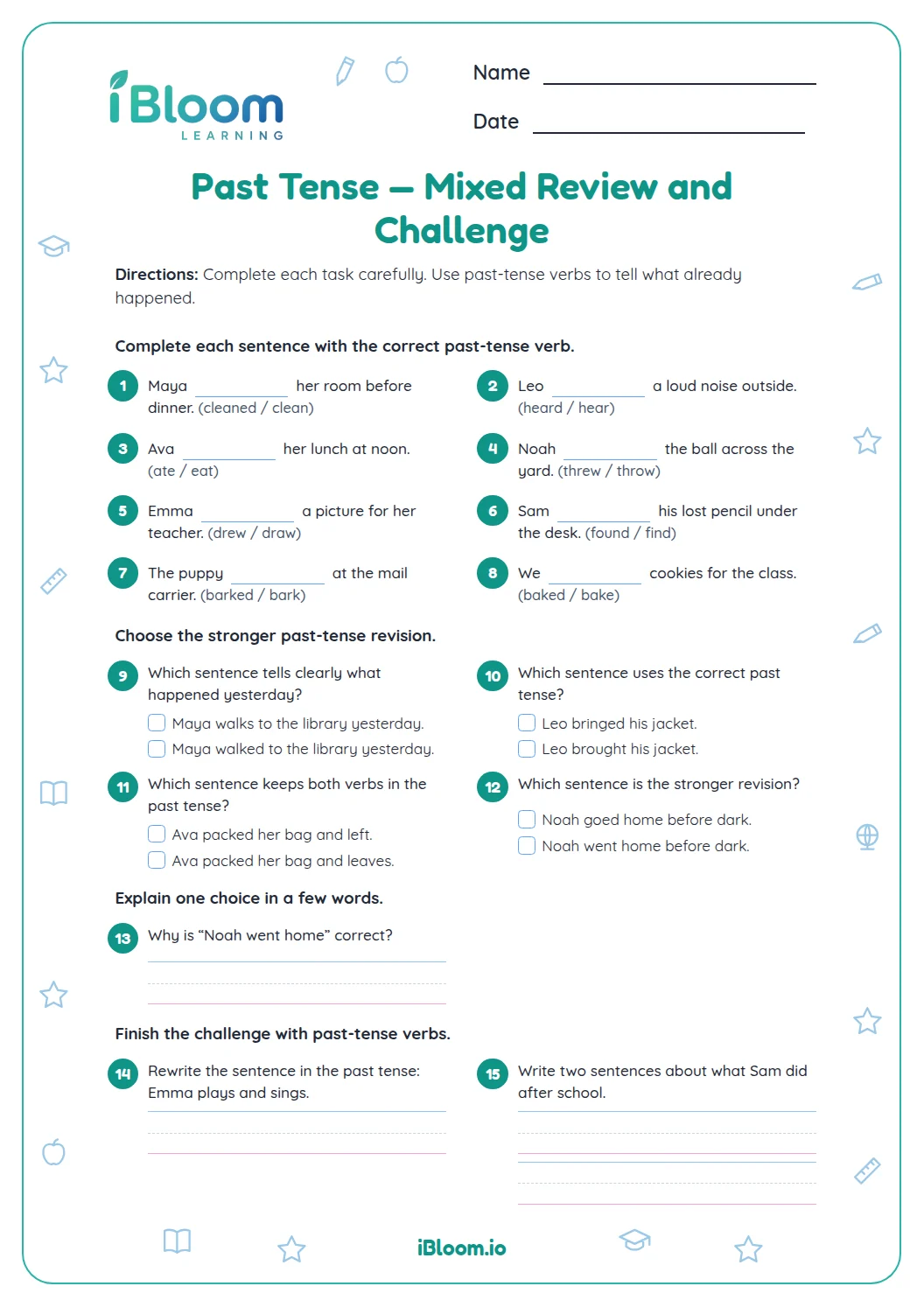
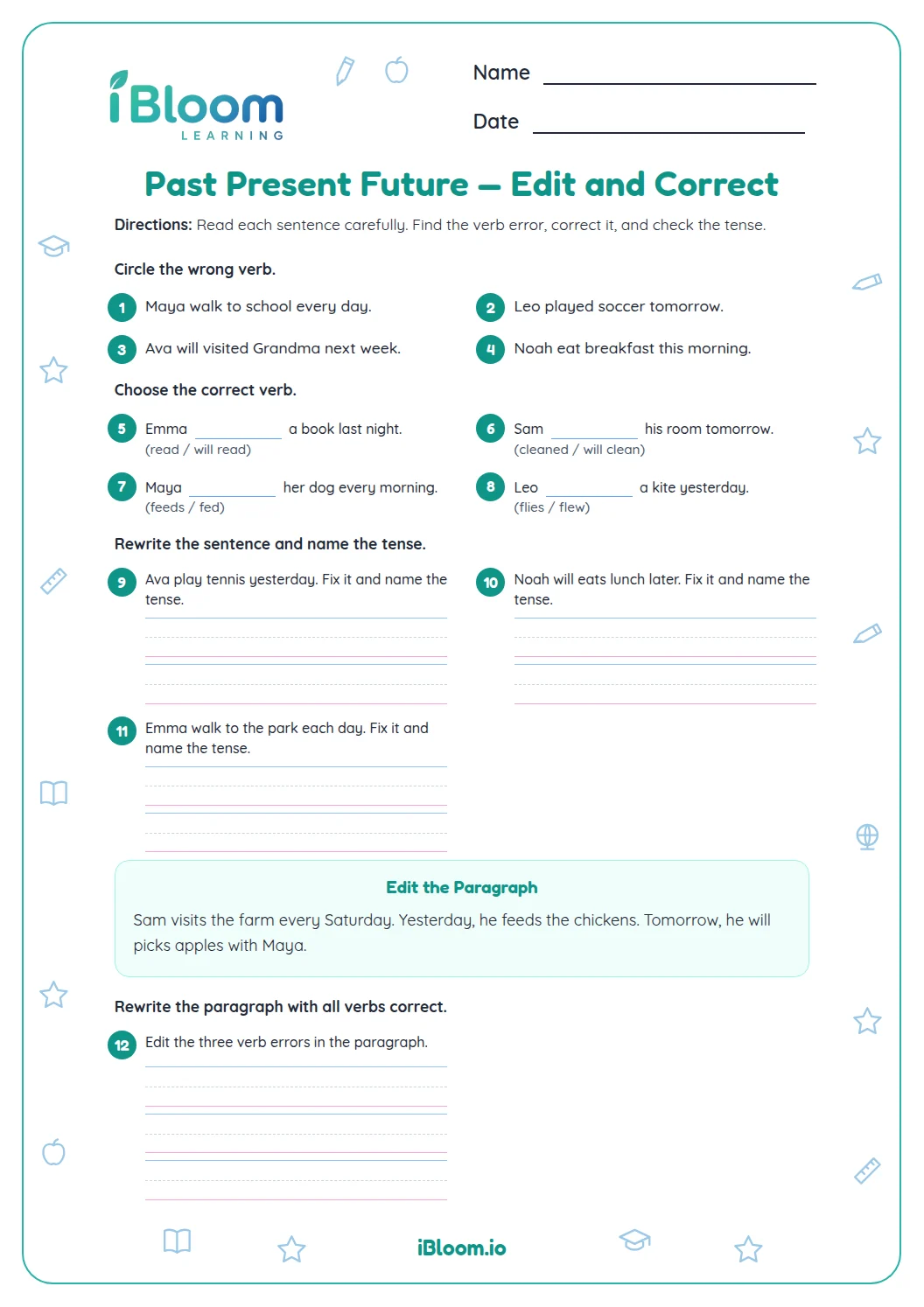
This Grade 2 printable gives students 14 chances to identify and correct verbs that tell what already happened. Part A asks students to choose regular past-tense verbs, Part B supplies irregular forms, and Part C replaces a verb that does not match its time clue. The answer key lists each correct form. It practices Common Core L.1.1.e, using verbs to convey past, present and future time.
Aligned to L.1.1.e
What does each part ask students to do?
The sheet starts with regular verbs, moves to irregular forms, then asks students to replace a verb that does not fit its sentence. Time clues help students identify the past form.
- Part A: choose a regular past-tense verb
- Part B: supply an irregular past form
- Part C: replace the incorrect verb in each sentence
How do you correct a past-tense verb?
Read the time clue first. Then decide whether the verb takes an -ed ending or changes to an irregular form.
- 1“Last week, we go to the farm.” → Change go to went.
- 2“Last week” places the action in the past, and go changes to went.
Why do some past-tense verbs look different?
Some verbs form the past with -ed, as in start/started. Others change their spelling or word form, such as go/went and sing/sang. Read the whole sentence aloud to check that the verb fits its time clue.
How to use this worksheet
- 1Read the time clue in each sentence.
- 2Choose the regular past form in Part A.
- 3Write each irregular form in Part B.
- 4Replace the incorrect verb in each Part C sentence.
- 5Use the answer key to check each verb and its spelling.
Common mistakes and quick fixes
The mistake
Adding -ed to every verb, such as “ goed.”
The fix
Check whether the verb is irregular; go becomes went.
The mistake
Using present tense after “yesterday.”
The fix
Match the verb to the time clue: yesterday means the action is over.
The mistake
Changing a verb but leaving a spelling error, such as “carryed.”
The fix
Change y to i before adding -ed: carry becomes carried.
Common Core alignment
This practice focuses on choosing and editing verbs that make past time clear.
Use verb forms to show whether an action happened before, now or later.
On this sheet: Children choose and edit verbs that show an action happened in the past.
Show the official wordingHide the official wording
Use verbs to convey a sense of past, present, and future (e.g., Yesterday I walked home; Today I walk home; Tomorrow I will walk home).
What to practice next
Make more practice
Further reading
Questions parents and teachers ask
How many questions are on the sheet?
There are 14 items in three parts. Students choose four regular past-tense verbs, write four irregular forms, and correct six verbs in context. The separate key lists each answer. The sheet takes students from choosing a form to applying it in a sentence.
Which irregular verbs does it practice?
Part B includes sing, lose, eat and draw. Students write sang, lost, ate and drew in sentence context. The key shows the expected spellings, and Part C also includes the irregular pair go and went. The Part C questions then revisit two irregular changes in complete sentences.
What does past tense mean on this worksheet?
Past tense tells that an action already happened. Clues such as “yesterday,” “last night” and “last week” appear in the sentences. Students use those words to choose or correct a verb, then check whether its spelling follows a regular or irregular pattern.
Why does carry become carried?
When a verb ends in a consonant followed by y, change y to i before adding -ed. That makes carried the correct form. One Part C sentence asks students to fix “carryed,” so they apply the spelling pattern in context.
Can a child complete this independently?
The worksheet is designed for individual practice with a brief reminder about regular and irregular forms. Students read each time clue, answer one part at a time and check the completed work with the included key. A teacher or parent can review any verb that was tricky.