




About this worksheet
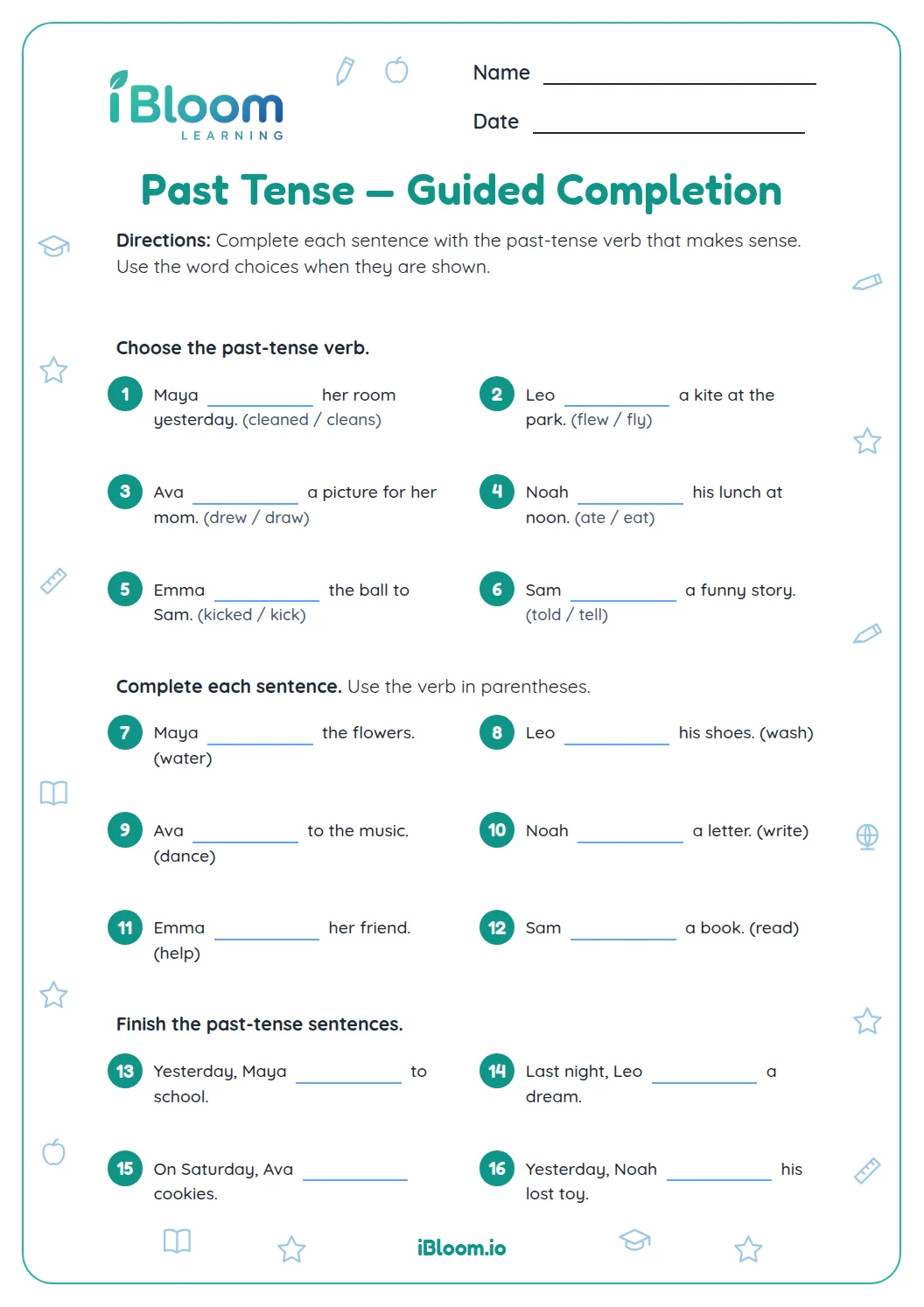
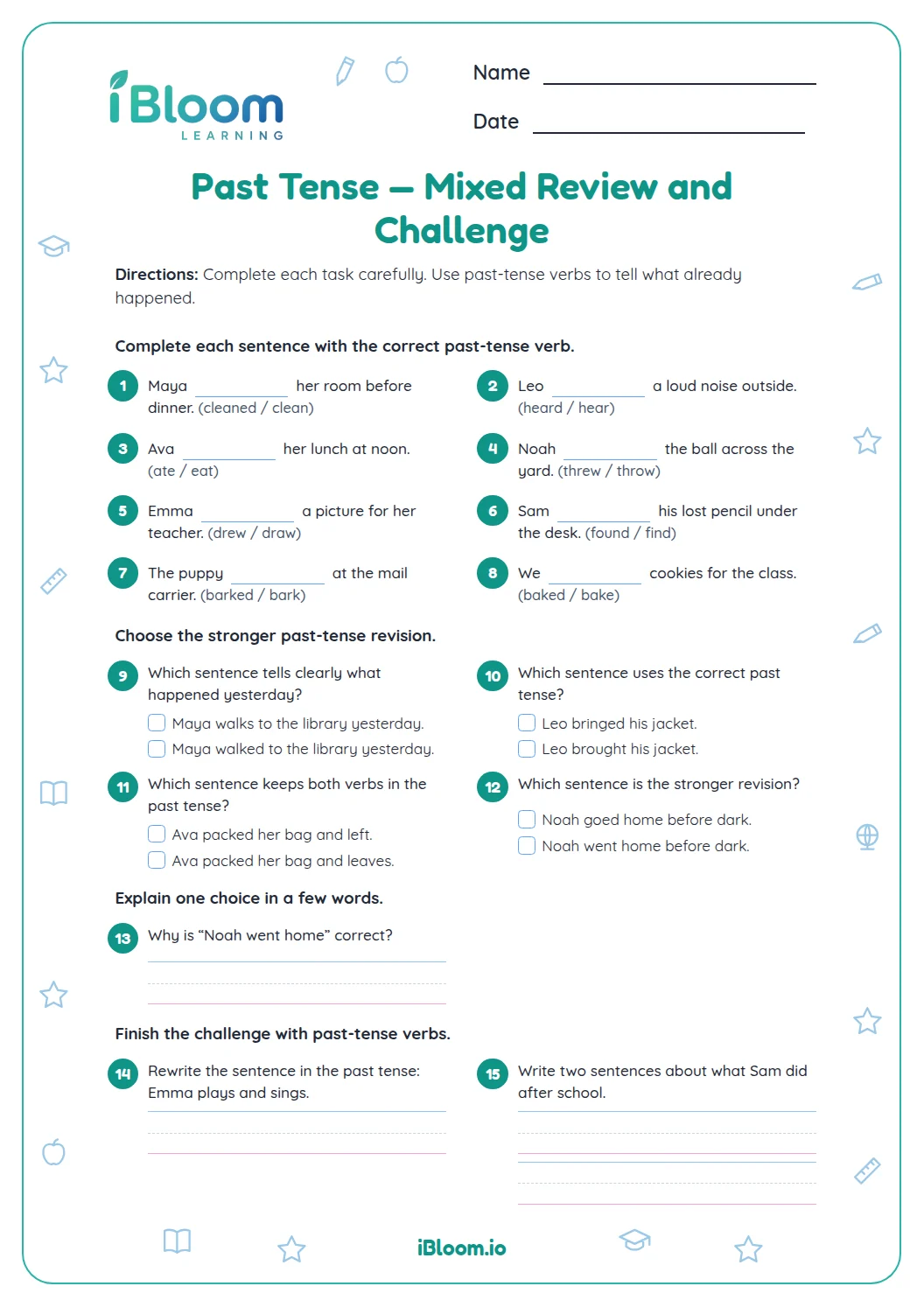
This Grade 2 printable builds past-tense writing in three steps: choose a past-tense verb, change regular verbs to past forms, then complete sentences with past-tense verbs. It replaces the old sheet’s short verb-choice set, recount prompts, and self-check with 16 focused items and a separate answer key. Students practice common irregular forms alongside regular -ed forms. The worksheet aligns with L.2.1.d.
Aligned to L.2.1.d
What does this past-tense worksheet include?
Part A asks students to choose the verb that fits a sentence about a completed action. Part B asks for the past form of six regular verbs, including spelling changes such as carry to carried and stop to stopped.
Part C uses past-tense verbs in complete sentences. The page includes 16 questions and a separate answer key.
How do students form a past-tense verb?
First notice when the action happened. Then choose or form the verb that tells about that earlier action. Regular verbs often add -ed, while common irregular verbs change form.
- 1Yesterday, I ___ my bike to the park.
- 2Answer: rode
How can an adult check the answers?
Read the full sentence with the answer in place. Check that it sounds complete and that the verb tells about an action that already happened.
How to use this worksheet
- 1Read the sentence and notice its time clue, such as yesterday or last night.
- 2In Part A, compare each verb choice with the sentence.
- 3In Part B, write the past form; check spelling when a verb ends in e, y, or a short vowel plus consonant.
- 4In Part C, read the completed sentence aloud.
- 5Use the answer key to check the form and meaning.
Common mistakes and quick fixes
The mistake
Using the present form after a past-time clue.
The fix
Look for yesterday, last night, or another clue, then read the sentence with the past form.
The mistake
Adding -ed to every verb.
The fix
Check whether the verb is irregular, such as bring/brought or take/took.
The mistake
Forgetting a spelling change.
The fix
For carry, change y to i before -ed; for stop, double the final consonant.
Common Core alignment
The irregular verbs in Parts A and C use common past-tense forms.
On this sheet: The irregular verbs in Parts A and C use common past-tense forms.
Show the official wordingHide the official wording
Form and use the past tense of frequently occurring irregular verbs (e.g., sat, hid, told).
What to practice next
Make more practice
Questions parents and teachers ask
What does this past-tense worksheet practice?
It practices choosing and forming verbs for actions that already happened. Students choose common past forms, change regular verbs, and complete sentences with past-tense verbs. The examples include both familiar irregular verbs and regular forms with spelling changes.
Which irregular verbs appear on the page?
The sentence items include rode, read, saw, fed, brought, made, took, and wrote. Students use each sentence’s time clue to decide which verb form belongs in the blank, then can compare their response with the separate answer key.
How many questions are included?
There are 16 questions across three parts: four verb choices, six regular-verb forms, and six sentence completions. A separate answer key lists a response for each question so families can check the work after the student has finished.
What should I do if my child writes “runned”?
Ask your child to read the sentence with “ran” and “runned.” Some frequently used verbs have an irregular past form that does not use -ed. The answer key can confirm the expected form, and the student can try the sentence aloud.
Can a student complete this worksheet independently?
A student who can read the short sentences may complete most items independently. An adult can read the directions aloud, then review the verb forms with the separate answer key. For extra practice, ask the student to use one answer in a new sentence.