






About this worksheet
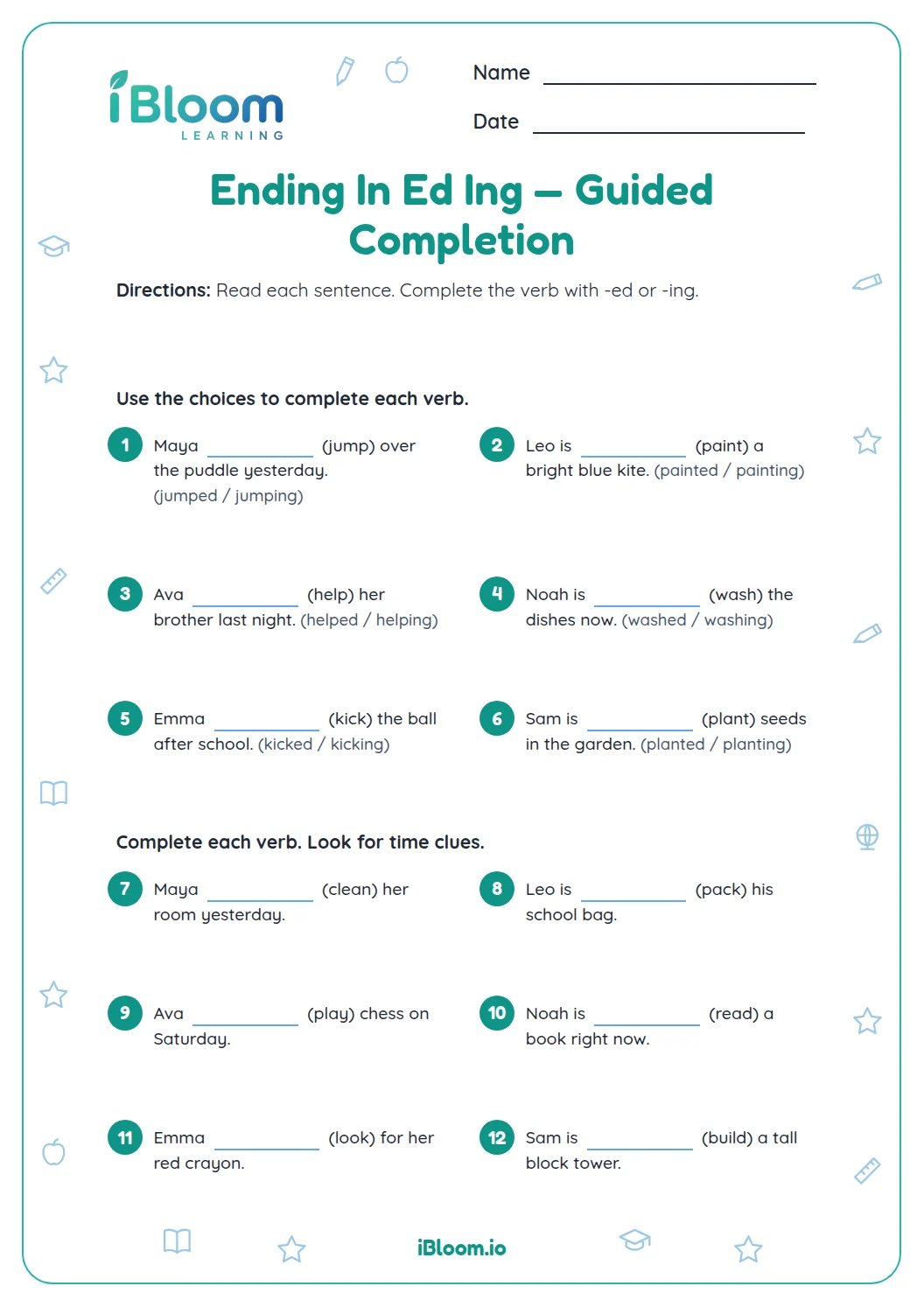
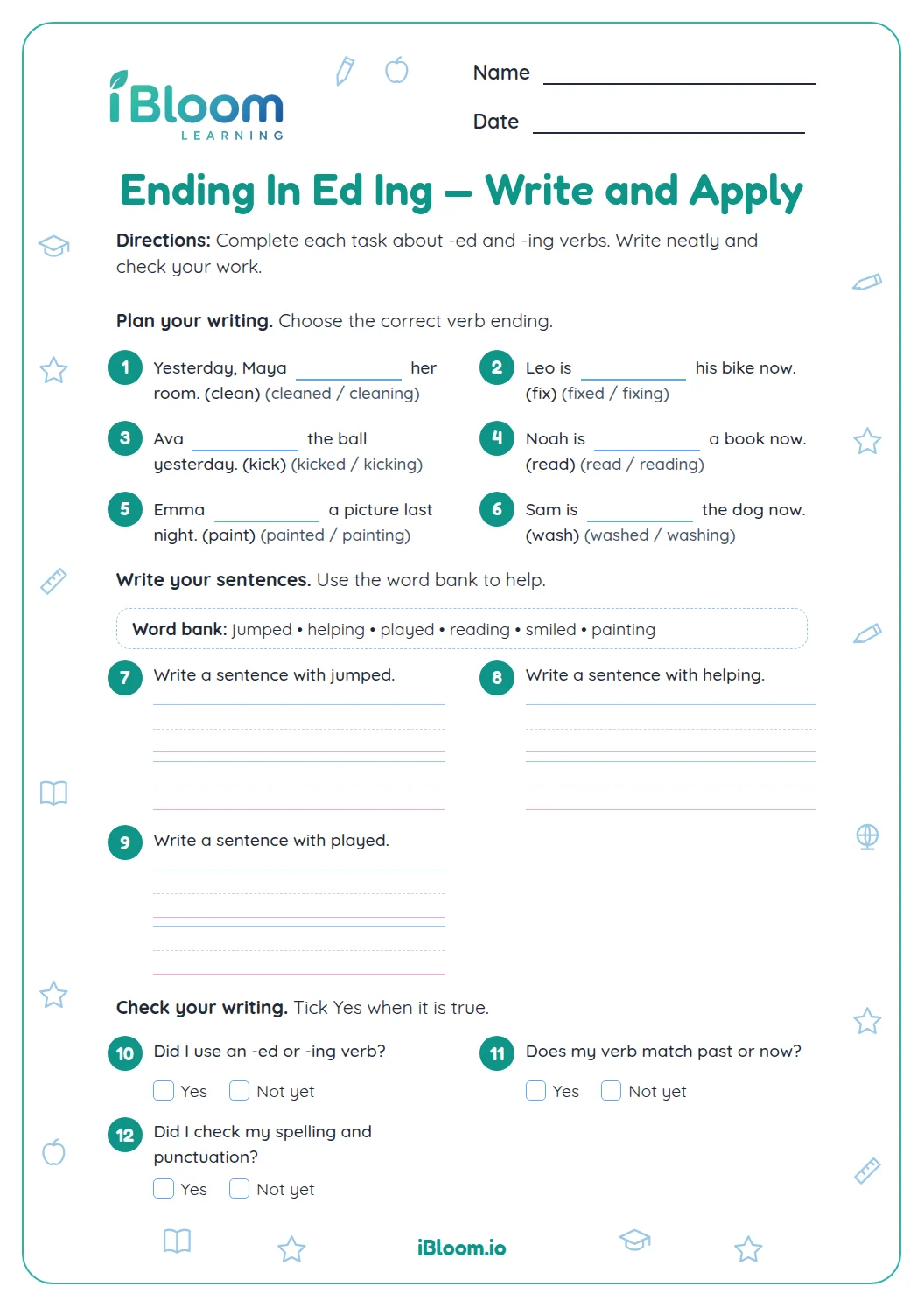
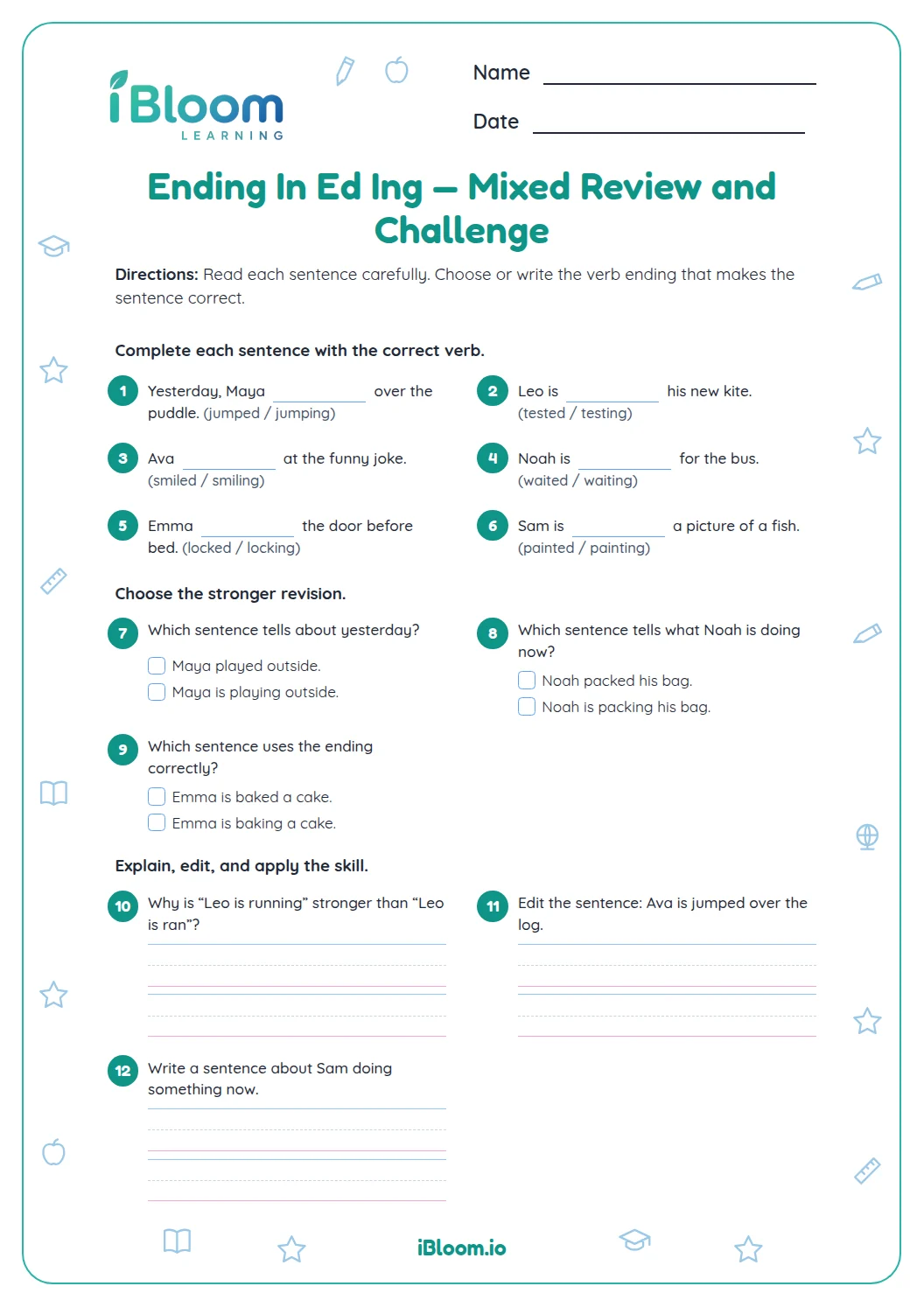
This free printable Grade 2 grammar worksheet gives children sentence practice with verbs that end in -ed and -ing. Each sentence has a clue, such as yesterday, last night or the helper word is, that tells which ending fits. In Part A they pick between pairs like painted and painting, in Part B they add the ending to a root verb such as bake or run, in Part C they rewrite two sentences with the verb fixed, and in Part D they write a sentence about yesterday. It practices Common Core L.2.2.d and L.1.1.e, and a two-page answer key is included.
Aligned to L.2.2.d and L.1.1.e
What do -ed and -ing tell us about a verb?
A verb has a root, like paint, and endings that change the time it tells. Adding -ed gives the past: Maya painted a picture yesterday. Adding -ing, with a helper word such as is or are in front, shows an action going on now: Maya is painting a picture.
Every sentence on the sheet gives children something to look for before they choose: a time clue (yesterday, last night, last week) or a helper word (is, are).
How do students choose the right ending?
The same three steps work for every question. Find the time clue. Look for is or are just before the blank. Then read the finished sentence aloud and listen. A clue such as last week points to -ed, while is points to -ing.
Question 4 adds a spelling check, because both choices are real words: hoping comes from hope and hopping comes from hop.
- 1The rabbit is ___ across the grass.
- 2The helper word is means it is happening now, so the verb ends in -ing.
- 3The root is hop: one short vowel, then one consonant. Double the p: hop + p + ing.
- 4Answer: hopping (hoping comes from hope, a different word)
Which spelling changes appear on this worksheet?
Most verbs simply add the ending: paint becomes painted and wash becomes washing. Four roots in Part B change a little, so they are worth talking through first.
- Drop the silent e before -ing: bake becomes baking (question 6)
- Add only -d when the root already ends in e: smile becomes smiled (question 9)
- Double the last consonant of a short one-vowel root: plan becomes planned and run becomes running (questions 7 and 8)
What is on this worksheet?
Twelve questions in four parts over two pages. Page 1 holds Part A and the first sentence of Part B; page 2 holds the rest of Part B and Parts C and D, so the sheet can be done in one sitting or split in two.
- Part A, Pick the verb: five sentences with two choices each, such as kicked or kicking (questions 1 to 5)
- Part B, Add -ed or -ing: four root verbs to write with the right ending and spelling (questions 6 to 9)
- Part C, Fix the verb: rewrite “Yesterday Leo kick the ball” and “Ava is jump on the bed” correctly (questions 10 and 11)
- Part D, Write your own: one sentence about yesterday with a verb ending in -ed (question 12)
- A two-page answer key, with a sample sentence for question 12
How to use this worksheet at home or in class
- 1Warm up out loud. Ask what your child did yesterday and what they are doing right now, and listen for the -ed and -ing endings.
- 2Read the directions together, then point to the clue in question 1: Yesterday tells us the painting is finished.
- 3Let your child finish Part A, reading each completed sentence aloud to hear whether it sounds right.
- 4Before Part B, write hop and bake on scrap paper and show hopping and baking. Ask what happened to the p and to the e.
- 5In Part C, have your child find the clue word or helper word first, then copy the whole sentence with the fixed verb. For Part D, check for a capital letter and a period.
- 6Check with the answer key. For any miss, say the sentence with the wrong verb and then the right one, so your child hears the difference.
Common mistakes and quick fixes
The mistake
Keeping the silent e and writing bakeing for question 6.
The fix
Drop the e before -ing: bake becomes baking. Write both and ask which one looks like a real word.
The mistake
Forgetting to double the consonant, as in runing for running, or choosing hoping for hopping. Hoping is a real word, so it looks right.
The fix
Ask whether the root has one short vowel and ends in one consonant. If so, double it: run, running; hop, hopping. Hope keeps its long o: hoping.
The mistake
Leaving the root bare after a time clue or helper word, as in “Yesterday Leo kick the ball” or “Ava is jump on the bed.”
The fix
Ask, “Did it already happen?” If yes, add -ed (kicked). If the sentence has is or are before the verb, add -ing (jumping).
Common Core alignment
Most US states use the Common Core Language standards or a close state version. These two standards name the verb and spelling skills on this worksheet.
Use spelling patterns when adding endings: drop the e in baking, double the p in hopping.
On this sheet: Part B: children spell baking, planned, running and smiled; question 4 tells hopping from hoping.
Show the official wordingHide the official wording
Generalize learned spelling patterns when writing words (e.g., cage → badge; boy → boil).
Choose a verb that shows when something happens: painted for yesterday, washing for right now.
On this sheet: All four parts: children choose, write, fix and use verbs whose endings show past or present time.
Show the official wordingHide the official wording
Use verbs to convey a sense of past, present, and future (e.g., Yesterday I walked home; Today I walk home; Tomorrow I will walk home).
What to practice next
Make more practice
Further reading
Questions parents and teachers ask
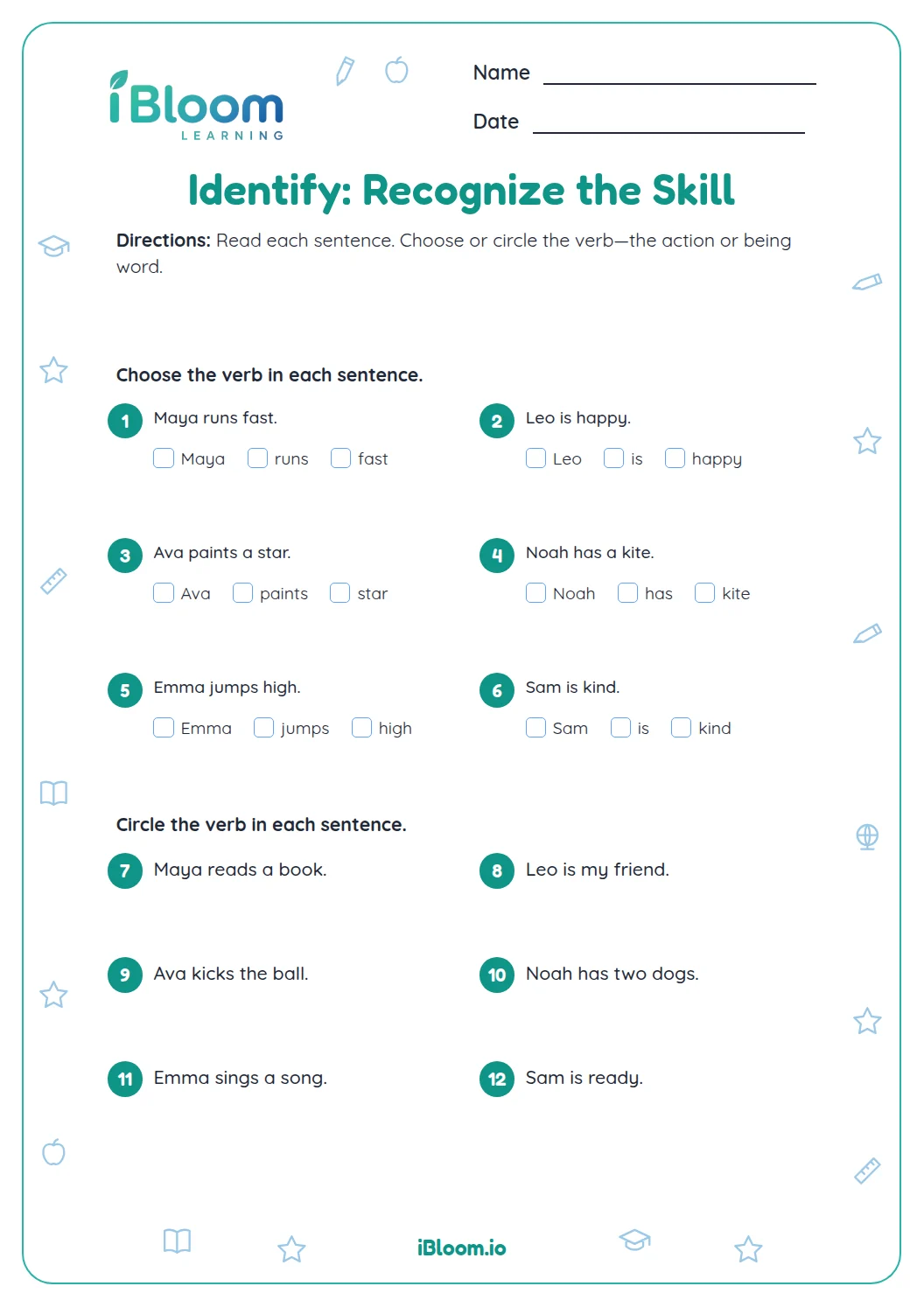
What are verbs that end in -ed and -ing?
They are action words with an ending added to the root. Paint becomes painted for something already finished and painting for something going on now. On this sheet, children choose the ending from a clue in the sentence, spell it correctly, fix two sentences and use an -ed verb in a sentence of their own.
How can my child tell whether to use -ed or -ing?
Look for the clue in the sentence. Words like yesterday, last night and last week point to -ed. The helper words is, am and are point to -ing. Reading the finished sentence aloud also helps, because “Ava is jump on the bed” sounds wrong as soon as it is said.
Why do some verbs double the last letter?
A root with one short vowel and one final consonant doubles that consonant before the ending, so hop becomes hopping and plan becomes planned. The double letter keeps the vowel short: hopping has a short o, while hoping, from hope, has a long o. Questions 4, 7 and 8 practice this rule.
What are the answers to Part C?
Question 10 should read “Yesterday Leo kicked the ball,” because yesterday means the kick already happened. Question 11 should read “Ava is jumping on the bed,” because is comes before the verb. Children copy the whole sentence with the fixed verb, which gives extra practice writing the endings correctly.
What should my child write in Part D?
Any true sentence about yesterday with a verb ending in -ed, such as “Yesterday I played soccer with my cousin.” Check that the verb ends in -ed, the sentence starts with a capital letter and it ends with a period. The answer key shows one sample sentence, since answers will vary.
How long does it take, and is there an answer key?
Most Grade 2 children need about 15 minutes. Yes, a two-page answer key follows the worksheet, so you can print the two worksheet pages alone and keep the key for checking afterward. The sheet splits easily: page 1 is mostly Part A, and page 2 holds the spelling, fixing and writing.