


About this worksheet
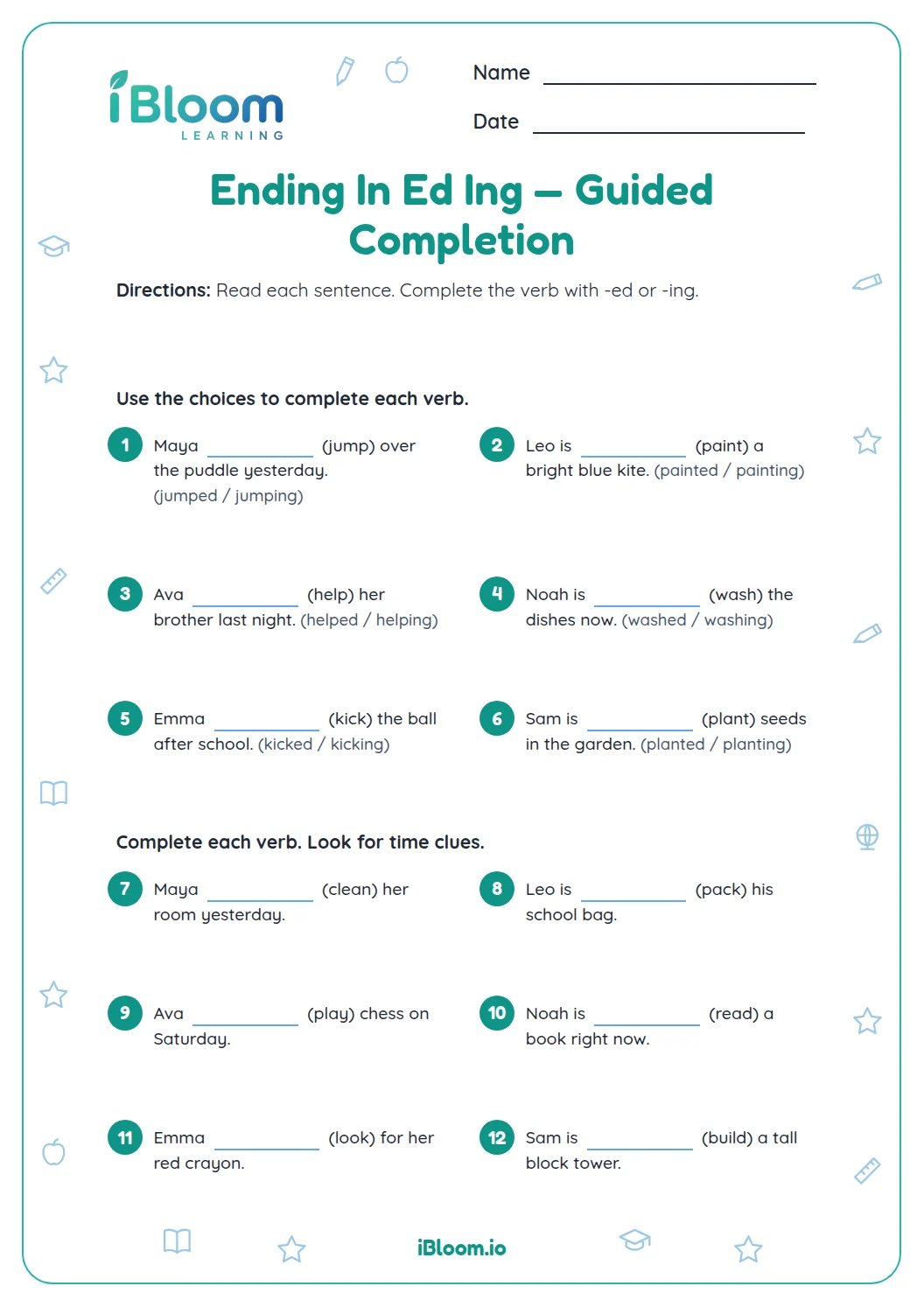
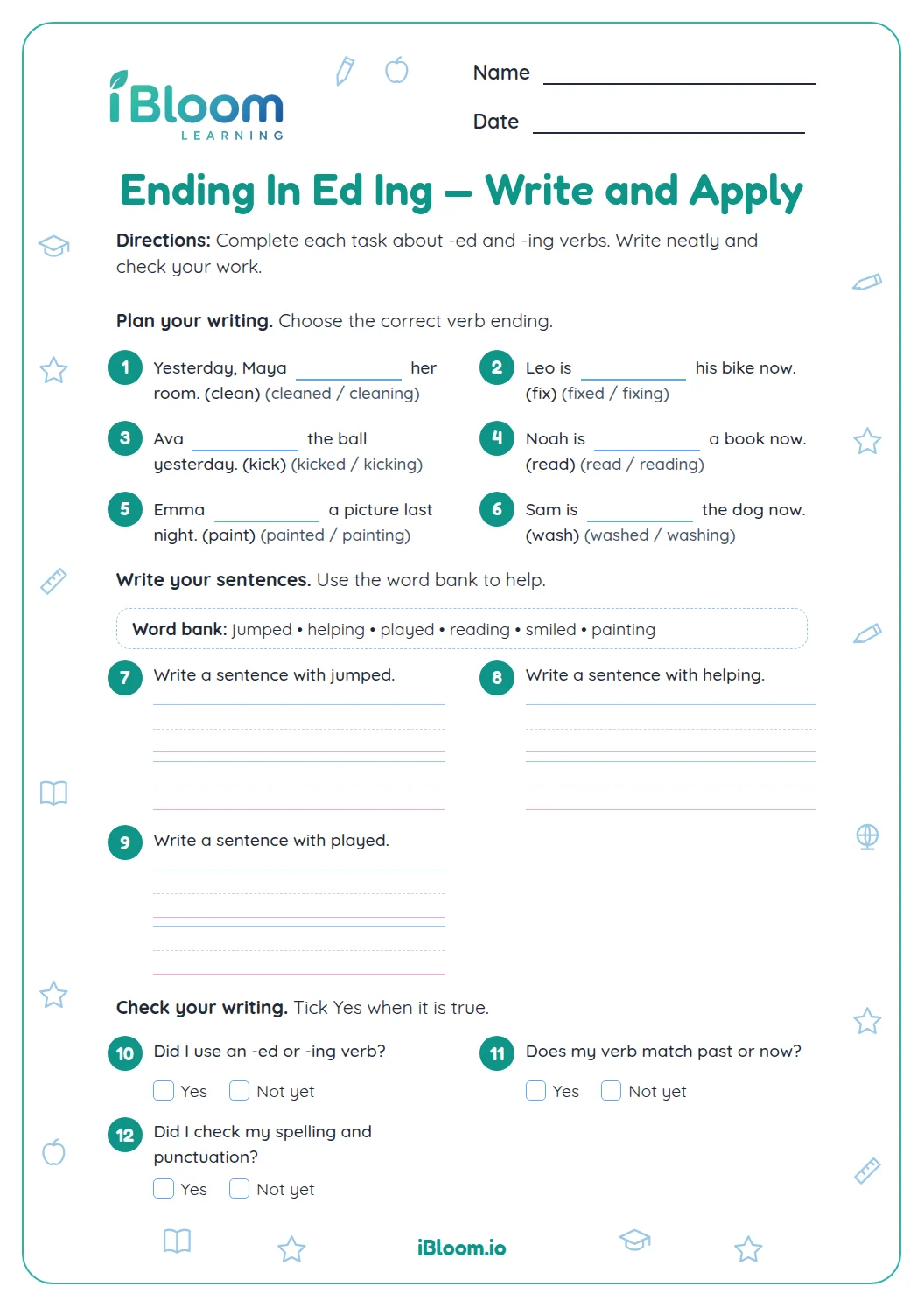
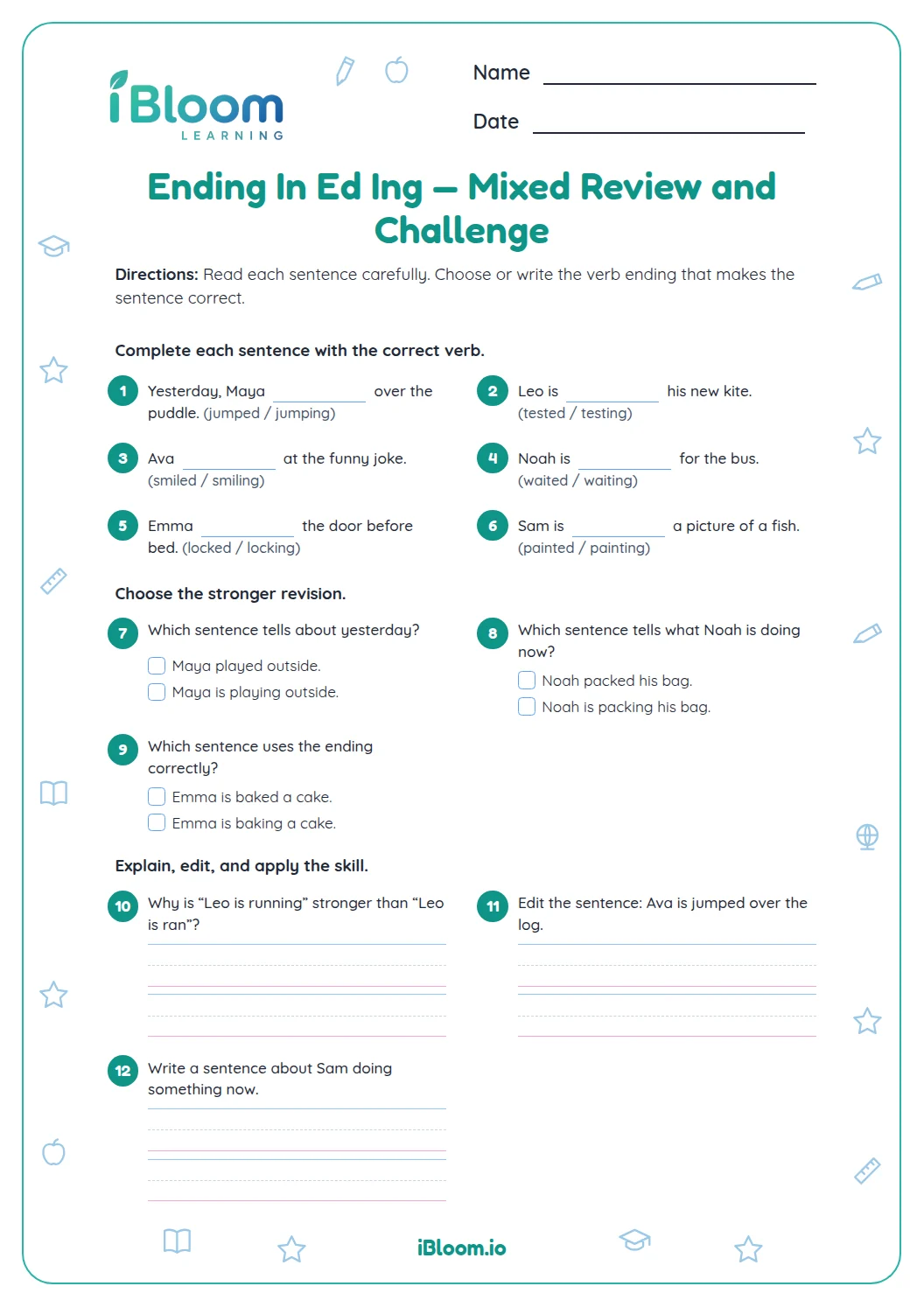
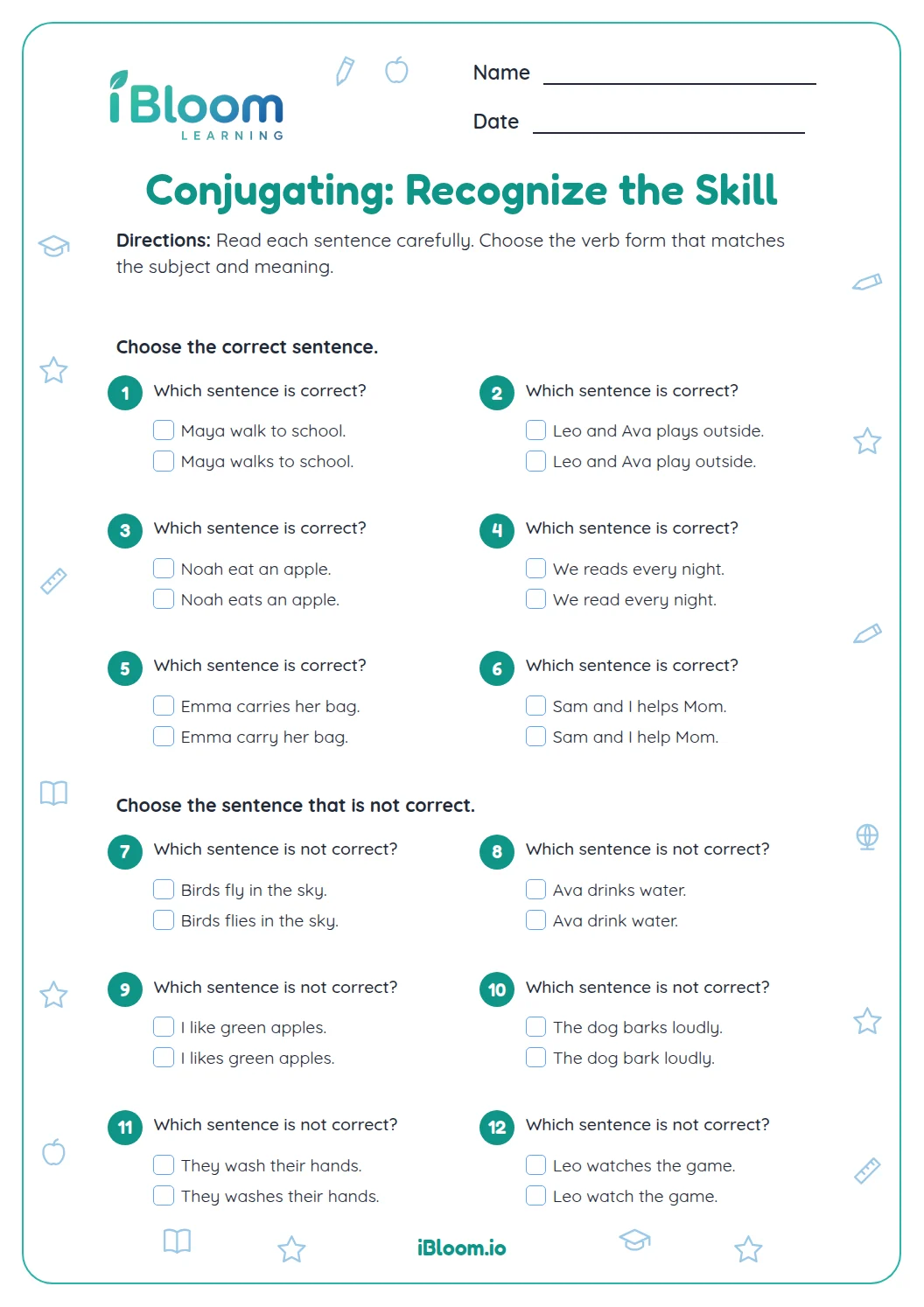
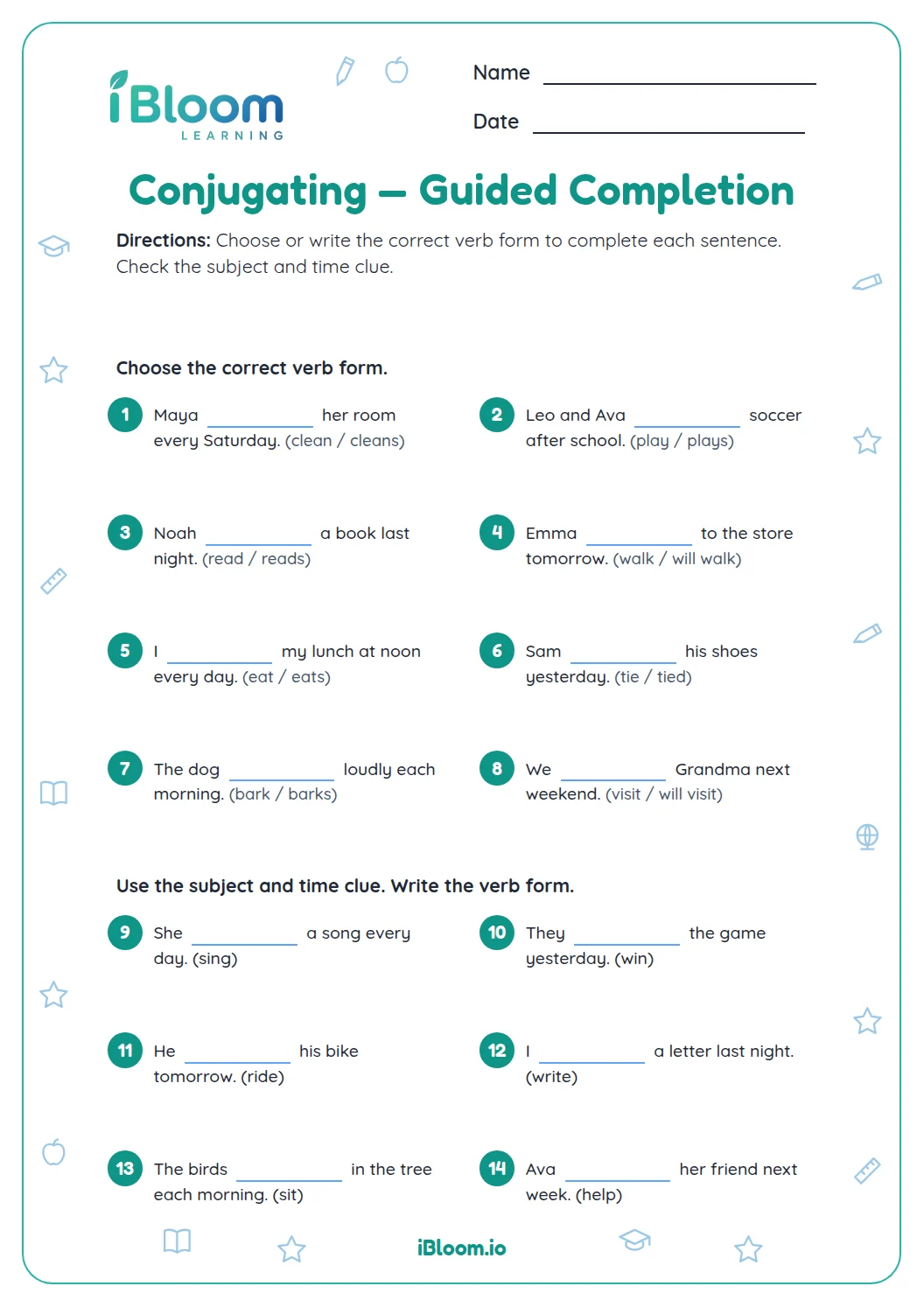
This free Grade 2 printable helps children edit verbs ending in -ed and -ing. Across 16 questions, students correct sentences with a mismatched verb ending, choose a fitting verb form, and complete short time-clue sentences. The work draws attention to past actions and actions happening now, including forms such as jumped, painting, and running. The answer key lists the target forms.
What does the worksheet ask students to do?
Part A asks students to repair eight sentences where a verb ending does not fit the sentence. Part B offers four choices, and Part C asks students to complete a verb with the ending that fits a time clue.
- 1Mia jump on the bed yesterday.
- 2Corrected verb: jumped
- 3The word yesterday signals a past action.
How do time clues help?
Words such as yesterday and last night point to an action that happened in the past. Now and right now point to an action happening in the present; a present action with -ing uses a helping verb such as is or are.
What spelling changes appear?
Some verbs add -ed or -ing directly, while a short verb may double its final consonant before -ing. Reading the whole sentence aloud helps check both the time and the sound of the verb.
How can you use this worksheet?
- 1Read the whole sentence before changing a verb.
- 2Underline a time clue such as yesterday or now.
- 3Choose a verb form that fits the clue and sentence grammar.
- 4Check whether the spelling needs an ending or a doubled consonant.
- 5Read the corrected sentence aloud, then use the key.
What slips should you watch for?
The mistake
Choosing -ing after yesterday.
The fix
Match the ending to the time clue: yesterday describes a past action.
The mistake
Writing “is paint” for an action happening now.
The fix
Use a helping verb with -ing: “is painting.”
The mistake
Forgetting to double a consonant in running or clapping.
The fix
Say the base word, then check the spelling pattern before adding -ing.
What to practice next
Further reading
Questions parents and teachers ask
What do -ed and -ing tell a reader?
Yes. There are 16 questions in three parts: eight sentence edits, four multiple-choice verb forms, and four short verb-ending completions. The answer key gives the corrected verb or form for each item, including spelling changes such as doubling the final consonant.
How many questions are on this page?
Some short verbs double their final consonant before -ing, as in run/running and clap/clapping. Other verbs simply add -ing, as in paint/painting. Students can say the base word, add the ending, and check whether the last consonant is doubled.
Why do some -ing verbs double a letter?
Students do need to spell the corrected forms, but each item is centered on choosing a verb form that matches the sentence time clue. Yesterday and last week point to past forms; now and today pair with is or are plus an -ing form.
Is this a spelling worksheet too?
Yes. The separate key lists each corrected verb form and selected answer. For sentence-edit items, it shows the target verb so an adult can check the ending and spelling while allowing the child to write the whole corrected sentence.
Does it include an answer key?
Yes. The separate key lists each corrected verb form and selected answer. For sentence-edit items, it shows the target verb so an adult can check the ending and spelling while allowing the child to write the whole corrected sentence. It also makes the irregular form cried easy to verify.