



About this worksheet
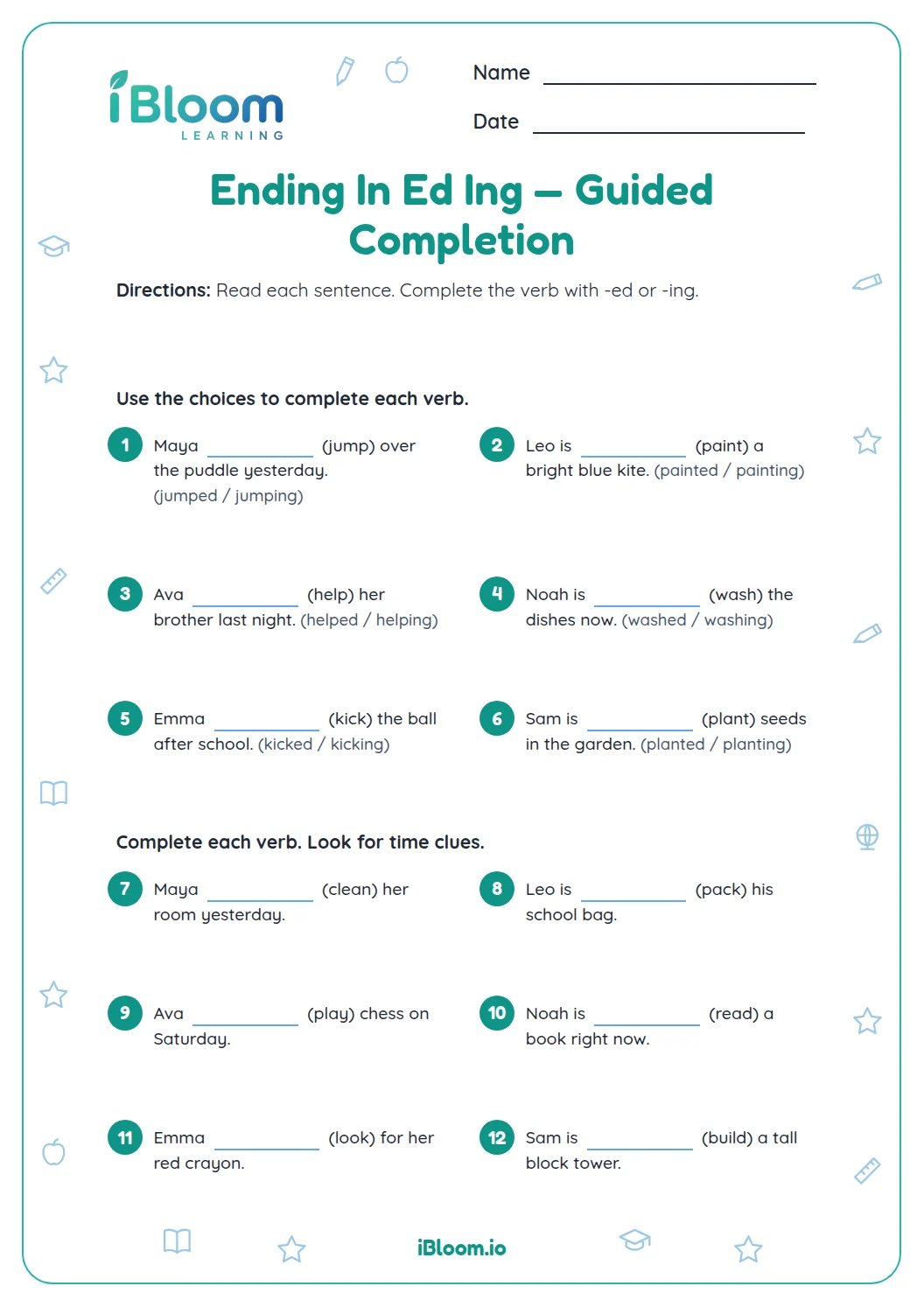
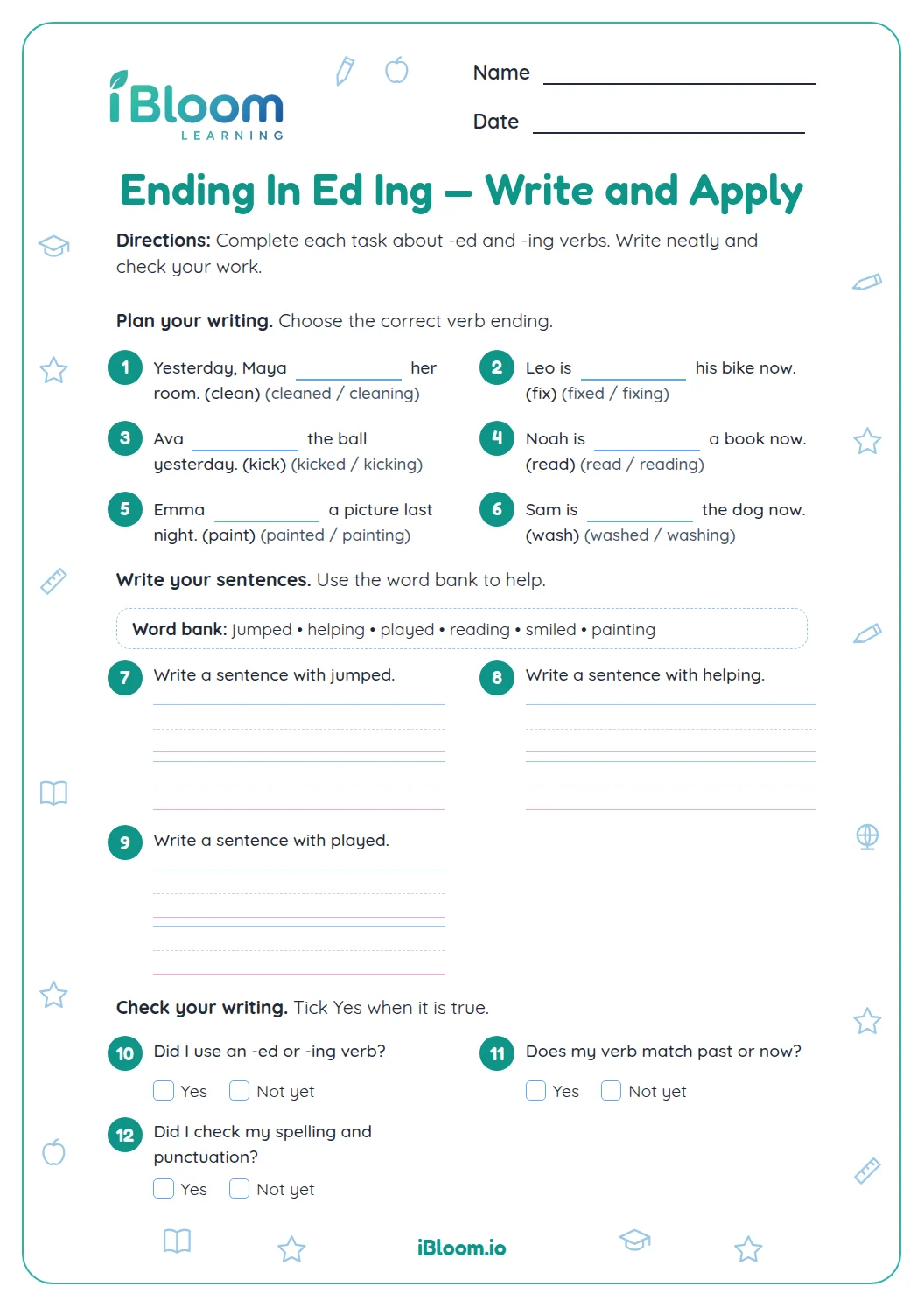
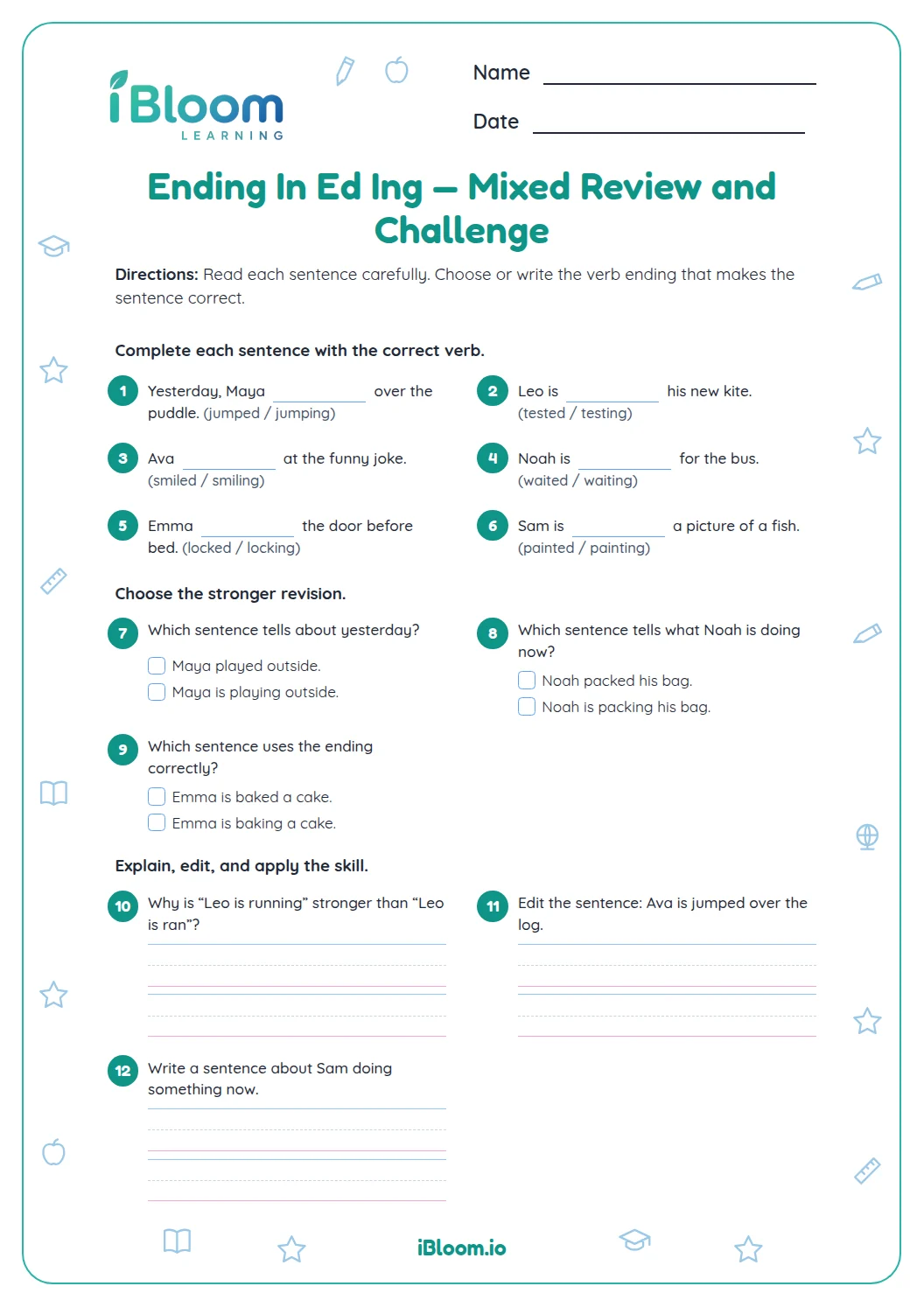
This free Grade 2 worksheet focuses on recognizing and using verbs ending in -ed and -ing. Learners identify the endings, choose forms that fit sentence clues such as “yesterday” and “now,” complete sentences with the correct spelling, and correct two verb forms. Two final prompts invite original sentences. A separate answer key includes sample responses.
How do -ed and -ing change a verb?
The ending changes the form of the action word. In this worksheet, “yesterday” points to a past action such as jumped, while “is” or “now” can signal an action in progress, such as jumping.
- 1Yesterday, I ___ (help) Dad.
- 2Write helped: the time clue “yesterday” calls for the past form.
How can you spell the new form?
Some verbs simply add the ending. For a short verb such as hop, double the final consonant before -ing: hopping. For smile, drop the silent e before adding -ing: smiling.
How do you check a verb in a sentence?
Read the time clue and the words around the blank. Then check that the verb ending matches the sentence and is spelled correctly.
How to use this worksheet
- 1Find the action word in each prompt.
- 2Look for time clues such as yesterday, now, or last night.
- 3Choose or write the form that fits the clue.
- 4Check the spelling when adding an ending.
- 5For the last two items, write a complete sentence with the requested form.
Verb-ending slips to check
The mistake
Using an -ing form after a past-time clue.
The fix
Match the verb to words such as yesterday or last night.
The mistake
Writing “hoping” for the action of hopping.
The fix
Double the final consonant in hop before adding -ing.
The mistake
Keeping the e in “smileing.”
The fix
Drop the silent e before adding -ing: smiling.
What to practice next
Make more practice
Further reading
Questions parents and teachers ask
How do children choose between -ed and -ing?
Use the sentence clue. Words such as yesterday and last night often point to a past action ending in -ed; is and now can signal an action in progress ending in -ing. Reading the whole sentence helps select the form that fits.
How many questions are on this worksheet?
There are 15 questions: six choices, five sentence completions, two corrections, and two original-sentence prompts. The sections move from recognizing a form to using it in writing, with a separate key for checking responses. Each writing prompt asks for a particular verb ending.
Why does hopping have two p’s?
Hop is a short verb with a short vowel followed by one consonant. Double the final p before adding -ing, so the correct spelling is hopping. This worksheet also practices dropping the silent e in smile before adding -ing. That spelling keeps the word easy to read.
Does the answer key include sample sentences?
Yes. The key lists fixed answers for the recognition, completion, and correction items, plus sample sentences for the final two prompts. Other sentences are acceptable when they use the requested ending correctly and form a complete thought. The sample answers show one possible response.
How long should the worksheet take?
About 20 minutes is a reasonable plan for 15 questions. The written sentences may take longer if the learner wants to revise spelling or add details. The worksheet can also be completed a section at a time, with answers checked after each part.