








About this worksheet
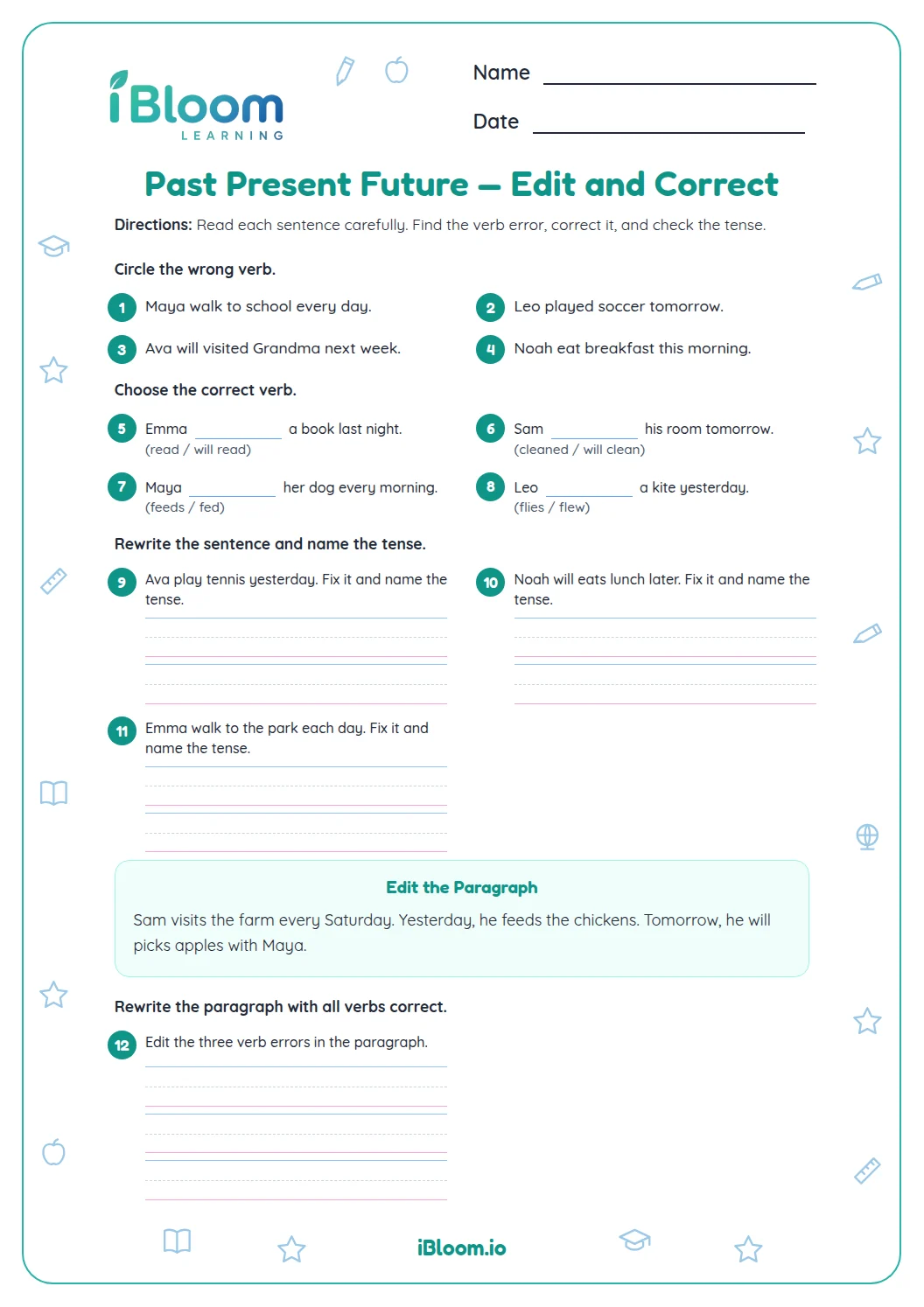
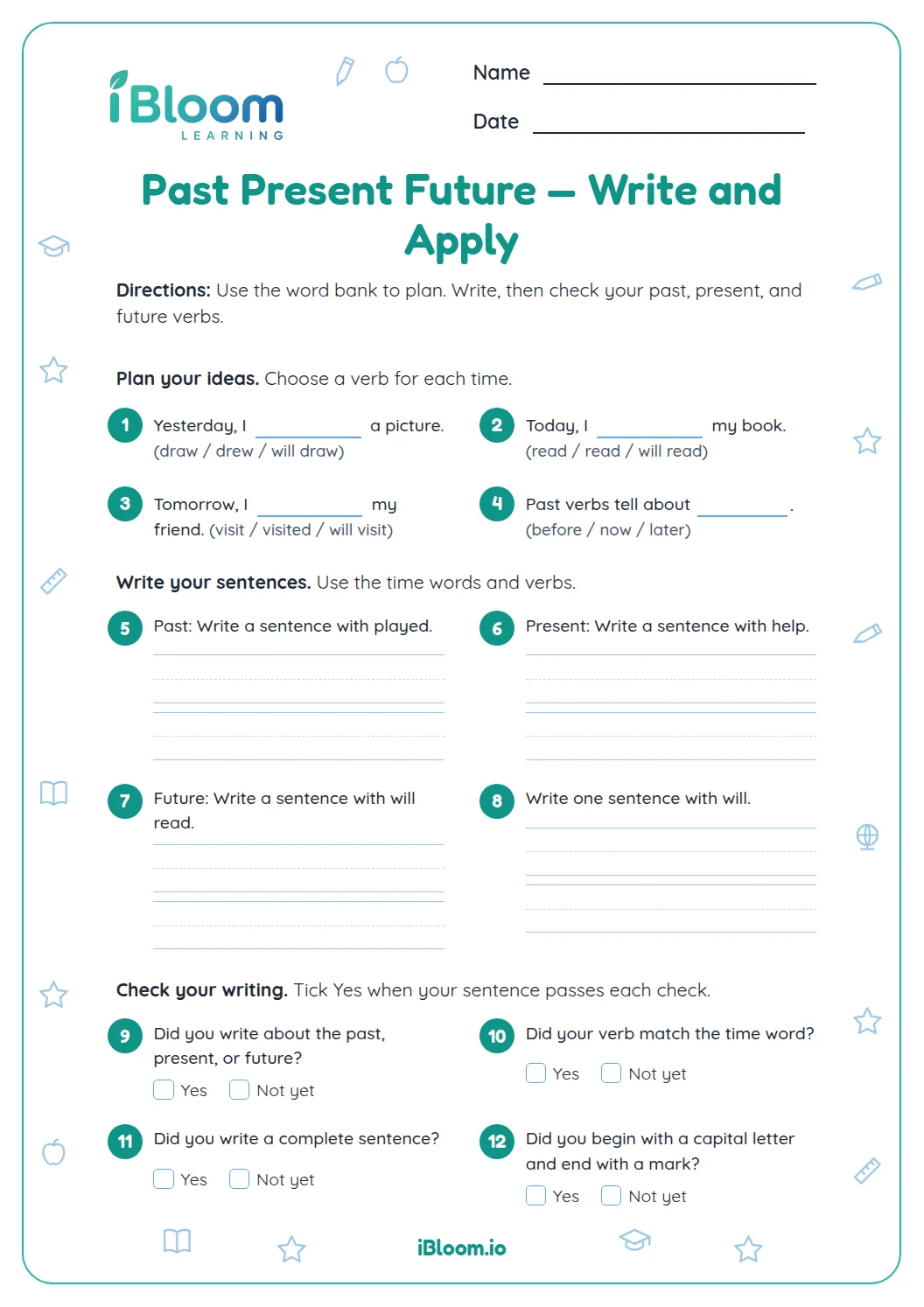
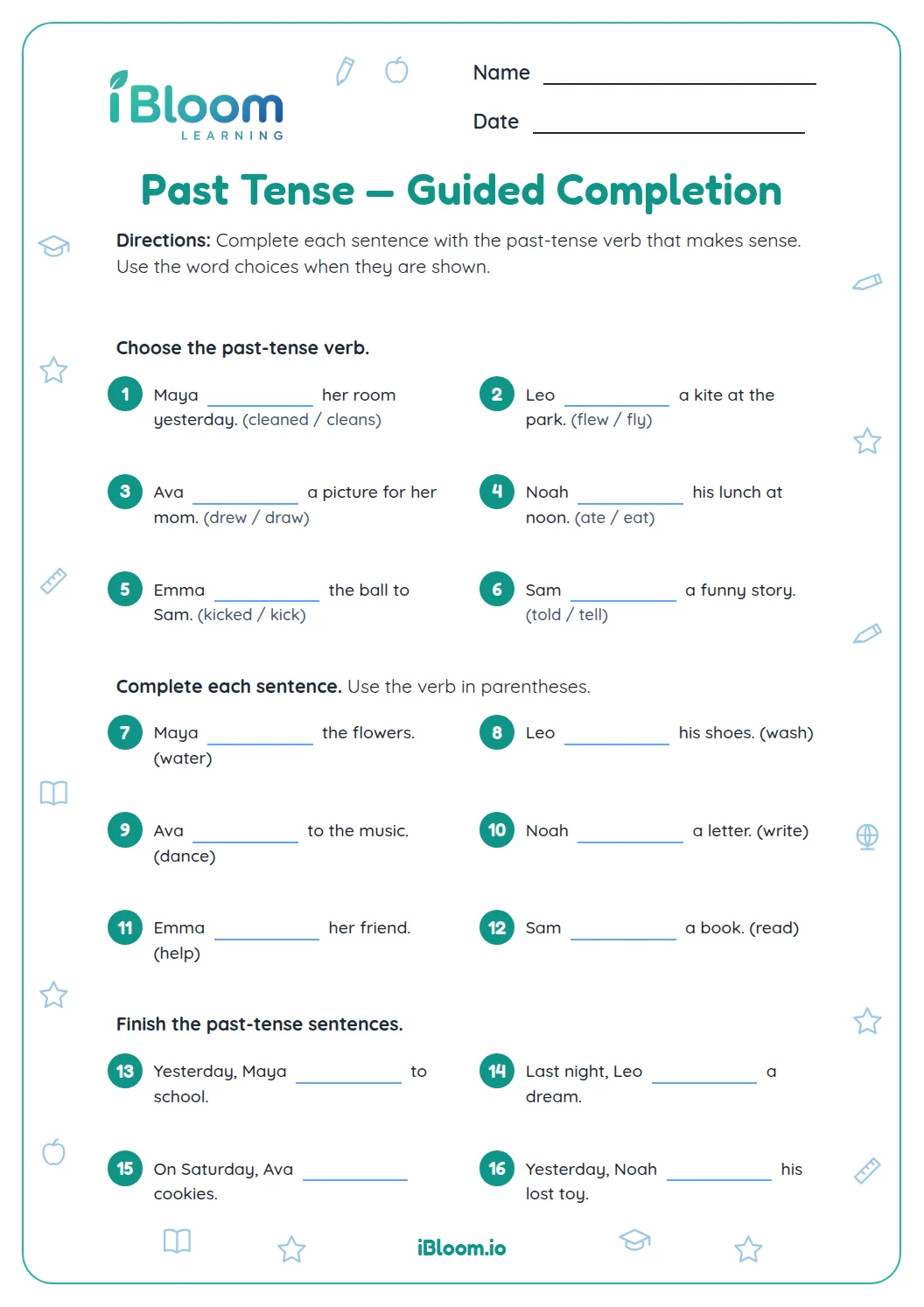
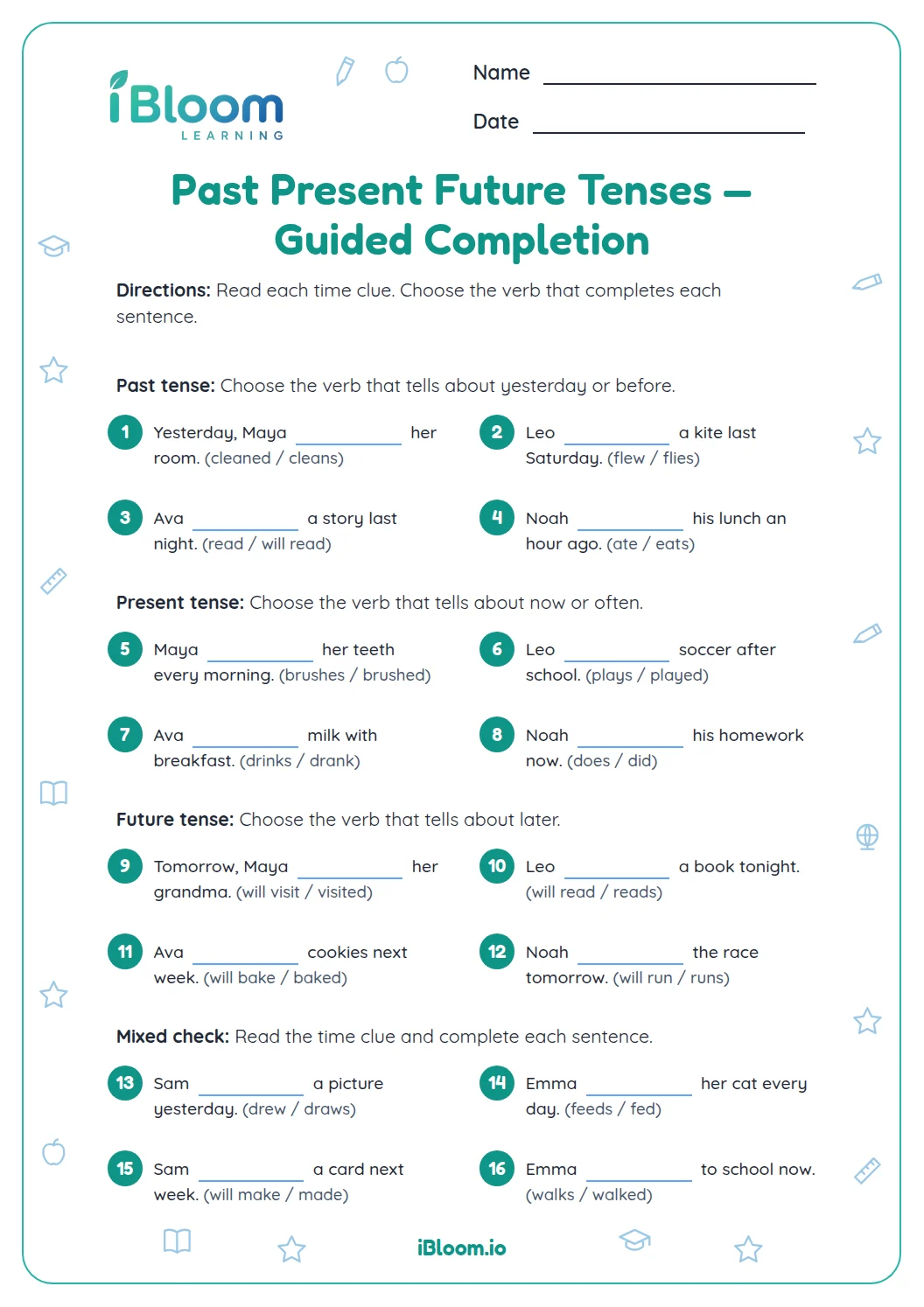
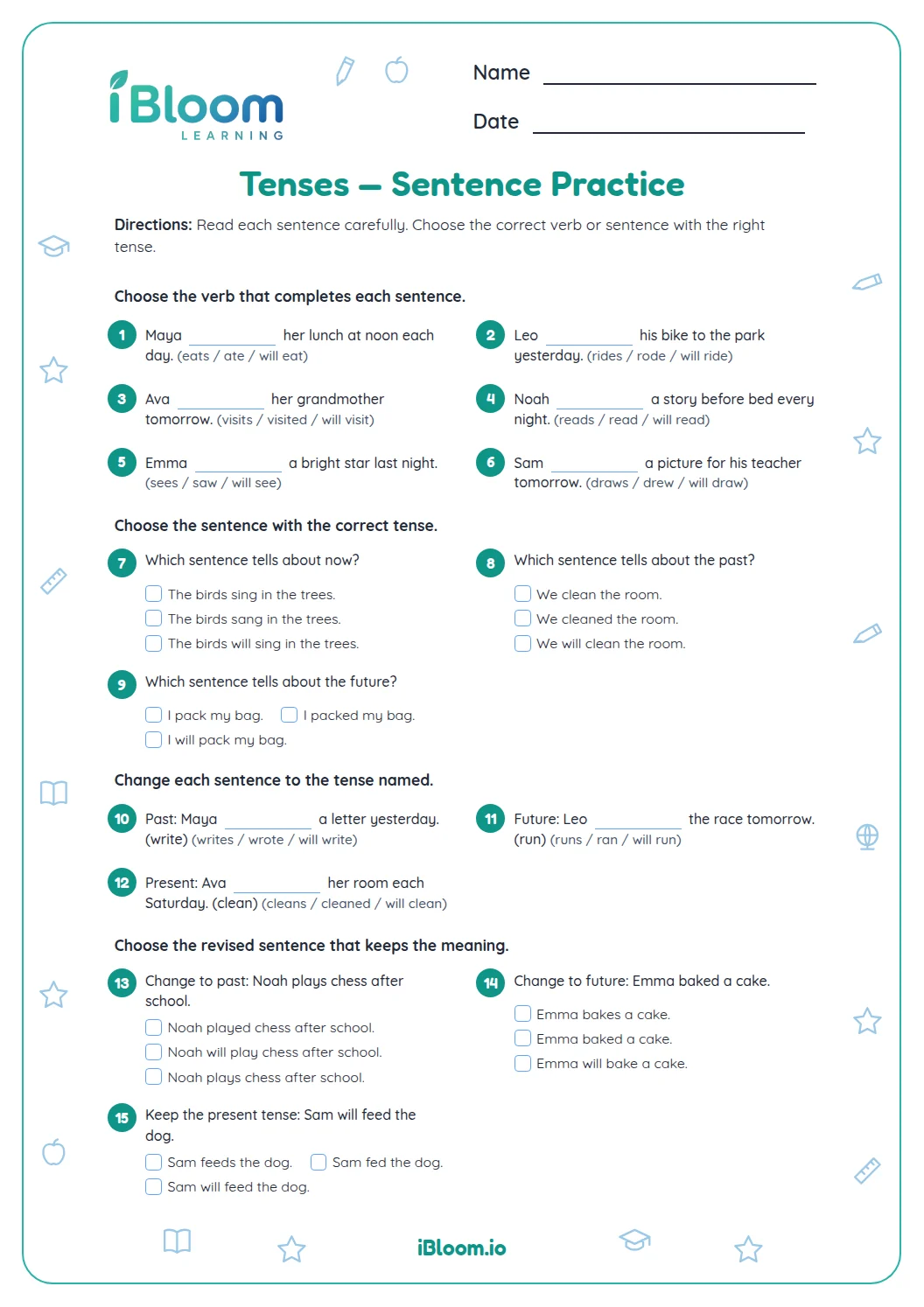
This free printable Grade 2 worksheet helps children match a verb to the time word in its sentence. Words such as yesterday, every day and tomorrow tell when something happens, and the verb has to agree. Children choose between two verbs, change a verb they are given, decide whether a sentence is past, present or future, and write a sentence of their own. Some verbs add -ed, and some, like ran, sat, made and wrote, change completely. The sheet practices Common Core L.2.1d and L.1.1e, and a separate answer key is included.
Aligned to L.2.1d and L.1.1e
What do past, present and future tense mean?
Tense is the part of a verb that tells when something happens. A past verb tells about something that already happened, like drew. A present verb tells about something that happens now or happens again and again, like draws. A future verb tells about something that has not happened yet, and in this sheet it is written with will, as in will draw.
Time words give the biggest clue. Yesterday, last night and last week point to the past. Every day, every morning and right now point to the present. Tomorrow, next week and next Sunday point to the future.
- 1Yesterday, I ___ (run) to the store.
- 2The time word is yesterday, so it already happened
- 3The verb run is irregular: it does not become runned
- 4Write the past form: ran
- 5Yesterday, I ran to the store.
What is on this worksheet?
The sheet grows harder over four parts. Parts A and B give a lot of help, with a pair of verbs or the verb in parentheses, Part C sorts sentences by tense, and Part D asks children to write.
- Part A, Use the time word: six questions with two verbs to pick from, such as drew and draws
- Part B, Finish the sentence: eight questions where children change a verb like sit, run, make or call to fit the time word
- Part C, Past, present or future?: five sentences to sort, with no time word to help
- Part D, Your turn: one sentence about yesterday, with writing lines
- Answer key on a separate page
Which verbs do not add -ed?
Many past verbs end in -ed, like played, cleaned and jumped. Some of the most common verbs break that pattern, and Grade 2 is when children learn their past forms. On this sheet they meet drew and wrote in Part A, write ran, sat and made in Part B, and see drove in Part C.
Irregular past forms are easiest to check by ear. Have your child say the whole sentence out loud before writing the verb: “Yesterday, I runned” sounds wrong in a way that “Yesterday, I ran” does not.
How do children write the future tense?
On this sheet the future is written by putting will in front of the verb, with no change to the verb itself: will visit, will clean, will call. A slip to watch for is changing the verb as well, as in will visited or will cleans. Question 3 gives the pattern as a choice, and questions 9 and 12 ask children to write it themselves.
How to use this worksheet at home or in class
- 1Warm up with one verb. Say "Yesterday I walked, today I walk, tomorrow I will walk." Then try it with run and sit.
- 2Do question 1 together. Circle the time word, yesterday, and ask which verb tells about the past.
- 3Let your child finish Part A and Part B, circling the time word in each sentence first.
- 4For Part B, ask your child to read the finished sentence out loud to see if it sounds right.
- 5In Part C there is no time word to look for, so ask: "Did it already happen, is it happening, or has it not happened yet?"
- 6Check with the answer key, and have your child add one new sentence for any verb they missed.
Common mistakes and quick fixes
The mistake
Adding -ed to an irregular verb, such as runned for ran or maked for made.
The fix
Say the sentence aloud and listen for what sounds right. Keep a short list of irregular verbs on the wall: ran, sat, made, drew, wrote, drove.
The mistake
Using a present verb with a past time word, as in Yesterday, Maya draws a picture.
The fix
Circle the time word first. If it points to the past, the verb needs the past form, so write drew.
The mistake
Putting -ed or -s after will, such as will visited or will visits.
The fix
Will already says it is the future, so the verb after it stays plain: will visit, will clean. Read it without will to check: “Ava visit her friend” shows the plain form.
Common Core alignment
Most US states use the Common Core standards or a close state version. These two language standards match what this sheet practices.
Form the past tense of common irregular verbs, like ran, sat and made on this sheet.
On this sheet: Part B asks children to write ran, sat and made; Part A has them choose drew and wrote.
Show the official wordingHide the official wording
Form and use the past tense of frequently occurring irregular verbs (e.g., sat, hid, told).
Use verbs to show past, present and future, as in walked, walks and will walk.
On this sheet: Every question matches a verb form to past, present or future time.
Show the official wordingHide the official wording
Use verbs to convey a sense of past, present, and future (e.g., Yesterday I walked home; Today I walk home; Tomorrow I will walk home).
What to practice next
Make more practice
Further reading
Questions parents and teachers ask
What should my child know before this worksheet?
Your child should know that a verb is a word for an action, such as run, draw or eat. It also helps to have heard words like yesterday and tomorrow. No grammar terms are needed: the sheet talks about the time word and the verb, and the words past, present and future are used only in Part C.
What is the answer to question 8?
The answer is ran. The time word is yesterday, so the sentence tells about the past. Run is an irregular verb, so the past form is ran, not runned. The finished sentence is Yesterday, I ran to the store. Children can check it by reading it aloud and listening for what sounds right.
Why does the sheet use will for the future?
Will plus the plain verb is the simplest way to show the future, as in will visit or will call, and the verb after will never changes. English has other ways to talk about the future, such as is going to, but this sheet keeps to one pattern so children can focus on matching the time word.
How does my child tell the tense in Part C?
By looking at the verb itself, because Part C has no word like yesterday or tomorrow. Mom walked the dog ends in -ed, so it is past. Dad drove us to school is past because drove is the past form of drive. We will bake cookies is future because of will, and Ben eats lunch at noon is present.
Can my child write a different sentence for question 20?
Yes. Any sentence about yesterday with a past verb works, such as Yesterday, I rode my bike. The answer key shows a sample sentence, not the only right one. Look for a capital letter, an ending period, and a past verb. Ask your child to read the sentence out loud and check the verb.
Is there an answer key for this worksheet?
Yes. A separate answer key shows the right verb for every question in Parts A and B, the tense of each sentence in Part C, and a sample sentence for the last question. Print the worksheet pages on their own and keep the key for checking together once your child has finished all four parts.