

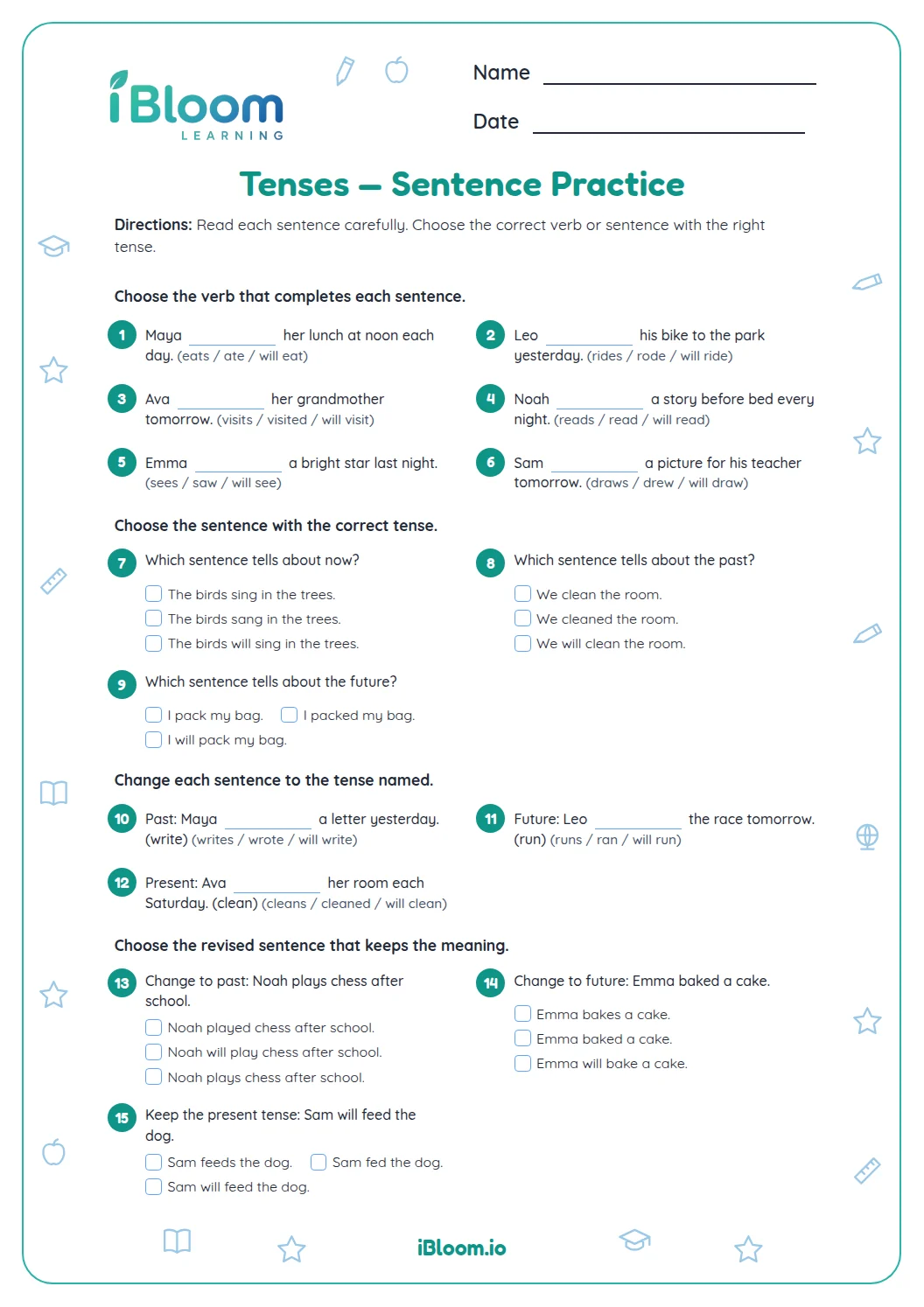

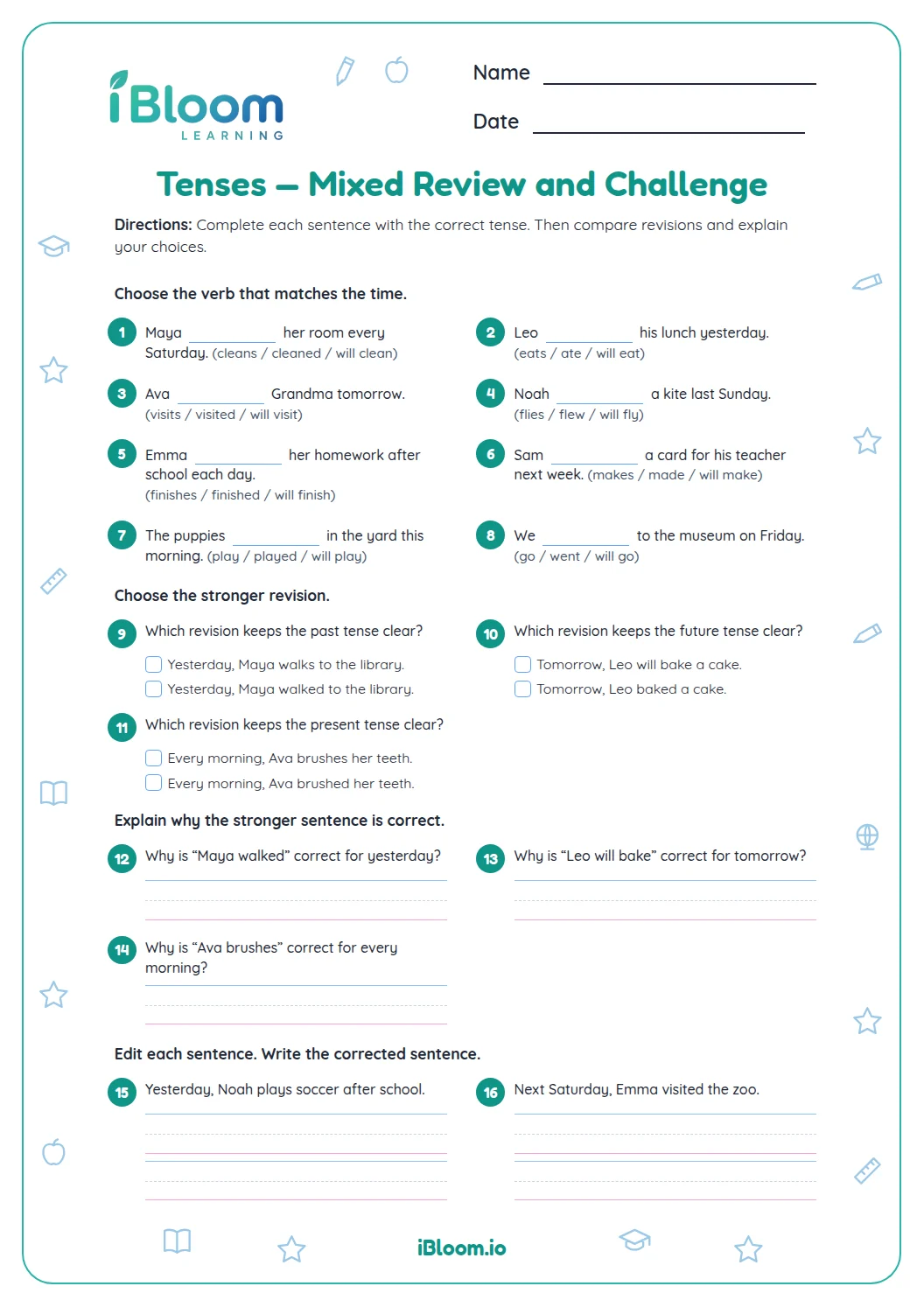


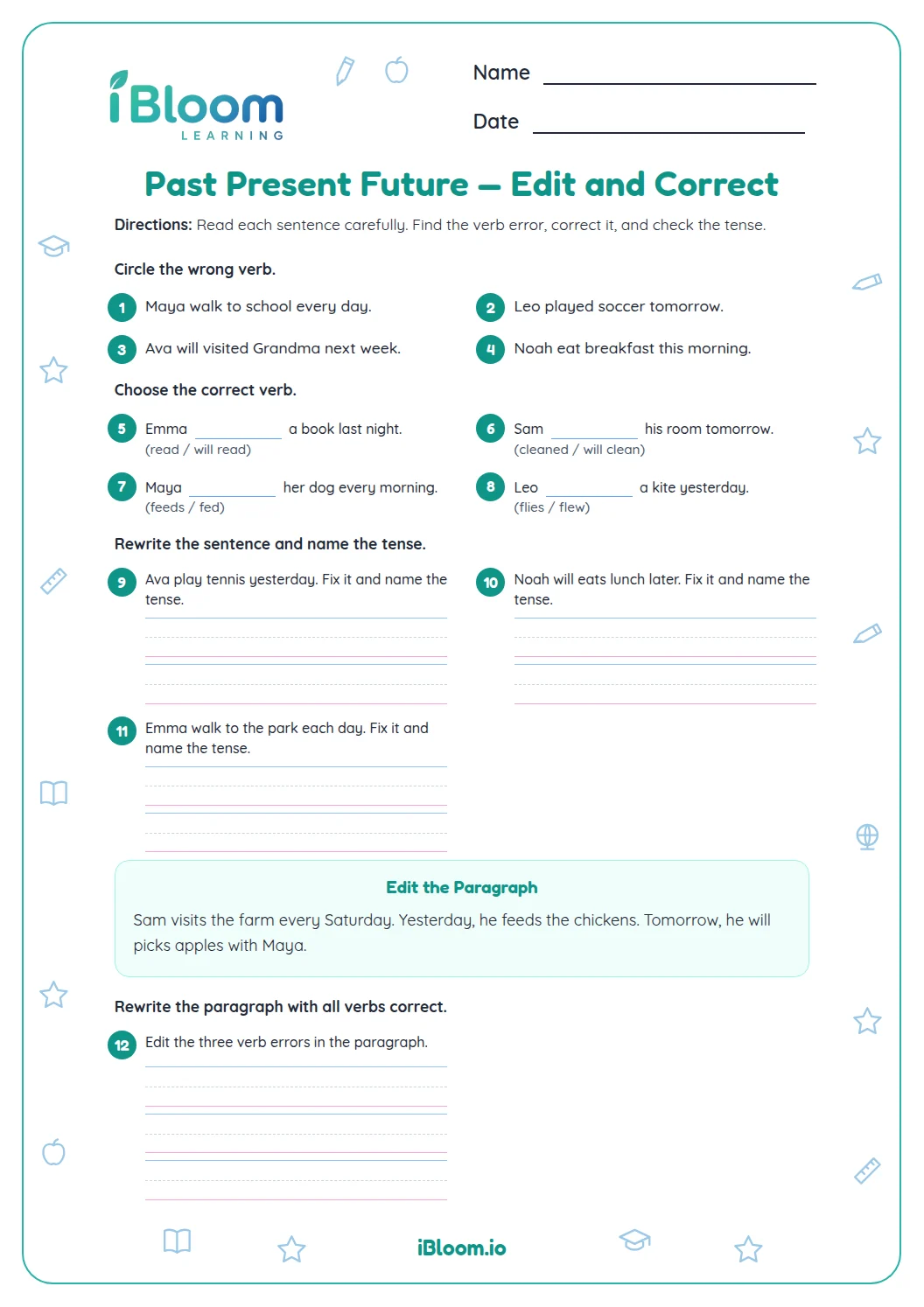


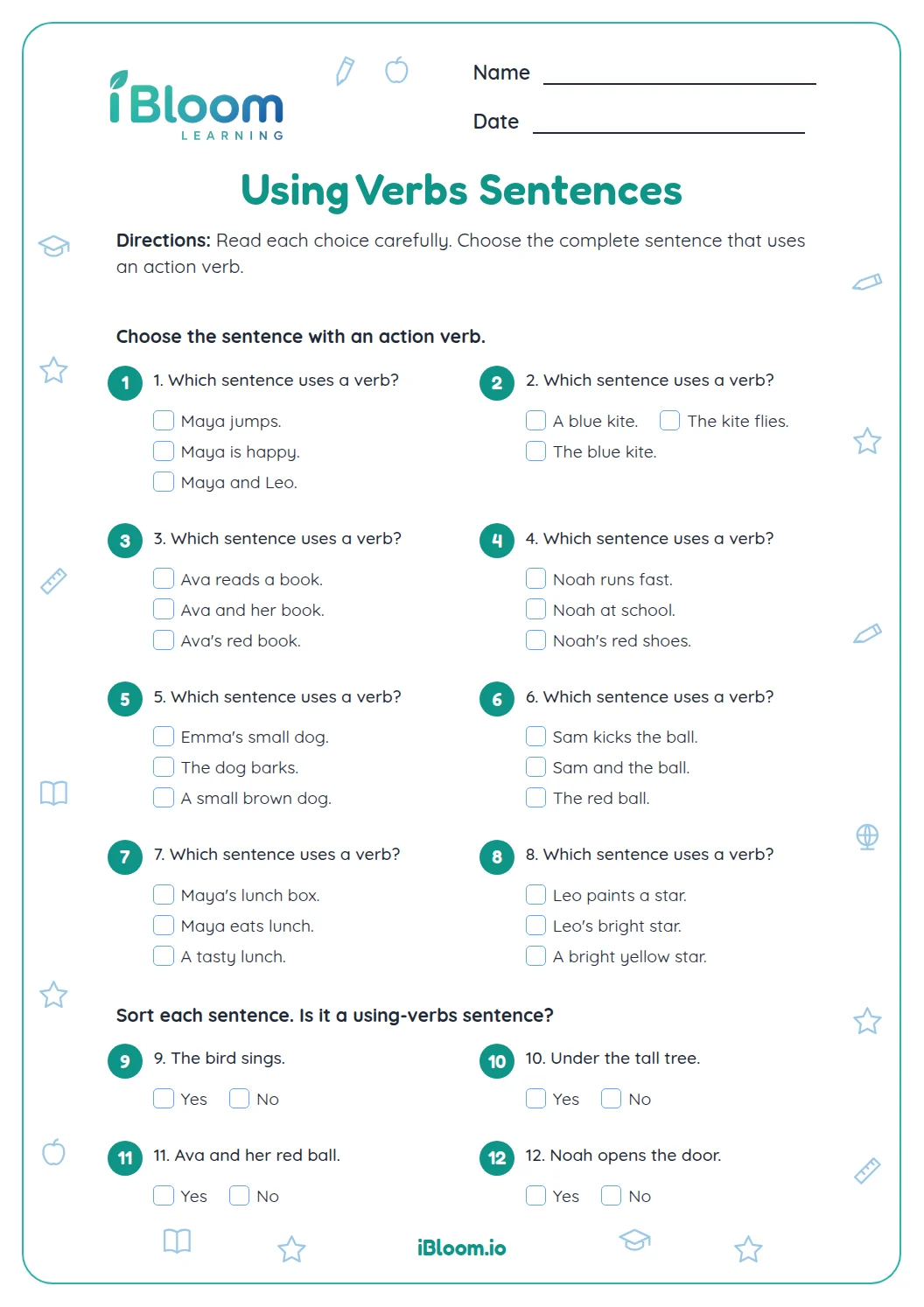
About this worksheet
This Grade 2 worksheet asks students to recognize present, past, and future verbs, then use common irregular past forms in sentences. Time clues support the tense choices, while the final items apply verb forms in context. The irregular past-tense practice supports CCSS L.2.1.d.
Aligned to L.2.1.d
How does a verb show when an action happens?
Verb tense tells whether an action happens now, happened before, or is expected later. Time words can help: “yesterday” points to the past, while “will” signals a future action.
- 1“Mia plays soccer after school.” → Present tense
- 2“Leo visited yesterday.” → Past tense
Why do some past-tense verbs change?
Some common past verbs do not add -ed. “Sit” becomes “sat,” “tell” becomes “told,” and “go” becomes “went.” Students choose irregular forms in Part B.
How can you check a verb in a sentence?
Read the whole sentence for a time clue, then check that the verb form fits. “Tomorrow, Dad will catch the train” uses will with the base verb catch.
How to use this worksheet
- 1Read the whole sentence, including its time clue.
- 2In Part A, name the tense of the verb.
- 3In Part B, choose the irregular past form that completes the sentence.
- 4In Part C, fit the verb form to the time clue.
- 5Read the completed sentence once more.
Common mistakes and quick fixes
The mistake
Using the present form after “yesterday”
The fix
The time clue points to an action already finished. Choose the past form, such as wore or went.
The mistake
Using “will” with a past verb
The fix
After will, use the base verb: “will wear,” not “will wore.”
The mistake
Choosing a verb from the wrong sentence part
The fix
Read the full sentence and identify which action is happening before selecting its tense.
Common Core alignment
This worksheet gives students focused practice with a grade-level skill.
Form and use past-tense forms of common irregular verbs.
On this sheet: Form and use past-tense forms of common irregular verbs.
Show the official wordingHide the official wording
Form and use the past tense of frequently occurring irregular verbs (e.g., sat, hid, told).
What to practice next
Make more practice
Further reading
Questions parents and teachers ask
What are the three tenses in Part A?
Present tense describes an action happening now or regularly, past tense describes an action that already happened, and future tense describes an action that will happen later. The questions include time clues such as yesterday and tomorrow. The word “plays” shows a present action that happens regularly, even though it may not be happening at this exact moment.
Why is “went” different from “goed”?
Go is an irregular verb, so its past form is went rather than a form made by adding -ed. Part B practices other common irregular forms, including sat, hid, told, saw, and came. Learning the changed form as a pair—go/went—helps students use it in a sentence about the past.
Why does “will” use the base verb?
In a future verb phrase, will comes before the base form of the verb: “will catch” or “will visit.” The verb does not change to its past form after will.This pattern also helps distinguish “will catch” from “caught,” which describes a completed action.
What does L.2.1.d mean for this worksheet?
The standard asks students to form and use past tense forms of frequently occurring irregular verbs. The worksheet includes sentence choices and completion practice with familiar verbs such as sat and told. The practice asks students to use those forms in context rather than memorize an isolated list.
How can I help check a tense answer?
Ask the student to find the verb and the time clue, then read the sentence with the chosen form. “Yesterday” points to the past, while “tomorrow” and will signal a future action. Then ask the student to explain how that clue helped them choose the verb.