





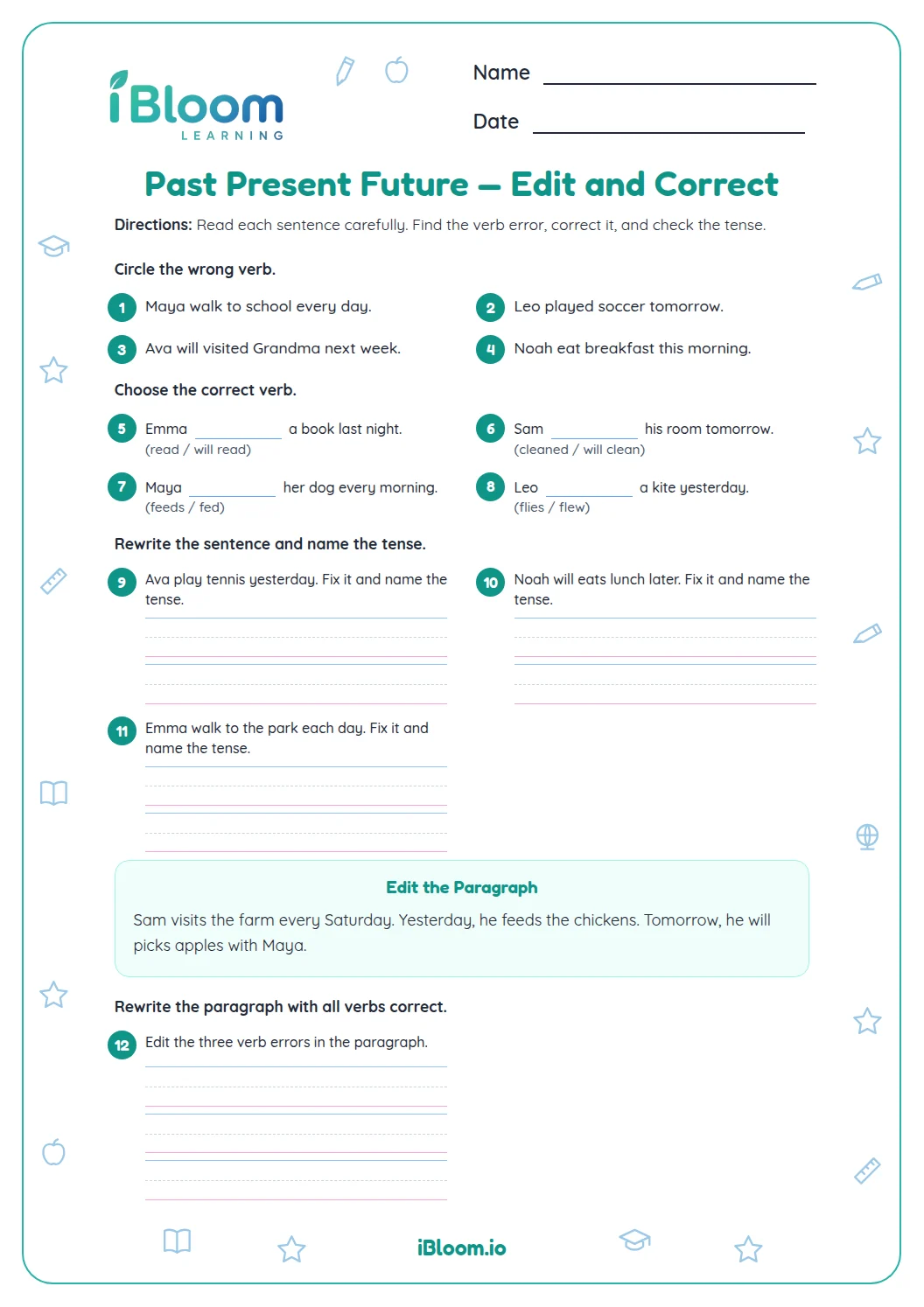
About this worksheet
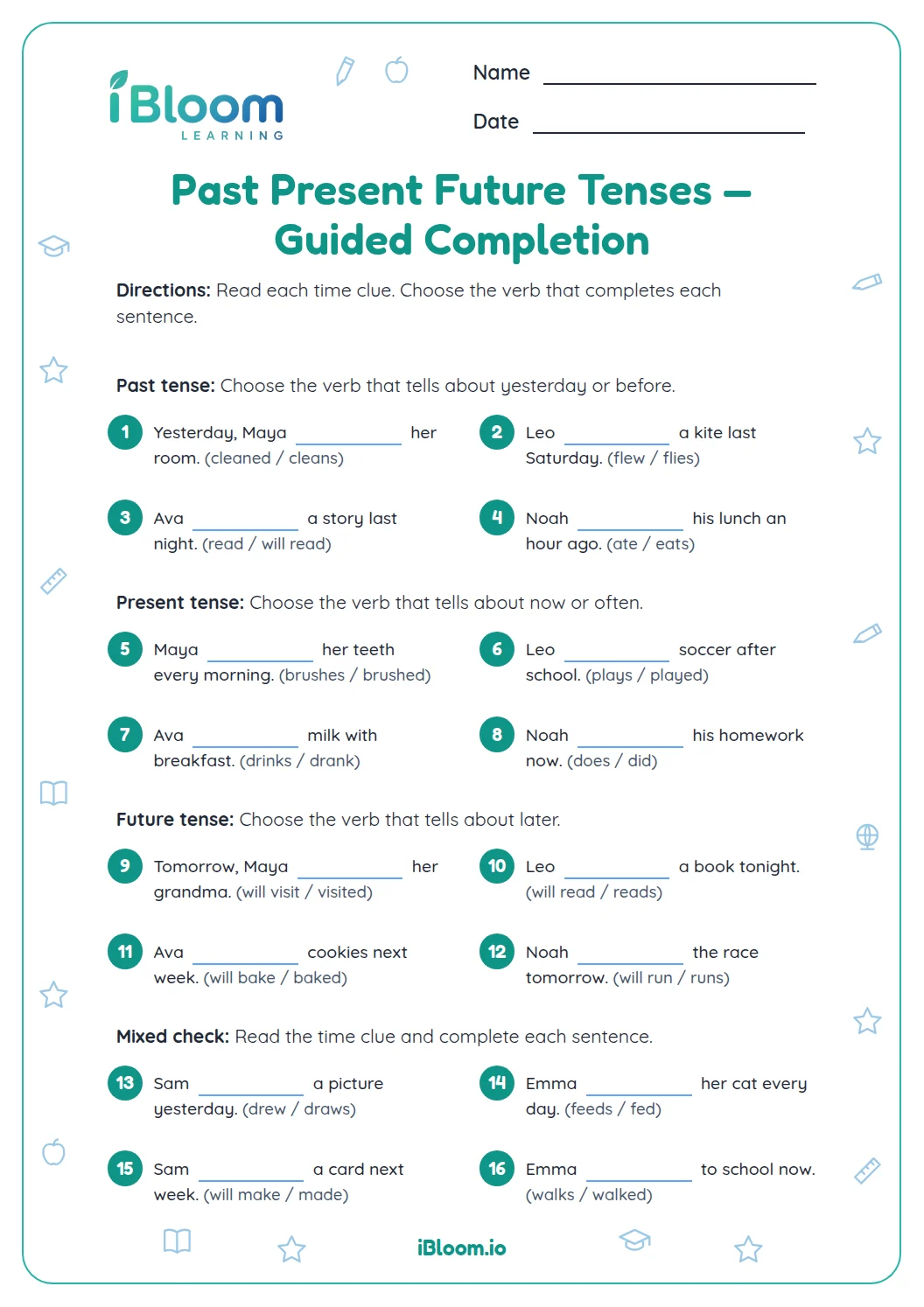
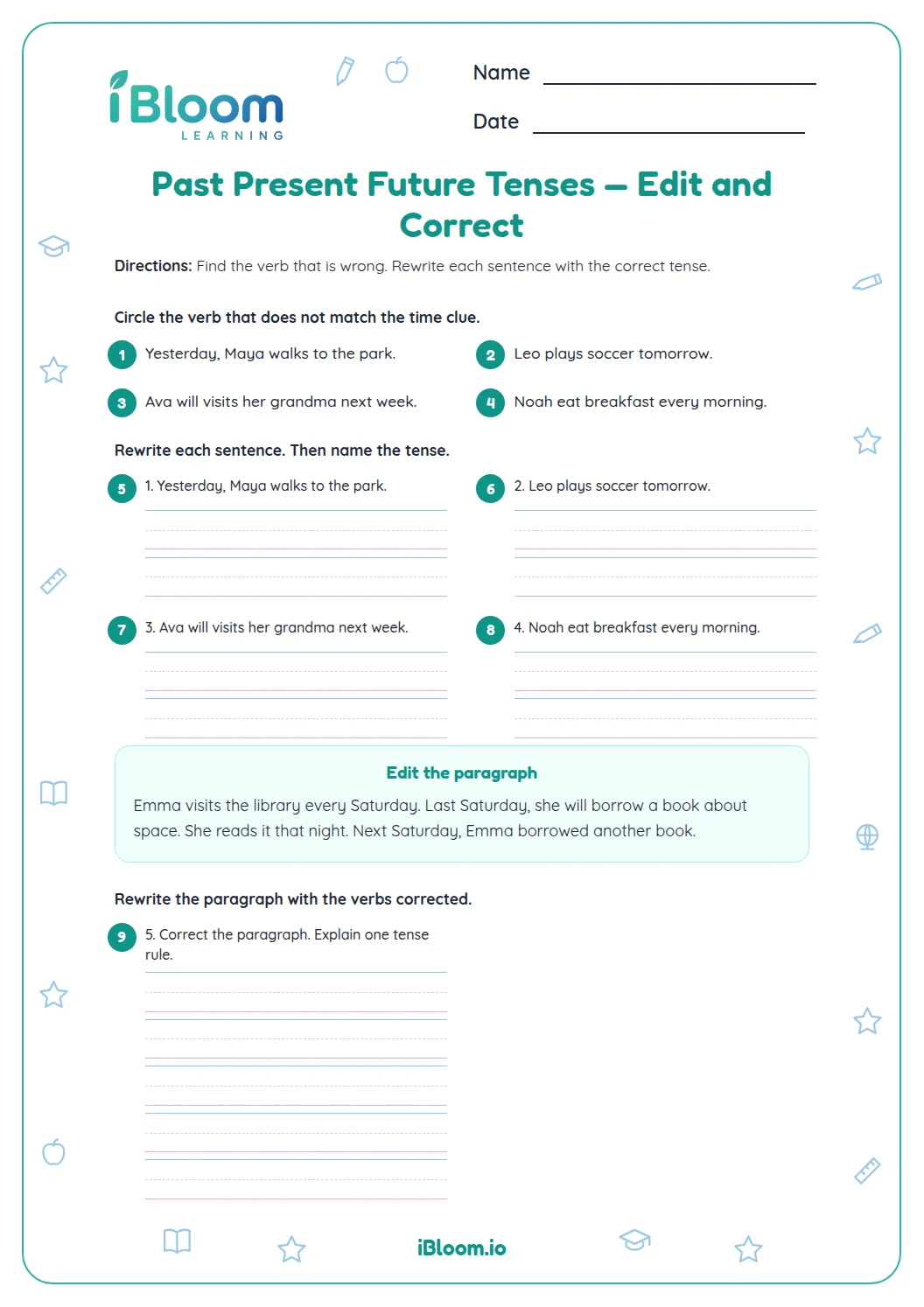
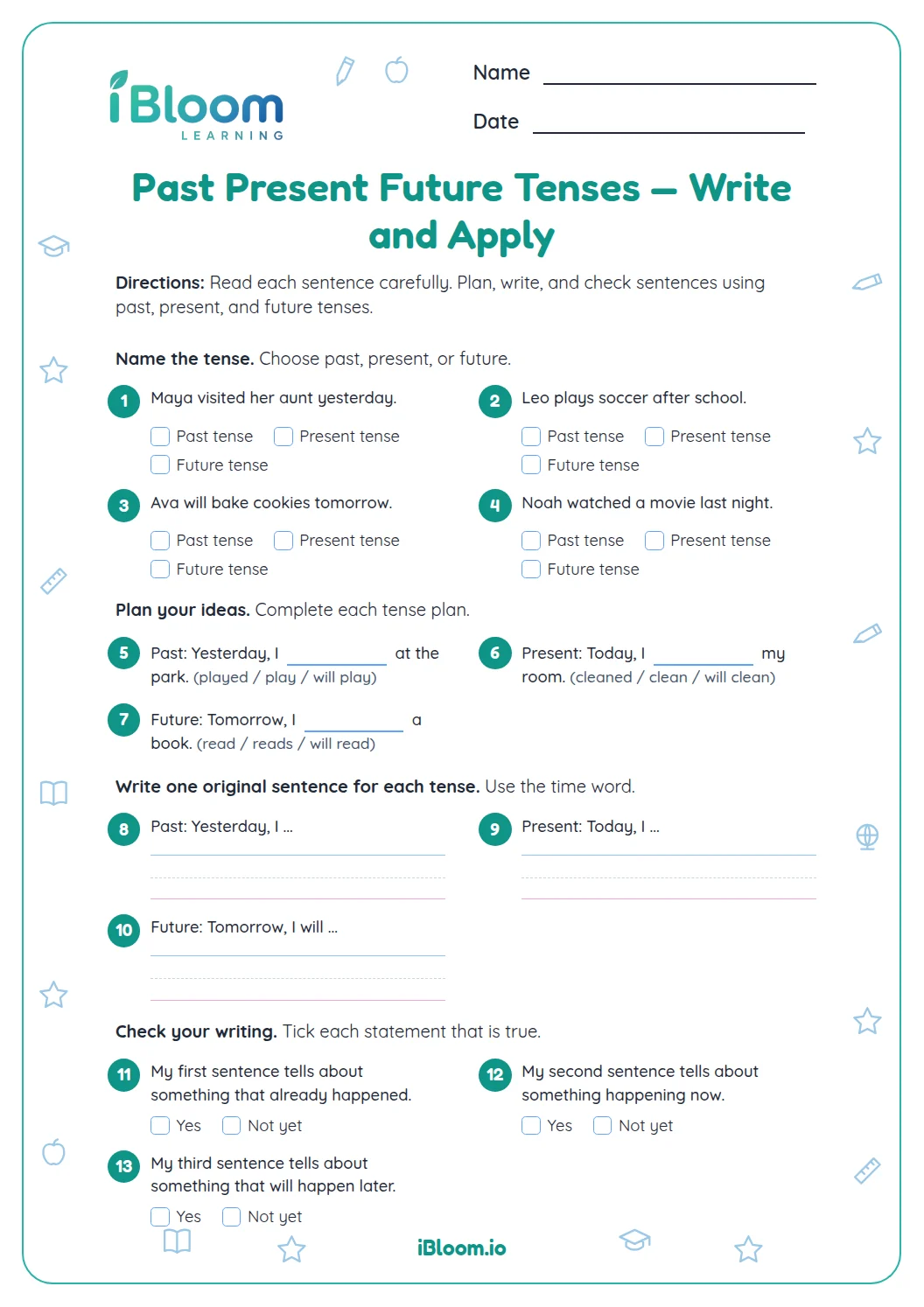
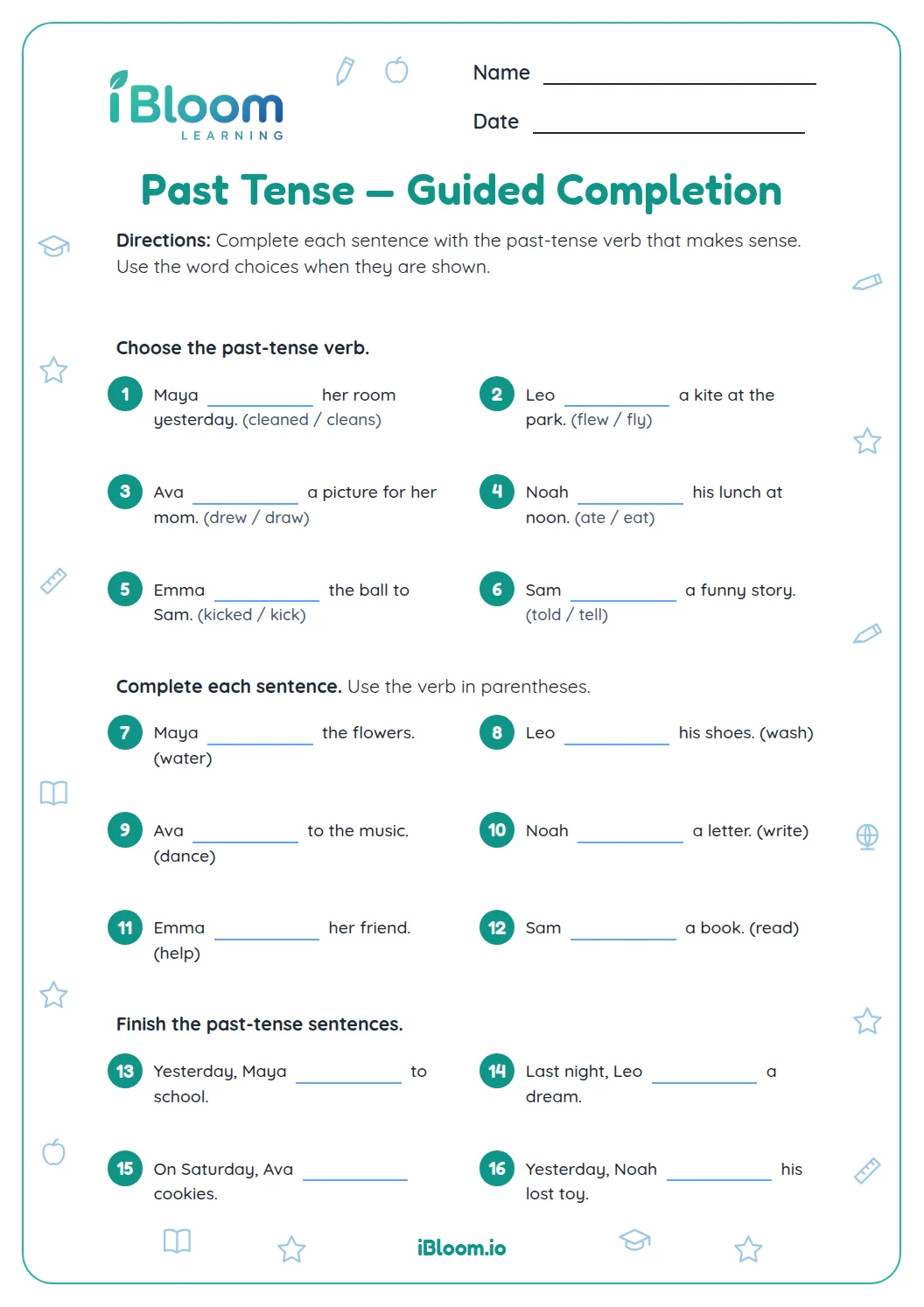
This Grade 2 printable reviews past, present, and future verbs through sentence completions, sentence choices, and two rewrites. Learners use time clues such as “yesterday,” “each day,” and “tomorrow” to select a matching verb form. Part A includes common irregular past-tense verbs such as flew and ate, connecting the practice to CCSS L.2.1.d. A separate key provides model responses for the rewrite items.
Aligned to L.2.1.d
How does the worksheet build tense practice?
Part A asks children to complete seven sentences using a verb and a clear time clue. Part B asks them to compare complete sentences, and Part C asks them to shift a sentence to yesterday or tomorrow.
- 1Yesterday, Maya ___ her room. (clean) → cleaned
Which clues help identify the time?
Words such as “last Saturday” point to the past, “every day” signals a repeated present action, and “next Friday” points to the future. Read the whole sentence before choosing a form.
How can an adult support practice?
Ask the learner to point to the time clue, then read the completed sentence aloud. For a rewrite, check that both the time word and verb changed to match.
How to use this worksheet
- 1Read each sentence through before filling its blank.
- 2Underline the word that tells when the action happens.
- 3Check whether the verb needs a past, present, or future form.
- 4For Part B, read every choice before selecting one.
- 5In Part C, change the verb and time phrase together.
Verb tense slips to watch for
The mistake
Using “will” with a yesterday clue.
The fix
Match “yesterday” with a past-tense verb, as in “flew.”
The mistake
Leaving an irregular verb unchanged, such as “eat” after “last night.”
The fix
Say the past form aloud: “We ate dinner.”
The mistake
Changing the verb but leaving the old time word.
The fix
Reread the whole rewritten sentence and make both parts agree.
Common Core alignment
This worksheet gives focused practice with common irregular past-tense verbs.
Part A practices forming common irregular past-tense verbs in complete sentences.
On this sheet:
Show the official wordingHide the official wording
Form and use the past tense of frequently occurring irregular verbs (e.g., sat, hid, told).
What to practice next
Make more practice
Further reading
Questions parents and teachers ask
What does the worksheet ask children to do?
Children complete seven sentences with the correct verb form, choose five sentences that match a time clue, and rewrite two sentences for a new time. The prompts use familiar actions such as packing lunch, visiting a relative, and playing a game.
Which irregular verbs appear in the practice?
Part A includes “flew” and “ate” alongside regular past-tense and present or future forms. These examples let children compare how a verb changes while using the time phrase in the sentence to guide their choice. Ask the learner to explain the clue before checking the answer.
How should a learner use the answer key?
Finish a part before checking the key. For the last two questions, compare the sample sentence with the learner’s version: the wording can differ, but the verb and time phrase should both describe the requested time. For example, a tomorrow rewrite needs “will” and a future time phrase.
Can I use this worksheet in a short lesson?
Yes. The three parts can be completed in order during a focused practice session. An adult can read a direction aloud, then ask the child to find the time clue and choose or write the verb form independently.
How long should the worksheet take?
Plan for about 15 minutes, depending on how much discussion the rewrites need. A learner can pause after Part A to check the verb forms, then continue with the sentence choices and written changes. Allow extra time to read each sentence aloud and explain a time clue. Plan a calm review together.