



About this worksheet
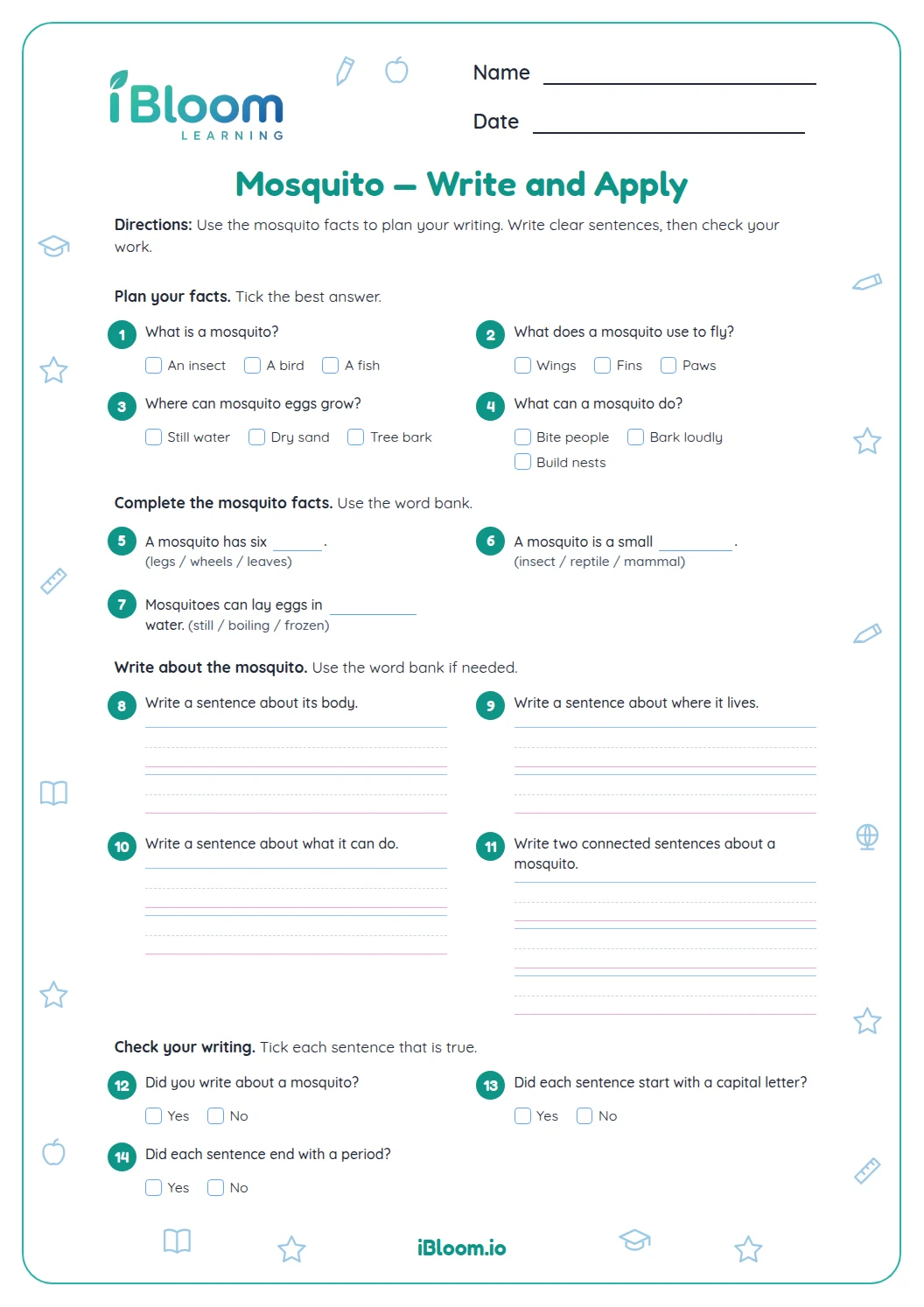
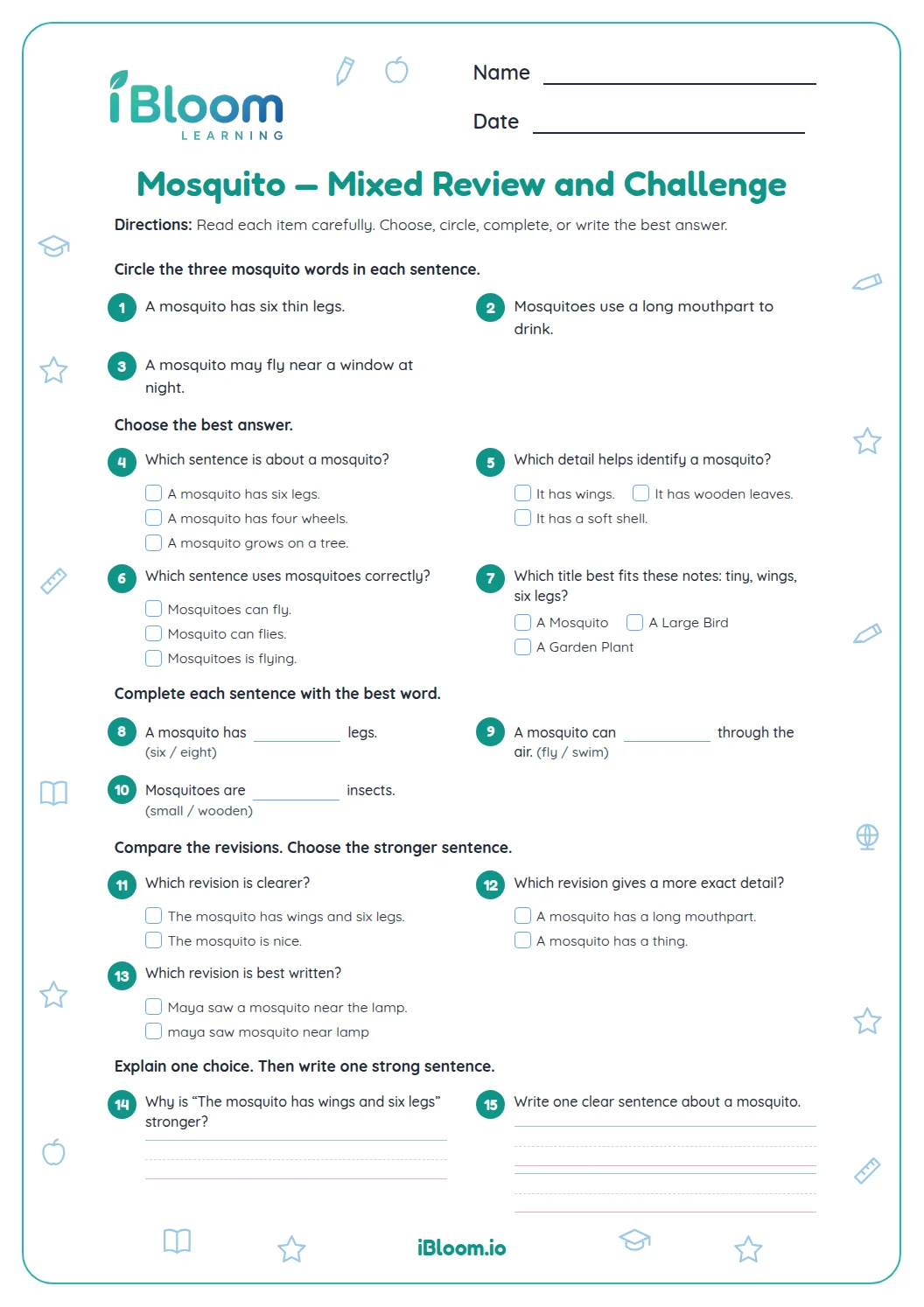
This free printable worksheet is for Grade 2 learners practicing mosquito writing. It includes 14 questions in 2 parts, with an answer key. Children complete mosquito-themed sentence frames using choices and their own ideas.
Aligned to W.2.8
What is on this mosquito page?
Children complete short sentences about a mosquito, draw details from the prompt, then write two brief ideas of their own. The key offers models while allowing sensible original responses.
The worksheet has 14 questions; the answer key follows the practice pages.
- Part A: complete 12 mosquito-themed sentences using choices
- Part B: write two original sentence completions
- Separate answer key with sample responses included.
How should a child approach the questions?
This page practices completing sentences and adding details to short mosquito-themed writing. Children choose words that make a sentence clear, draw details from prompts, and finish two ideas with their own responses. An adult can point to the clue with the child before choosing an answer.
Encourage the child to reread each completed sentence from the beginning. If it sounds complete and matches the mosquito topic, the chosen word or original ending is likely doing its job. An adult can point to the clue with the child before choosing an answer.
- 1A mosquito has two ___.
- 2Key answer: wings
How can an adult support this practice?
Encourage the child to reread each completed sentence from the beginning. If it sounds complete and matches the mosquito topic, the chosen word or original ending is likely doing its job. An adult can point to the clue with the child before choosing an answer.
Use the separate answer key to check the selected words and compare open responses with the model. A drawing can look different from the key as long as it includes the details named in the prompt. An adult can point to the clue with the child before choosing an answer.
How to use this worksheet
- 1Read the direction at the start of each part.
- 2Answer each question using its wording and choices.
- 3Reread the completed response to check that it fits.
- 4Use the answer key to check the work and discuss an answer that needs another look.
Common mistakes and quick fixes
The mistake
Answering before reading the whole prompt.
The fix
Read the complete sentence or situation, then choose a response that fits.
The mistake
Confusing a word or digit with its role in the question.
The fix
Check the clue named in the prompt before answering.
The mistake
Skipping a final check.
The fix
Reread the response and compare it with the answer key.
Curriculum alignment
Children use the prompt and their own observation to add relevant details to short mosquito writing.
On this sheet: Children use the prompt and their own observation to add relevant details to short mosquito writing.
Show the official wordingHide the official wording
Recall information from experiences or gather information from provided sources to answer a question.
What to practice next
Make more practice
Further reading
Questions parents and teachers ask
What writing practice is on this page?
Children complete 12 short sentences using word choices, then finish two sentence frames with their own ideas about mosquitoes. The prompts practice choosing details that make a sentence clear and connected to its topic. Look for the object that blocks sunlight in the prompt.
How many questions are included?
There are 14 items in two parts. Part A contains 12 sentence completions with choices, and Part B contains two open sentence frames for the child to finish. Ask the child to name the shaded place as well.
How should I check the open responses?
The key gives sample endings, not the only acceptable wording. Accept another response when it forms a clear sentence, fits the prompt, and makes sense; the child’s drawing or observation may differ from the sample. The key follows the same order as the questions.
Can a child work independently?
A child who can read the choices may complete many items independently. An adult can read a sentence aloud, help spell a word, or invite the child to reread the whole sentence after filling its blank. A read-aloud can make each choice easier to understand.
What can help a child write a clear ending?
Have the child say the whole sentence aloud after adding an ending. Check that the words finish the thought and stay connected to the mosquito topic; then add a detail from something the child has noticed or learned. This turns the idea of shade into a visible cause and effect.
What can we practice next?
Try another draw-and-write prompt from the same collection after this page. The related prompts give children a new topic to observe, talk about, and develop into a complete written idea. Connect each answer to the place it protects from direct sun.