





About this worksheet
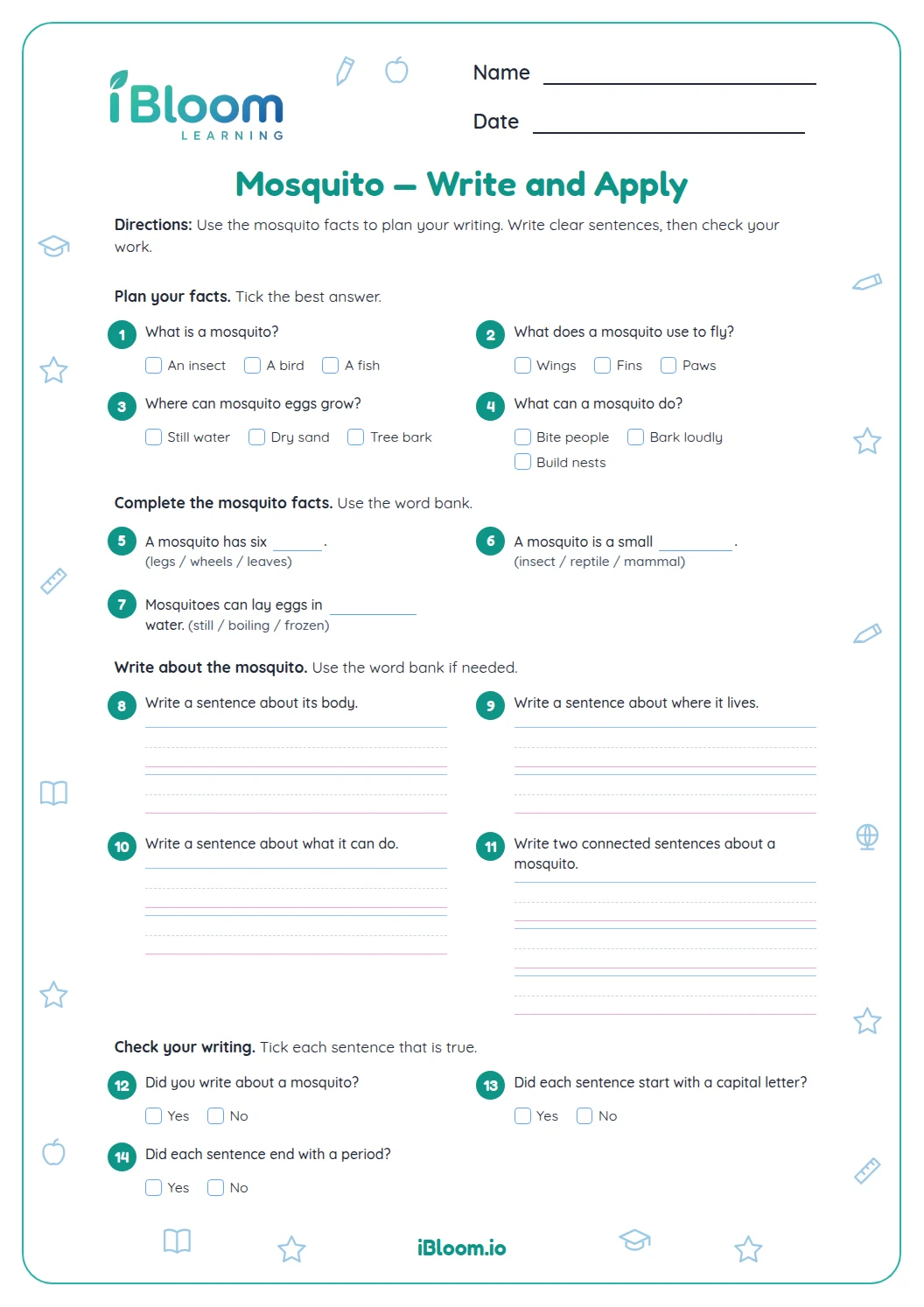
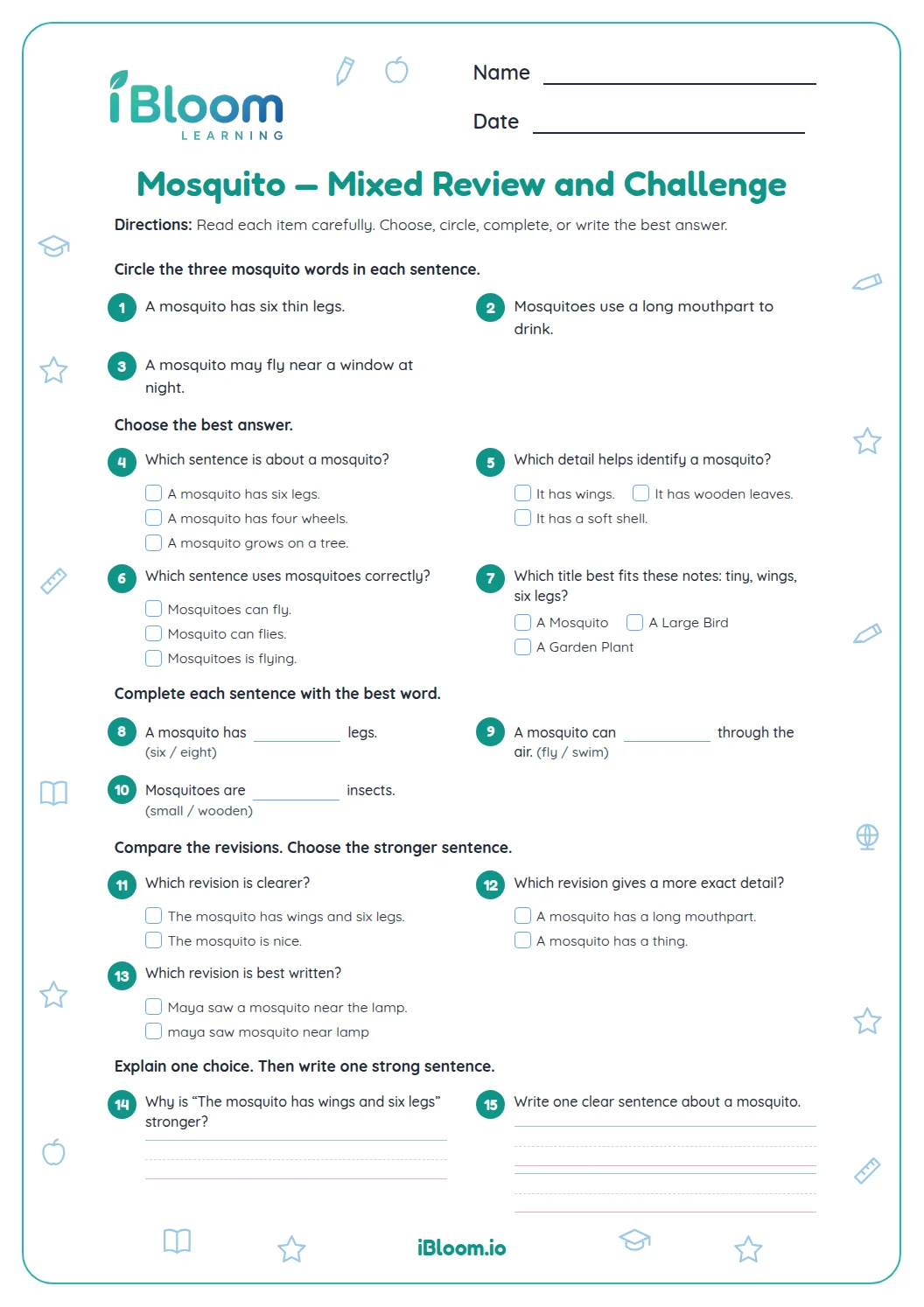
This free Grade 2 printable uses a mosquito theme to practice making complete sentences. Children choose a whole thought instead of a fragment, add a capital letter or ending mark, expand a sentence with a detail, and combine two ideas. The sentence work aligns with CCSS L.2.1f, producing, expanding, and rearranging complete sentences; the editing practice also supports L.2.2 conventions.
Aligned to L.2.1f and L.2.2
What does this mosquito worksheet practice?
The three parts move from recognizing complete thoughts to writing them. Part A contrasts complete sentences with fragments. Part B supplies a missing capital letter or ending mark. Part C asks children to add a detail and combine ideas into a sentence.
- Part A: choose 6 complete sentences
- Part B: fill 6 missing capitals or punctuation marks
- Part C: expand and combine ideas in 2 written responses
How can you tell if a sentence is complete?
Look for who or what the sentence is about and what that person, animal, or thing does or is. Then read the words aloud. “The mosquito flew past the lamp” tells a whole thought; “The mosquito with six legs” names something but does not tell what it did.
How do you make a sentence more interesting?
Keep the complete thought, then add a detail that answers where, when, or what kind. In the second Part C response, combine two related ideas into one sentence with a subject and verb.
- 1Start: The mosquito flew.
- 2Ask where or what kind?
- 3Expanded: The tiny mosquito flew over the pond.
Which capital and ending mark should you use?
Begin a sentence with a capital letter. Use a period for a statement, a question mark when asking, and an exclamation mark for a strong warning or feeling. Read the words to hear what kind of sentence they make.
How to use this worksheet
- 1Read each Part A choice aloud and listen for a whole thought.
- 2For Part B, decide whether the missing mark belongs at the beginning or end.
- 3In Part C, say the sentence first, then add one detail or connect the ideas.
- 4Check that each written sentence starts with a capital and ends with suitable punctuation.
- 5Review the answer key; accept other clear, complete sentences for the open responses.
Common sentence slips and quick fixes
The mistake
Choosing “The mosquito with six legs” as a complete sentence.
The fix
Ask what the mosquito did. Add a verb to complete the thought, such as “The mosquito with six legs flew away.”
The mistake
Leaving a lowercase first letter after a period.
The fix
Point to the start of each sentence and check that its first word begins with a capital.
The mistake
Using a period after a question.
The fix
Read the sentence aloud. If it asks for information, end it with a question mark.
Common Core alignment
This worksheet practices Grade 2 sentence building and written conventions.
Produce and expand complete sentences in the mosquito-themed writing prompts.
On this sheet: Parts A and C identify, expand, and produce complete sentences by combining related ideas.
Show the official wordingHide the official wording
Produce, expand, and rearrange complete simple and compound sentences (e.g., The boy watched the movie; The little boy watched the movie; The action movie was watched by the little boy).
Add capitals and end punctuation when completing short sentences.
On this sheet: Part B fills in beginning capitals and sentence-ending punctuation.
Show the official wordingHide the official wording
Demonstrate command of the conventions of standard English capitalization, punctuation, and spelling when writing.
What to practice next
Make more practice
Further reading
Questions parents and teachers ask
What makes a sentence complete?
A complete sentence tells a whole idea, usually naming who or what and telling what that subject does or is. “The mosquito flew” is complete. “The mosquito with six legs” is a fragment because it does not say what the mosquito did.
What grade is this mosquito sentence worksheet for?
It is written for Grade 2. Children choose complete thoughts, supply capitals and ending marks, and write their own expanded sentences. The questions use familiar words and a mosquito theme so the grammar practice stays focused on sentence meaning.
Does every written response have only one right answer?
No. The answer key gives sample responses for the two open writing prompts. A different answer is correct when it follows the prompt and forms a clear, complete sentence with suitable capitalization and punctuation. The key models each task.
How should a child expand “The mosquito flew”?
Keep the original idea and add a detail that helps a reader picture it. For example, “The tiny mosquito flew over the pond” adds what kind and where. Part C practices adding details and combining two related ideas into one sentence.
Why does the worksheet ask for capitals and punctuation?
A capital letter shows where a sentence begins, and the ending mark helps a reader hear whether it states, asks, or exclaims something. Part B asks children to choose a missing capital or mark, then the answer key shows each one.
How long does it take, and is there an answer key?
Plan for about 15 minutes for the 14 questions, including time to write full sentences. The printable includes a separate answer key with exact answers for choice and fill-in items plus sample responses for open writing. Read the written answers aloud together.