







About this worksheet
This free Grade 2 worksheet helps children recognize clear, friendly messages and the parts of a short letter. Part A names the greeting, message, closing, and sender. Part B compares friendly writing with unclear examples, then checks commas in greetings and closings. Part C asks children to add missing commas. The separate answer key includes the labels, choices, and corrected lines.
Aligned to L.2.2b
What are the four parts children name?
A greeting addresses the reader, a message shares the main information, a closing signs off politely, and the sender’s name tells who wrote the letter. Part A gives one example of each.
Read the four lines in order to hear a short thank-you letter: Dear Ana, Thank you for the book. Your friend, Maya. On paper, the greeting, closing, and sender’s name each belong on their own line.
What makes a message clear and friendly?
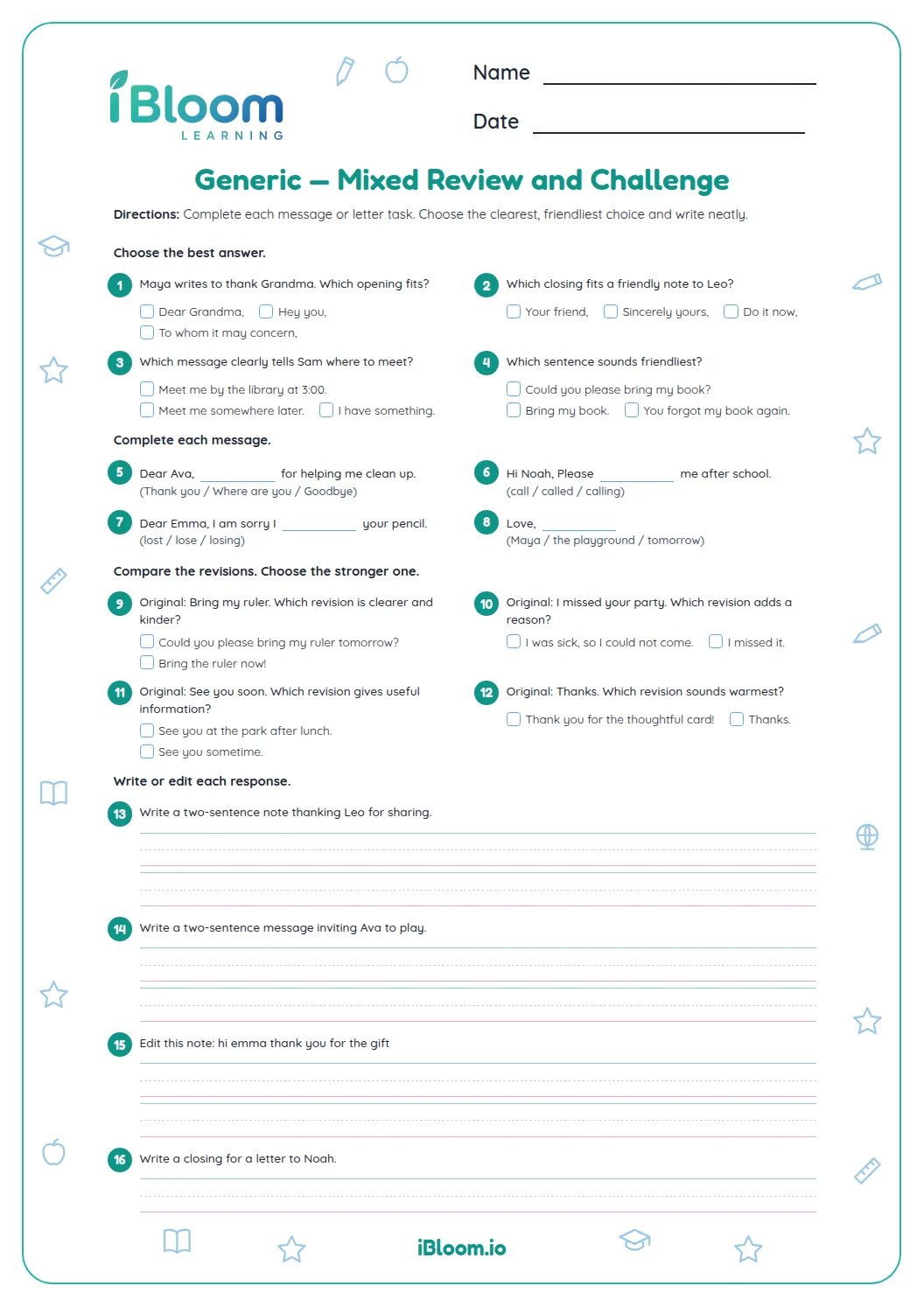
A clear note tells the reader what to do or what the writer means. Friendly words help the message sound kind. Questions 5–8 ask children to choose complete notes and letters, as in the examples on the old worksheet. Questions 9–10 focus on commas after greetings and closings.
- 1Question 5: Choose the clear message to Maya.
- 2“Maya, bring your book” tells the reader what to bring.
- 3Choose the example with a clear action and a specific item.
How do the final six items build on the choices?
Part B first asks children to recognize clear, friendly writing, then compare correctly punctuated greetings and closings. In Part C, they add a comma after each greeting or closing themselves. Each line already has the capitals it needs, so children can focus on the comma.
When checking, name the part before checking its comma. “Your friend” is the closing; the sender’s name would go on the next line.
How to use this worksheet
- 1Read the four Part A lines aloud in order as a short letter.
- 2Explain greeting, message, closing, and sender, then have your child label them.
- 3In Part B, read all three choices and locate each comma.
- 4In Part C, have your child copy the complete line and add its comma.
- 5Check the answers and say whether each corrected line opens or closes a letter.
Mistakes to notice and fix
The mistake
Putting a comma after Dear instead of after the name.
The fix
Treat Dear Ben as one greeting and put the comma at the end.
The mistake
Calling “Your friend,” the sender.
The fix
The closing signs off; Maya is the name of the person sending the letter.
The mistake
Adding a period after a closing.
The fix
Compare the closing with a message sentence: a closing such as Love takes a comma here.
Common Core alignment
Recognize and add commas after letter greetings and closings.
On this sheet: Children select correctly punctuated lines, then rewrite six lines with commas.
Show the official wordingHide the official wording
Use commas in greetings and closings of letters.
What to practice next
Make more practice
Further reading
Questions parents and teachers ask
Does this worksheet ask children to write a whole letter?
Children work with individual letter lines on this sheet. They identify four parts, choose six correctly punctuated examples, and rewrite six greetings or closings. After checking, invite your child to put a greeting, a thank-you message, a closing, and a name together on paper.
What is the difference between a closing and a sender?
A closing is the polite sign-off before the writer’s name. The sender is the person who wrote the letter. In Part A, Your friend is the closing and takes a comma; Maya is the sender. Reading both lines aloud can help children hear how they work together.
Why is Dear, Ben incorrect here?
The comma belongs after the complete greeting: Dear Ben followed by a comma. Putting it after Dear separates the opening word from the reader’s name. Have your child read the greeting as one phrase and point to the place after Ben where the comma belongs.
What should children write in Part C?
Children should copy each entire greeting or closing and add one comma at the end. They rewrite Dear Grandma, Your friend, Dear Sam, Sincerely, Dear Ava, and Yours truly. Check each answer against its own prompt, making sure the comma follows the last word and every original word is present.
How can I check the answers without doing the work for my child?
Ask your child to name the letter part and explain where it ends before showing the key. For a misplaced comma, cover the choices and read the whole greeting aloud. Then reveal the choices again and let your child find the one with the comma at the end.