
About this worksheet
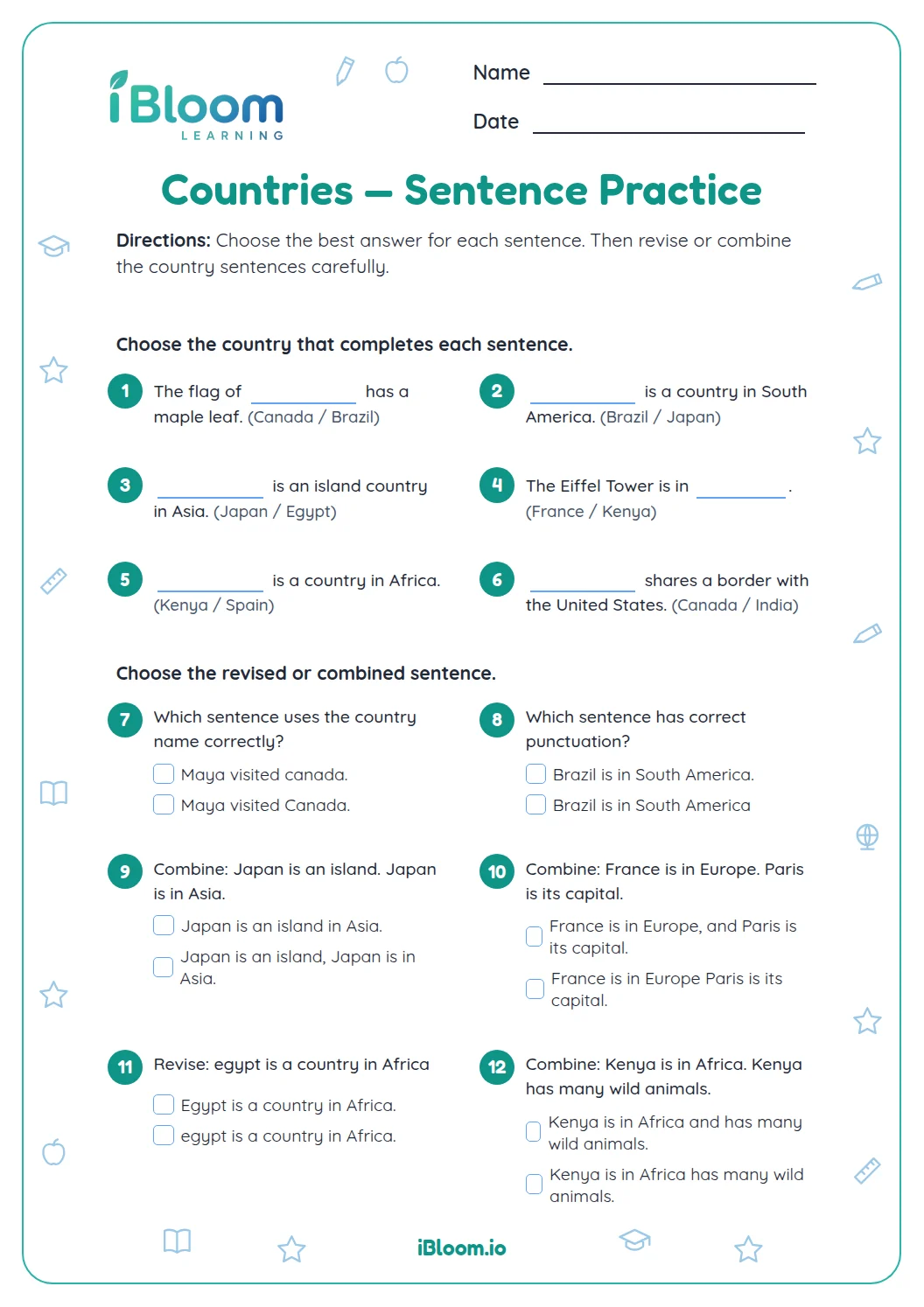
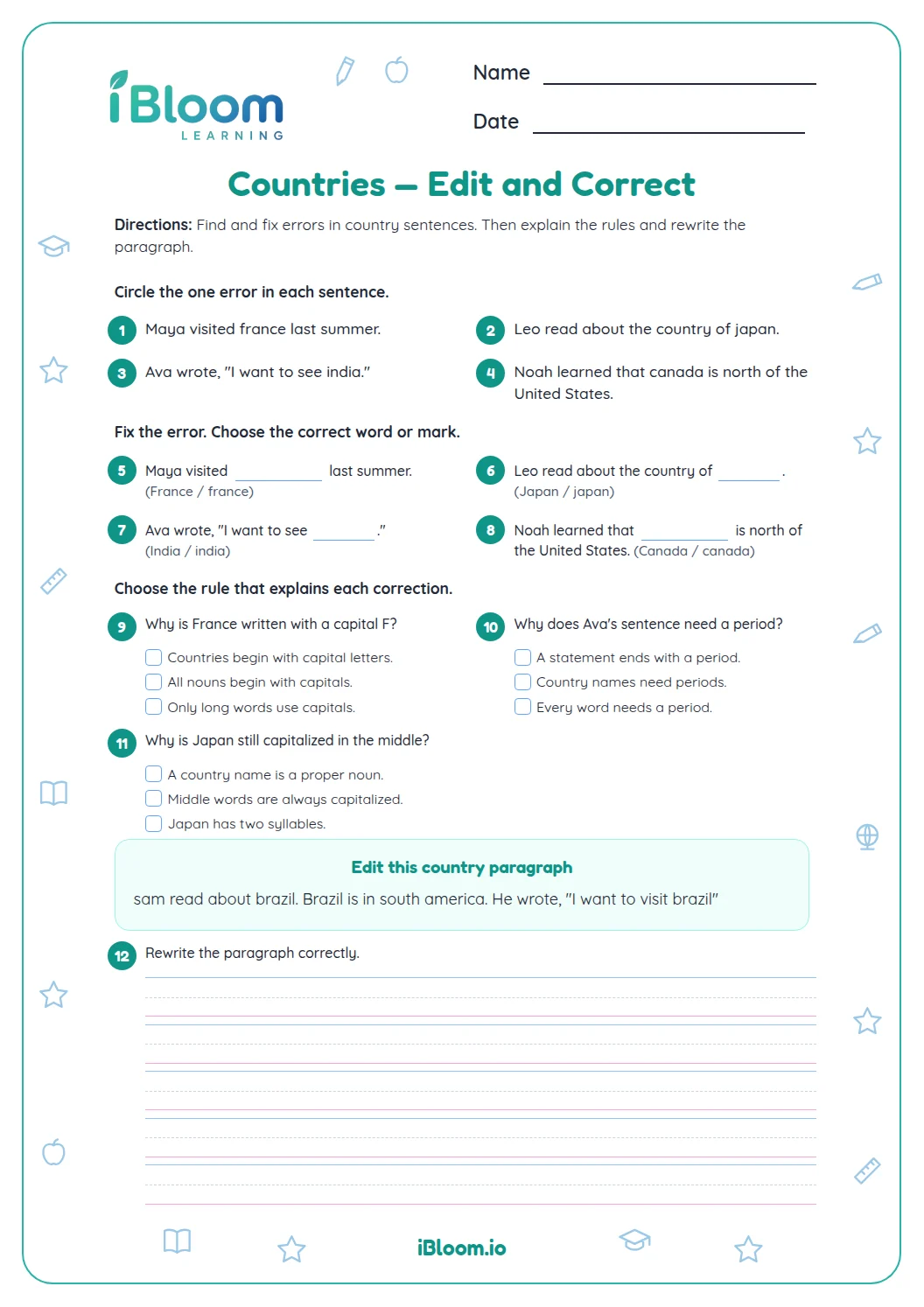
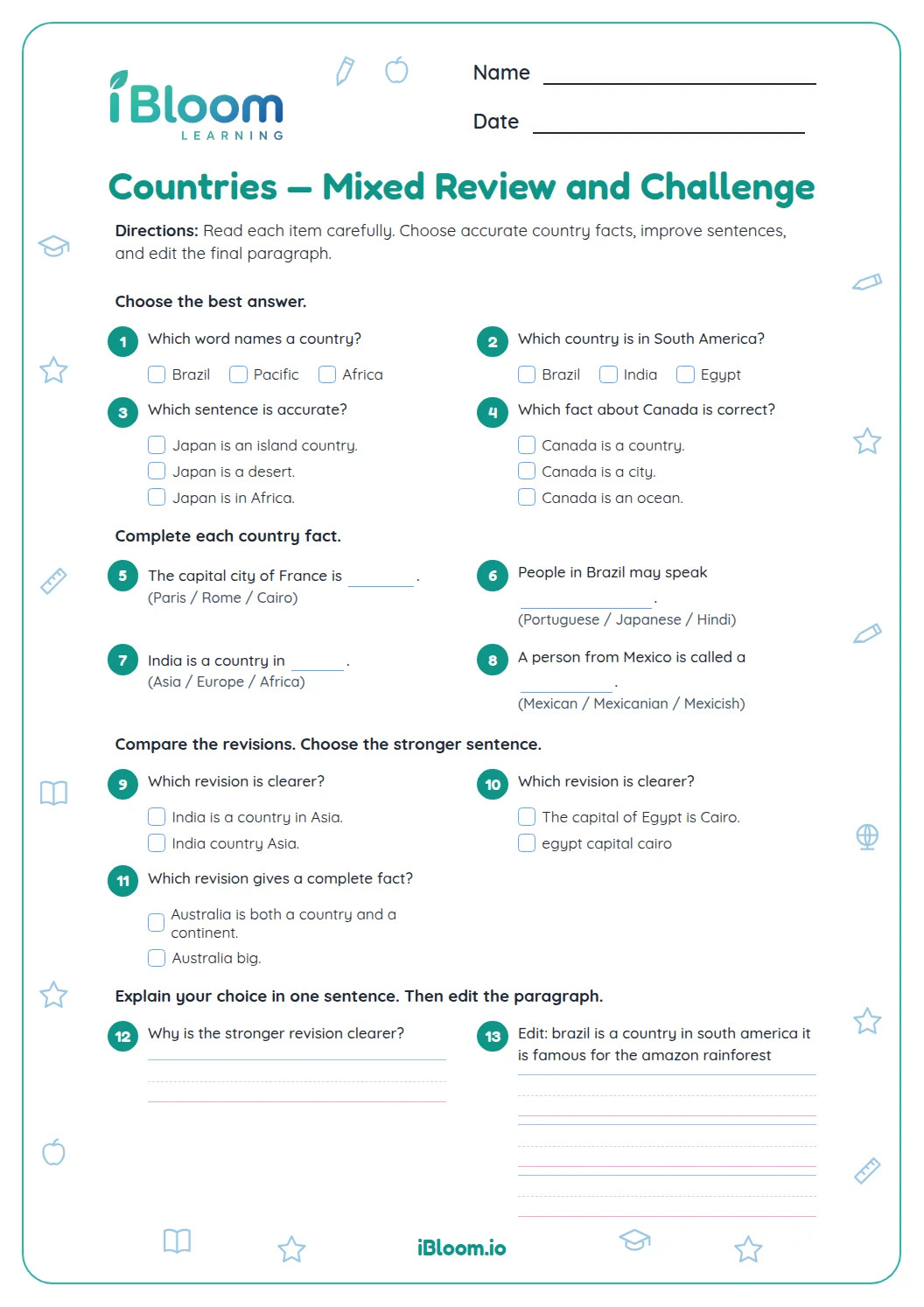
This Grade 2 writing worksheet guides a child through a small country research project. The prompts move from naming a country and locating it to recording facts, citing a source, comparing places, and writing a two-sentence summary from notes. Because children may research different countries, the answer key gives sample responses rather than one required set of facts.
How does the worksheet guide the research?
The first prompts establish the country, continent, capital, and a language. The learner then records a landform or body of water, weather, food, and source.
What kinds of facts should a child find?
Later prompts ask for additional country facts, a question to investigate, and a comparison with the learner’s own country or state. A book or class reference helps keep facts accurate.
How do the notes become a summary?
The final prompt asks for two sentences built from two recorded notes. For example, “Japan is in Asia. Its capital is Tokyo” combines location and capital facts.
- 1Two notes: Japan is in Asia; Tokyo is its capital.
- 2Summary: Japan is in Asia. Its capital is Tokyo.
How to use this worksheet
- 1Choose a country and write its name.
- 2Use a book or class source to locate it and find the capital.
- 3Record short facts in the remaining prompts.
- 4Write down the source you used.
- 5Choose two notes and turn them into a two-sentence summary.
Common mistakes and fixes
The mistake
Copying a fact without understanding it.
The fix
Say the fact in your own words before writing it.
The mistake
Mixing up a country and its capital.
The fix
Check which name labels the country and which names its capital city.
The mistake
Writing a summary that repeats one note.
The fix
Use two different notes so each sentence adds a fact.
What to practice next
Questions parents and teachers ask
Does this worksheet require a particular country?
No. The learner may choose a country and use a book or trusted class source to find its facts. The answer key uses Japan as a sample so families can see the kind of response each prompt invites.
How many prompts are on the research page?
There are 16 prompts. They guide the learner from choosing and locating a country to recording facts, naming a source, making a comparison, and writing a two-sentence summary. The worksheet and answer key each use three pages. The final item asks the child to combine two of those notes in a short written summary.
What should a Grade 2 child write in the summary?
The final prompt asks for two sentences based on two of the facts collected earlier. For example, a child might write that Japan is in Asia and that Tokyo is its capital. The sentences should use the learner’s own research notes.
Why does the answer key say “Sample”?
Countries and research choices vary, so many answers will differ from the example. The key models possible facts about Japan; a child’s response should be checked against the source used and should answer the prompt. Use a source that matches the selected country, and accept a different accurate fact when it addresses the same prompt.
What sources can children use?
A classroom reference book, children’s encyclopedia, atlas, or a source selected by a teacher or parent can help. An adult can help the child confirm spellings and distinguish a country’s capital from other important cities. The worksheet asks children to name their source so the facts can be checked and revisited.