
About this worksheet
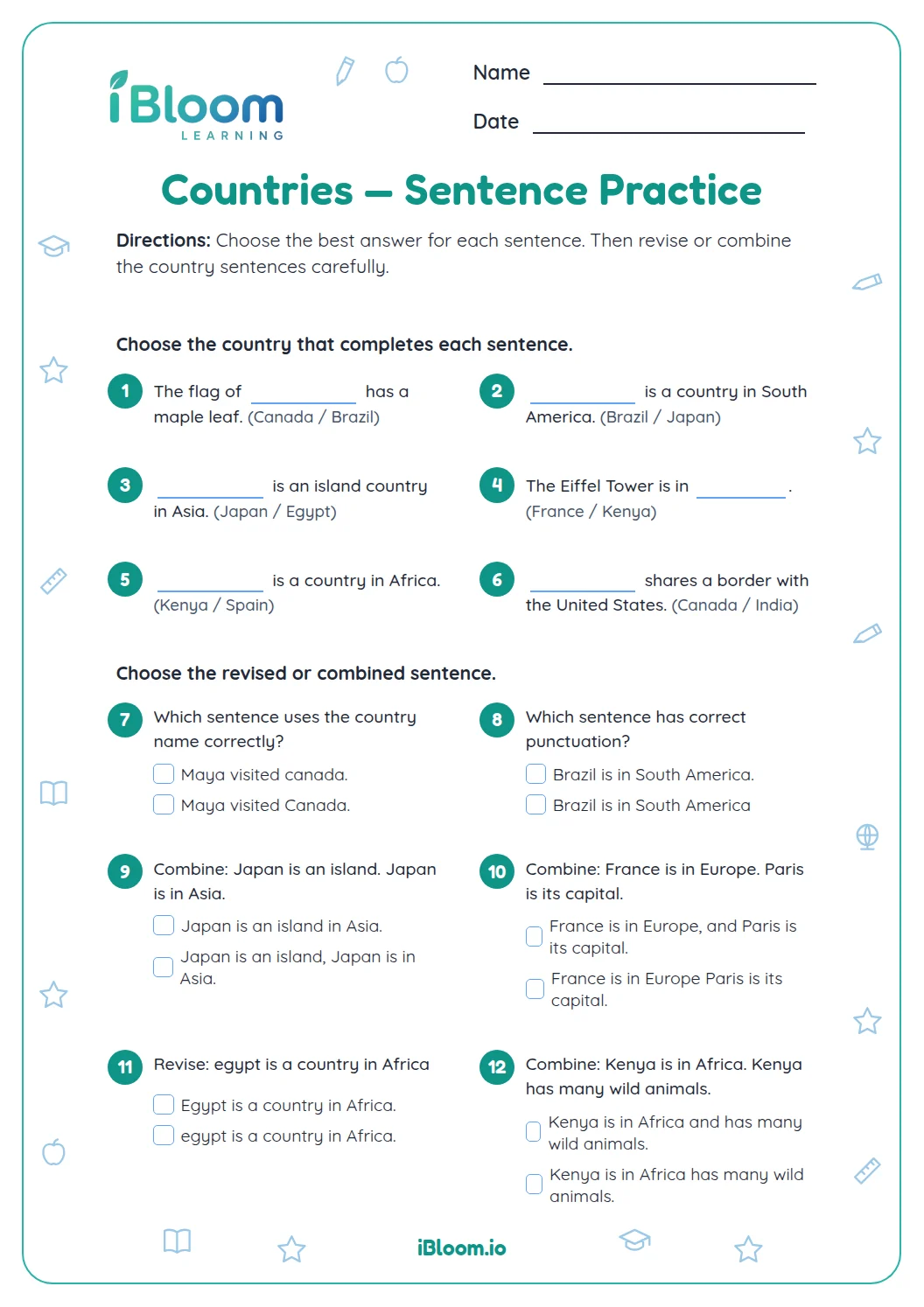
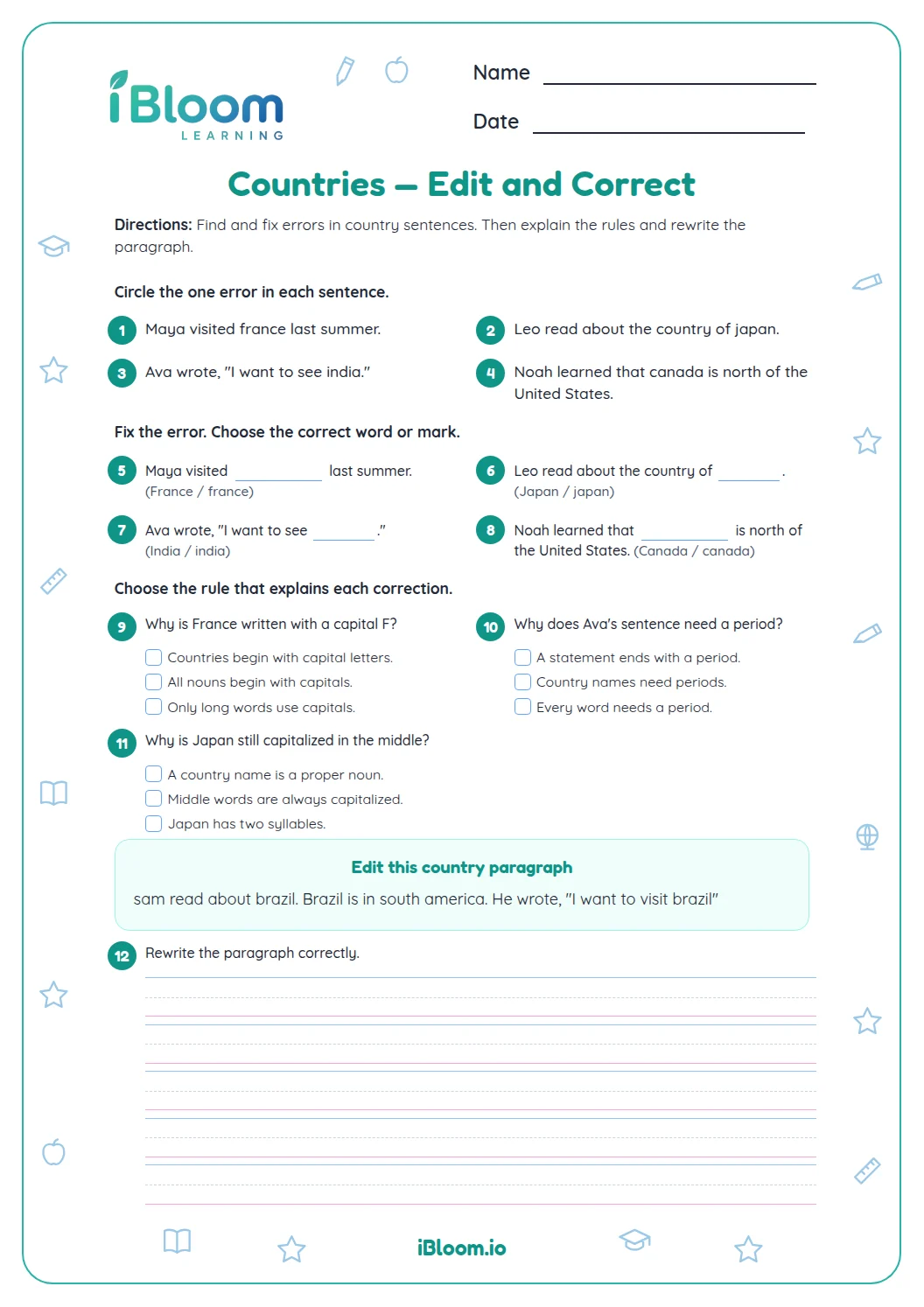
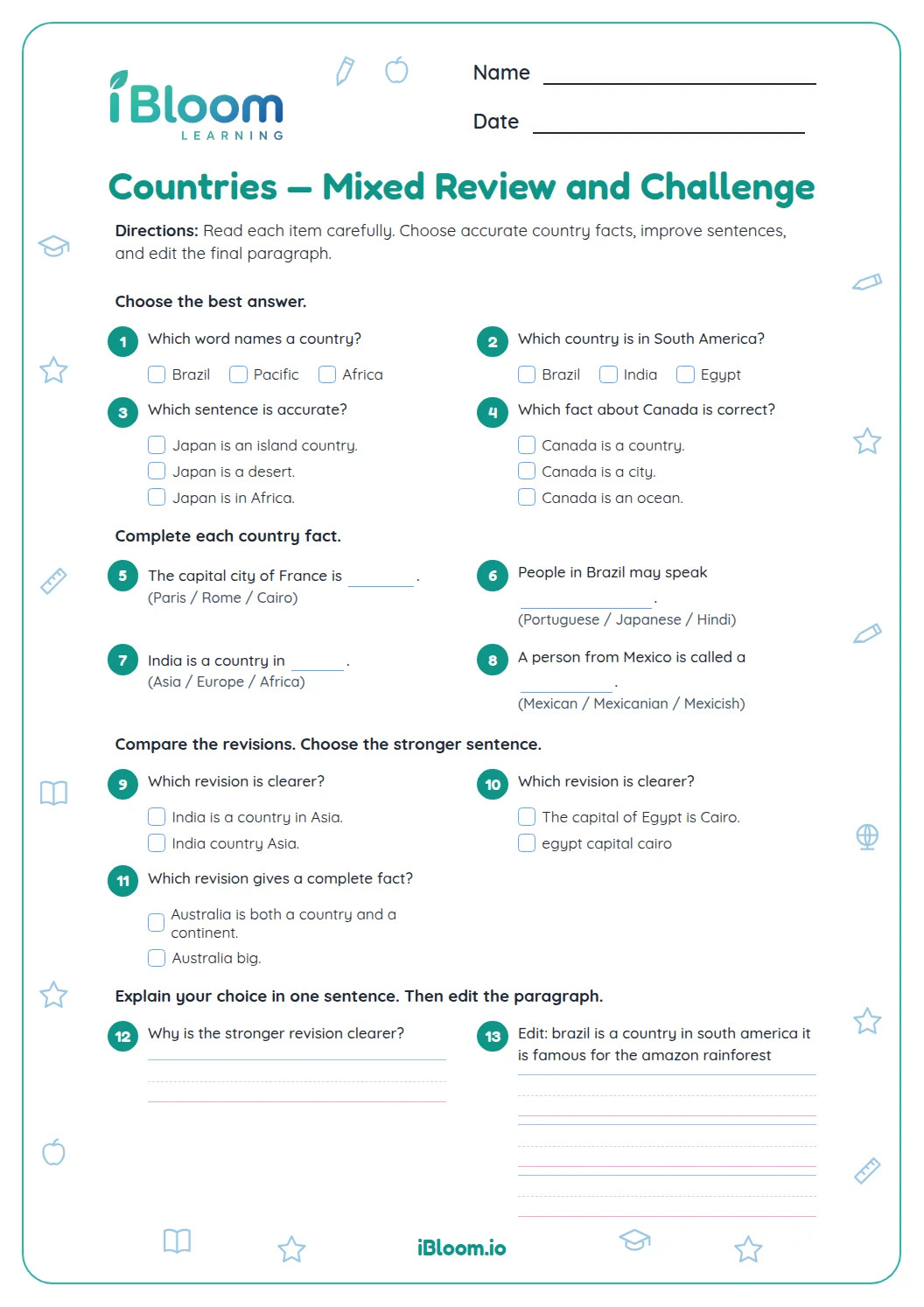
This Grade 2 worksheet gives students short source clues about Canada, Japan, and Brazil. Across 14 questions, they find and record facts such as a country’s location, capital, and number of provinces, then use supplied facts in short writing responses. The final items ask for two fact sentences about Canada and a closing sentence about Brazil. The answer key includes sample wording for those open responses.
Aligned to W.2.8
How do students find a fact in a source?
Read the source clue and look for the detail that answers the question. The clues on this page give country locations, capitals, and other information about Canada, Japan, and Brazil.
For question 5, the source says Canada’s capital is Ottawa. The missing fact is Ottawa, copied from the clue.
- 1Source: Canada’s capital is Ottawa.
- 2Canada’s capital is ___. → Ottawa
What makes a useful research note?
A useful note is brief and connected to the country topic. It can record one fact, such as a capital, or pair two facts when a question asks for both.
Question 11 asks for Brazil’s continent and capital. A concise note, “South America; Brasília,” records both details.
How can students use notes in a short report?
Turn related facts into complete sentences, keep the country as the topic, and reread to make sure each fact matches the source. A closing sentence can bring the short response to a clear end.
Question 13 asks for two fact sentences about Canada. Question 14 asks for a closing sentence using Brazil’s location and capital.
How to use this worksheet
- 1Read the source clue before looking at the answer choices.
- 2Underline the word in the question that tells which fact to find, such as capital or continent.
- 3Record a short note instead of copying every detail.
- 4Keep your report focused on the country named in the prompt.
- 5Reread each sentence for a capital letter, a period, and a fact that matches the source.
Common mix-ups
The mistake
Choosing a country or city that is familiar but does not match the source clue.
The fix
Return to the source sentence and match the question word, such as capital, with its fact.
The mistake
Copying a detail that is true but does not answer the research question.
The fix
Ask whether the detail answers the prompt and belongs in the report about that country.
The mistake
Writing notes as fragments when a complete report sentence is requested.
The fix
Use the country name as the subject, then add a verb and the source fact.
Common Core alignment
Students gather and use facts from the provided source clues to write brief informative responses.
Gather a relevant fact from a provided source and use it to answer a question.
On this sheet: Questions 1–12 use facts in provided source clues to answer research questions and record notes.
Show the official wordingHide the official wording
Recall information from experiences or gather information from provided sources to answer a question.
What to practice next
Make more practice
Further reading
Questions parents and teachers ask
Which countries appear on the worksheet?
The source clues cover Canada, Japan, and Brazil. Students find details such as their locations and capitals, record notes, and use supplied information in short writing responses. The page does not require students to research additional countries. Each question includes the facts needed to respond, so students can practice source use without searching elsewhere.
Does a student need an atlas or internet access?
No outside research is needed to answer the worksheet. Each fact needed for the questions appears in a source clue on the page. Students can focus on reading, selecting relevant details, taking brief notes, and turning facts into sentences.
What is a useful research note?
A useful note is short and answers the question. For example, “Ottawa” records Canada’s capital, while “South America; Brasília” records Brazil’s continent and capital. The final writing questions then use facts from the clues in complete sentences. The worksheet supplies all the facts on the page, including this detail, for students to record and reuse in their writing.
How should students answer the writing questions?
For question 13, students write two accurate fact sentences about Canada using the supplied location and capital. For question 14, they write a closing sentence about Brazil using its location and capital. The key gives samples; other clear sentences using those facts are acceptable.
Why does the worksheet ask for two facts together?
A country response can include more than one relevant detail. One question asks students to record Brazil’s continent and capital together, so both facts stay connected to the same topic. The writing questions also ask students to reuse related facts in complete sentences.
What is a next step after this page?
Students can try the linked Grade 2 research pages about animals, bugs, jobs, or space. They can use the same routine: read the provided source, select facts that answer a question, jot brief notes, and build a short response from those notes.