



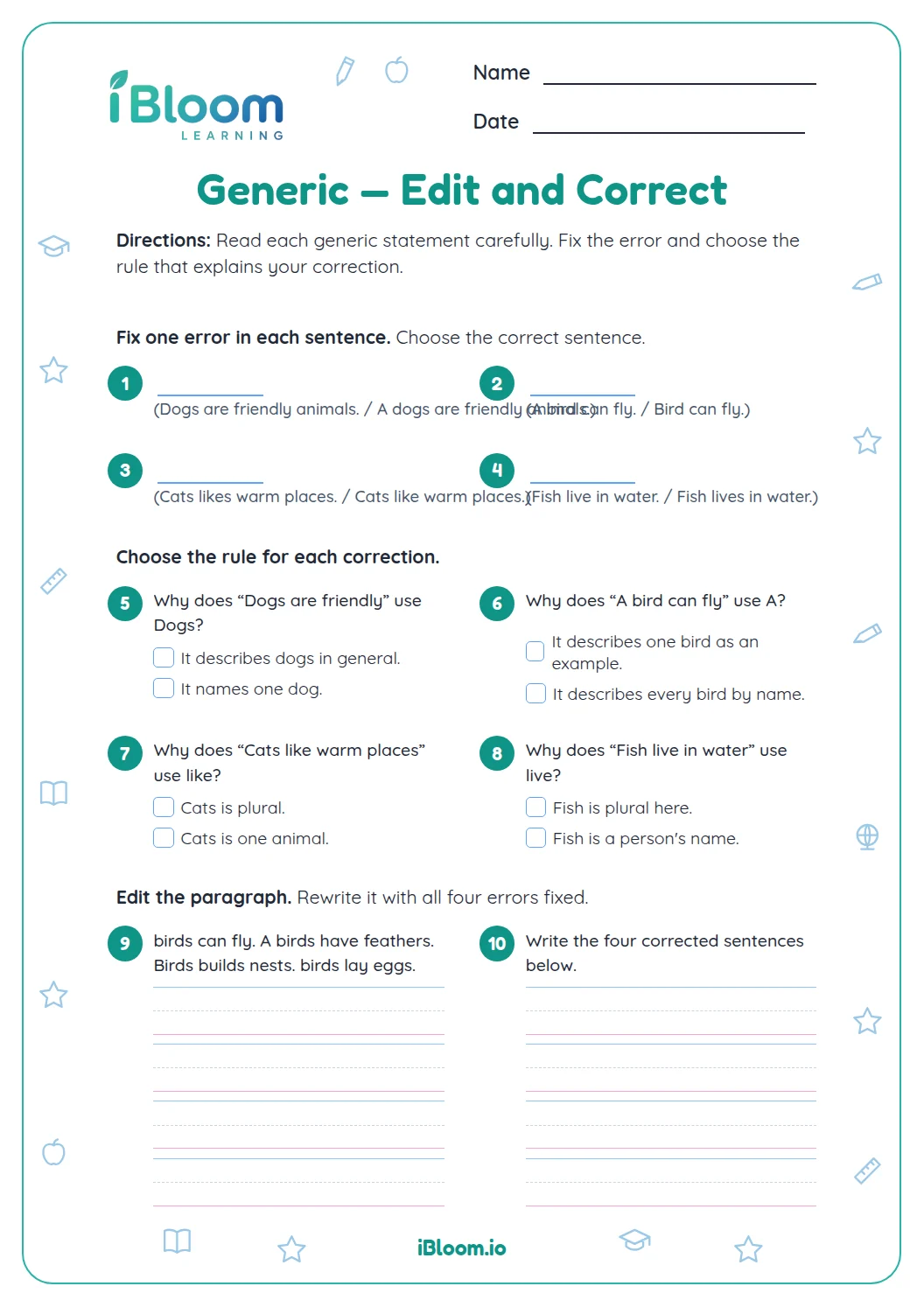
About this worksheet
This Grade 2 animal editing worksheet uses 15 short sentence items to practice capitals, end marks, spelling and grammar. Children choose a missing word or punctuation mark, then check plural nouns and verbs in animal facts. The answer key lists each correct choice. Familiar animal examples make the editing clues easy to discuss. The page practices CCSS L.2.2.
Aligned to L.2.2
What is in this animal editing worksheet?
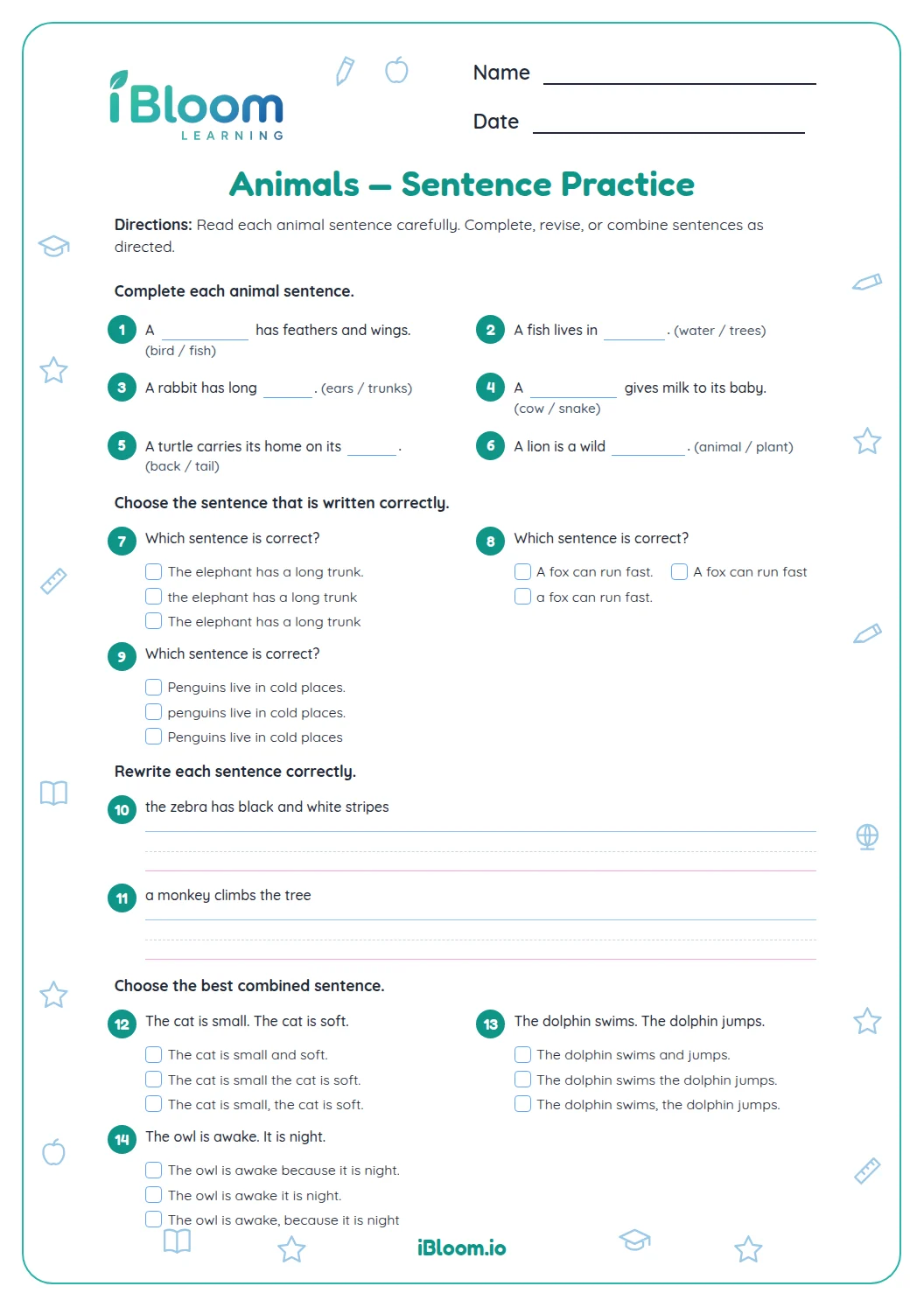
Fifteen short animal sentences give second graders practice fixing one clear editing error at a time. The first part checks capitals and end marks; the second checks plural nouns, verbs, spelling and sentence agreement.
Students select the corrected version from three choices. This keeps attention on how a sentence should look and sound before children edit a longer animal report.
- Part A: capitalize sentence beginnings and choose end marks
- Part B: edit animal nouns, verbs and spelling
How can a child edit one sentence at a time?
Start at the beginning and read to the end mark. Check that the first word starts with a capital and that the mark matches the sentence. Then reread the subject and verb: one dog runs, while two dogs run.
- 1“The dogs runs fast.” has a plural subject.
- 2Change runs to run: “The dogs run fast.”
How does editing help with animal research?
When a student writes an animal fact, a quick edit makes the fact easier to read. The same checks here—capitals, punctuation, spelling and matching words—can be used after drafting a report about an animal.
How to use this worksheet
- 1Read the whole animal sentence.
- 2Check the capital at the beginning and the end mark.
- 3Find who or what the sentence is about.
- 4Make the verb match one animal or more than one.
- 5Reread the corrected choice and use the key to check.
Common mistakes and quick fixes
The mistake
Using a period after a question.
The fix
Ask whether the sentence asks something; questions end with a question mark.
The mistake
Keeping an -s verb with a plural subject, as in “dogs runs.”
The fix
Say “one dog runs” and “two dogs run” to hear the matching forms.
The mistake
Confusing tail with tale.
The fix
Use tail for an animal’s body part; a tale is a story.
Common Core alignment
This worksheet practices the editing skills described by these standards.
Use capitals, punctuation and correct spelling when editing sentences.
On this sheet: All three parts ask students to edit capitalization, punctuation, spelling or grammar in sentences.
Show the official wordingHide the official wording
Demonstrate command of the conventions of standard English capitalization, punctuation, and spelling when writing.
What to practice next
Make more practice
Further reading
Questions parents and teachers ask
What editing skills do the animal sentences practice?
Students correct capitals, end marks, spelling, plural nouns, verbs and sentence boundaries. Every question has three sentence choices, with one version edited correctly. The answer key lists the correct version for all 15 items. Invite the child to point out one clue in the sentence, such as the plural subject, end mark or first capital.
Can I use this worksheet before an animal report?
Yes. It gives children a short editing routine they can use after drafting an animal fact: reread the sentence, check capitals and punctuation, then check spelling and whether the words fit together. The same routine works on a longer report. Have the child say each subject and verb as a pair: one duck swims, two ducks swim.
How do I teach singular and plural verbs?
Have the child point to the subject first. One duck swims; two ducks swim. Then reread the whole sentence aloud and listen for the verb that matches the animal or animals. Ask what the sentence means before choosing a spelling. A fox has a tail, while a tale is a story told in words.
Why is “tail” the right spelling for an animal?
Tail names the part at the back of an animal. Tale means a story. In the sentence “A fox has a bushy tail,” the body part makes the meaning clear. After self-checking, students can edit one sentence from their own animal notes using the same capital, punctuation and spelling checks.
How many questions and pages are included?
There are 15 questions in two parts, followed by a separate separate answer key. Most students can finish in about 20 minutes, with extra time for reading each correction aloud. Invite the child to make up a new animal fact and use the same checks before adding it to a report.