



About this worksheet
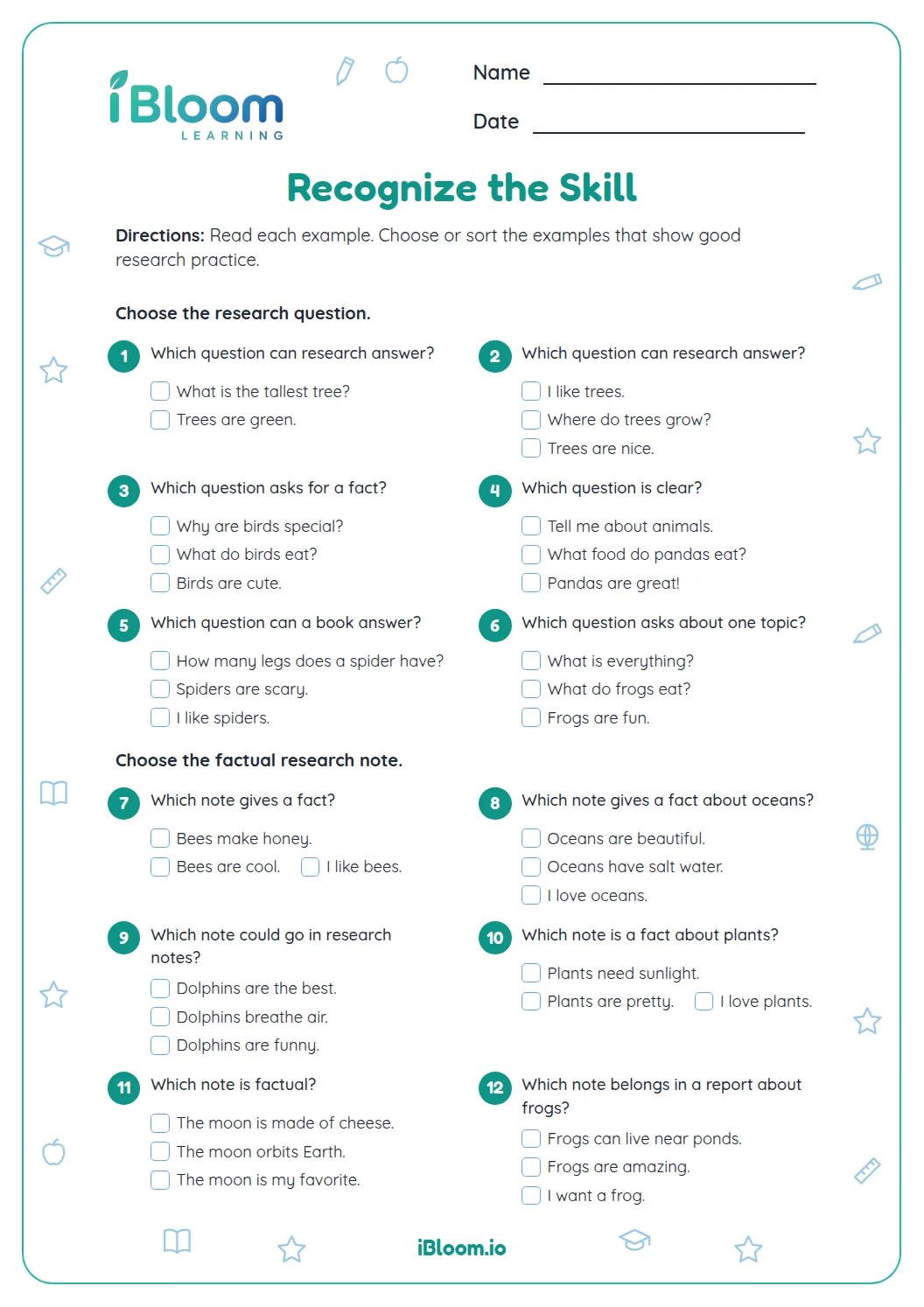
This Grade 2 animal research worksheet guides young writers through a short, guided project. Children choose a bird or fish, ask a research question, record facts about habitat and food, name a source, and turn notes into a short report. A final drawing includes a research-based label. The sequence supports shared research and writing, with open response space and a separate key of sample expectations.
How do children gather useful animal facts?
The sheet begins by choosing a bird or fish and asking a question. Children look in a nonfiction book or a trusted website, then record facts about habitat, food, and a helpful body feature. Naming the source makes it easier to find the information again.
Question 3 asks where the animal lives. A useful note might be “A robin builds its nest in a tree,” followed by the book title or website where the fact was found.
- 1Question: Where does a robin live?
- 2Fact: A robin builds a nest in a tree.
- 3Source: The book or website title
- 4Report sentence: Robins build nests in trees.
How do notes become a short report?
Children use their own words to make a topic sentence, add details from their notes, and finish with a closing sentence. The prompts keep the report focused on one animal rather than asking for a long, open-ended essay.
What should children check before sharing?
Read each sentence aloud. Check that it tells a complete idea, begins with a capital letter, and ends with punctuation. Compare report details with the notes to make sure the facts stayed accurate.
How can I use this sheet?
- 1Choose one animal and say what you already wonder about it.
- 2Find a nonfiction source with an adult or teacher.
- 3Record short facts instead of copying whole paragraphs.
- 4Use the notes to write a beginning, two details, and a closing.
- 5Reread for facts, capitals, punctuation, and clear sentences.
What errors should I watch for?
The mistake
Copying a whole sentence from a source.
The fix
Close the source and explain the fact in your own simple words.
The mistake
Writing details that do not answer the research question.
The fix
Choose facts about the same animal and connect them to the question.
The mistake
Forgetting to name the source.
The fix
Write the book title or website name beside the notes.
What to practice next
Make more practice
Questions parents and teachers ask
What source should children use?
Choose a short nonfiction book from a library or a trusted, age-appropriate website with an adult. The worksheet asks children to record the title or site name so they can return to the fact and check it. This gives children another chance to explain the strategy and check the result against the details in the prompt.
Can children choose an animal besides a bird or fish?
The opening choice pictures show a bird and a fish as simple starting points. A teacher or family can let the child name another animal and use the same habitat, food, body feature, and report prompts. This gives children another chance to explain the strategy and check the result against the details in the prompt.
How long should the report be?
Yes. The key gives examples, while a child may write another accurate answer supported by the source they used. Check that the response answers the prompt and names the source when asked. A child can return to the book or website to confirm an unfamiliar detail before adding it to the report.
Does the answer key give one correct animal fact?
No single fact is expected because children may research different animals and use different sources. The key provides sample expectations: facts should be accurate, written in the child’s own words, and connected to a named source. This gives children another chance to explain the strategy and check the result against the details in the prompt.
What does the drawing add to the research?
There are 14 prompts across choosing a topic, gathering facts, planning and writing, revising, and drawing. The key gives sample expectations; research answers may differ when they match a reliable source. Allow time for reading a source before completing the writing prompts and checking that details are accurate.