




About this worksheet
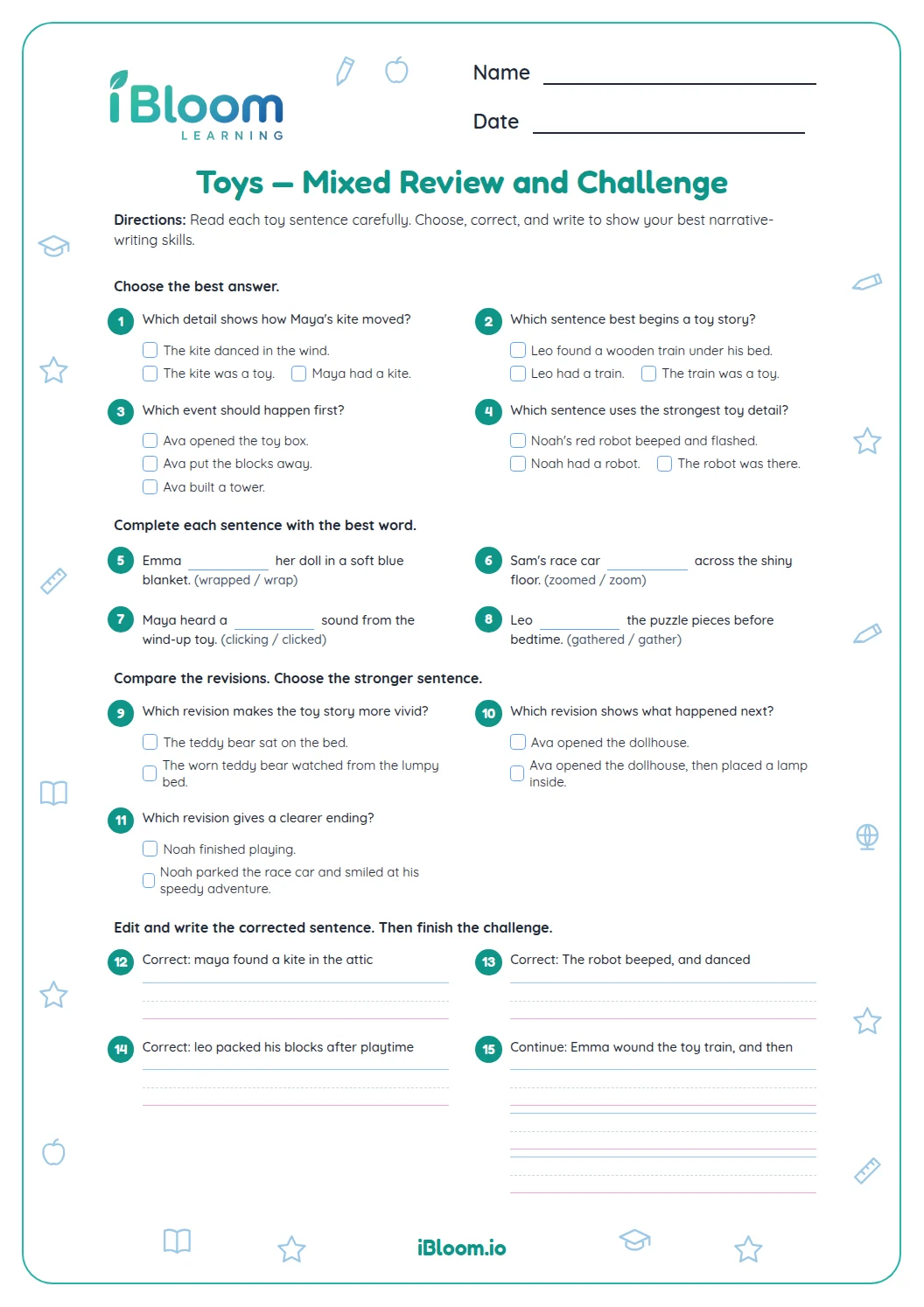
Learners recognize what makes a toy story move: a character wants something, events unfold in order, a problem changes what happens, and an ending responds to it. Short examples use toys as story settings while separating narrative details from facts about toys.
Aligned to W.3.3
What this worksheet practices
Learners recognize what makes a toy story move: a character wants something, events unfold in order, a problem changes what happens, and an ending responds to it. Short examples use toys as story settings while separating narrative details from facts about toys.
How to use the practice
The practice is organized into 2 parts, with 14 questions and a separate answer key.
Common Core alignment
This worksheet practices the grade-level skill named in the page title.
Toy Story Skills
On this sheet: The questions directly practice the skill described by this standard.
Show the official wordingHide the official wording
Write narratives to develop real or imagined experiences or events using effective technique, descriptive details, and clear event sequences.
What to practice next
Make more practice
Further reading
Questions parents and teachers ask
What belongs in the beginning of a narrative?
A beginning introduces a character and a situation so readers understand where the story starts. A toy story might show who found a missing marble or what a character plans to do with a new kite before the main events unfold.
How is a toy fact different from a story event?
A fact explains something generally true about a toy, such as a yo-yo moving on a string. A story event tells what a character does or experiences, such as dropping the yo-yo and searching beneath the couch. The difference is whether it reports information or an event.
Why do stories use time words such as then?
Time words help readers follow the order of events. Words such as first, next, later, and finally show when actions happen. They make it easier to understand how a character responds to a problem and reaches the ending. Writers can use them to connect events smoothly.
What makes an ending fit a narrative?
A fitting ending responds to what happened earlier. If a kite is stuck in a tree, the ending can show the character finding a safe way to retrieve it. An unrelated fact about kite shapes would not resolve that story problem.