






About this worksheet
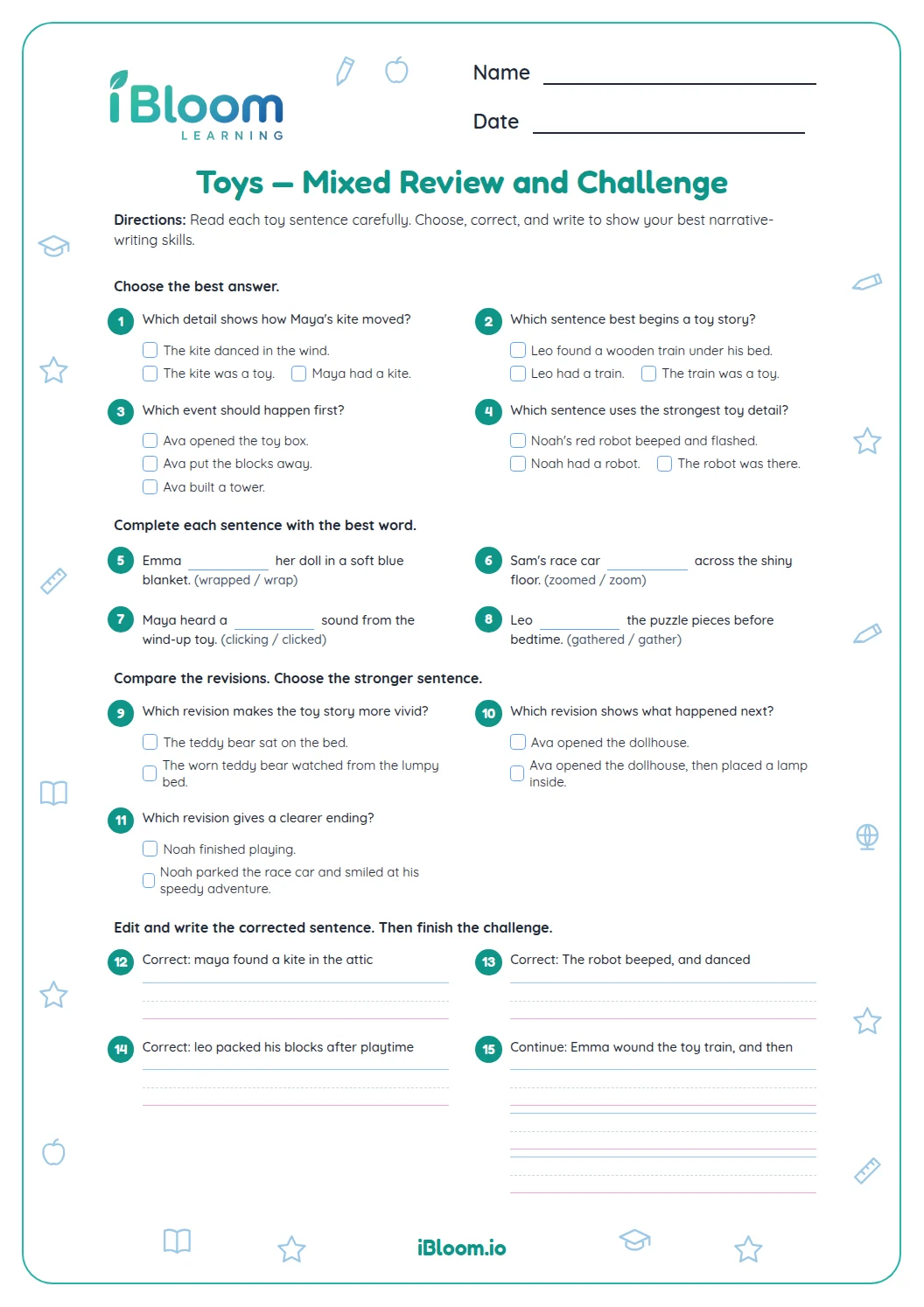
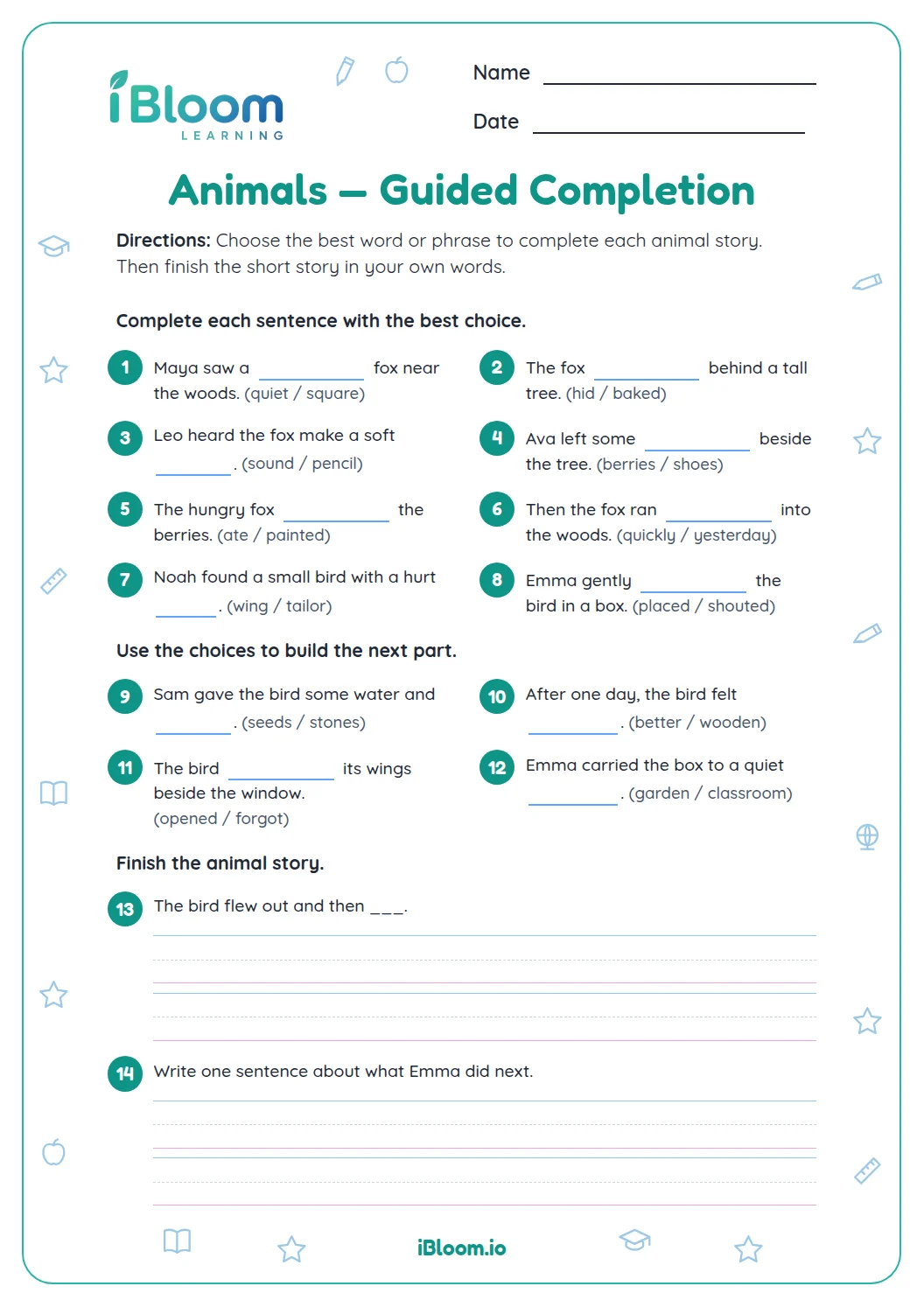
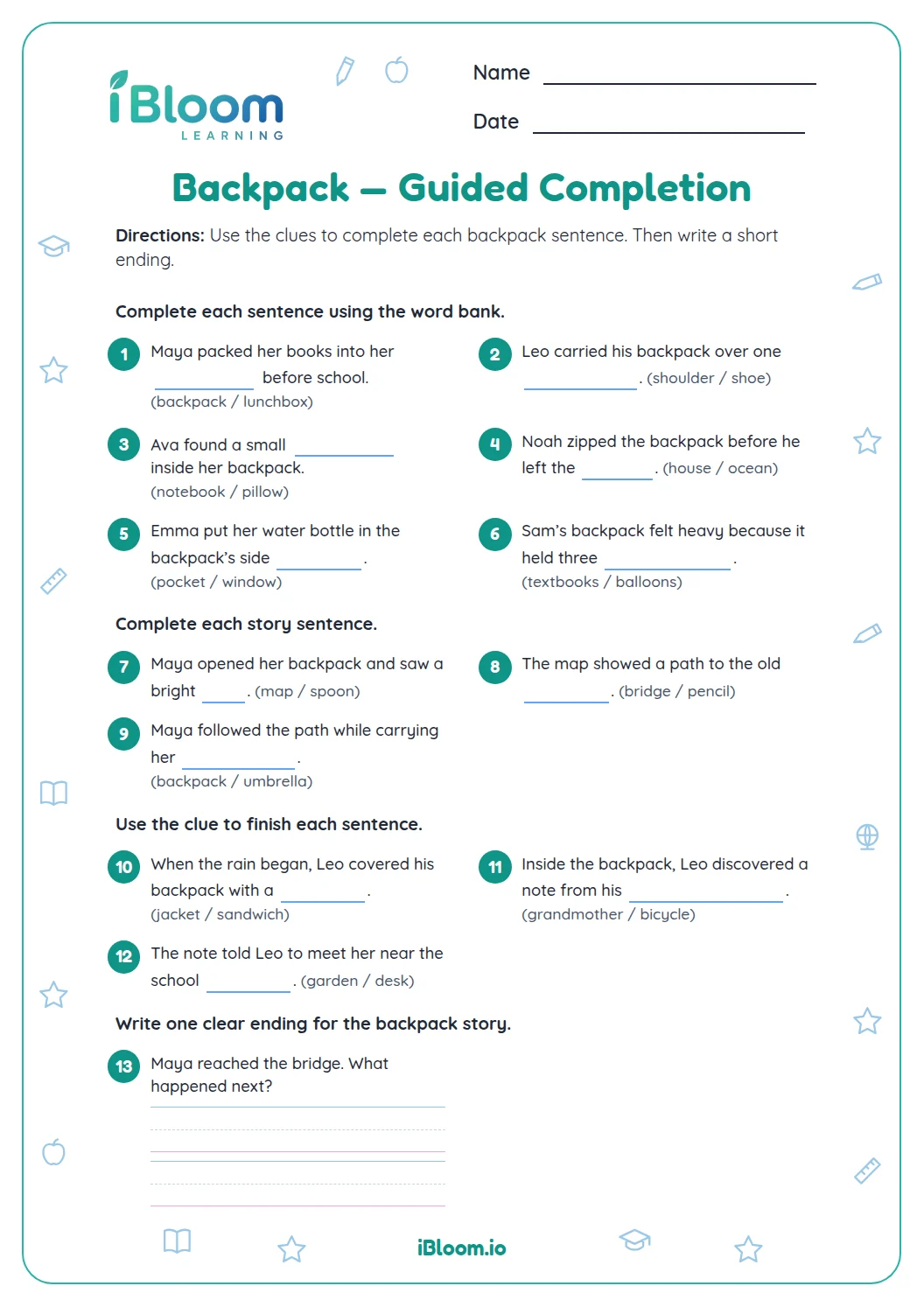
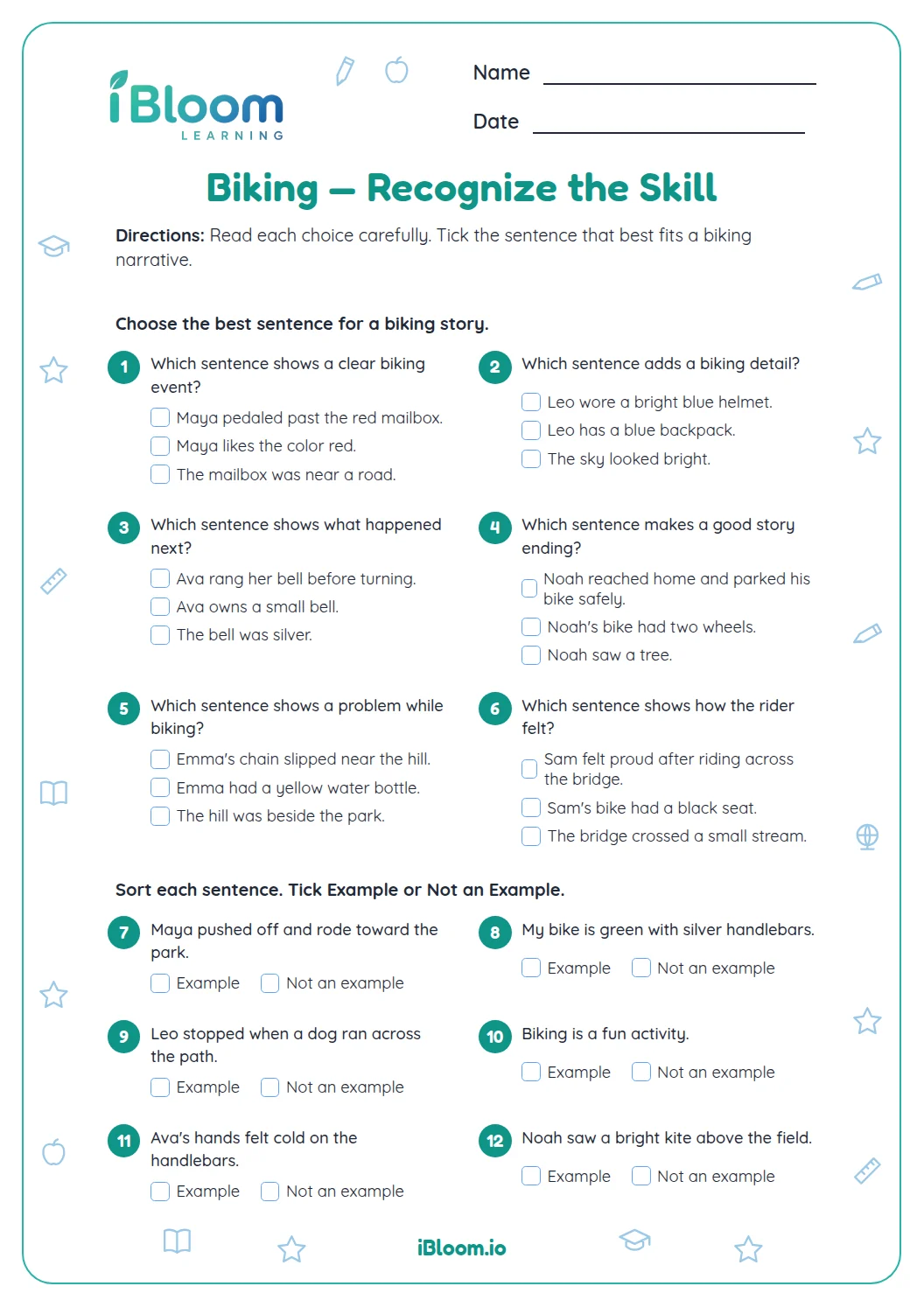
This free printable Grade 3 worksheet gives children sentence practice for narrative writing, with a toy box full of characters: Maya and her toy train, Noah and his kite, Leo and his robot. Children choose the best word for five sentences (a verb tense, an adverb, a joining word and a or an), fix three sentences that are missing capital letters and end marks, and combine three pairs of short sentences into one. It practices Common Core L.3.1i and L.3.2, and a separate answer key is included.
Aligned to L.3.1i and L.3.2
How do you join two short sentences?
Two short sentences about the same thing often repeat words. Joining them makes the writing smoother and shows how the ideas fit together. Look for the repeated words, then pick a joining word that matches the idea: and adds, but shows a difference, because gives a reason, and that lets the second idea describe a noun.
In Part C, the robot pair repeats “the robot” in both sentences. Swapping the second mention for that removes the repeat and keeps both ideas.
- 1Leo has a robot. The robot can wave.
- 2Both sentences are about the robot, so the second one repeats it.
- 3Replace “The robot” with that: Leo has a robot that can wave.
- 4Check: one capital letter, one end mark, one complete idea.
What do the word choices in Part A teach?
Stories usually tell what already happened, so much of Part A is about choosing the right form of a word. Question 1 begins with Yesterday and needs pushed. Question 2 needs the irregular past tense flew, because flied is not a word. Clue words such as yesterday and last Saturday help children find the tense without guessing.
The other three questions check small links and describing words. Because joins a reason to an action in question 3, quickly tells how the car zoomed in question 4, and an goes before old in question 5, since old starts with a vowel sound.
What is on this worksheet?
Eleven questions on two pages, in three parts that move from choosing to writing. Every sentence is about toys, so the topic stays familiar and the attention goes to the sentence.
- Part A, Pick the best word: five multiple choice sentences on tense, an adverb, a joining word and a or an
- Part B, Fix the sentence: three sentences to rewrite with capital letters for names and days and the right end mark
- Part C, Combine the sentences: three pairs to join into one sentence
- Answer key on its own pages, with a sample sentence for each pair in Part C
How to use this worksheet at home or in class
- 1Start with the characters. Ask your child to name a toy and tell you one thing it did yesterday, in a full sentence.
- 2Do question 1 together. Point to Yesterday and ask whether the action is happening now or already happened.
- 3Let your child finish Part A alone, then read each sentence aloud with the chosen word to hear whether it sounds right.
- 4In Part B, have your child touch each name and day that needs a capital letter before writing. For question 7, ask which end mark a question needs.
- 5In Part C, ask what the two sentences have in common before your child writes. Answers will differ, so check that each is one complete sentence with a capital letter and an end mark.
- 6Check with the answer key and read the sample sentences together. Ask your child to say how theirs is different.
Common mistakes and quick fixes
The mistake
Using the plain verb after a time word, like “Yesterday, Maya push her train.”
The fix
Underline the time word. Yesterday and last Saturday tell you the action is over, so the verb needs its past form: pushed, flew.
The mistake
Leaving names and days in small letters, or ending a question with a period: “does ava play with her puzzle every saturday.”
The fix
Names of people and days of the week always start with a capital letter, and so does the first word. A sentence that asks something ends with a question mark.
The mistake
Joining two sentences with only a comma: “Leo has a robot, it can wave.”
The fix
A comma alone cannot hold two complete ideas together. Use and or that, or end the first sentence with a period.
Common Core alignment
Most US states use the Common Core standards or a close state version. These Grade 3 language standards match the sentence work on this page.
Write simple, compound and complex sentences.
On this sheet: Part C asks children to join pairs of short sentences, using words such as and or that.
Show the official wordingHide the official wording
Produce simple, compound, and complex sentences.
Use capital letters, end marks and correct spelling when writing.
On this sheet: Part B asks children to add capital letters and the right end mark to three sentences.
Show the official wordingHide the official wording
Demonstrate command of the conventions of standard English capitalization, punctuation, and spelling when writing.
What to practice next
Make more practice
Further reading
Questions parents and teachers ask
Why is the answer to question 2 flew and not flied?
Flew is the irregular past tense of fly. Many verbs add -ed in the past, but a few change form instead, like fly and flew or run and ran. Children learn these by seeing and writing them, not from a rule. The words last Saturday also tell them the kite flight is over.
Which words need capital letters in Part B?
In question 6, the first word, Maya, needs a capital letter. In question 7, children capitalize Does, Ava and Saturday and end with a question mark. In question 8, Noah and Monday need capitals. Names of people, days of the week and the first word of a sentence always start with a capital.
Why does question 3 use because?
Because gives a reason: Ava hugged her teddy bear since the thunder was loud. But would show a difference and or would offer a choice, and neither fits the story. Children can test each word by reading the whole sentence aloud and asking whether it makes sense.
Do children have to write the same combined sentences as the answer key?
No. Part C answers vary, and the key shows one sample for each pair. Accept any answer that is one complete sentence, keeps both ideas, starts with a capital letter and ends with a mark. For the robot pair, “Leo has a robot, and it can wave” is also correct.
How long does this worksheet take?
Plan on about 20 minutes: five quick word choices, three short rewrites and three sentence combinations. The writing lines in Parts B and C take the longest, so you can stop after Part A and finish the rest later. The answer key makes checking quick.
Is there an answer key for this worksheet?
Yes. The answer key has its own two pages. It shows the right word for each Part A question, the corrected sentences for Part B and a sample combined sentence for each pair in Part C. Print only the worksheet for your child and keep the key to check afterward.