





About this worksheet
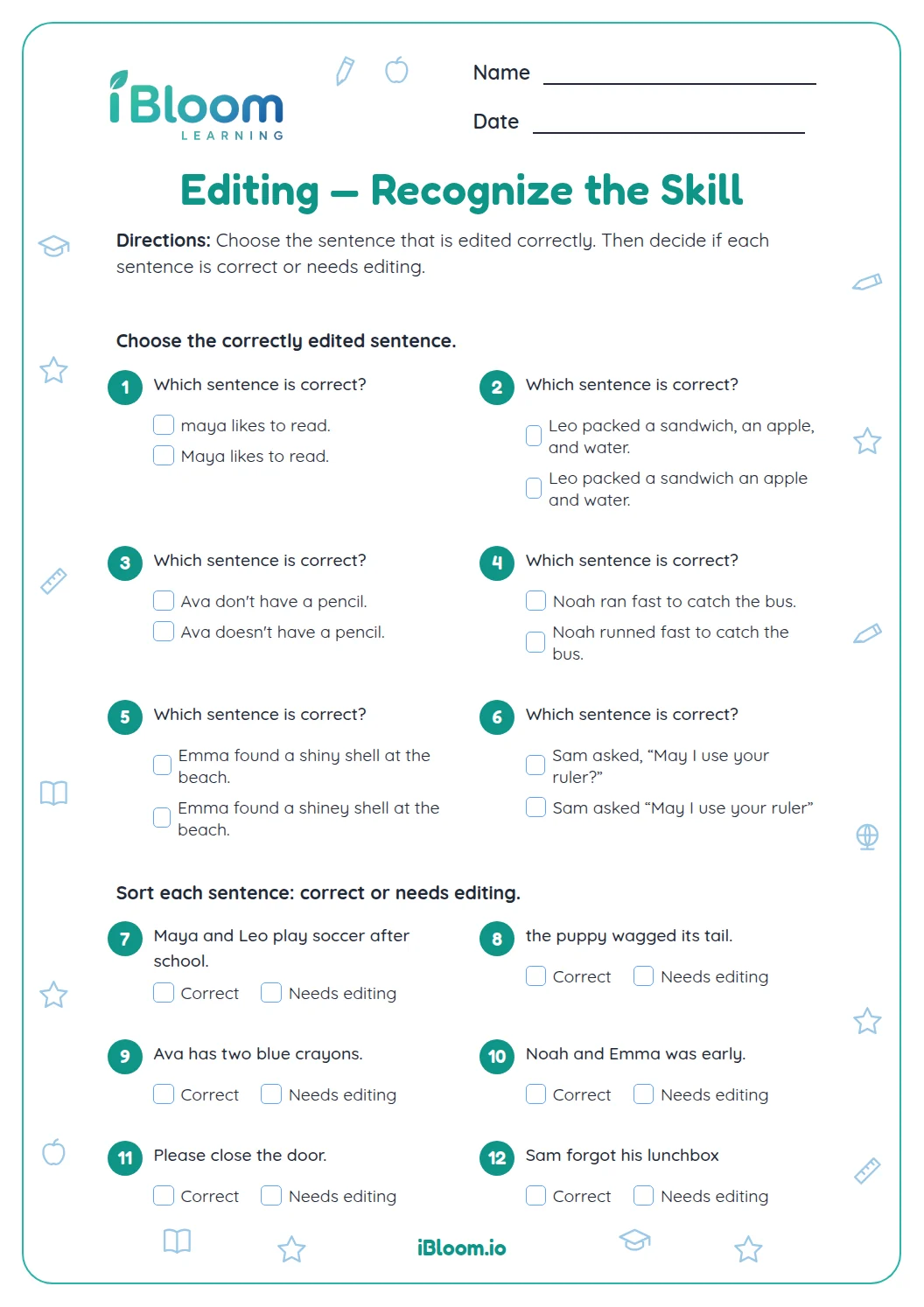
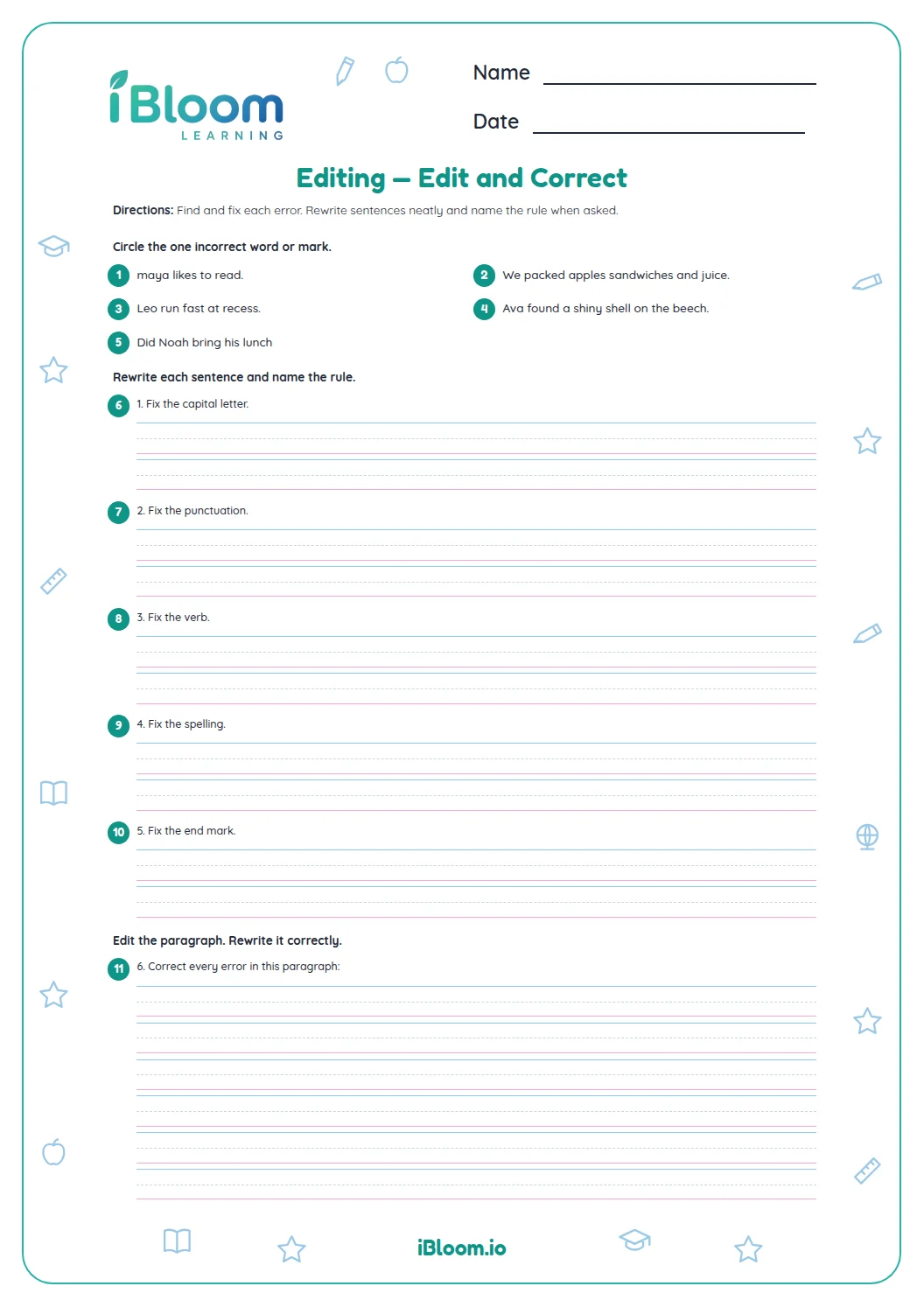
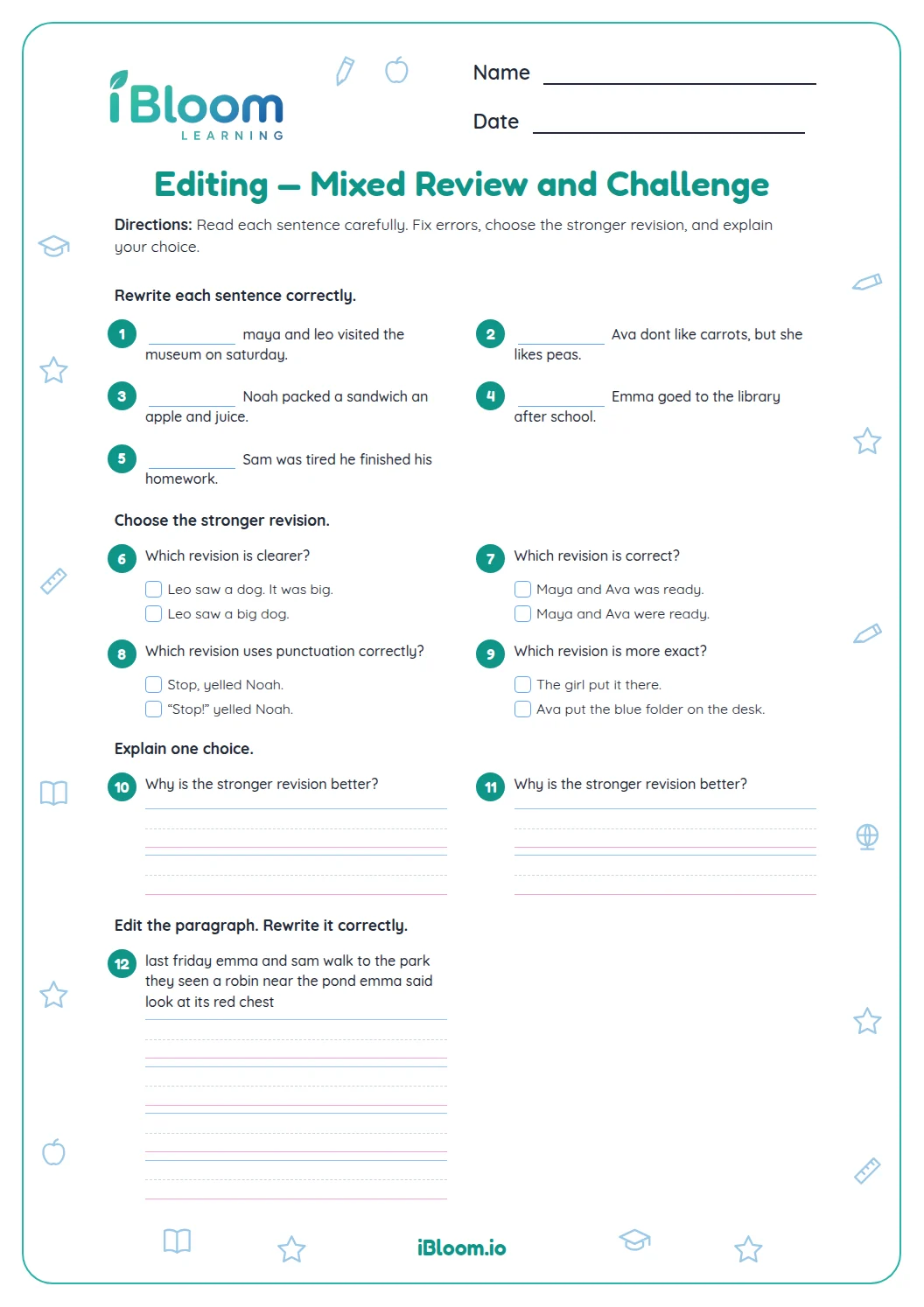
This Grade 3 editing worksheet asks students to correct sentences with capitalization, punctuation, and spelling errors, then apply those conventions in an original sentence. The 14 tasks include sentence beginnings, names and places, dates, commas, contractions, and question marks. A separate answer key supplies corrected versions and one sample response.
Aligned to L.3.2
What does this worksheet practice?
Questions 1–12 and 14 ask students to rewrite a sentence correctly. Question 13 asks them to write about a place they visited. The practice covers capitals, spelling, commas, end marks, and punctuation in dialogue.
- Complete each part in order.
- Use the key to check answers.
What should a student check when editing a sentence?
In “where did Jordan put the blue folder”, the wording asks a question, so the corrected sentence begins with a capital and ends with a question mark: “Where did Jordan put the blue folder?”
- 1we went to the park. → We went to the park.
How can a student check the work?
For the original sentence, there can be many correct responses. The key gives one sample; check that a student’s sentence is complete and uses appropriate capitalization and punctuation.
How to use this worksheet
- 1Read each sentence aloud once.
- 2Check that the first word and names begin with capitals.
- 3Check commas, apostrophes and end marks.
- 4Rewrite the whole sentence so the corrections are clear.
- 5Compare with the answer key.
Common mistakes and quick fixes
The mistake
Capitalizing every important-looking word.
The fix
Capitalize the first word, names and specific places or dates.
The mistake
Using a period after a question.
The fix
Let the sentence’s meaning choose the end mark.
The mistake
Fixing punctuation but leaving a lowercase name.
The fix
Scan for people, places, days and the pronoun I.
Common Core alignment
The practice focuses on Grade 3 writing conventions.
Edit sentence capitals, commas, apostrophes and end punctuation.
On this sheet: Edit sentence capitals, commas, apostrophes and end punctuation.
Show the official wordingHide the official wording
Demonstrate command of the conventions of standard English capitalization, punctuation, and spelling when writing.
What to practice next
Further reading
Questions parents and teachers ask
Which editing skills does this page include?
Students correct capitalization, spelling, commas, apostrophes, quotation punctuation, and end marks. The examples include names, a city, a day of the week, a contraction, and spoken words. Each correction is based on the words and meaning already in that sentence.
Are all the sentences wrong in the same way?
No. Each sentence calls for its own check. Some need capitals, some need punctuation, and some need both. Students should reread the complete sentence and decide which changes make it correct. Reading the sentence aloud can help a student notice where punctuation belongs.
What is the open-ended question?
Question 13 asks students to write a sentence about a place they visited. Many responses can be correct; the answer key shows one sample. A student’s sentence should be complete and use a capital and end mark. The writing prompt invites a response from the student’s own experience.
How should dialogue be punctuated in question 12?
The corrected version is “Please close the gate,” said Dad. The comma separates the spoken words from the dialogue tag, quotation marks show the exact words, and Dad is capitalized as a family name used in place of a name.
How many pages are in the printable?
There are two worksheet pages and two answer-key pages. The worksheet contains 14 numbered tasks: 13 corrections and one original sentence. The two-page worksheet keeps the practice together before the separate key. The two-page worksheet keeps the practice together before the separate key.