




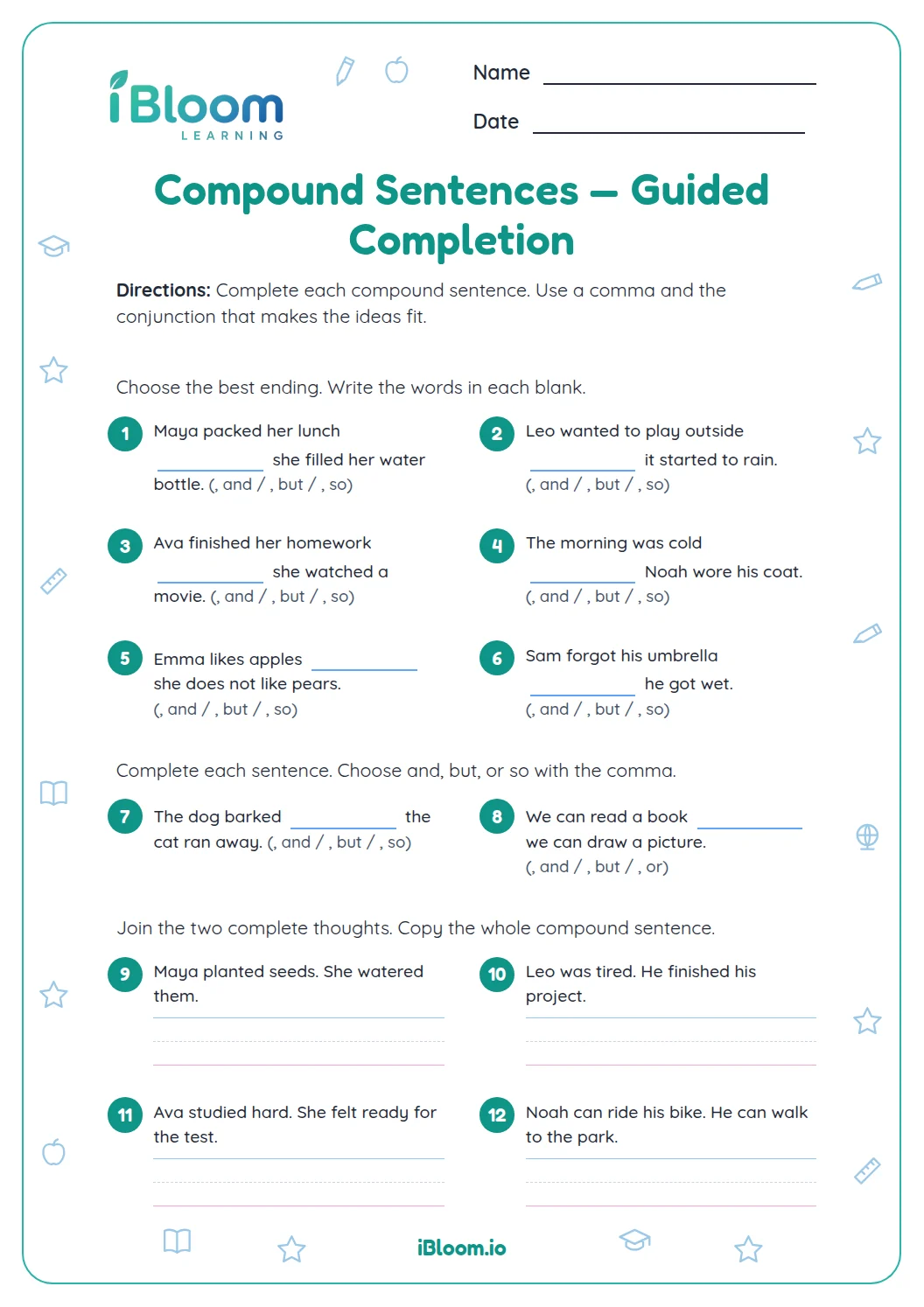
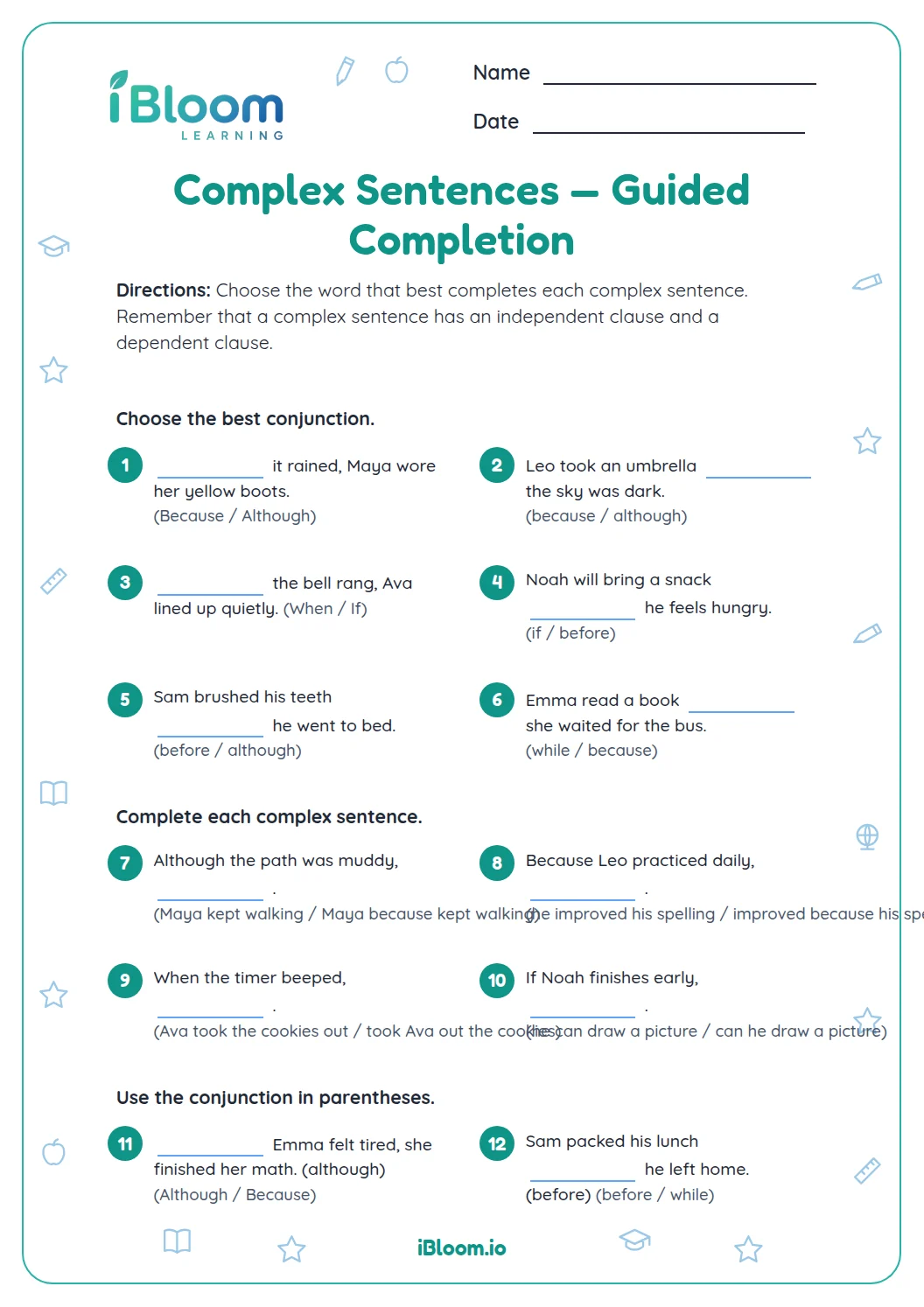

About this worksheet
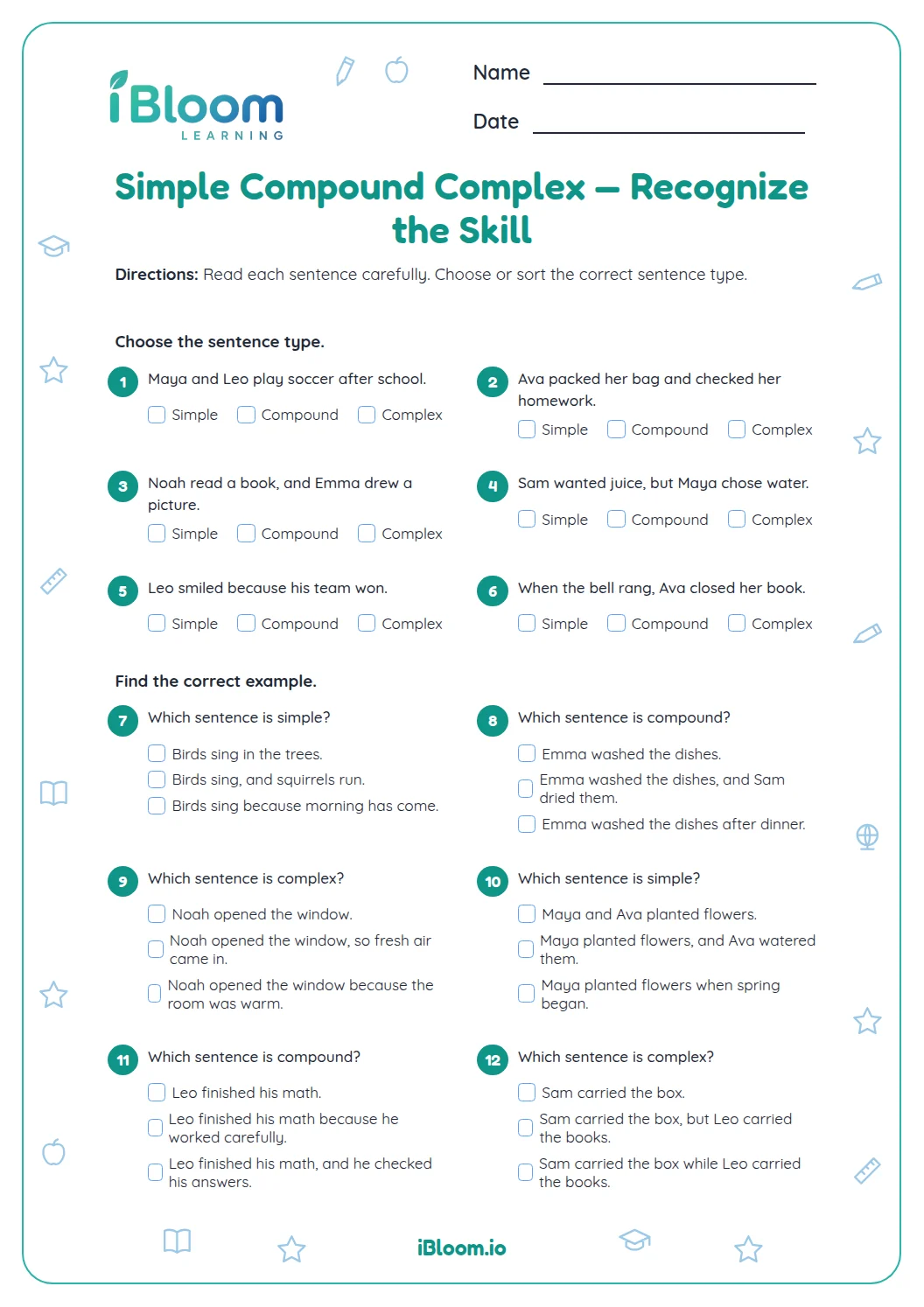
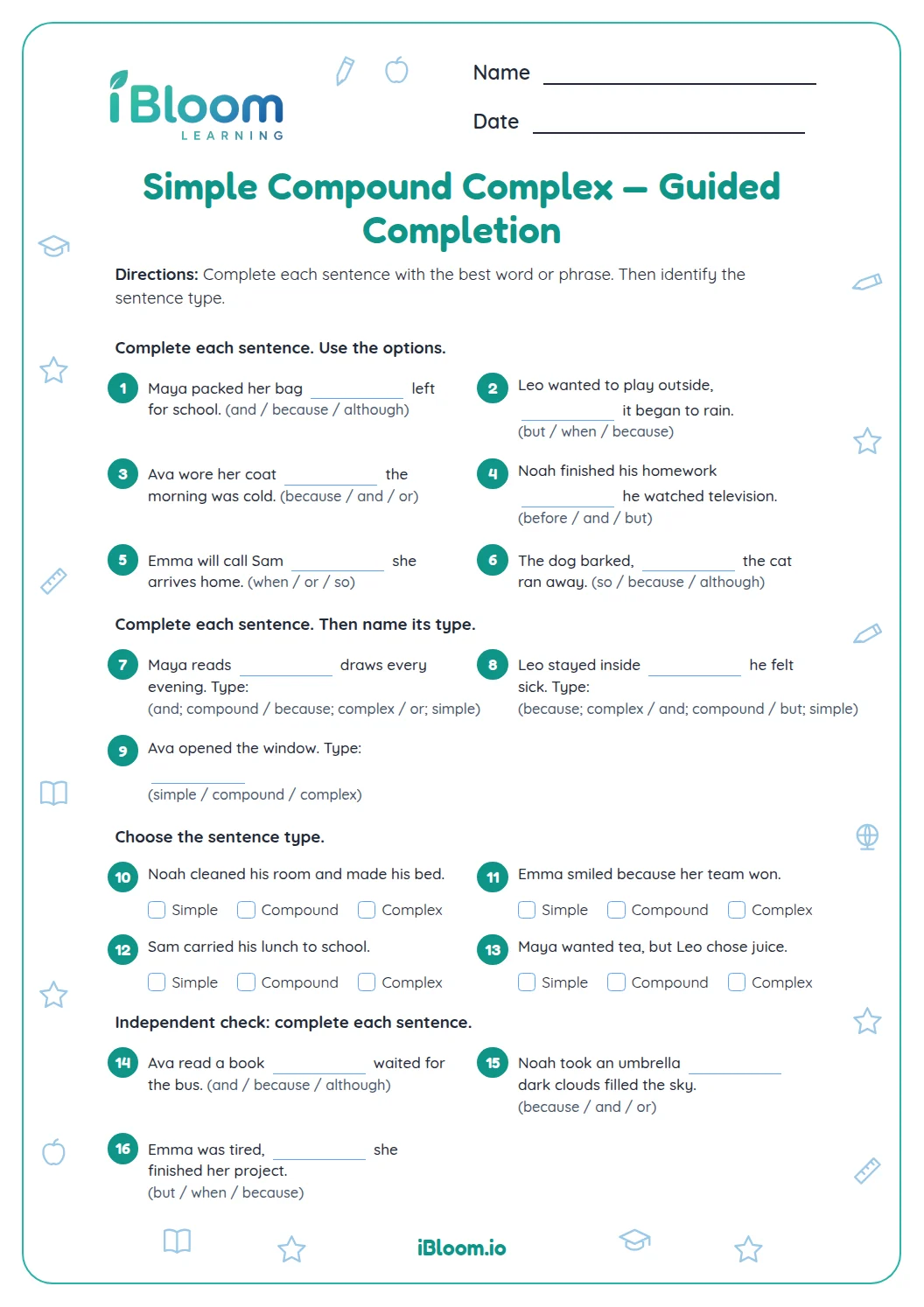
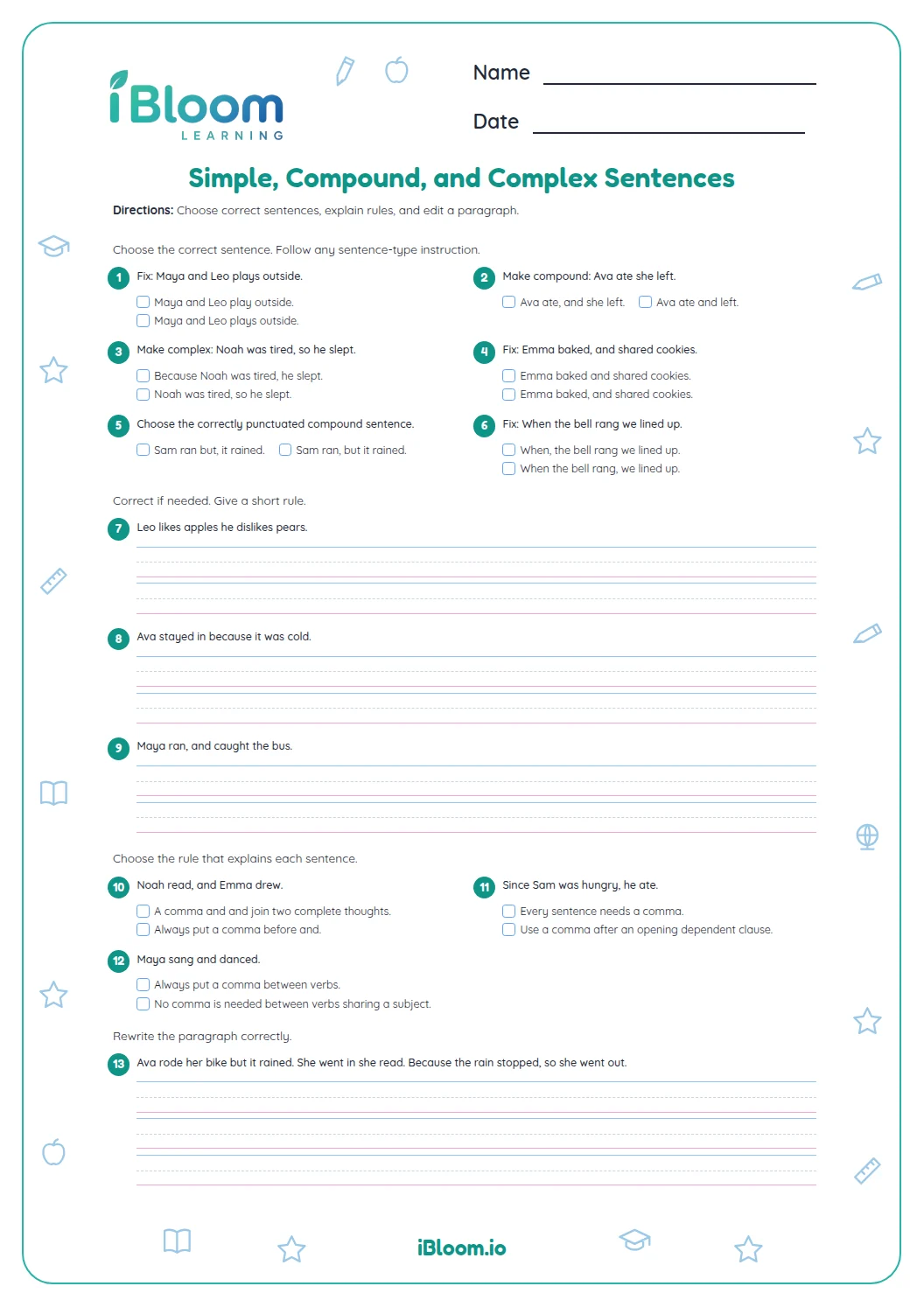
This Grade 3 printable reviews simple, compound, and complex sentences through 14 questions in three parts. Students classify complete sentences, select conjunctions that show how ideas connect, recognize a correct revision, and write a complex sentence using because. The examples use familiar school, home, and outdoor situations. The practice aligns with CCSS L.3.1.i, which asks students to produce simple, compound, and complex sentences. A separate answer key lists fixed answers and a sample sentence.
Aligned to L.3.1.i
What kinds of sentences are in the review?
Part A asks students to classify seven sentences as simple, compound, or complex. Part B chooses conjunctions and checks how sentences join or revise ideas. The examples use familiar school and outdoor situations.
- 1“When the bell rang, the class lined up.” → Complex
- 2“The clouds gathered, but the game continued.” → Compound
How does a conjunction connect ideas?
And, but, or, and so can connect independent ideas. Words such as because, when, although, and after introduce a dependent idea. Read both sides of the joining word to check that the relationship makes sense.
- 1“The rain stopped, ___ we went outside.” → so
- 2The rain ended; going outside follows as a result.
How can a student build a complex sentence?
Start with a dependent clause that begins with because, when, or although, then connect it to a complete thought. The last question asks students to write a sentence about rain using because. For example, “Because it rained, Maya carried an umbrella” gives a reason and a complete result.
- 1Because it rained, Maya carried an umbrella.
- 2“Because it rained” gives a reason; “Maya carried an umbrella” completes the thought.
How to use this worksheet
- 1Read the whole sentence before choosing a label.
- 2Check whether the sentence has one independent clause or more.
- 3Look for a dependent-clause word such as when, because, or although.
- 4For conjunction questions, read both sides and check the relationship.
- 5For a revision, choose the option that joins the ideas correctly.
- 6For the final response, check that because clause is connected to a complete thought.
Mistakes to watch for
The mistake
Calling a sentence compound because it contains “and.”
The fix
Check whether “and” joins two complete thoughts. “Jamal read a book and drew a map” has one subject and is simple.
The mistake
Calling every sentence with a comma complex.
The fix
Look for a dependent clause introduced by a word such as when, because, or although.
The mistake
Joining two complete thoughts with only a comma.
The fix
Use a comma and a coordinating conjunction, or make two separate sentences.
Produce and recognize the three sentence types.
On this sheet:
Show the official wordingHide the official wording
Produce simple, compound, and complex sentences.
What to practice next
Make more practice
Further reading
Questions parents and teachers ask
What does this worksheet ask students to do?
Students identify simple, compound, and complex sentences, choose conjunctions, revise a sentence, and write a complex sentence. The three parts move from recognition to sentence building. The answer key labels fixed answers and gives sample wording for the open response.
How can a child tell a compound sentence from a complex one?
A compound sentence joins two complete thoughts, often with and, but, or so. A complex sentence has a dependent clause introduced by a word such as when, because, or although. Students can check whether each side of the joining word can stand as a complete sentence.
Does every sentence with “and” count as compound?
No. In “Jamal read a book and drew a map,” one subject does two actions, so the sentence has one independent clause. A compound sentence needs two complete thoughts joined correctly. Part A includes this example so students can look beyond a familiar conjunction.
How does the worksheet check sentence understanding?
Students classify sentences, choose conjunctions, recognize a correct revision, and write one complex sentence. The key labels each fixed answer and offers a sample for the open response. For a missed item, ask the student to point to the clause or joining word that supports the answer.
What is a useful way to review missed answers?
Ask the student to underline the subject and verb in each clause, then circle the joining word. This reveals whether the sentence has one complete thought, two joined complete thoughts, or a dependent clause. Compare that evidence with the answer key before correcting the label.
What makes the last response a complex sentence?
The final response uses because to begin a dependent clause and connects it to a complete thought. “Because it rained, Maya carried an umbrella” is one model: the first clause gives a reason, and the second can stand as a sentence. Other sensible rain sentences using because are correct.