




About this worksheet
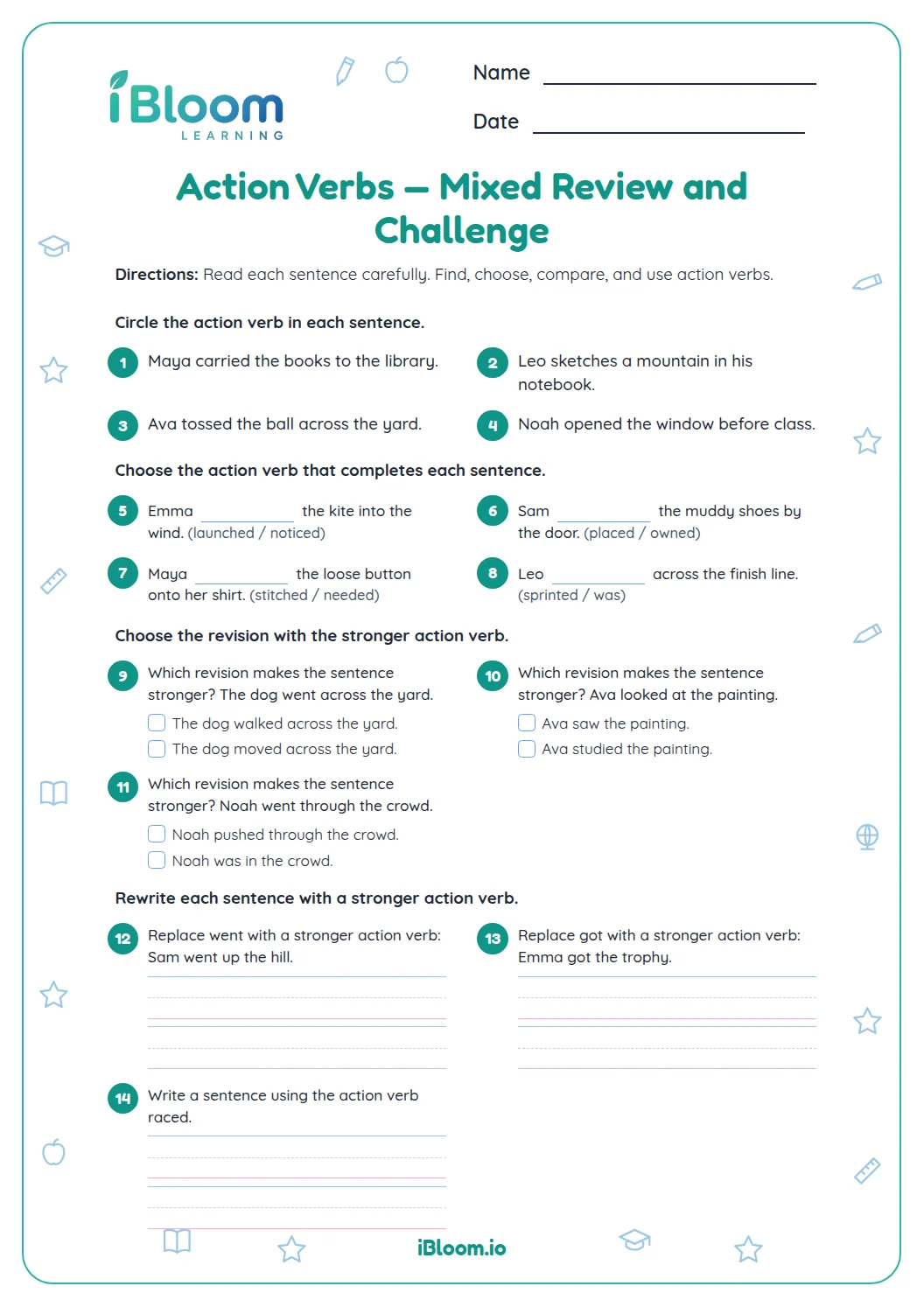
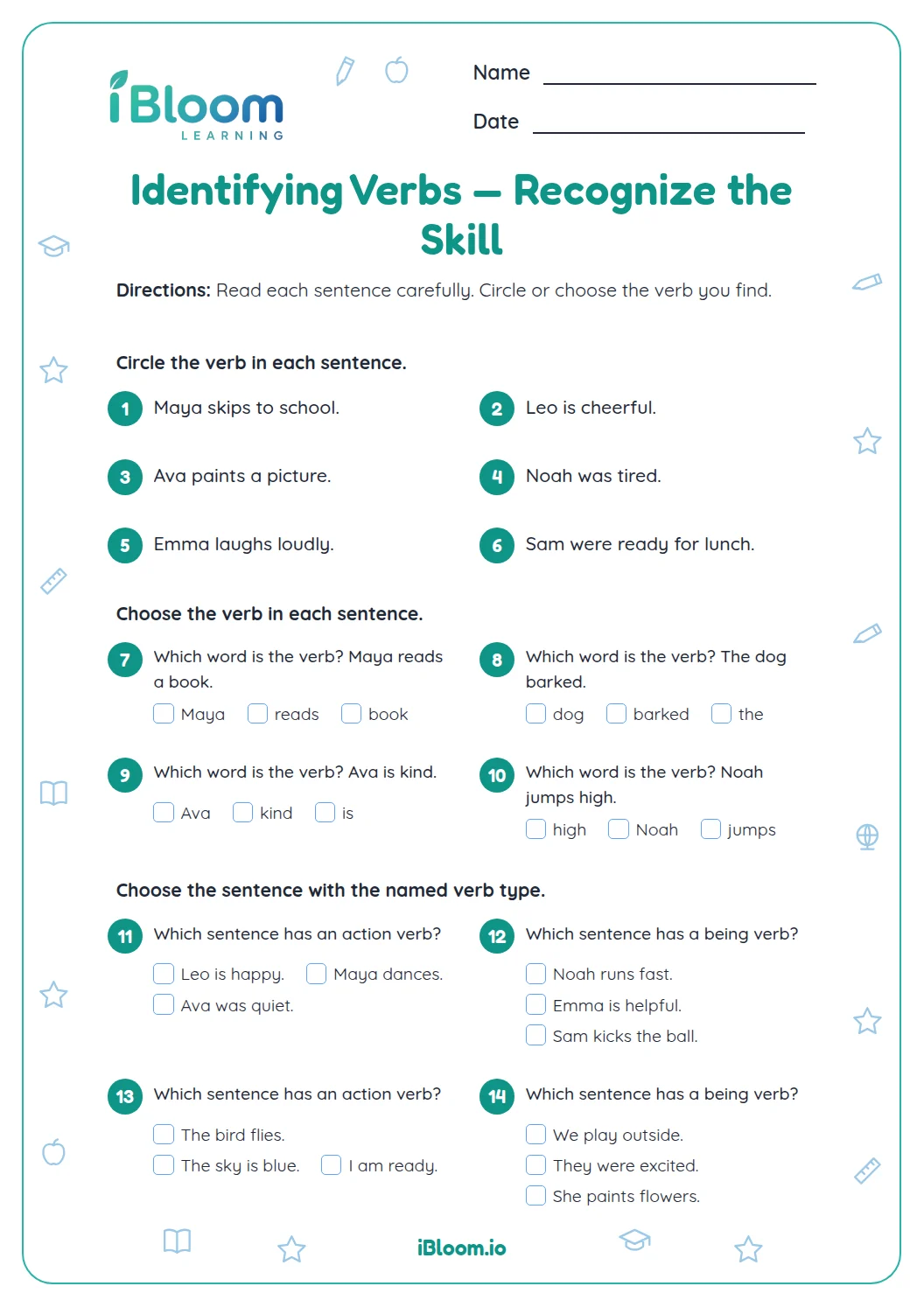
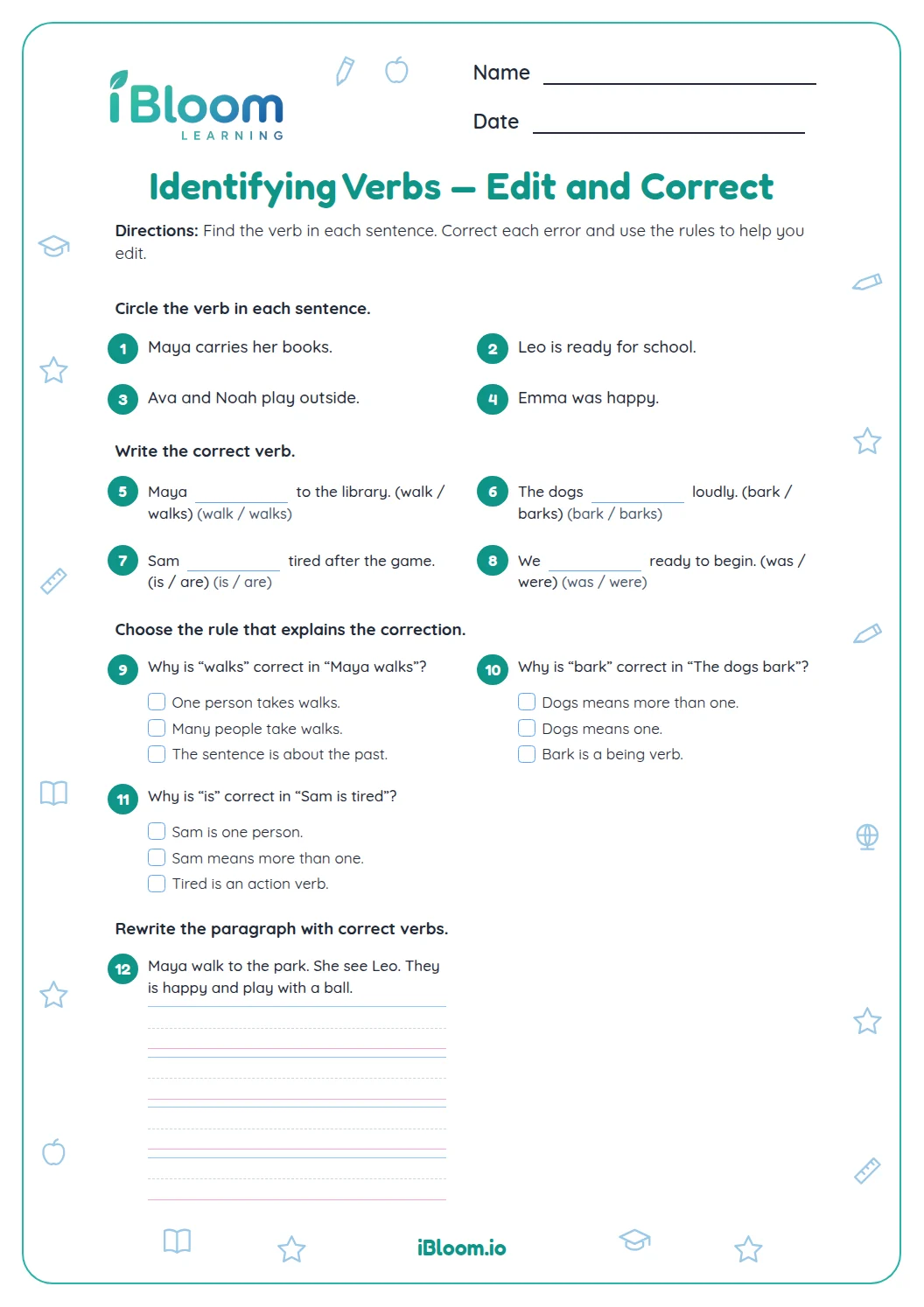
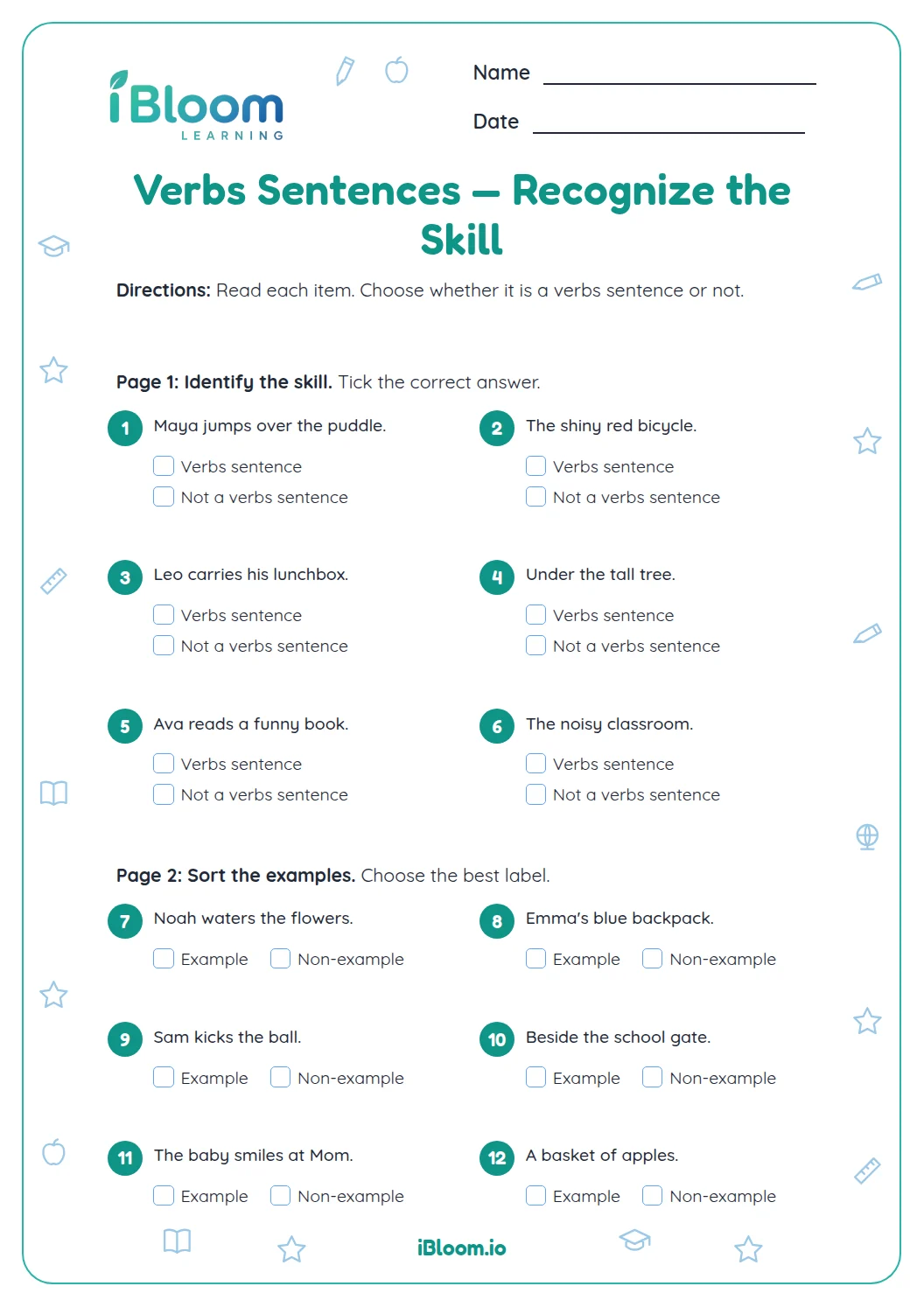
This Grade 3 printable gives learners 16 short questions on using verbs in context and choosing forms that fit each sentence. It includes a separate answer key for checking responses.
Aligned to L.3.1a
What does an action verb tell us?
An action verb tells what a person, animal, or thing does. In a sentence, look for the word connected to the subject that names an action.
- 1The puppy bounds over the log.
- 2Ask: What does the puppy do?
- 3It bounds. The action verb is bounds.
How do you choose the right verb form?
Part B asks learners to choose a verb form that fits the subject and time clue. Children is plural, so race fits; yesterday signals past tense, so tapped fits.
How can you correct an action verb?
Part C gives a sentence with an action-verb error. Learners write the corrected verb, checking subject and time clues. The key lists the corrected form for each sentence.
How to use this worksheet
- 1Read the whole sentence before choosing a verb.
- 2Ask what action the subject does.
- 3Notice time words such as yesterday or last spring.
- 4Check whether the subject is one person or more than one.
- 5Read the edited sentence aloud to see if the verb fits.
- 6Use the answer key to check verb choices and forms.
Common mistakes and quick fixes
The mistake
Choosing a noun instead of the verb.
The fix
Ask what the subject does; the answer is usually the action verb.
The mistake
Ignoring the time clue.
The fix
Circle words such as yesterday, then use a past-tense verb.
The mistake
Changing the subject while editing.
The fix
Keep the who or what the same and change only the verb form the direction asks for.
Common Core alignment
Learners examine how verbs work inside sentences and revise verb choices.
Find verbs in sentences and explain their work as action words.
On this sheet: Learners identify verbs in context and choose verb forms that make sentences clear.
Show the official wordingHide the official wording
Explain the function of nouns, pronouns, verbs, adjectives, and adverbs in general and their functions in particular sentences.
What to practice next
Make more practice
Further reading
Questions parents and teachers ask
What is an action verb?
An action verb tells what a person, animal, or thing does. In “The puppy bounds over the log,” bounds names the puppy’s action. Ask what the subject does, then check whether that verb makes sense in the complete sentence.
Why does the worksheet include past-tense verbs?
Some items include time clues such as yesterday and last spring. Those words signal that the action happened in the past, so the verb form must change. Learners use the full sentence to choose or correct the action verb.
What does the editing part ask learners to do?
Part C has six sentences with an action-verb error. Learners write the corrected verb, checking whether it agrees with the subject and fits any time clue. The separate answer key lists the expected verb form for each edit.
How can a child check a verb choice?
Read the complete sentence and ask what the subject does. Then check the subject and any time clue, and read the sentence aloud with the chosen verb. This helps catch mismatches such as “The boys runs” or a present-tense verb after “yesterday.”
Does every verb name a physical movement?
Action verbs can describe actions that are not easy to see, too. This worksheet uses clear examples such as sketches, plays, and carried, so children can focus on spotting the verb and matching its form to the sentence.
How long does the worksheet take?
About twenty minutes is a useful estimate for 16 questions. The last six ask learners to correct a verb in a sentence, which takes careful reading. Encourage them to check the subject and time clue before writing each corrected form.