








About this worksheet
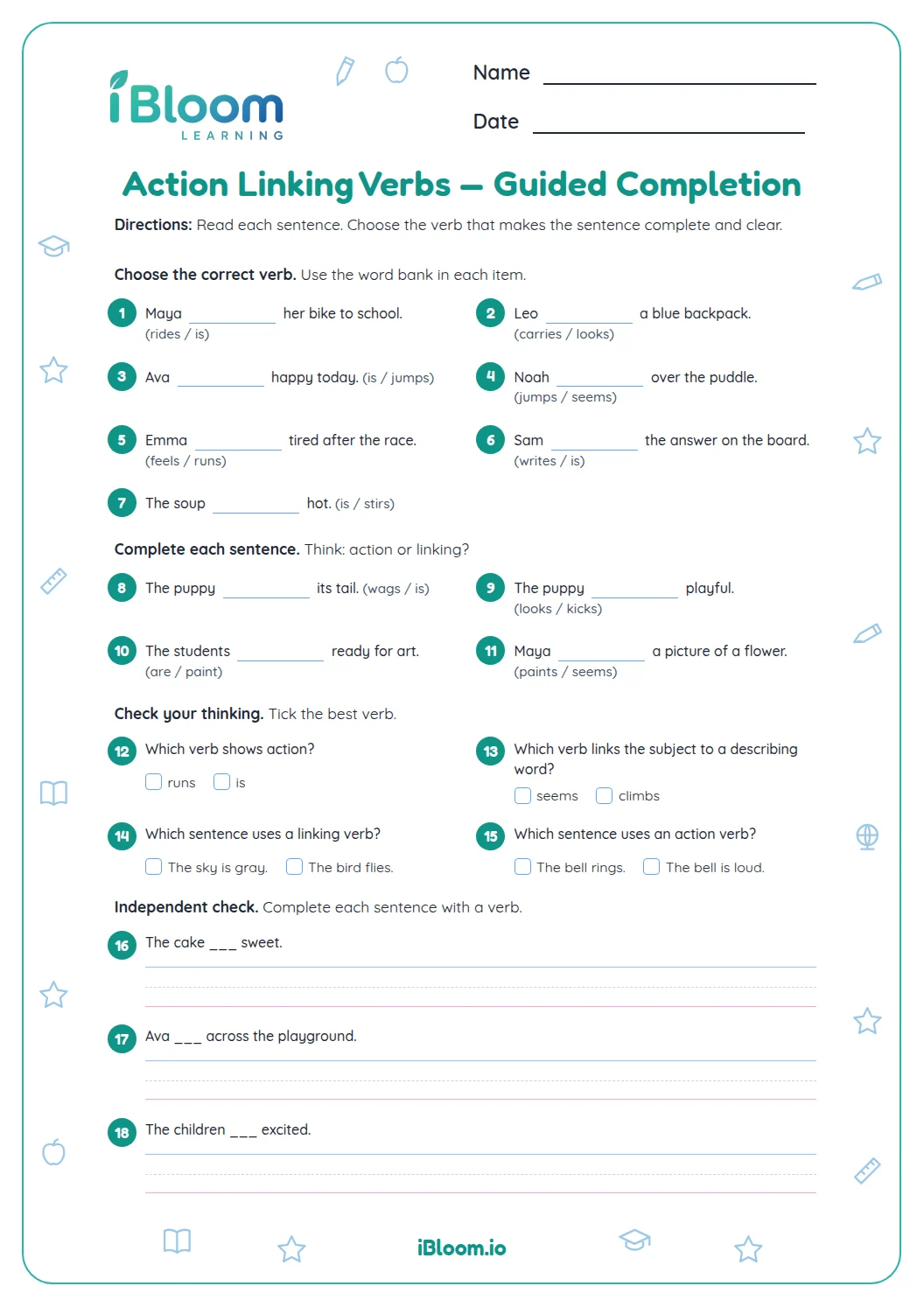
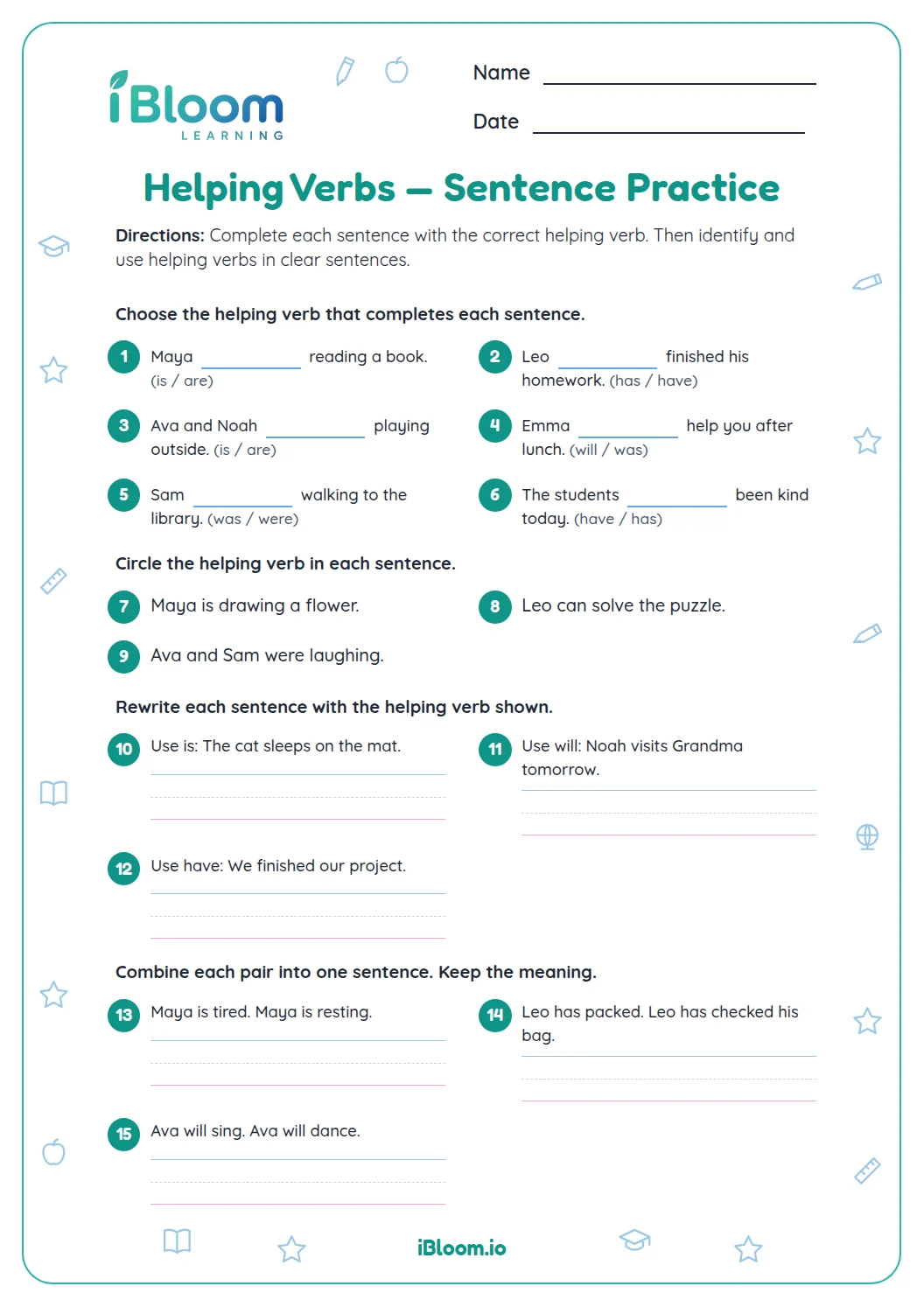
This free printable Grade 3 worksheet gives children sentence-level practice with action verbs, the words that tell what someone or something does. Children circle the verb in four sentences, choose the verb that fits in six more (three that tell action from linking words like is and was, and three that need a clue), and write two sentences of their own. It practices Common Core L.3.1.a and L.3.3.a, and a separate answer key is included.
Aligned to L.3.1.a and L.3.3.a
What is an action verb?
An action verb is a word that tells what someone or something does: a dog digs, a boy kicks, a bird builds. A good test is to ask whether you could act the word out. You can act out skip or whisper, but you cannot act out is or was.
Words like is, was and seems are verbs too, but they link a subject to a description. They are the wrong choices in questions 5 to 7 on this sheet, so children practice telling real actions from linking words.
How do children find the verb in a sentence?
Start with the subject, the person or thing the sentence is about. Then ask, “What does it do?” The answer is the action verb. In question 1, the subject is the dog and what the dog does is dig.
Past and present forms both count. Question 2 uses kicked, which tells about something already done, and question 1 uses digs, which tells about now.
- 1The dog digs a deep hole.
- 2Who is it about? the dog
- 3What does the dog do? digs
- 4Circle digs
What is on this worksheet?
Twelve questions in four parts, from finding a verb to using one. The sentences are short so that attention stays on the verb.
- Part A: circle the action verb in four sentences
- Part B: choose the action verb that fits a blank, with is, was and seems as the other choices
- Part C: choose the clearest verb from three action verbs, using clue words like tired, slowly and sleeping
- Part D: write two sentences with an action verb (one uses jumped)
- Answer key on a separate page
Why does choosing the right action verb matter?
Some action verbs say much more than others. In question 8 the tired puppy crawled, and that one word shows how slowly it moved. Sprinted would be wrong, because the clue words say the puppy is tired.
Part C asks children to read the whole sentence for clues before choosing a verb, which is the same habit that helps them pick strong verbs in their own writing.
How to use this worksheet at home or in class
- 1Read the directions for Part A aloud and ask your child to act out two verbs, such as skip and whisper.
- 2Do question 1 together using the two questions: who is it about, and what do they do?
- 3Let your child finish Part A alone, then check it with the answer key before going on.
- 4For Part B, have your child read each choice in the blank before deciding, and say why is, was and seems do not show action.
- 5For Part C, ask your child to underline the clue word in each sentence, such as tired or sleeping, before choosing.
- 6For Part D, read each sentence aloud with your child, and check it begins with a capital letter and ends with a period.
Common mistakes and quick fixes
The mistake
Circling the noun instead of the verb, such as hole in question 1 or nests in question 3.
The fix
Ask what the subject does, not what it touches. The dog digs a hole, so digs is the action; hole is the thing that gets dug.
The mistake
Choosing is or was because the sentence sounds almost right, as in question 7.
The fix
Read it aloud with each choice. “My brother is his bike” makes no sense, but “My brother rides his bike” shows an action.
The mistake
Picking a strong verb that does not match the clue words, such as sprinted for the tired puppy in question 8.
The fix
Underline the clue words first. Tired and slowly point to crawled, and sleeping and quiet point to tiptoed.
Common Core alignment
Most US states use the Common Core standards or a close state version. These two Grade 3 language standards describe what this sheet practices.
Explain what a verb does in a sentence: here, name the action the subject does.
On this sheet: Parts A and B ask children to find and choose the verb that tells what the subject does.
Show the official wordingHide the official wording
Explain the function of nouns, pronouns, verbs, adjectives, and adverbs in general and their functions in particular sentences.
Choose words for effect, such as crawled for a tired puppy and tiptoed past a sleeping baby.
On this sheet: Part C asks children to choose the verb that shows how a puppy, a runner or Mia moves.
Show the official wordingHide the official wording
Choose words and phrases for effect.
What to practice next
Make more practice
Further reading
Questions parents and teachers ask
What is an action verb?
An action verb is a word that tells what someone or something does, such as run, dig, kick or whisper. On this worksheet, children find action verbs in sentences like “The dog digs a deep hole” and “Ava whispered to her sister.” An easy test is to ask whether you could act the word out.
How is an action verb different from a linking verb?
An action verb shows something being done, while a linking verb such as is, was or seems connects the subject to a description. Part B of this worksheet puts them side by side. In question 6, stirs shows what the chef does, while was and seems would not make sense.
Why is sprinted the answer to question 9?
The sentence says the runner crossed the line as fast as she could, so the verb has to show speed. Sprinted does. Strolled is slow, and tiptoed means walking quietly on your toes. Reading the clue words in the whole sentence is the skill Part C is built to practice.
Do the verbs have to be in the same tense?
No. The sentences mix present tense (digs, build) and past tense (kicked, whispered) on purpose, and in each one the verb still names what the subject does. Past and present forms are practiced in more detail on the Past Present Tense worksheets, linked under the next skills on this page.
What should my child write in Part D?
Each answer should be one complete sentence with a capital letter, an action verb and a period. For question 11 the sentence has to use jumped, for example “The frog jumped into the pond.” In question 12, any sentence about a bird with a clear action verb is correct.
Is there an answer key for this worksheet?
Yes. A separate answer key shows the circled verb in each Part A sentence, the correct choice in Parts B and C, and a sample sentence for each of the two writing questions in Part D. Print the worksheet pages by themselves and keep the key for checking together afterward.