






About this worksheet
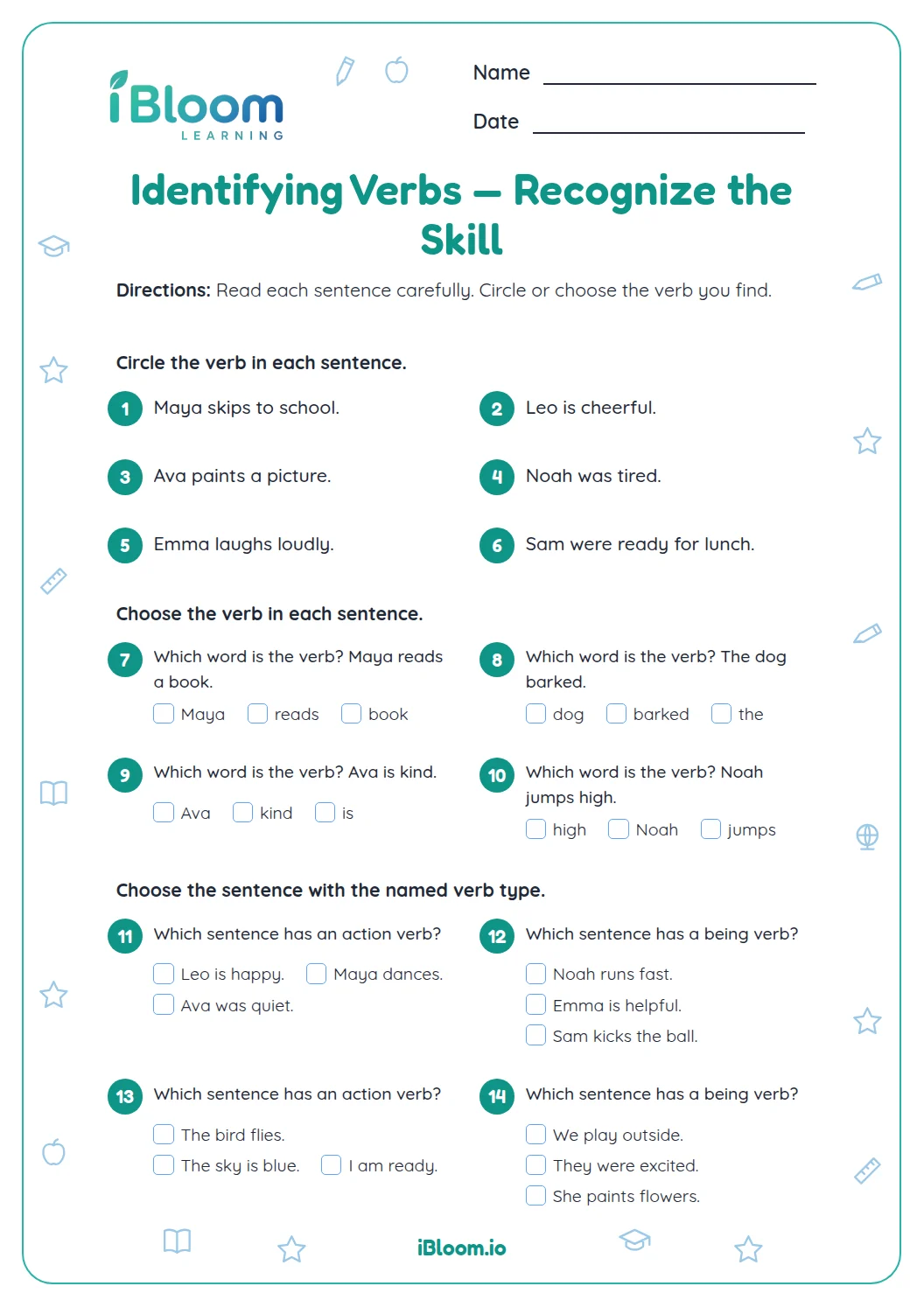
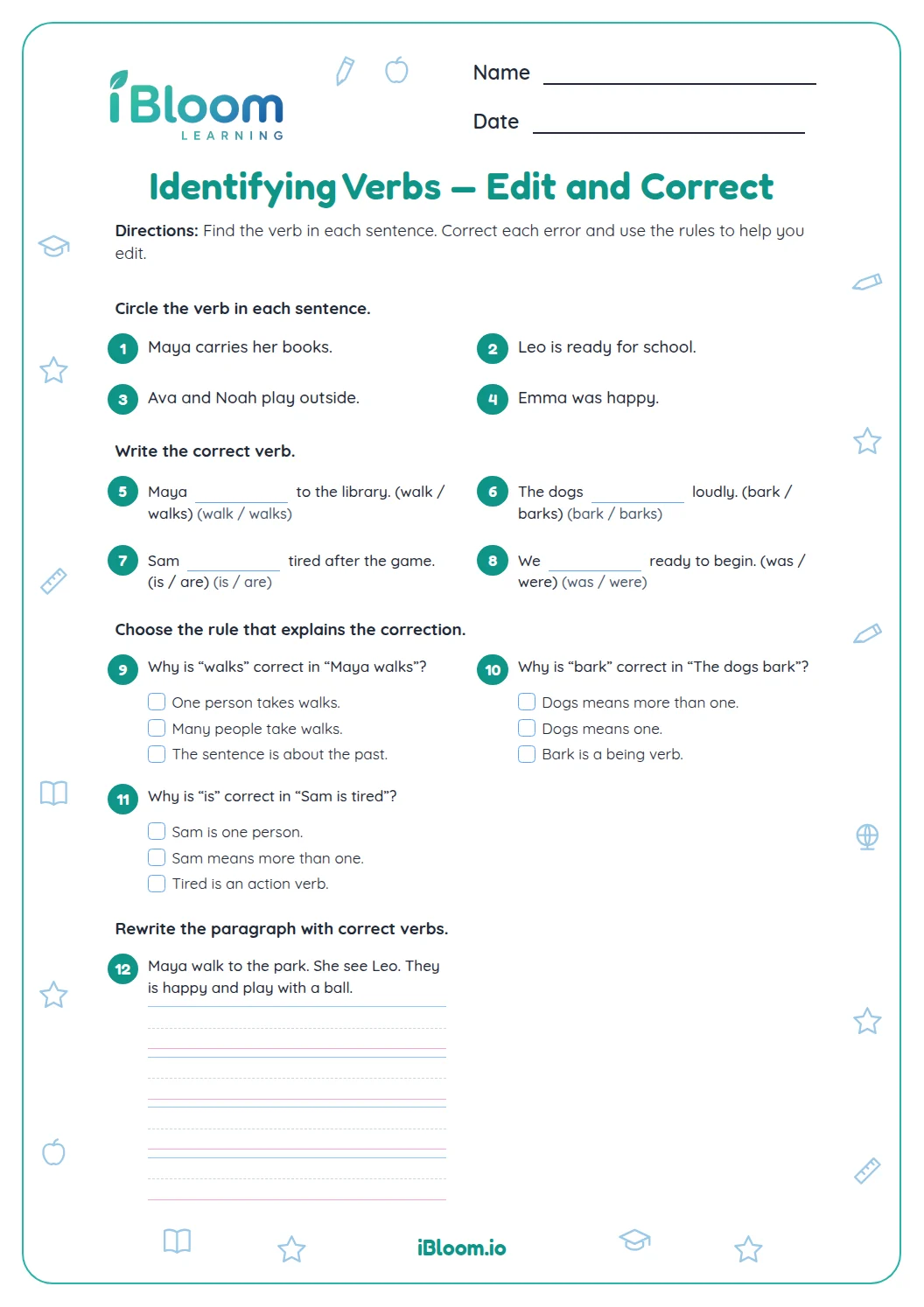
This free Grade 3 worksheet gives students 16 sentences and asks them to circle the verb in each one. The set includes action verbs such as carries and visited, linking verbs such as is and seem, and a helping-verb phrase in “I can help today.” A two-page answer key shows the target word or words for every sentence. The activity practices CCSS L.3.1.a by identifying verbs and noticing their function in particular sentences.
Aligned to L.3.1.a
What does a verb do in a sentence?
A verb tells what a person, animal, or thing does, or describes a state of being. Part A begins with direct examples such as “Maya carries lunch” and “Leo is ready.” Circle the word that does the verb’s job in that sentence.
- 1Maya carries lunch.
- 2What does Maya do? She carries lunch.
- 3Circle carries.
Are all the verbs action words?
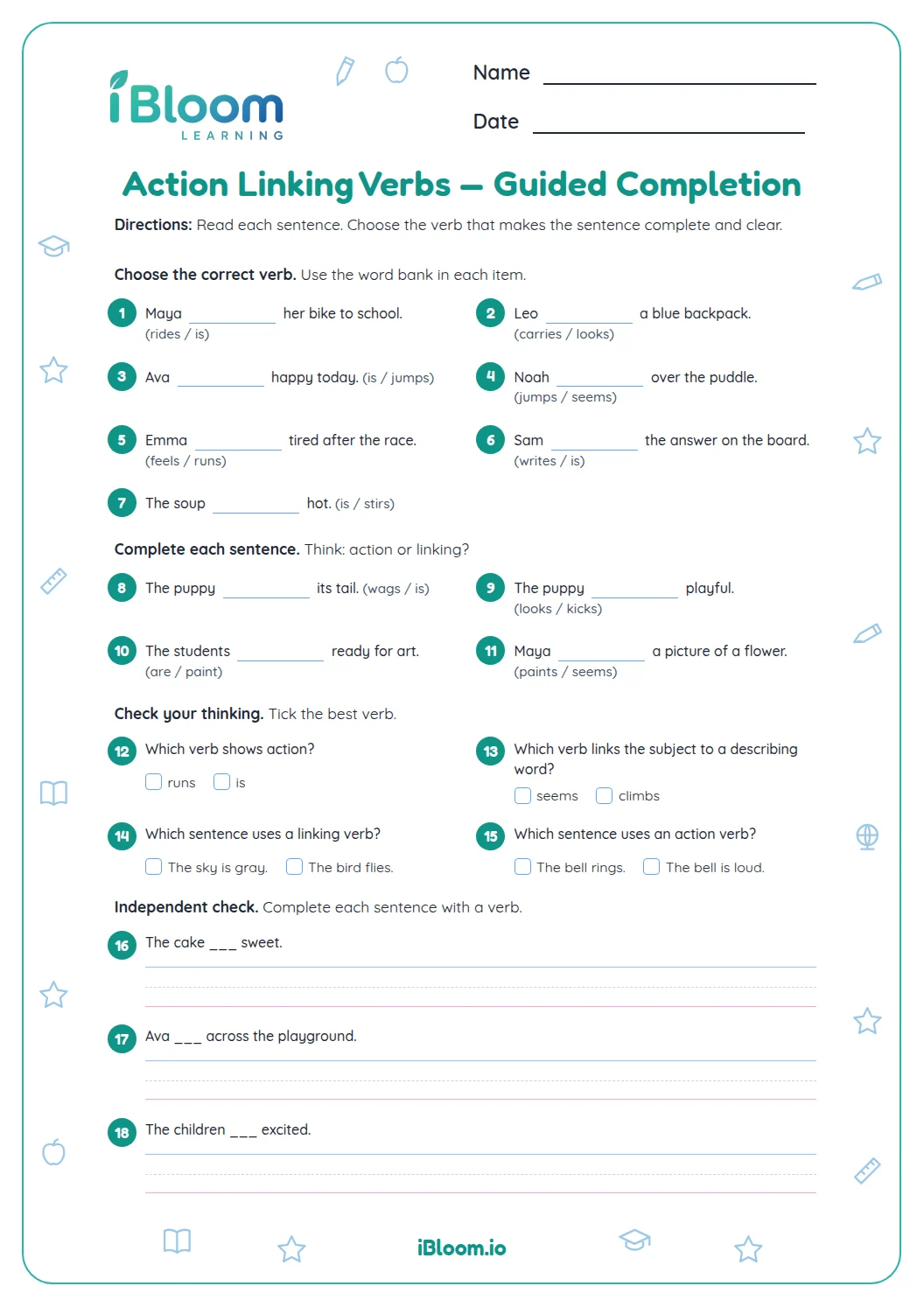
No. Some verbs link a subject to a description, as is does in “Leo is ready” and seem does in “They seem happy.” “The soup smells good” uses smells to link soup with a description of it. Read the whole sentence so you can tell how the verb is working.
What if a sentence has a helping verb?
In “I can help today,” can helps the main verb help. Together, can help is the verb phrase. Circle both words for that item. For the other sentences, circle the single verb that shows the action or state. The key identifies both words in the phrase.
How to identify each verb
- 1Read the complete sentence aloud.
- 2Ask what the subject does, or what the sentence says the subject is like.
- 3Circle the word that answers that question.
- 4Check whether a helping verb works with a main verb, as can help does.
- 5Compare all 16 responses with the key and reread any missed sentence.
Common verb-identification slips
The mistake
Circling a noun such as lunch instead of the action word.
The fix
Ask what the subject does; Maya carries, so carries is the verb.
The mistake
Missing a linking verb because it does not show a visible action.
The fix
Look for a word such as is, was, smells, or seem that connects the subject to a state or description.
The mistake
Circling only help in “I can help today.”
The fix
Include the helping verb can with the main verb: can help.
Curriculum alignment
This worksheet practices the skill described in the listed standard.
Identify verbs and consider their function in the sentences on the sheet.
On this sheet: Students circle verbs in action, linking, and helping-verb examples; the key includes both words in “can help.”
Show the official wordingHide the official wording
Explain the function of nouns, pronouns, verbs, adjectives, and adverbs in general and their functions in particular sentences.
What to practice next
Make more practice
Further reading
Questions parents and teachers ask
How many sentences are on this verb worksheet?
There are 16 sentences across four parts, printed on two worksheet pages. Students circle the verb in each sentence, and the separate two-page key marks the answers. The examples include action verbs, linking verbs, and one helping-verb phrase. The first sentences review single-word verbs before the mixed examples.
Does the worksheet include linking verbs?
Yes. Examples include is in “Leo is ready,” was in “Sam was tired,” smells in “The soup smells good,” and seem in “They seem happy.” The surrounding words help students see how each verb links a subject with a state or description.
What should students circle in “I can help today”?
Circle both can and help. Can is the helping verb, and help is the main verb; together they form the verb phrase. The answer key marks both words, so students can compare the complete phrase rather than only the action word.
Is “smells” a verb in “The soup smells good”?
Yes. Smells links the subject soup to the description good. It does not describe an action the soup is doing, but it still functions as the verb in this sentence. Reading the whole sentence helps show the word’s job. Here, smells connects soup with how it is described.
Which standard does this worksheet support?
It supports CCSS L.3.1.a, which asks students to explain the function of verbs and other parts of speech generally and in particular sentences. Here, students identify verbs in action, linking, and helping-verb examples. They apply the idea in complete sentences.
How should an adult check the work?
Have the student finish the 16 sentences before using the key. For a missed response, reread the sentence and ask what the subject does or what state it is in. For “can help,” point out both parts of the verb phrase.