




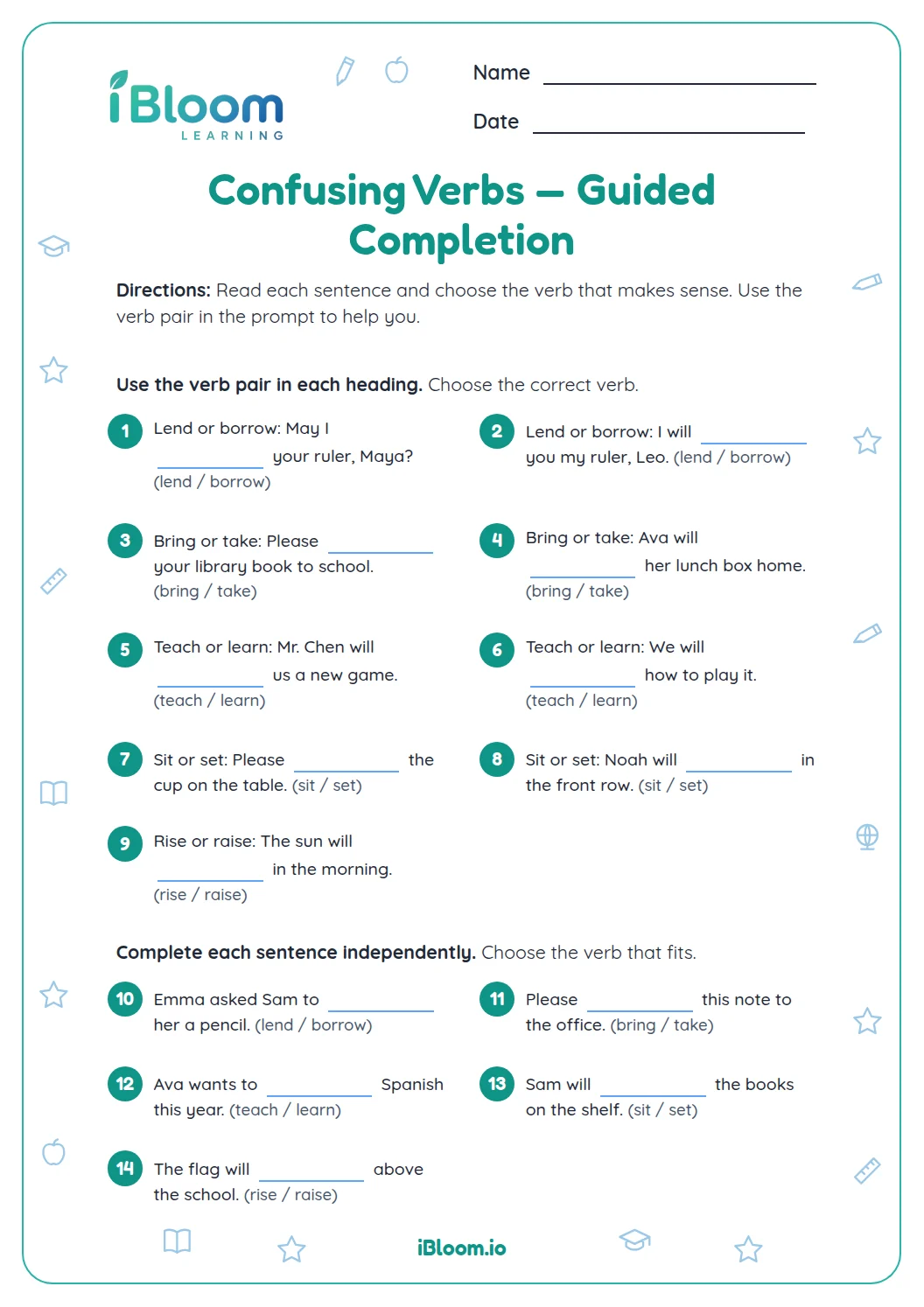

About this worksheet
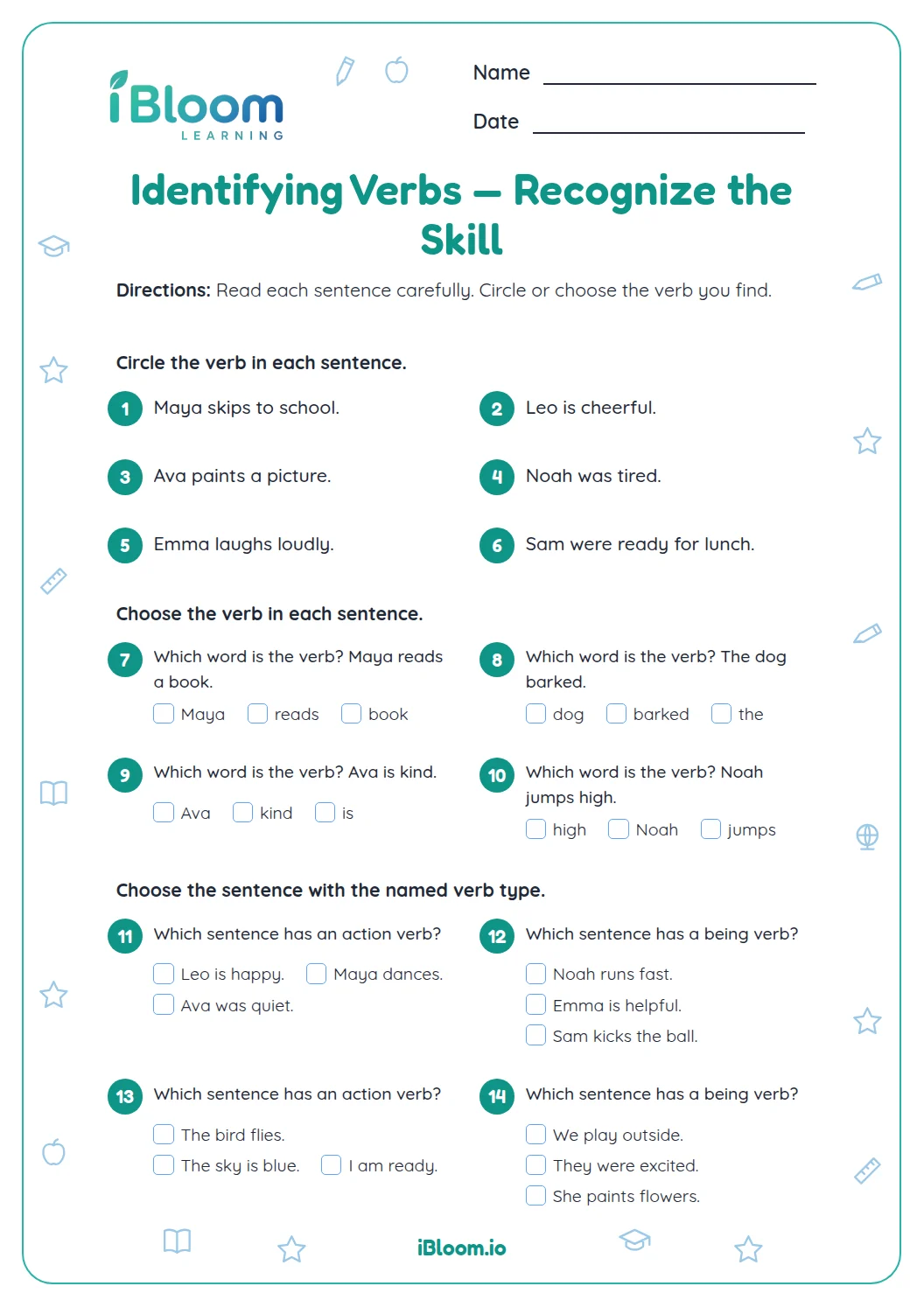
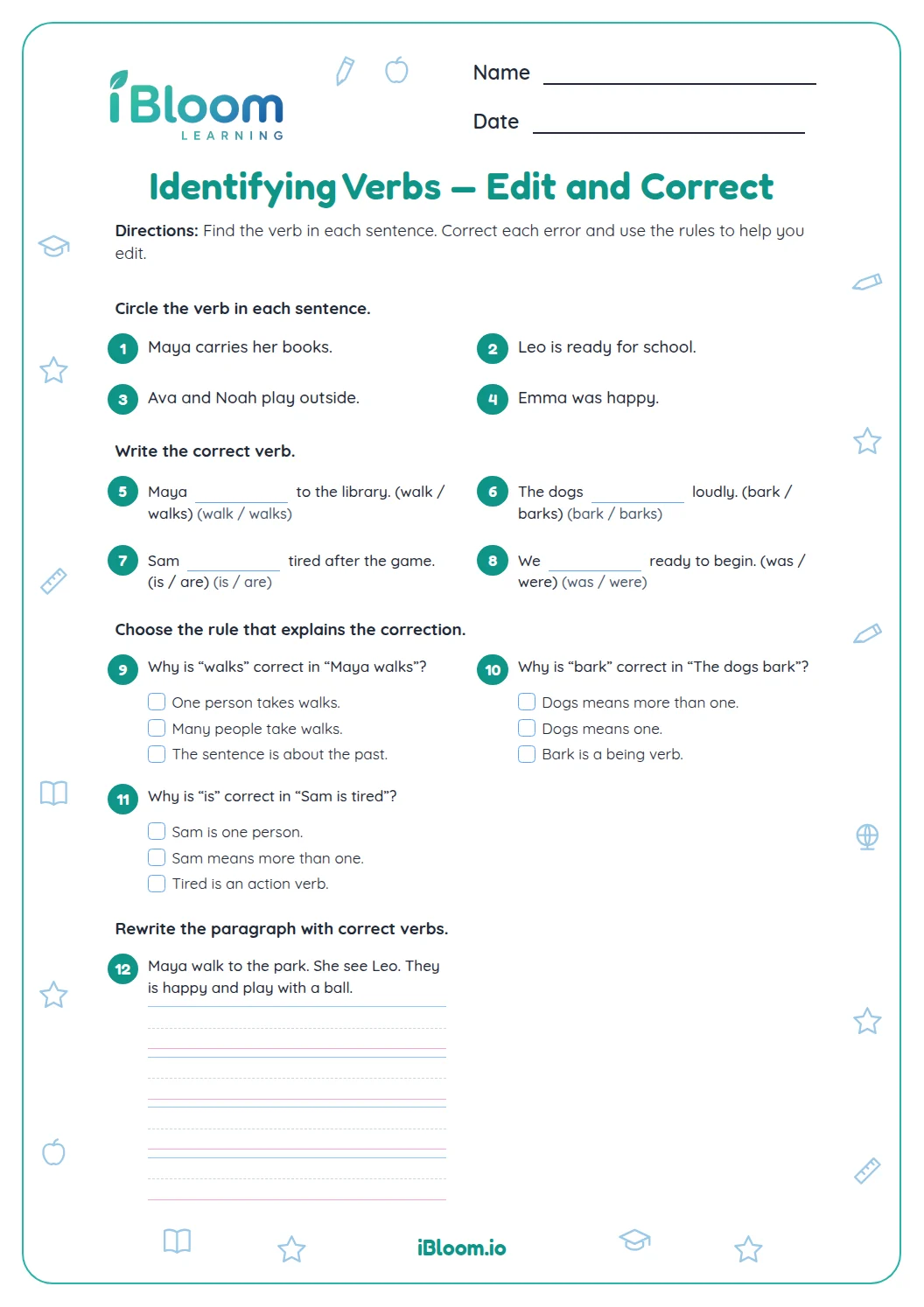
This Grade 3 printable gives learners 14 compact questions on finding verbs and applying them in complete sentences. It includes a separate answer key for checking responses.
Aligned to L.3.1.a
How do learners find a verb?
Read the whole sentence and ask what the subject does or is. The first questions include action verbs and the being verb “are.”
- 1Maya planted three seeds.
- 2“Planted” tells what Maya did, so it is the verb.
How does a verb fit its sentence?
The middle questions practice past and present forms and matching the verb to its subject. Read time clues such as “yesterday” and “every day” before choosing.
What writing practice is included?
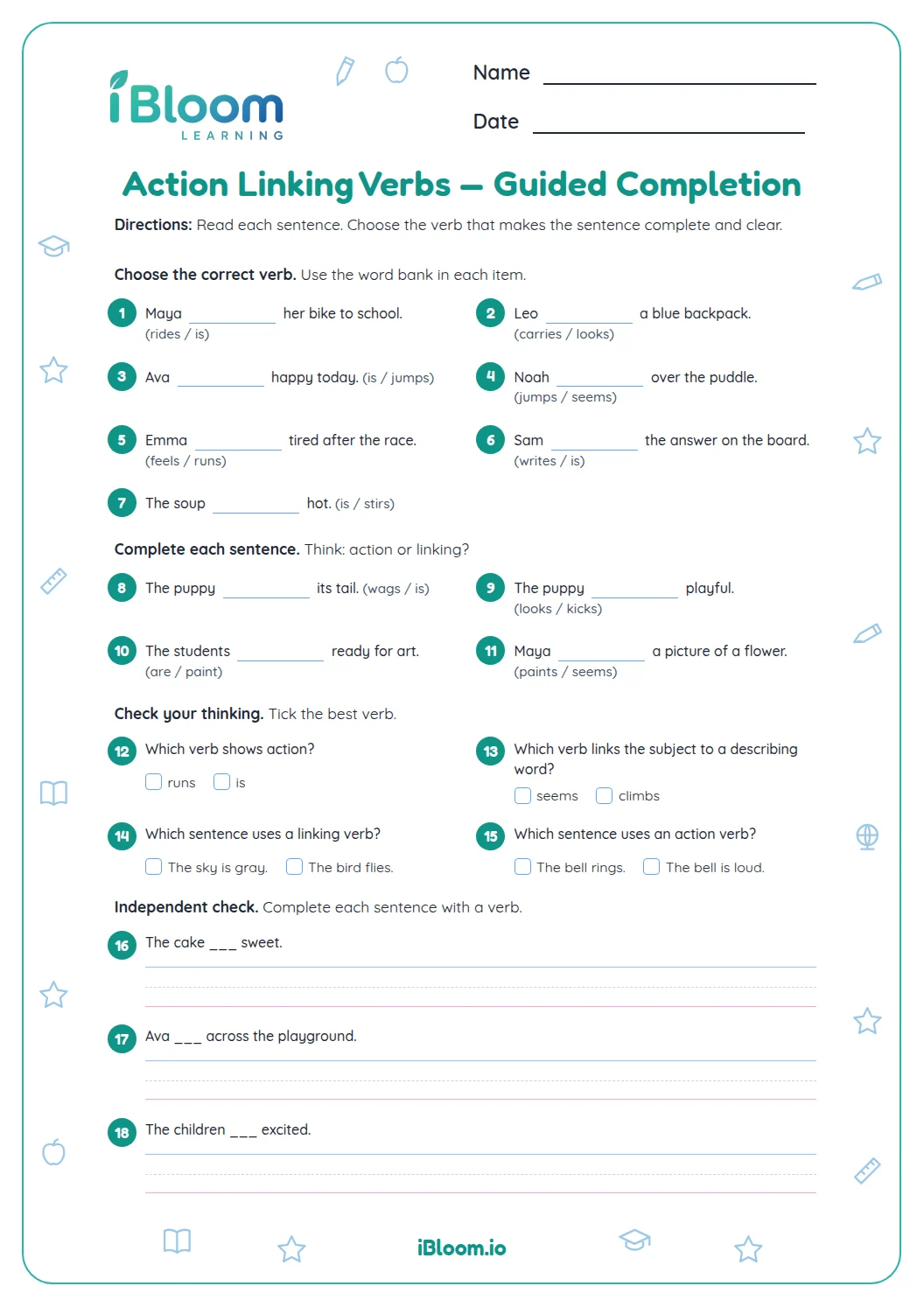
The final questions ask learners to complete sentences with verbs that fit the meaning and time clues. The key gives the expected verb for each item.
How many pages should I print?
Print the two worksheet pages. The answer key is a separate set of pages for checking completed work.
How to use this worksheet
- 1Read the full sentence before choosing or underlining a verb.
- 2Ask whether the verb shows an action or being.
- 3Use time words to choose past or present tense.
- 4Check that the verb agrees with its subject.
- 5Complete each sentence with a verb that fits.
- 6Use the separate key to review the fixed-answer items.
Common mistakes and quick fixes
The mistake
Skipping a being verb such as “are.”
The fix
Ask what the subject is, not only what it does.
The mistake
Using a present verb after “yesterday.”
The fix
Match the verb tense to the time clue.
The mistake
Writing “They was ready.”
The fix
Use “were” with the plural subject “they.”
Common Core alignment
Recognize and use verbs that show actions, being, and past or present time.
On this sheet: Recognize and use verbs that show actions, being, and past or present time.
Show the official wordingHide the official wording
Explain the function of nouns, pronouns, verbs, adjectives, and adverbs in general and their functions in particular sentences.
What to practice next
Make more practice
Further reading
Questions parents and teachers ask
What does the worksheet ask learners to do?
Learners find verbs in sentences, distinguish action and being verbs, choose forms that fit time and subjects, and complete sentences. The worksheet has 15 questions and a separate answer key. Read each full sentence to see what the subject does or is, then check which verb form makes the sentence complete.
Does it include being verbs?
Yes. Learners identify “are” in a sentence and choose “was” as a being verb in another example. The writing prompts also ask for a sentence with a being verb, so children practice recognizing and using this kind of verb in context.
How does the sheet practice verb tense?
Each answer is keyed directly, so learners can check the word they selected or wrote. For sentence blanks, compare the verb with the sentence meaning and its time clue. The key gives a target response, and a different verb may also work when it makes a clear, grammatical sentence.
What is included in the answer key?
The key gives answers for the identification, fill-in, and correction prompts. For open-ended sentence questions, it provides sample responses, since learners can write many correct sentences. Use the samples as models for a clear sentence that includes the requested kind of verb.
How can I help if a learner is stuck?
Have the learner read the complete sentence aloud and point to the subject first. Ask what the subject does or is, then look for a time clue such as “yesterday.” This routine helps connect the verb choice to the sentence instead of guessing from one word.