





About this worksheet
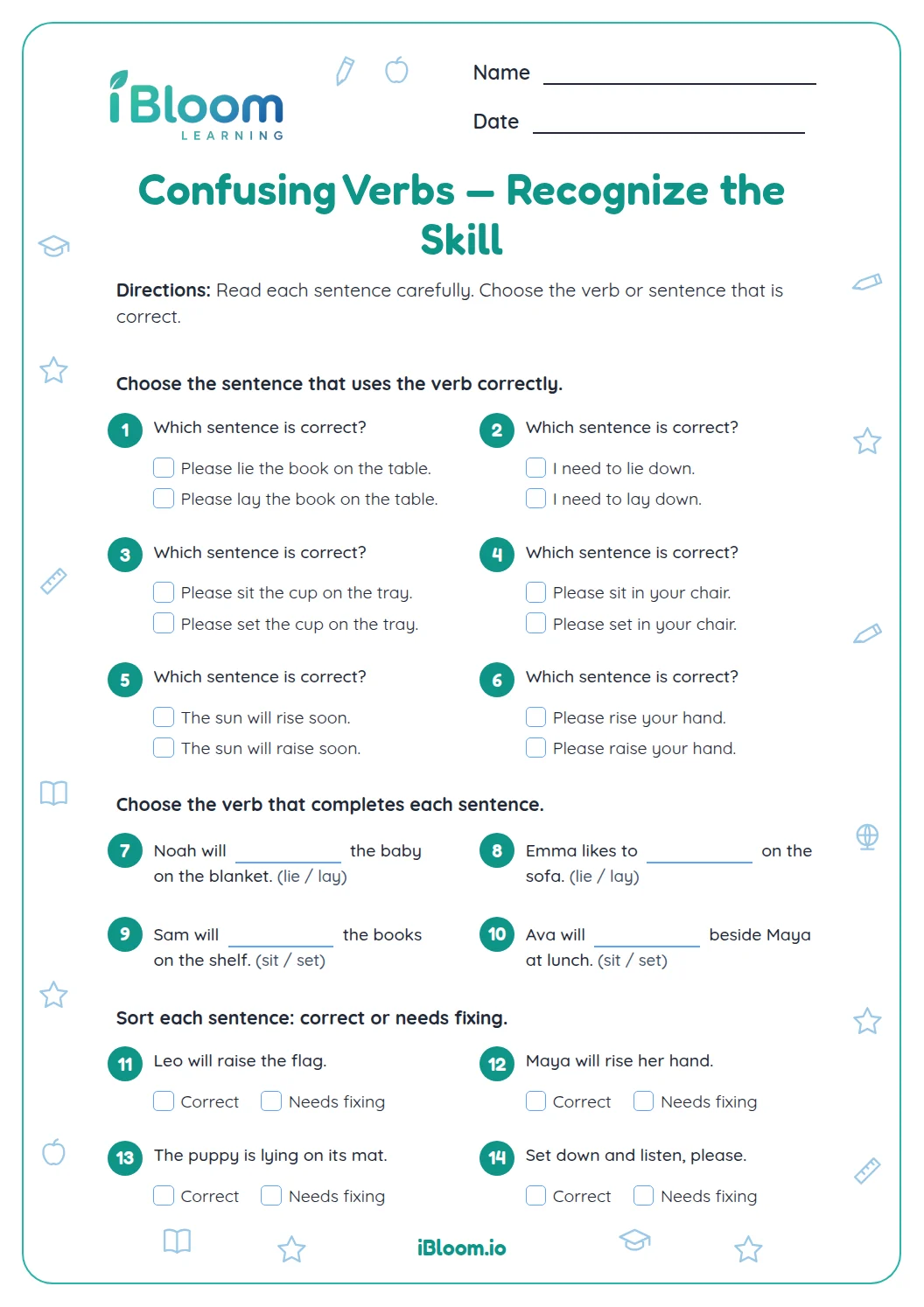
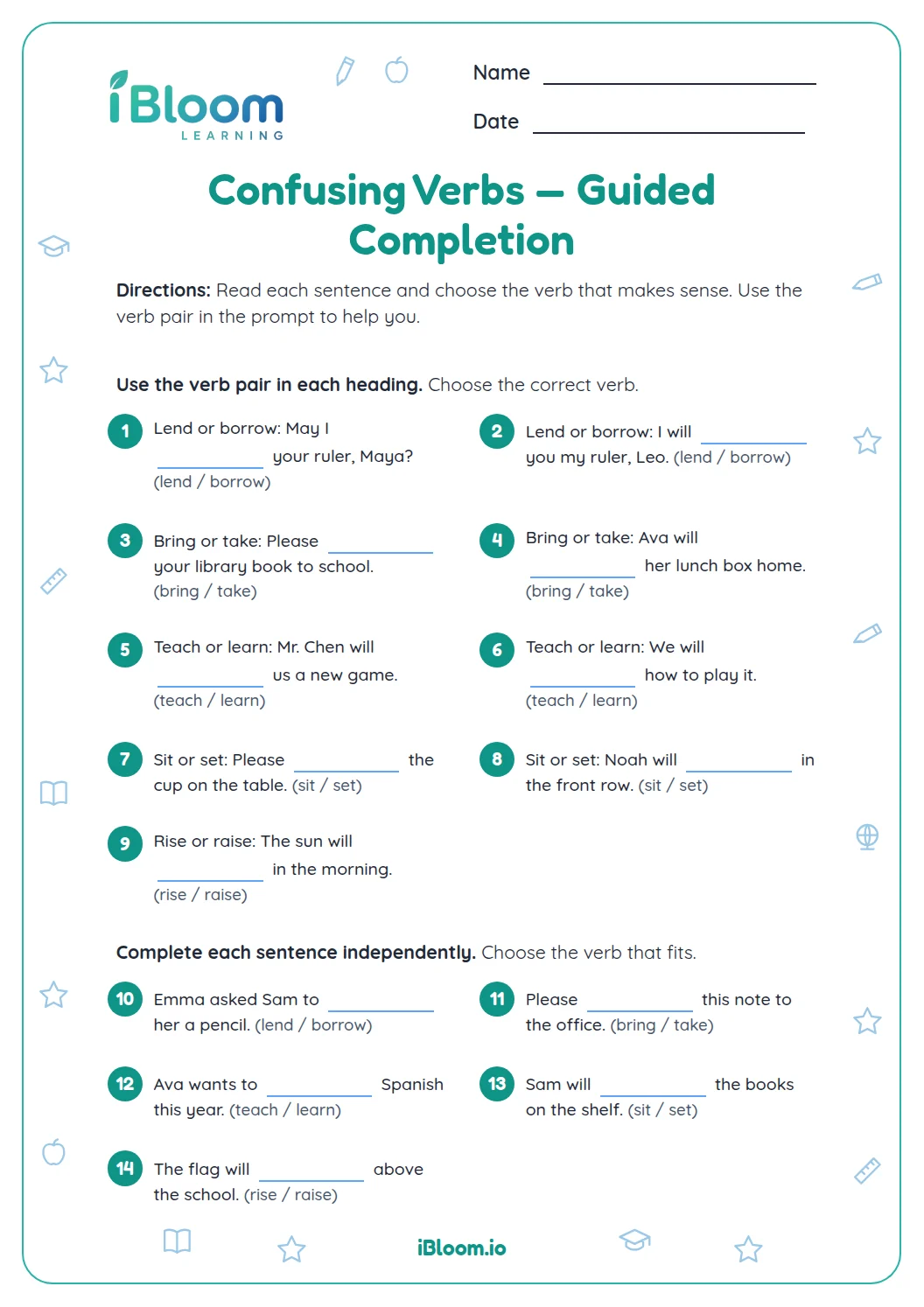
This Grade 3 worksheet practices confusing verbs in complete sentences. Students choose between pairs such as lend and borrow, bring and take, teach and learn, and lie and lay, then complete or combine sentences with the right verb. The questions support CCSS L.3.1 by asking students to use standard English grammar and usage in writing. A separate answer key includes sample sentences for the open responses.
Aligned to L.3.1
How can context help choose a verb?
Read the whole sentence and ask who is doing what. In question 1, Maya gives Leo permission to use her book, so she will lend it. In question 2, Leo receives and uses Maya’s book, so he will borrow it.
- 1Maya will lend her book to Leo.
- 2Maya gives the book; Leo receives it.
- 3Answer: lend
How do you repair a confusing verb?
Keep the sentence’s meaning, replace the verb that does not fit, and reread it. In question 11, “Ava ___ Noah how to skate” needs taught because Ava gives Noah instruction.
How can two ideas become one sentence?
Join the events with a clear verb that preserves who acted and who received the action. Question 14 uses set for putting plates in place and sit for Emma’s action afterward.
How to use this worksheet
- 1Read the entire sentence before choosing a verb.
- 2Ask who gives, receives, carries, teaches or rests.
- 3Use the clue to choose the verb with the needed meaning.
- 4For completion items, choose the form that fits the sentence.
- 5For combinations, keep both ideas and make the sentence clear.
Common mistakes and quick fixes
The mistake
Switching lend and borrow
The fix
The person who gives an item lends it; the person who receives it borrows it.
The mistake
Using teach for the learner
The fix
The person who gives instruction teaches; the person gaining a skill learns.
The mistake
Using lay when someone rests
The fix
In present tense, lie means rest and lay means place. Lay is also the past tense of lie, as in “Sam lay on the couch.”
Curriculum alignment
The questions give students practice with the skill named in this standard.
Uses standard grammar and verb usage while choosing, correcting and combining sentences.
On this sheet: Students apply standard verb usage in sentence choices, corrections and combinations.
Show the official wordingHide the official wording
Demonstrate command of the conventions of standard English grammar and usage when writing or speaking.
What to practice next
Make more practice
Further reading
Questions parents and teachers ask
Which confusing verb pairs are included?
Students choose among lend and borrow, bring and take, teach and learn, and lie and lay. They also repair or combine sentences using those verbs. The answer key lists the intended choices and gives sample wording for questions where more than one sentence can work.
What is the difference between lend and borrow?
The person who gives an item lends it, and the person who receives it borrows it. In question 1, Maya lends her book to Leo. In question 2, Leo borrows Maya’s book. Looking at who has the item helps make the choice clear.
How are bring and take different?
Bring usually means to carry something toward the speaker or a place being discussed; take means to carry it away to another place. The sentence gives the direction clue. Students read the destination and speaker context before choosing between the two verbs.
Why does the worksheet include lie and lay?
Lie can mean to rest in a reclining position, while lay means to put something down. In question 12, lay is the past tense of lie: Sam rested on the couch. The other items compare a puppy lying down with laying a book on a table.
What kinds of written responses are included?
Four questions ask students to complete a verb in context, and two ask them to combine related ideas. The key gives a sample for each open response. Accept another sentence when it keeps the intended meaning and uses the confusing verb correctly.