




About this worksheet
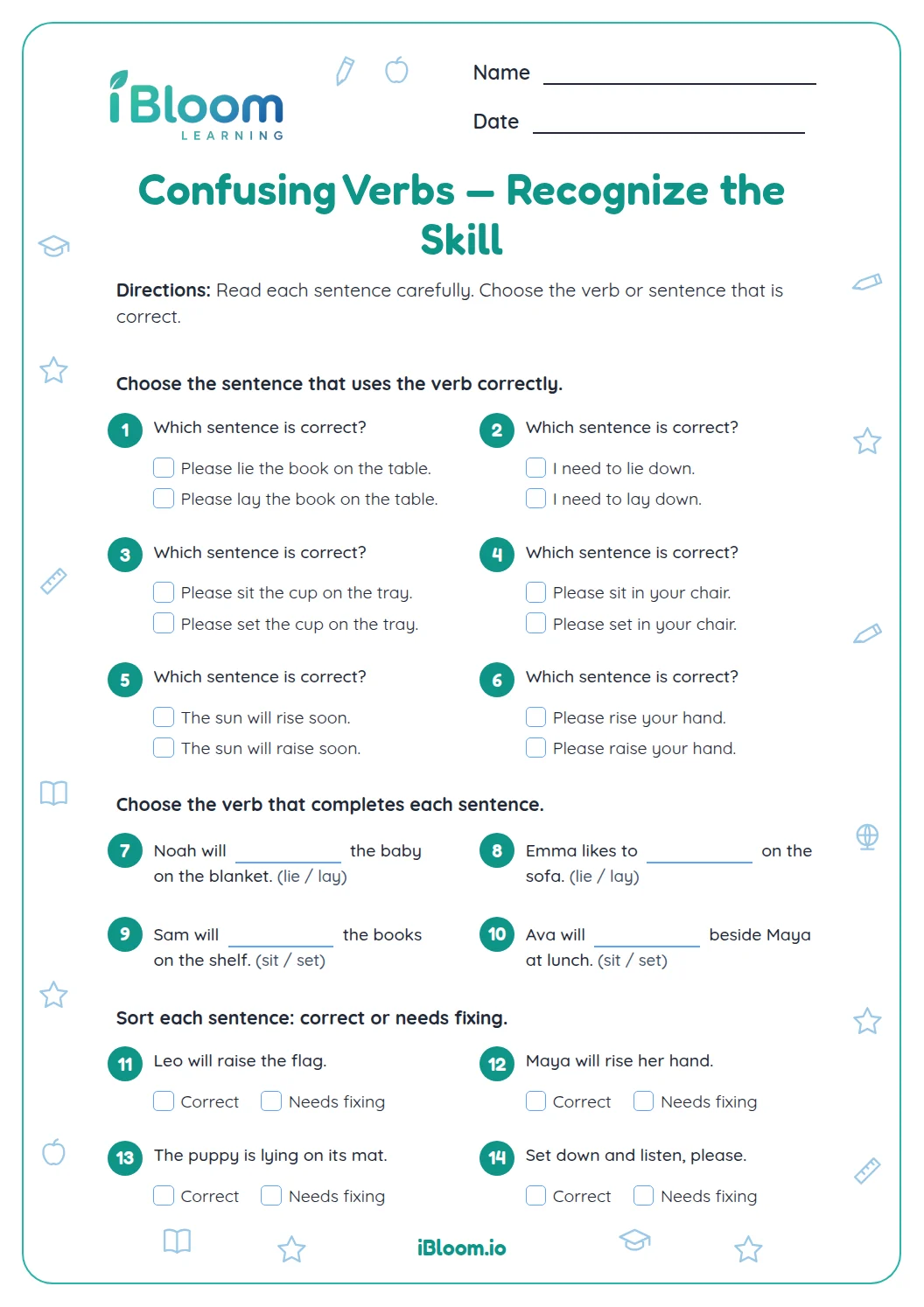
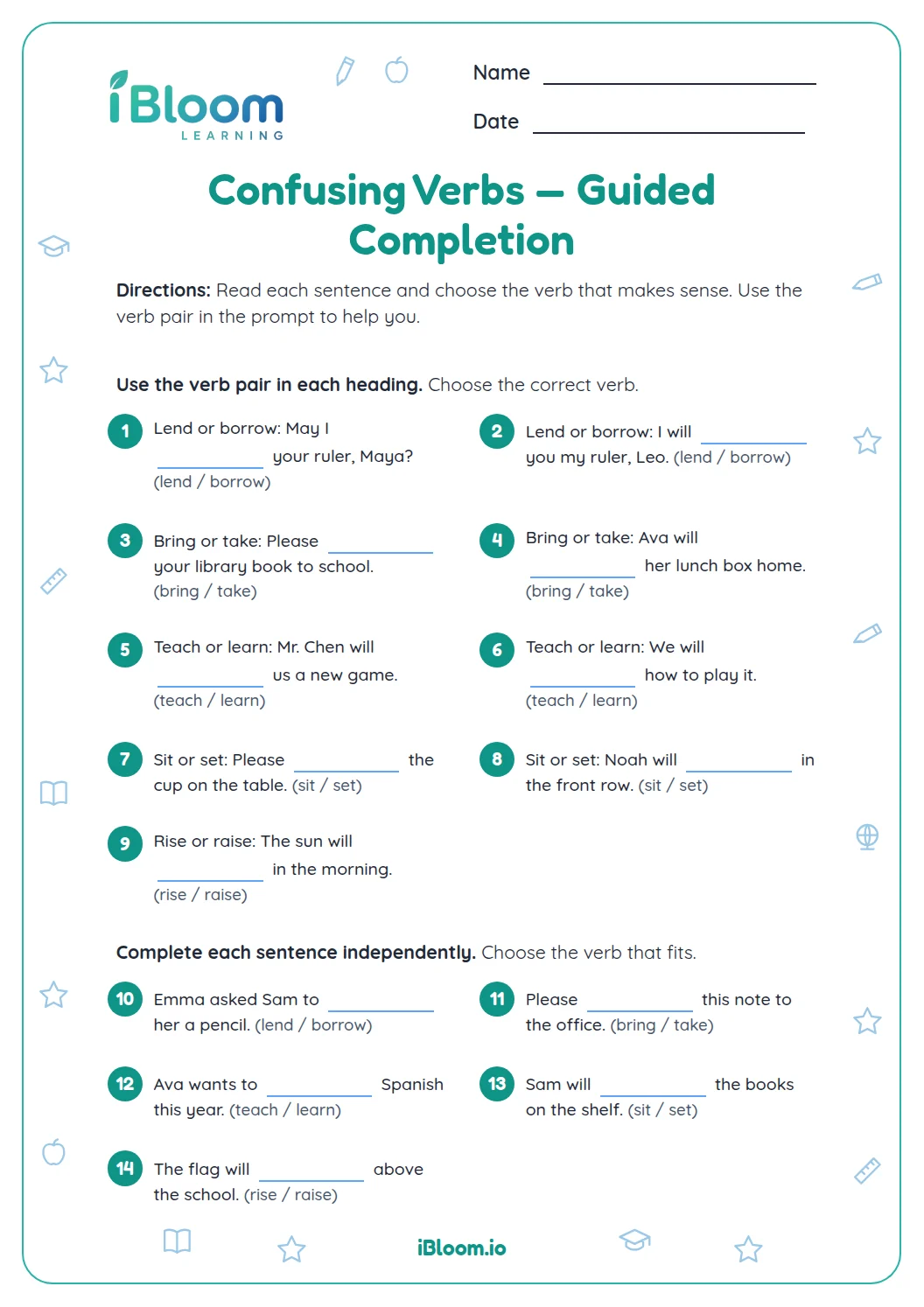
These sentences make each choice depend on meaning and context. Students distinguish verb pairs such as take and bring, borrow and lend, teach and learn, and review familiar sound-alike words that can be confused in writing. Sixteen short items replace the old single sentence-choice prompt with varied, age-appropriate application.
Aligned to L.3.1.a
How does context help with confusing words?
Read the whole sentence before choosing. The sentence often tells who is acting, what is moving, and where it is going. “Borrow” means receive something temporarily; “lend” means give it temporarily. “Teach” means help someone learn.
The pairs in questions 9–14 are especially useful to say aloud with the sentence around them.
What about words that sound alike?
Some choices sound alike but have different meanings or spellings. “Its” shows possession, while “it’s” means “it is.” “There” points to a place, “their” belongs to people, and “they’re” means “they are.”
What quick check helps choose a verb?
Look for the subject and any object. Someone can sit, but a person sets a book down; the sun rises, while a person raises a hand.
How to use this worksheet
- 1Read the whole sentence before choosing a verb.
- 2Ask whether the subject reclines, sits, places, or lifts something.
- 3Write each target verb in a sentence that shows its meaning.
- 4Use the key to check the verb and revise the paragraph if needed.
Common mistakes and quick fixes
The mistake
Using lay without an object.
The fix
Use lie for reclining; use lay to place something.
The mistake
Mixing up sit and set.
The fix
Sit describes a seated person; set places an object.
The mistake
Using rise when someone lifts something.
The fix
Use raise when a person or thing lifts an object.
Common Core alignment
Students choose and use verbs accurately in complete sentences and a short paragraph.
Use subject-verb and pronoun-antecedent agreement.
On this sheet: Students apply verb meanings in complete sentence contexts.
Show the official wordingHide the official wording
Explain the function of nouns, pronouns, verbs, adjectives, and adverbs in general and their functions in particular sentences.
What to practice next
Make more practice
Further reading
Questions parents and teachers ask
Which confusing verbs are on this worksheet?
The fourteen questions practice lie and lay, sit and set, and rise and raise. Students choose a verb in context, write original sentences, and use all four requested verbs in a short school-morning paragraph. The key includes the fixed answers and sample writing.
How are lie and lay different?
Use lie when a person or animal reclines: “The puppy will lie by the door.” Use lay when someone places an object somewhere: “Lay the book on the desk.” In the present tense, lay needs an object receiving the action.
How are sit and set different?
Sit means to rest in a seated position. Set means to place something. A student may sit beside a friend and set a book on the desk. In each sentence, look for whether a person is sitting or moving an object to a place.
When should I use rise or raise?
Rise describes something moving up on its own, as the sun rises. Raise means to lift something, such as raising a hand. Ask whether the subject moves upward by itself or whether someone lifts an object. Try acting out each meaning with a simple gesture.
How should I use the answer key for writing?
The key’s open-response examples show correct use, but students can write different sentences. Check that the requested verb fits the meaning and that the sentence is complete. For the paragraph, confirm all four target verbs appear in sensible contexts. Use gestures to remember which verb describes each action.