






About this worksheet
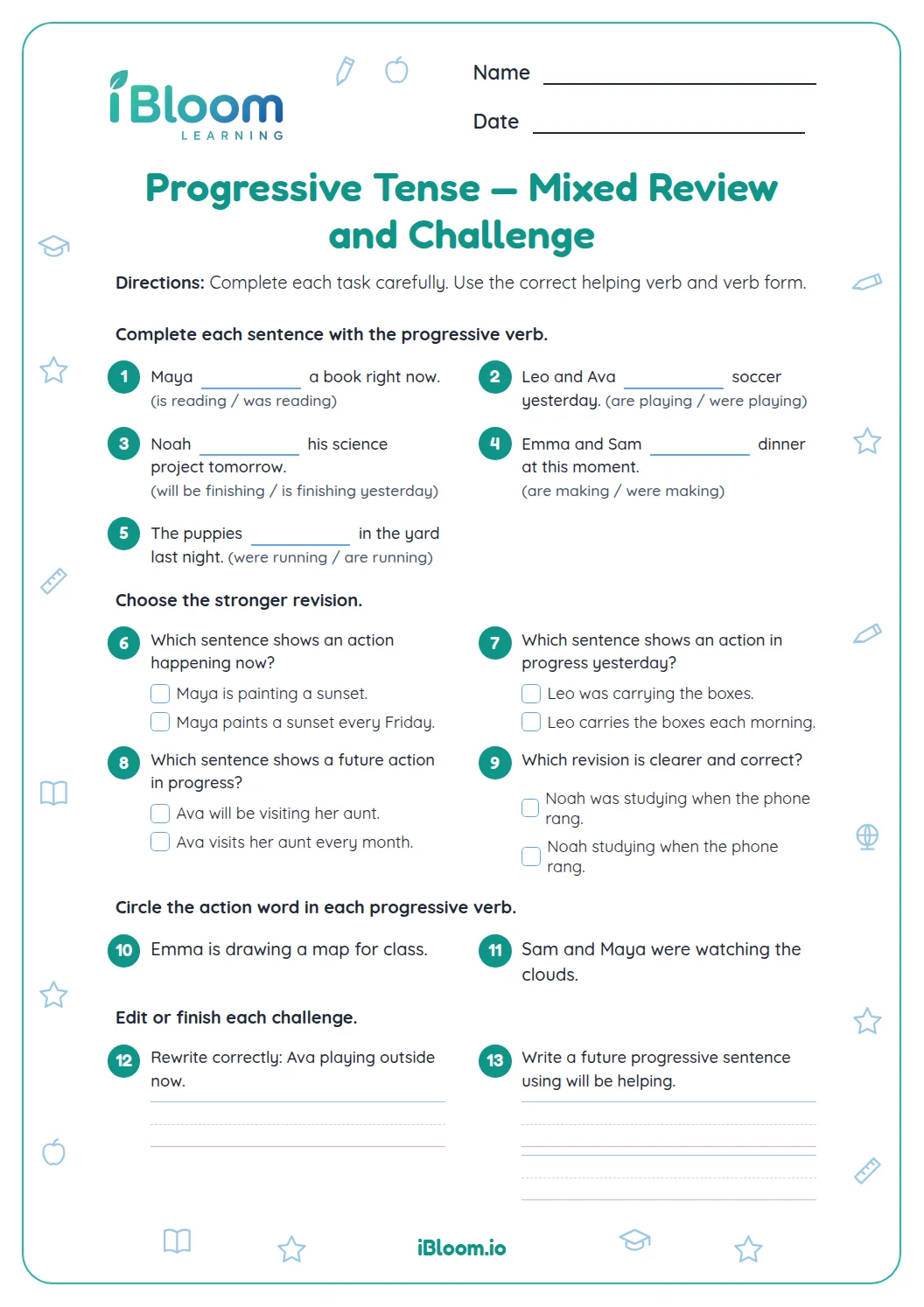
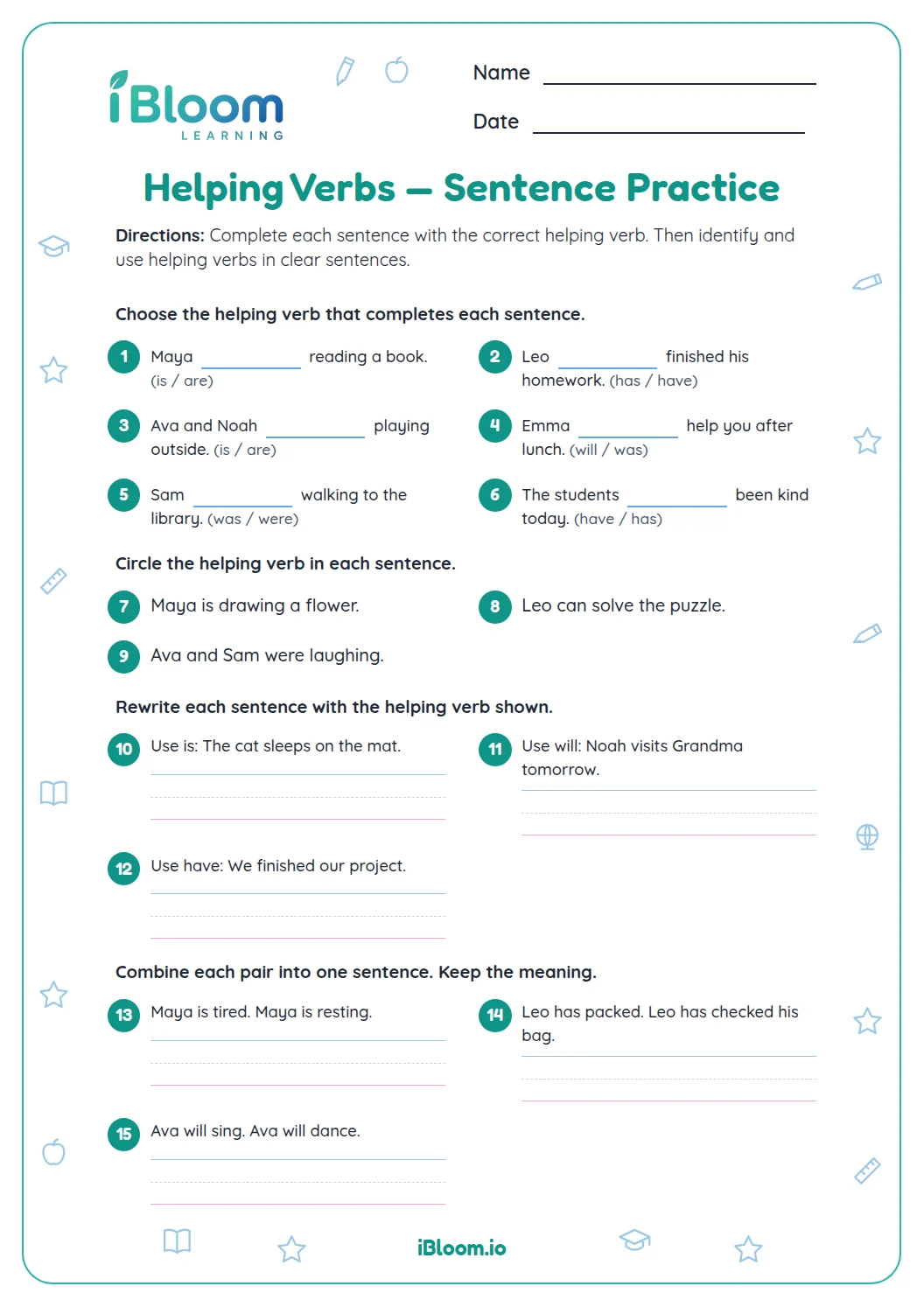
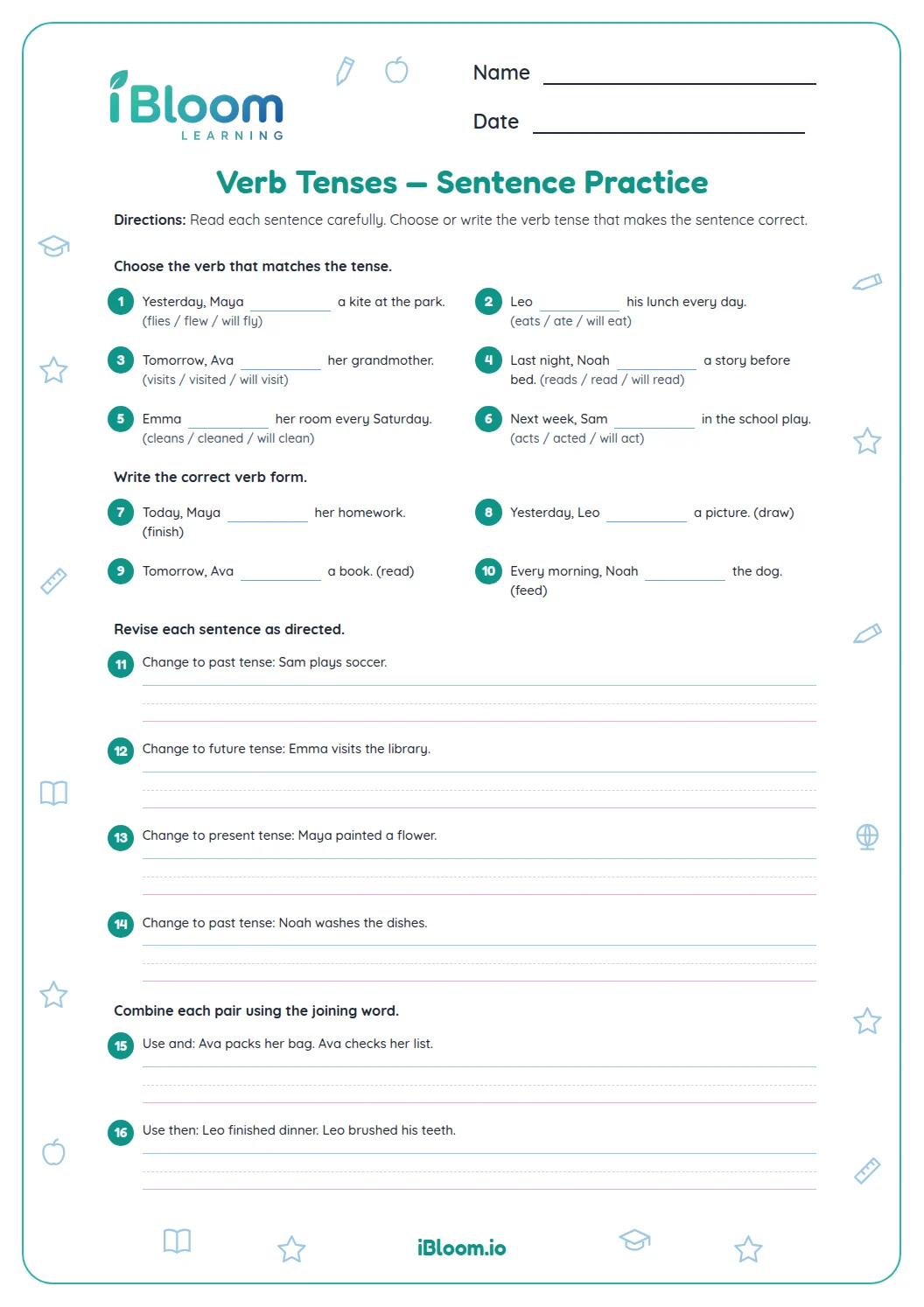
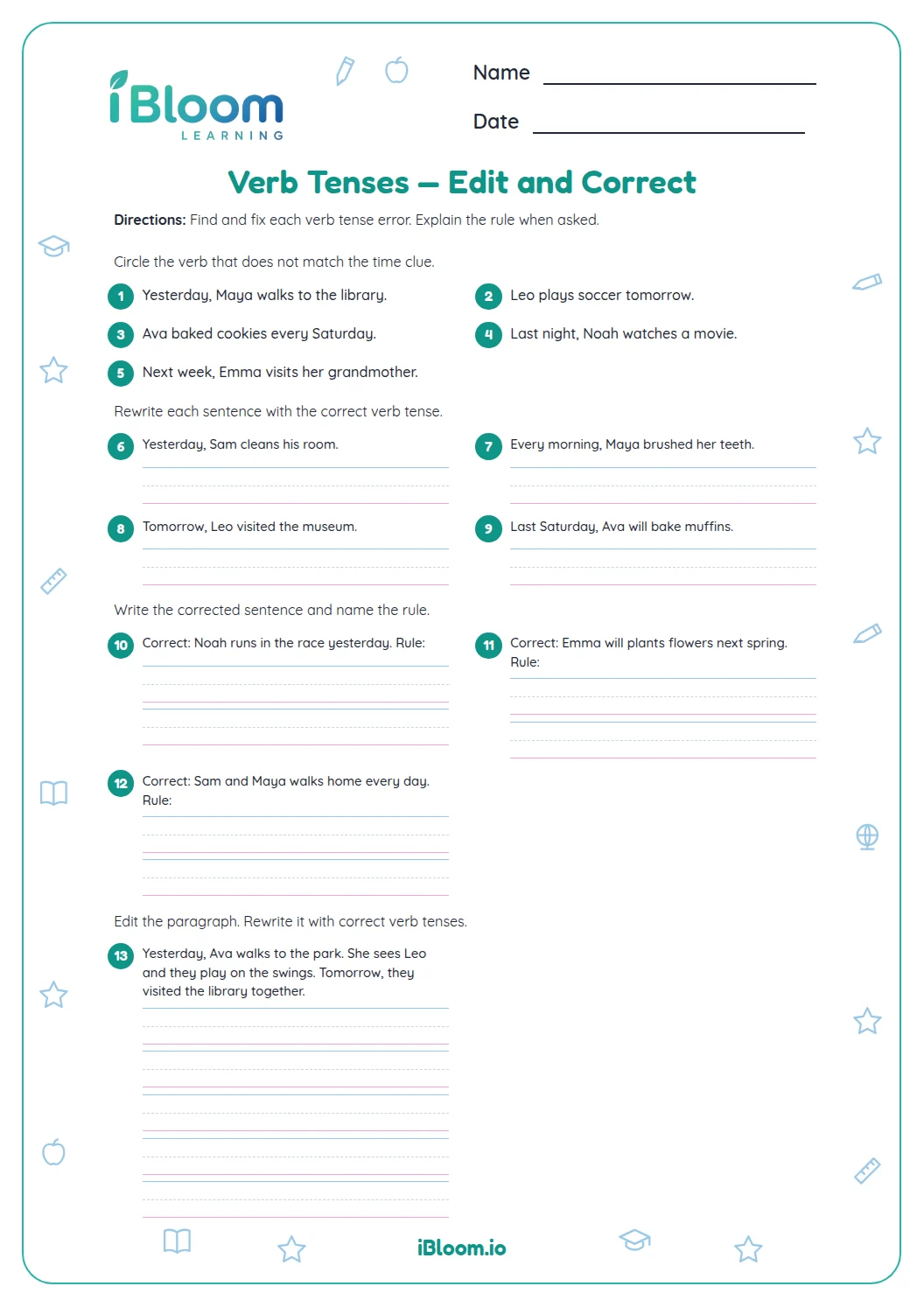
This Grade 3 worksheet practices progressive verb phrases in the present, past, and future. Students choose an -ing action word to complete a sentence that already includes its helping verb. Time clues such as “yesterday” and “tomorrow” help them read the full phrase and match it to the intended time.
How is a progressive verb phrase formed?
Use a form of “be” with an action word ending in “-ing”: is flying, were walking, or will be reading. The missing word in each question is the action word; the helping verb is already printed.
How do the time clues help?
Read clues such as “right now,” “yesterday,” and “tomorrow,” then check the helping verb. Together, they identify whether the action is in progress in the present, past, or future. In Question 3, “Yesterday at noon” and “was” point to “making.”
What should students check before choosing?
Read the whole phrase aloud. The answer should end in -ing and fit after the printed helping verb.
- 1Yesterday at noon, Dad was ___ lunch.
- 2Answer: making
How to use this worksheet
- 1Read the directions and example aloud.
- 2Complete the first part together, naming the clue or rule.
- 3Let the student try the next part independently.
- 4Use the answer key to check each response.
- 5Review one missed item by explaining the correct choice.
Verb-form slips and fixes
The mistake
Repeating the helping verb in the blank.
The fix
The sentence already has “is,” “was,” “were,” or “will be”; choose only the action word.
The mistake
Using the base verb after a helping verb.
The fix
For a progressive phrase, use the action word ending in -ing.
The mistake
Ignoring the time clue.
The fix
Match the time phrase and helping verb before comparing the action-word choices.
What to practice next
Make more practice
Questions parents and teachers ask
What is a progressive verb phrase?
A progressive phrase uses a form of “be” with an action word ending in “-ing.” Examples include “is flying,” “were walking,” and “will be reading.” The worksheet leaves the action word blank and prints the helping verb in the sentence.
How do time clues help?
Words such as “right now,” “yesterday,” and “tomorrow” show when an action is in progress. Pair the clue with the helping verb already in the sentence, then choose the -ing form that completes the phrase. Reading the full sentence helps confirm the choice.
Why does the helping verb change?
The helping verb changes with the time and subject. “Is” can describe an action happening now, “was” or “were” an action in progress in the past, and “will be” an action in progress in the future. The action word still ends in -ing.
What should students check in each answer?
Check that the choice names the action and ends in -ing. Then read it together with the helping verb and time clue. The answer key lists the intended action word for all sixteen questions so students can check their work after each section.
How can students practice after the sheet?
Invite the student to make a sentence about something happening now, something that was happening yesterday, and something that will be happening tomorrow. Underline the helping verb and action word ending in -ing in each example. This gives practice noticing the same progressive pattern across all three time frames.