






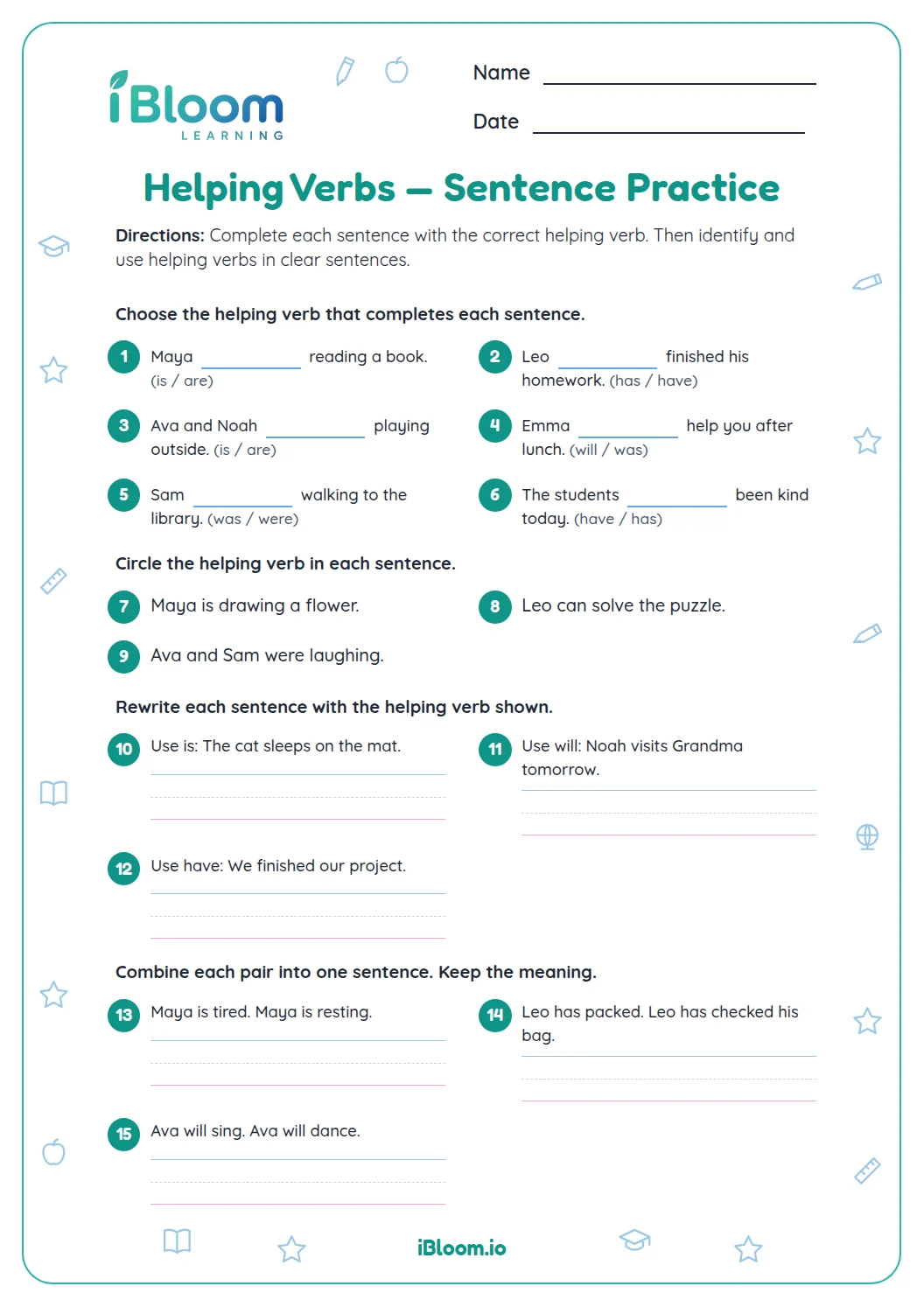

About this worksheet
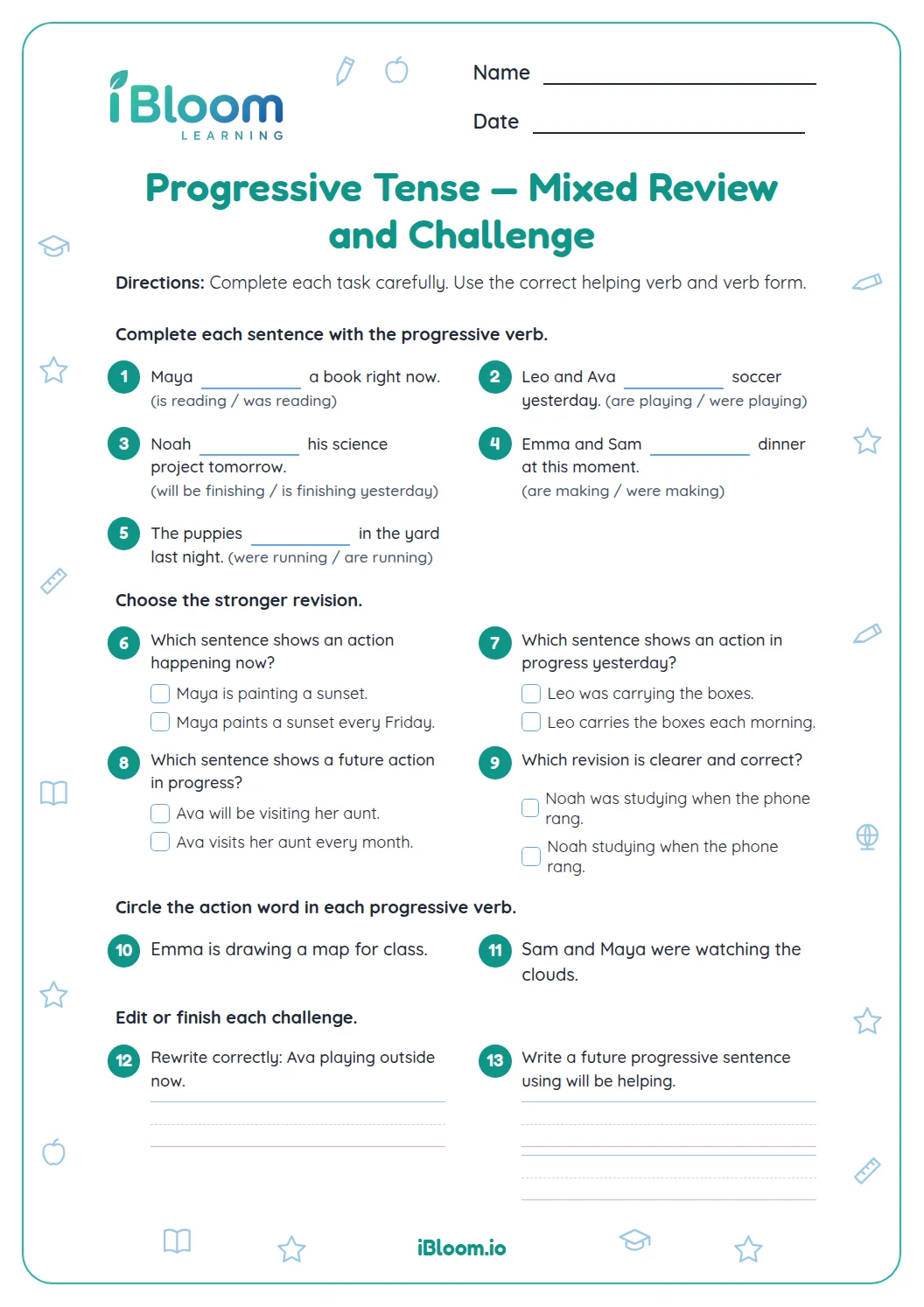
This Grade 3 printable has 16 progressive-tense questions and a separate answer key. Students complete sentences with a verb phrase that matches a time clue, then form progressive phrases from verbs in parentheses. The final tasks revise incorrect subject-verb agreement and combine sentence pairs with and. The sequence preserves the earlier sheet’s complete, form, revise, and combine practice.
How do time clues guide the verb phrase?
Questions 1–7 ask students to complete each sentence in progressive tense. Words such as now, yesterday, and tomorrow point to present, past, or future time. Choose a form of be that matches the subject and time, then add the verb ending in -ing.
- Present: am/is/are + verb-ing
- Past: was/were + verb-ing
- Future: will be + verb-ing
How do you build a progressive verb phrase?
For questions 7–10 and 14–16, start with the verb in parentheses and add the right helping verb plus -ing. For example, “watch” becomes “are watching” with the plural subject we.
- 1We ___ (watch) the clouds right now.
- 2Answer: are watching
- 3The subject is singular, and “right now” signals present progressive.
How do students revise and combine sentences?
In question 13, change “was” to “were” so it agrees with the plural subject they. Questions 15–16 complete progressive phrases from verbs in parentheses. The final questions on the sheet combine sentence pairs with and while keeping both ongoing actions.
How to practice progressive verbs
- 1Circle the time clue in each sentence.
- 2Find the subject and choose am, is, are, was, were, or will be to match it.
- 3Add the verb ending in -ing; check spelling when the ending changes.
- 4For the revision item, make the helping verb agree with the subject.
- 5Join each sentence pair with and while keeping both actions.
- 6Use the key to check the form and reread each complete sentence aloud.
Common progressive tense mistakes and fixes
The mistake
Using “is” with the plural subject they.
The fix
Match the helping verb to the subject: they are, they were.
The mistake
Leaving out the -ing verb after a form of be.
The fix
Use the helping verb followed by the action verb ending in -ing.
The mistake
Using a present phrase after a past-time clue such as yesterday.
The fix
Check the time word and use was or were for an action in progress in the past.
What to practice next
Make more practice
Questions parents and teachers ask
What does progressive tense show?
Progressive tense shows an action that is or was continuing at a particular time. It uses a form of be with a verb ending in -ing, such as is drawing or were waiting. This worksheet practices present, past, and future progressive phrases.
How do students choose the right helping verb?
Check the subject and the time clue. Use is with a singular present subject, are with a plural present subject, was or were for past time, and will be for future time. Then pair the helping verb with the action verb ending in -ing.
What is the answer to “We ___ (watch) the clouds right now”?
The answer is “are watching.” We is a plural subject, so it pairs with are, and right now signals present time. The progressive phrase combines are with watching to show an action happening at this moment. The key uses that completed phrase.
Why does the worksheet change “They was playing tag”?
They is plural, so the helping verb should be were: “They were playing tag.” The edit keeps the action and past time while correcting subject-verb agreement. Students practice noticing this mismatch in the revision section. In the revision item, were agrees with the plural subject they.
How should students combine the sentence pairs?
Join the two complete ideas with and, keeping both actions in progressive form. For example, “Leo is washing the car. Leo is singing.” becomes “Leo is washing the car and singing.” The key gives models; equivalent correctly punctuated versions can work. These edits preserve the progressive-tense focus and the earlier sheet’s sentence work.
Is an answer key included?
Yes. A separate answer key shows the verb phrases, the corrected sentence, and sample combined sentences. Some combined sentences can be worded more than one way, so check that both actions remain, the tense is preserved, and the sentence reads clearly.