







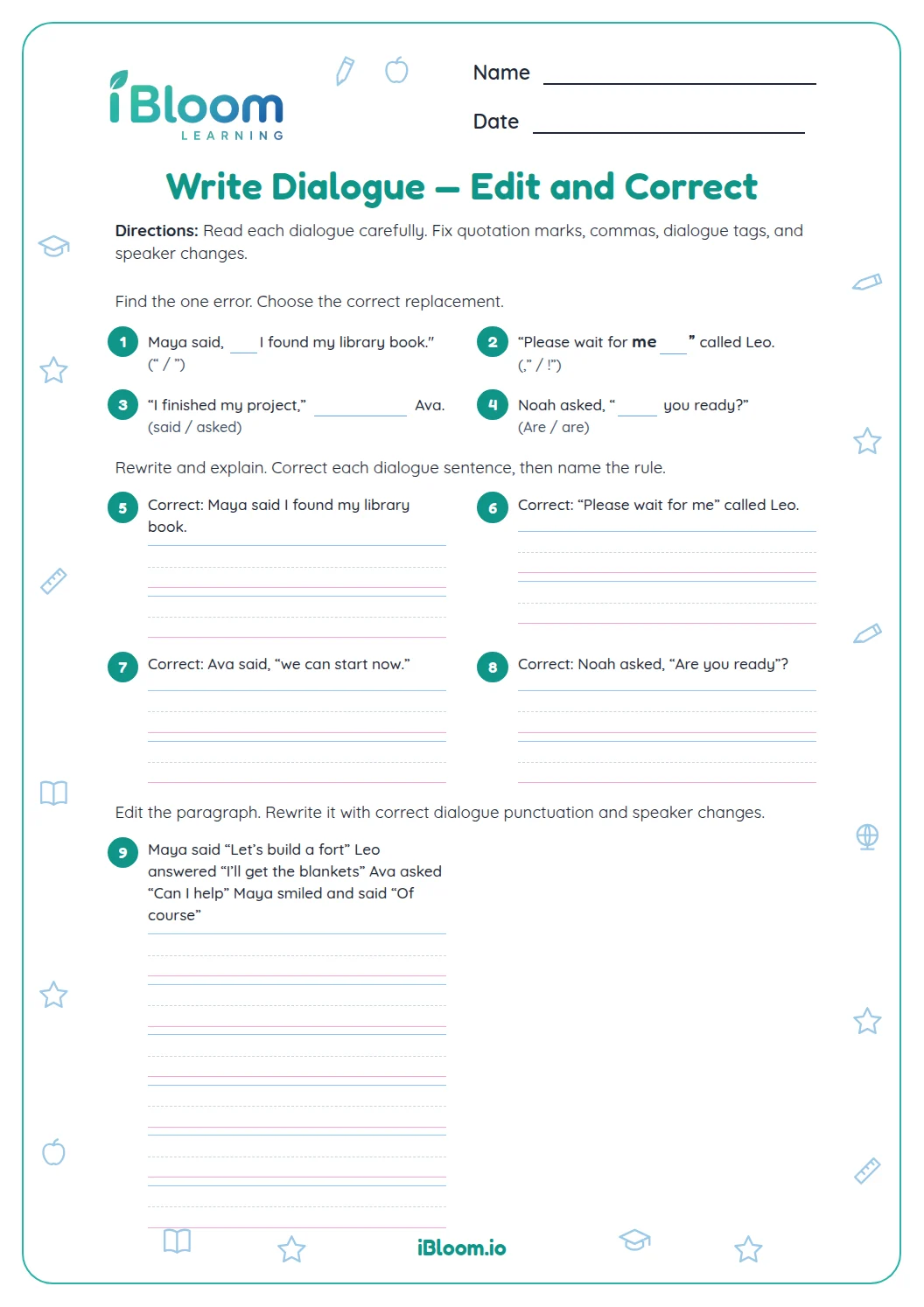
About this worksheet
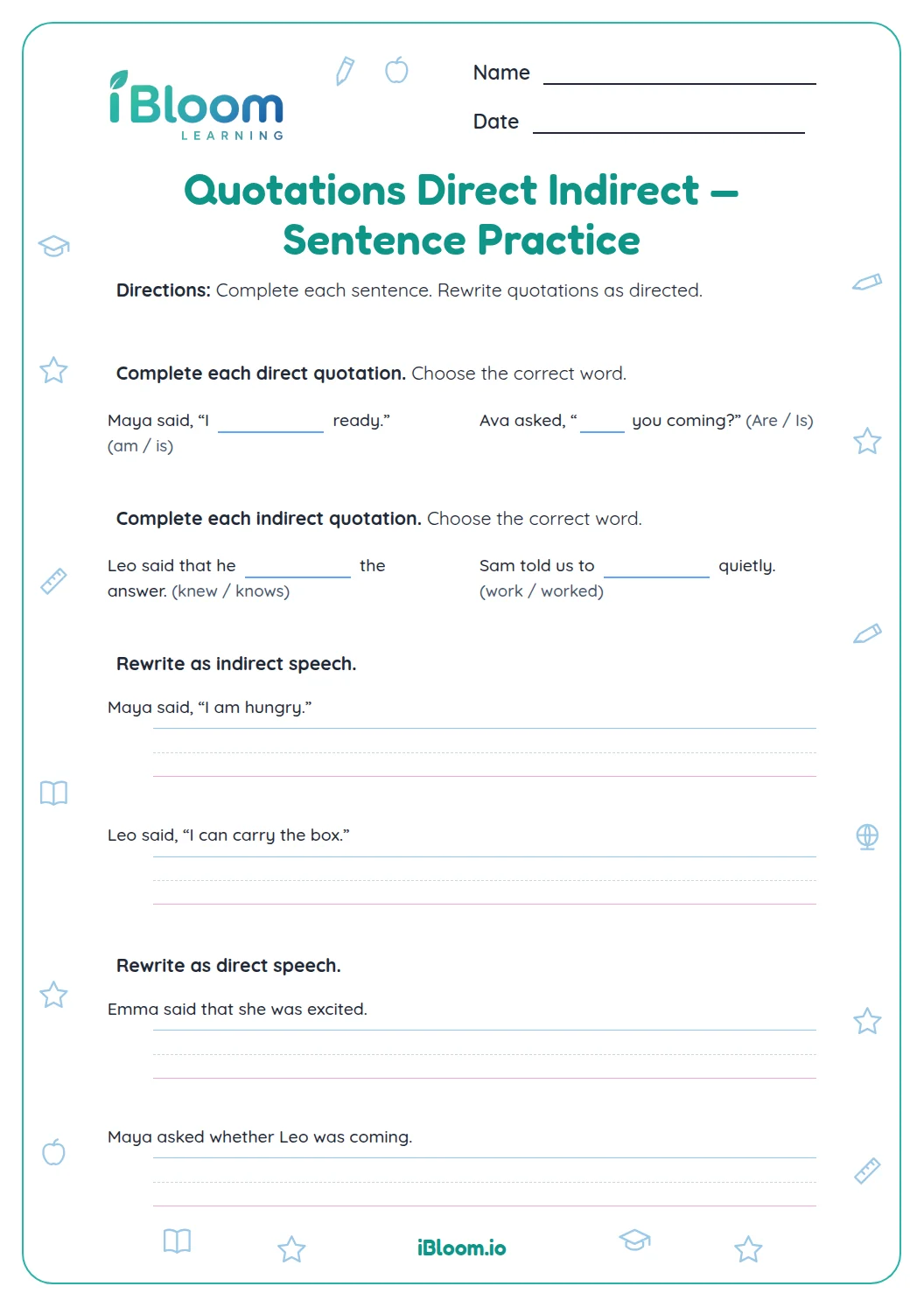
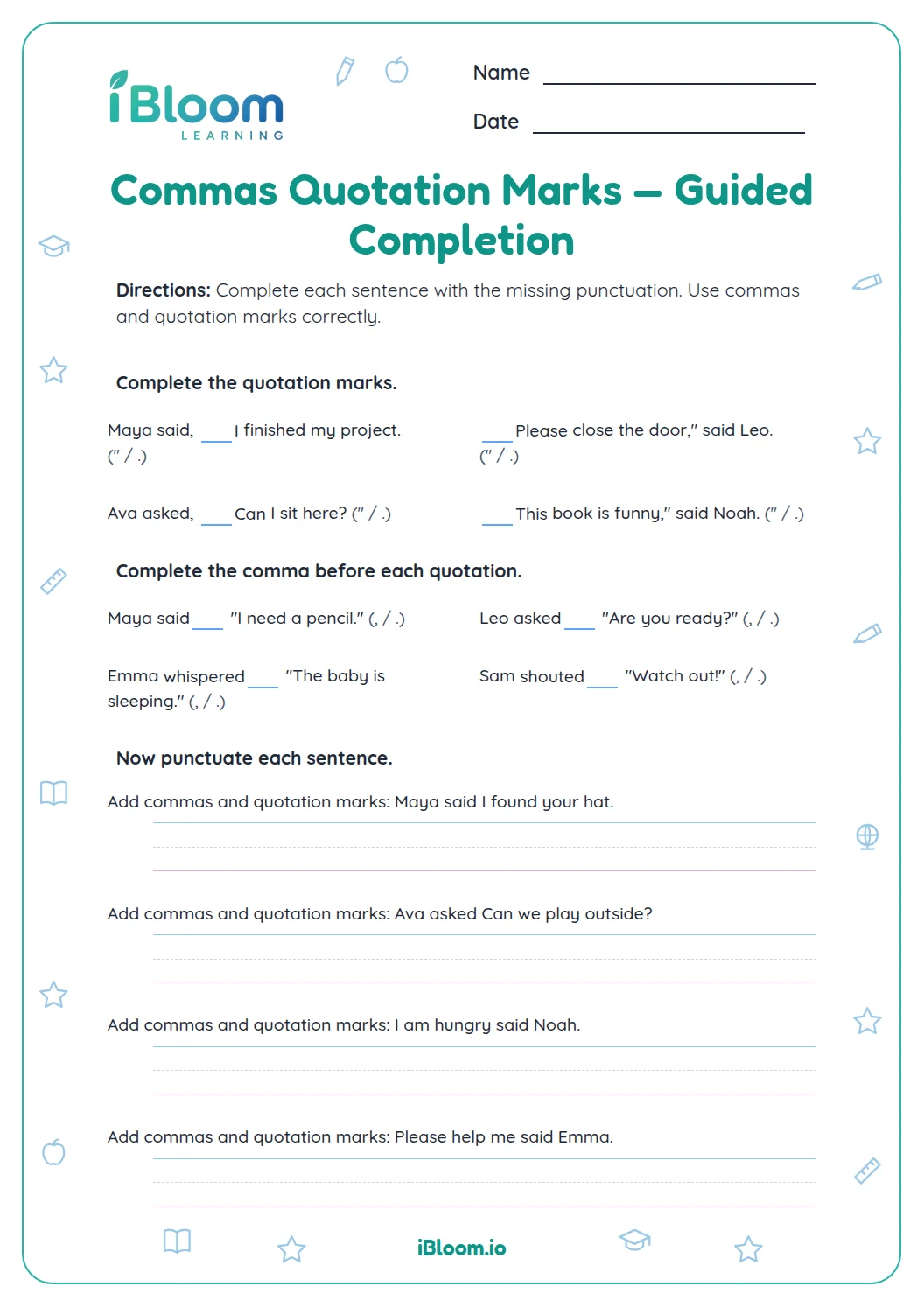
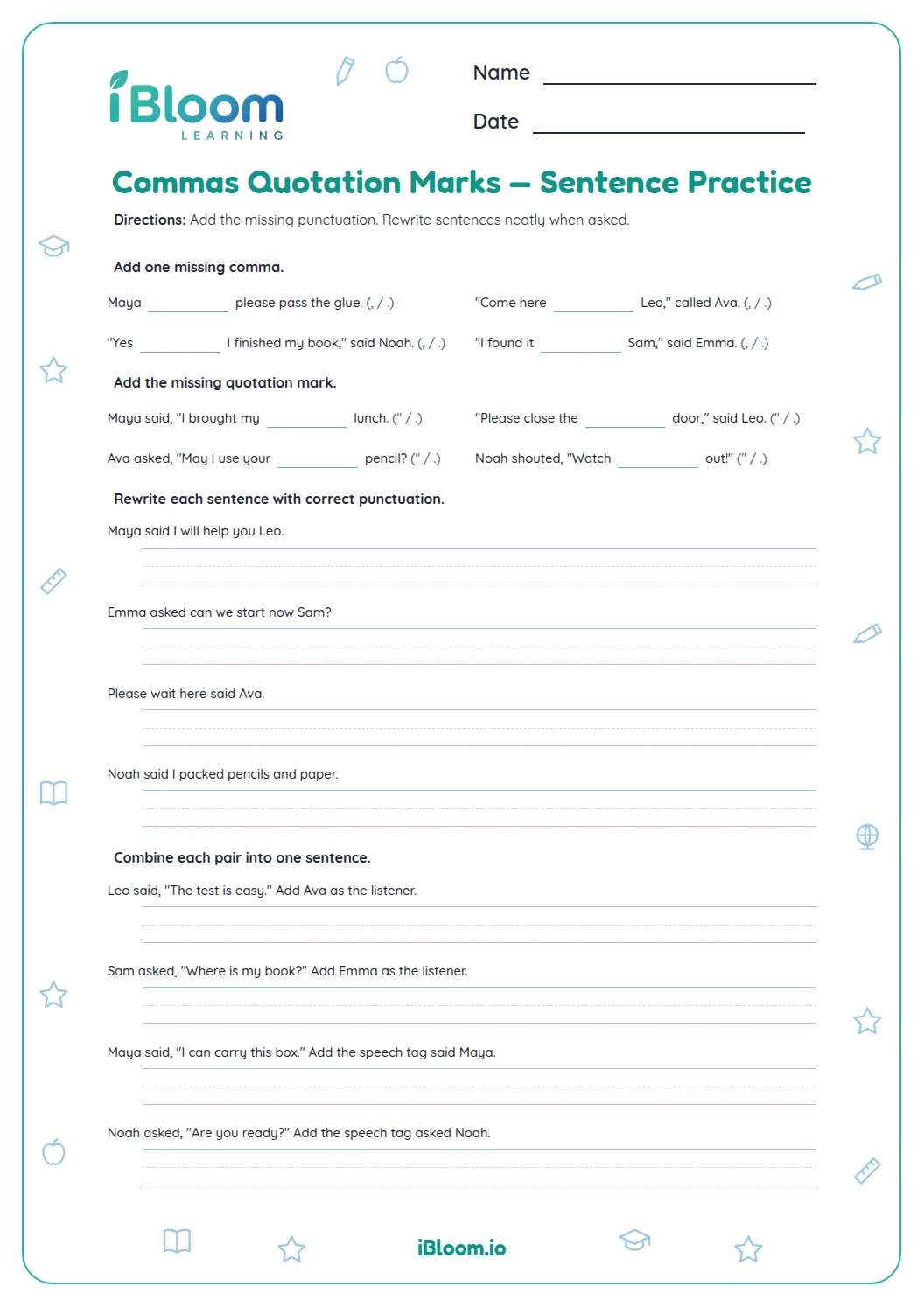
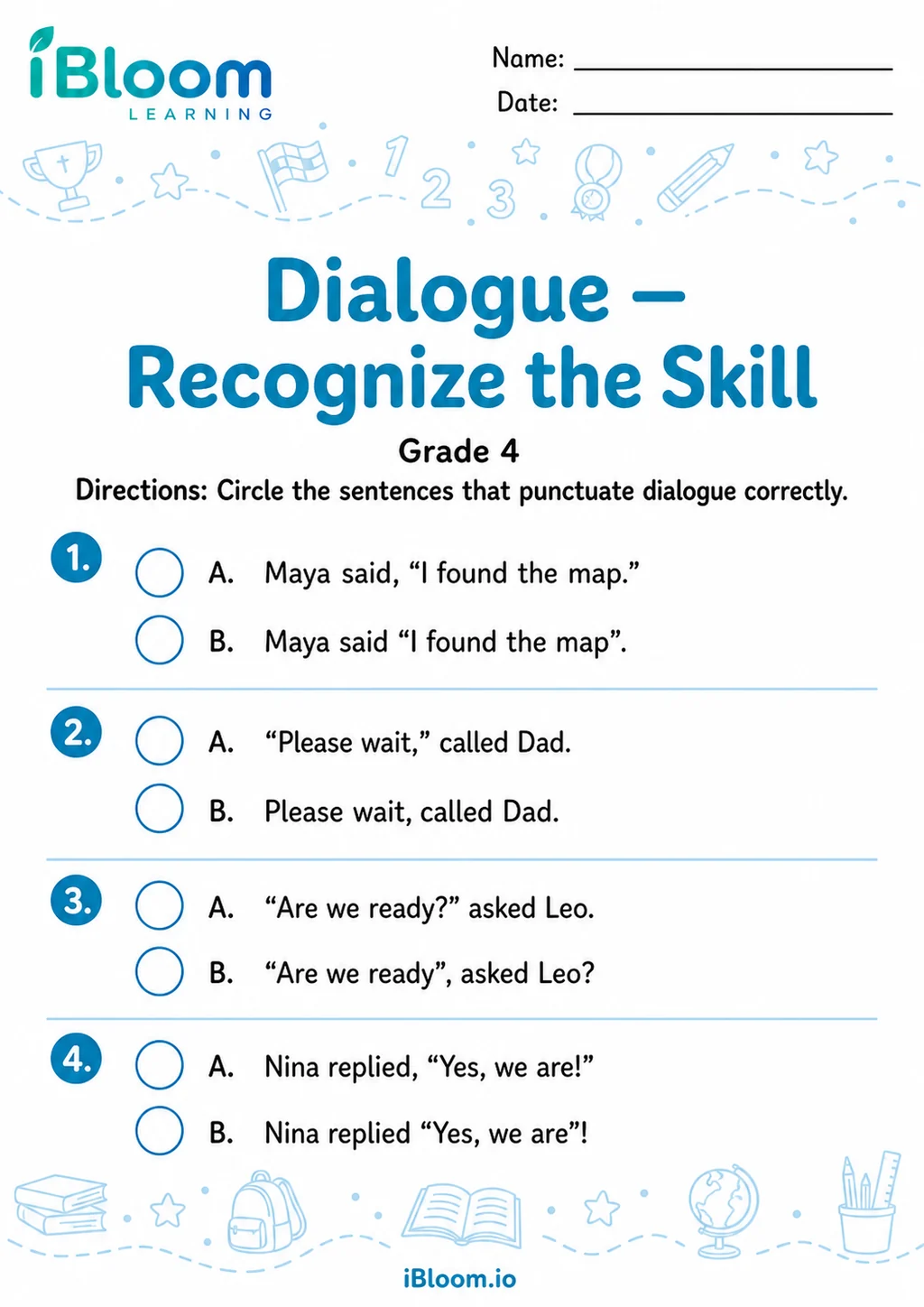
This Grade 4 printable gives children practice moving between exact speech and reported speech. The 14 questions include tense and pronoun changes, reporting verbs, punctuation choices, and a short exact-quotation task. The separate answer key accepts equivalent correct forms where appropriate. The punctuation practice aligns with CCSS.ELA-Literacy.L.4.2.b.
Aligned to CCSS.ELA-Literacy.L.4.2.b
How are direct and indirect speech different?
Direct speech repeats the speaker’s exact words, usually inside quotation marks. Indirect speech reports the message without quotation marks around the reported words, and pronouns or verb tense may change.
For example, “I am ready” becomes Maya said that she was ready. The answer preserves the meaning while shifting I to she and am to was.
- 1Maya said, “I am ready.” Maya said that she ___ ready.
- 2Answer: was
- 3The reported sentence uses she and was.
Where do commas and quotation marks go?
A comma commonly separates a reporting phrase from a following quotation: Maya said, “I am ready.” The quotation marks surround the speaker’s exact words. Question 8 asks children to identify both punctuation marks.
What does each part practice?
Part A changes quoted statements and questions into reported speech and practices reporting verbs. Parts B and C review punctuation, direct versus indirect speech, and an exact quotation.
- Part A: complete reported statements and identify reporting words
- Part B: recognize punctuation used with exact speech
- Part C: apply the distinction in short examples
How can a child check a reported sentence?
Read the original and reported sentences back to back. Check that the message stays the same, that pronouns match the new speaker, and that a past reporting verb has the expected tense shift. For direct speech, check the comma and quotation marks.
How to use this worksheet
- 1Read the directions together and name the skill in your own words.
- 2Complete the first few items slowly, explaining each choice.
- 3Work through the remaining questions independently or in a small group.
- 4Use the answer key to check each response and discuss any mismatch.
- 5Return to missed items and solve them again with the key covered.
Common mistakes and quick fixes
The mistake
Leaving I unchanged when the speaker is named in the report.
The fix
Ask who said the words; change I to the speaker’s name or matching pronoun.
The mistake
Keeping present tense after a past reporting verb when the task asks for a backshift.
The fix
Check whether am/is becomes was and will becomes would in the reported sentence.
The mistake
Putting quotation marks around an entire indirect report.
The fix
Use quotation marks for the exact words spoken, not for a paraphrase.
Common Core alignment
This page connects the practice activities to the following Common Core standard.
Use commas and quotation marks to mark direct speech.
On this sheet:
Show the official wordingHide the official wording
Use commas and quotation marks to mark direct speech and quotations from a text.
What to practice next
Make more practice
Further reading
Questions parents and teachers ask
What is the difference between direct and indirect speech?
Direct speech gives a speaker’s exact words inside quotation marks. Indirect speech reports the message without quoting those exact words. This worksheet lets children practice the change, including pronoun and tense shifts such as “I am ready” becoming “she was ready.”
How many questions and pages are included?
The worksheet has 14 questions on two student pages, followed by a two-page answer key. It moves from completing reported speech to punctuation and short application items. Print the key separately if you want children to try the questions independently first.
What punctuation does question 8 ask about?
Question 8 asks which marks enclose exact speech and follow the reporting phrase. The answer is a comma and quotation marks: the comma separates the reporting phrase, and the quotation marks surround the speaker’s exact words. Children can point to the comma before the quotation and to the quotation marks around the exact words.
Why does “I am ready” become “she was ready”?
The speaker’s I changes to she because Maya is now named as the speaker. Since said is past tense, am shifts to was in the reported sentence. The meaning stays the same even though the point of view and verb form change.
Does the key accept more than one wording?
The key gives a target answer for each short response and allows equivalent wording when it keeps the original meaning and follows the directions. For example, a different suitable reporting verb may work in a blank if the sentence remains grammatical and accurately reports the speech.