






About this worksheet
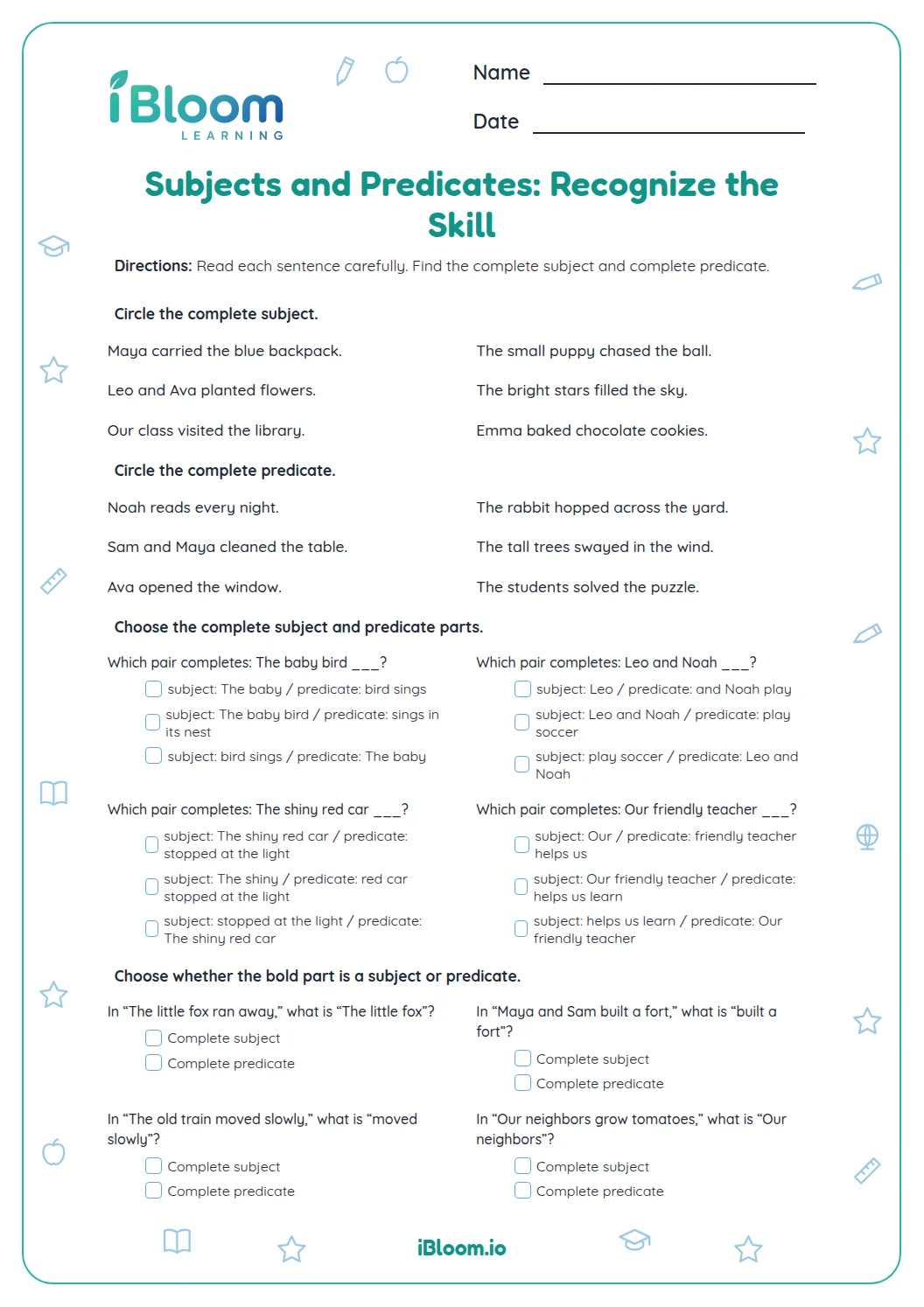
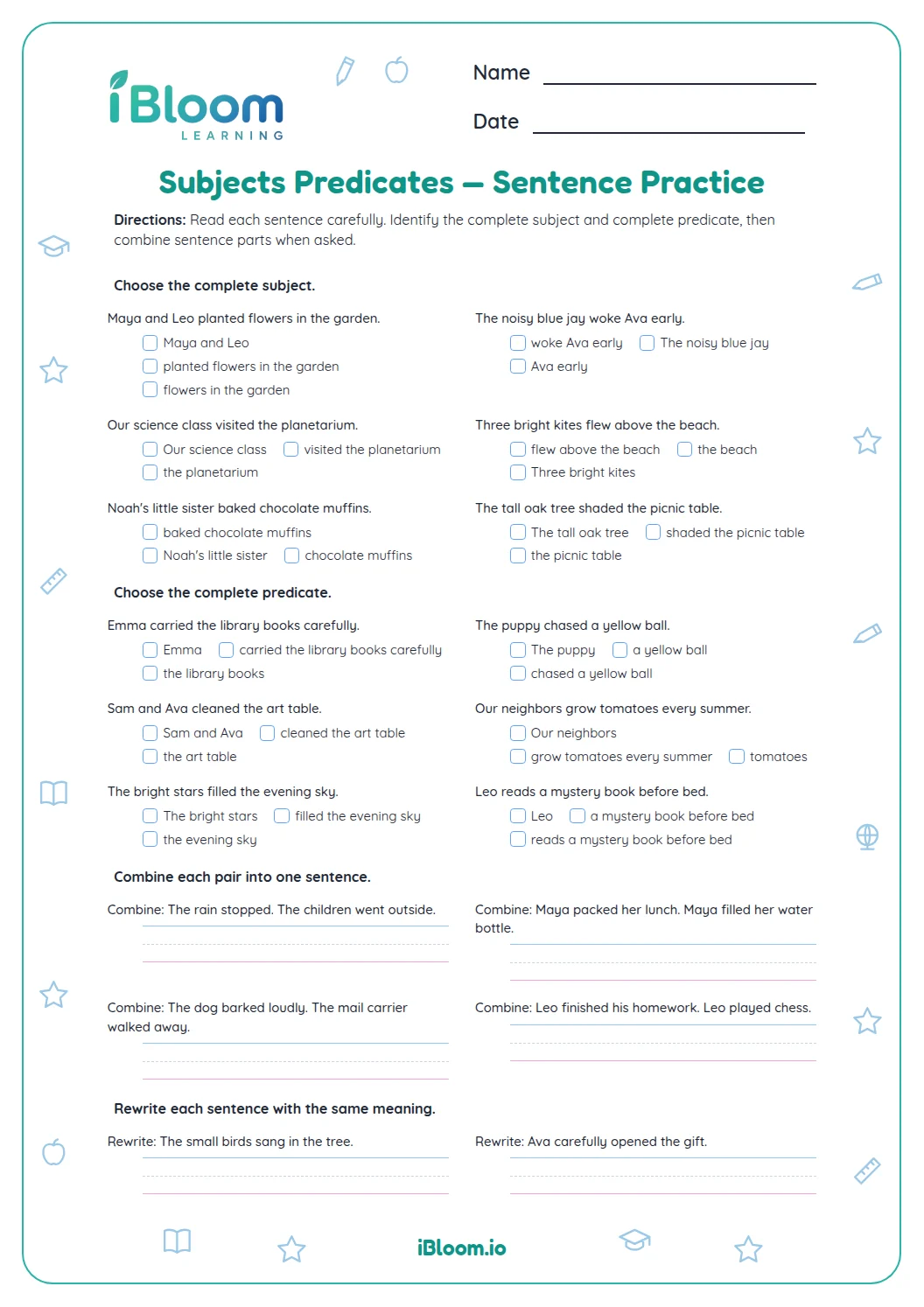
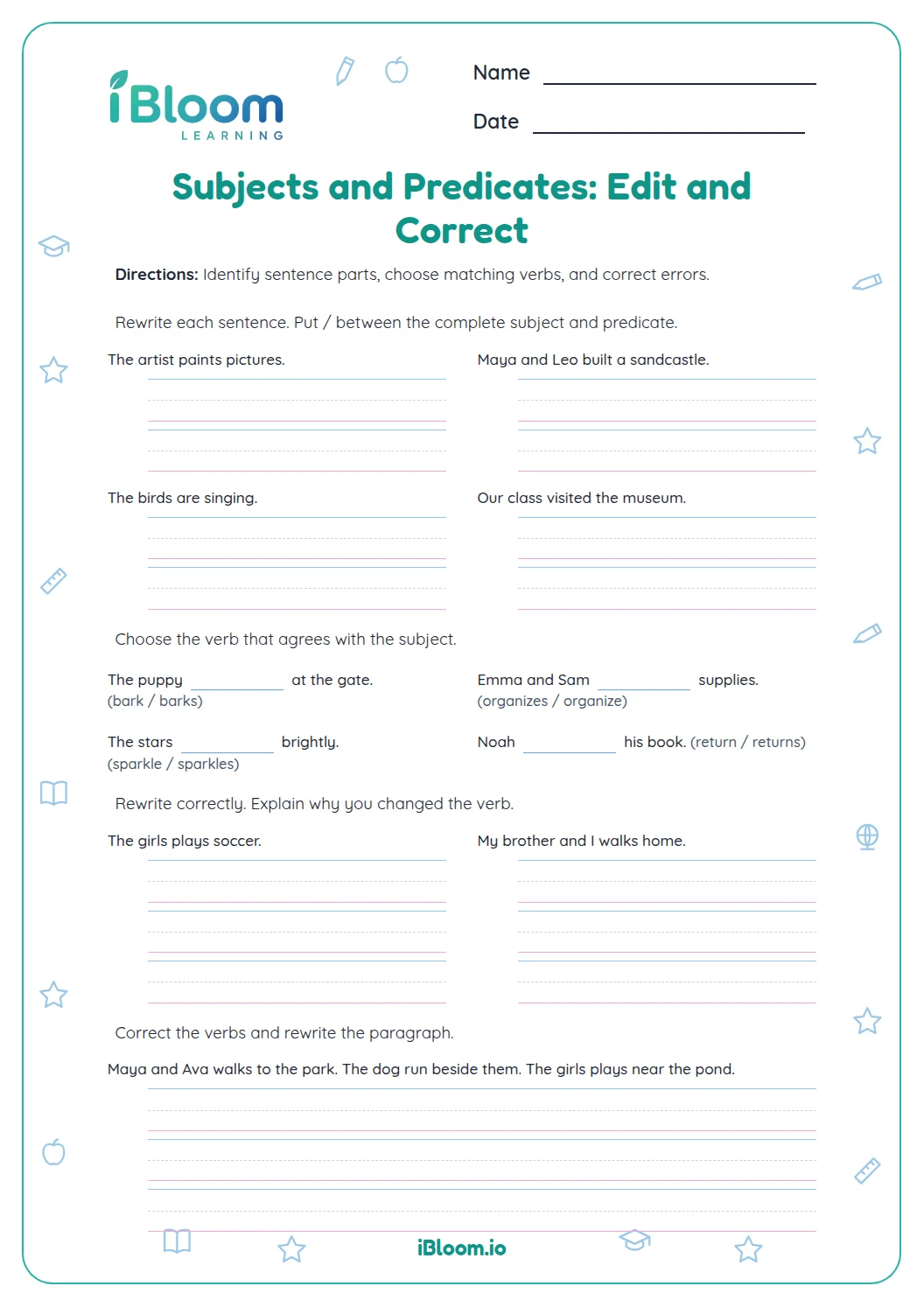
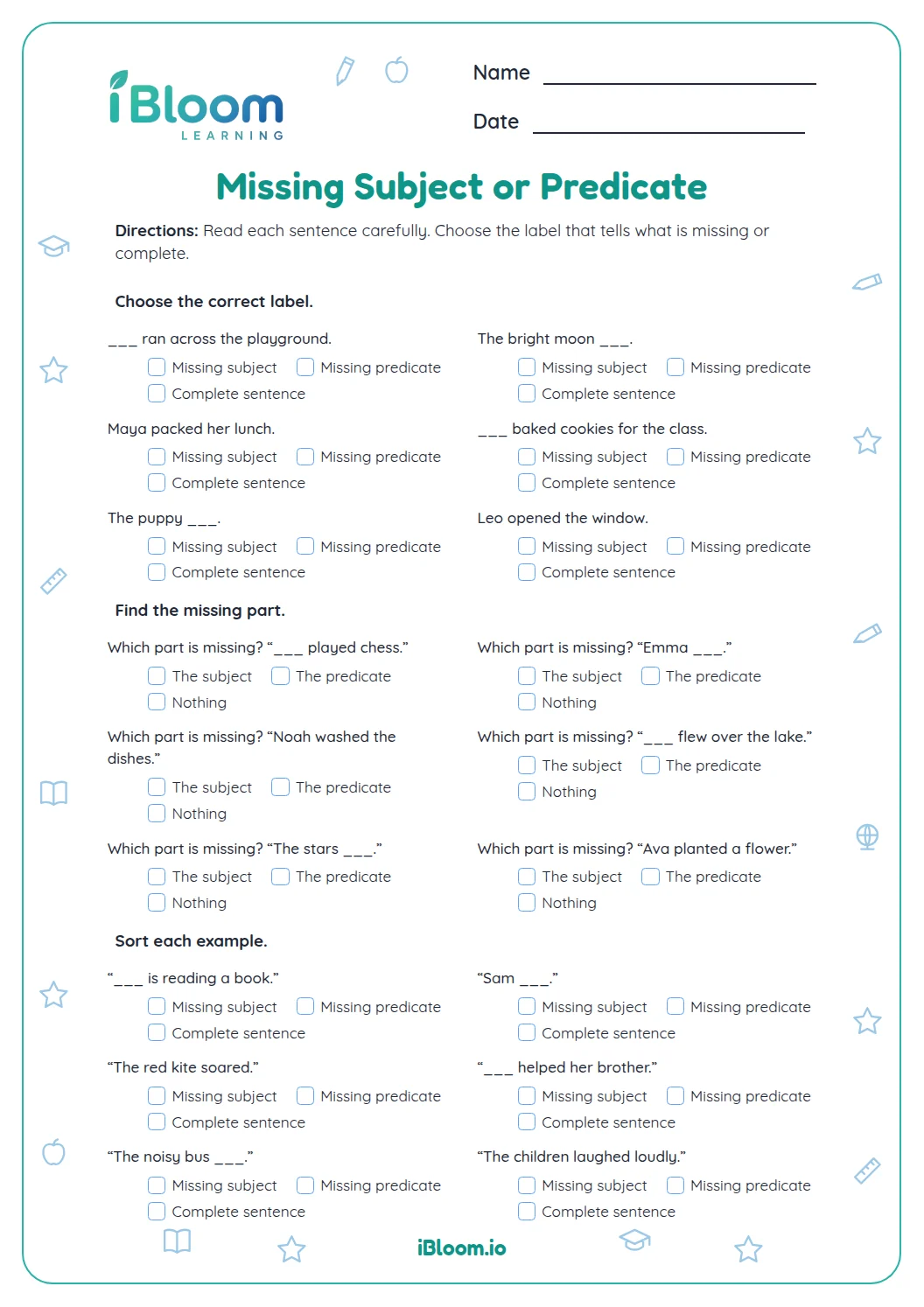
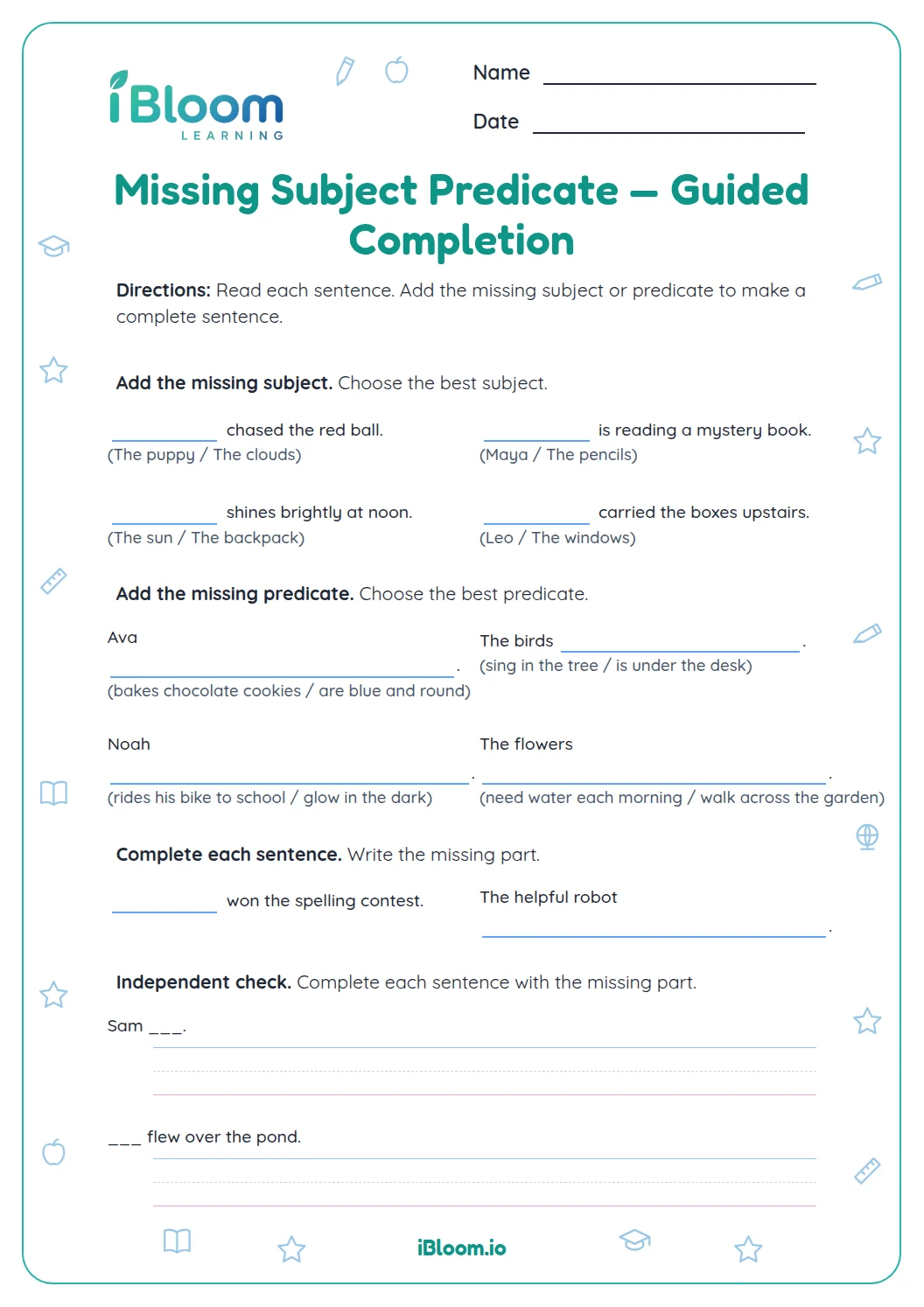
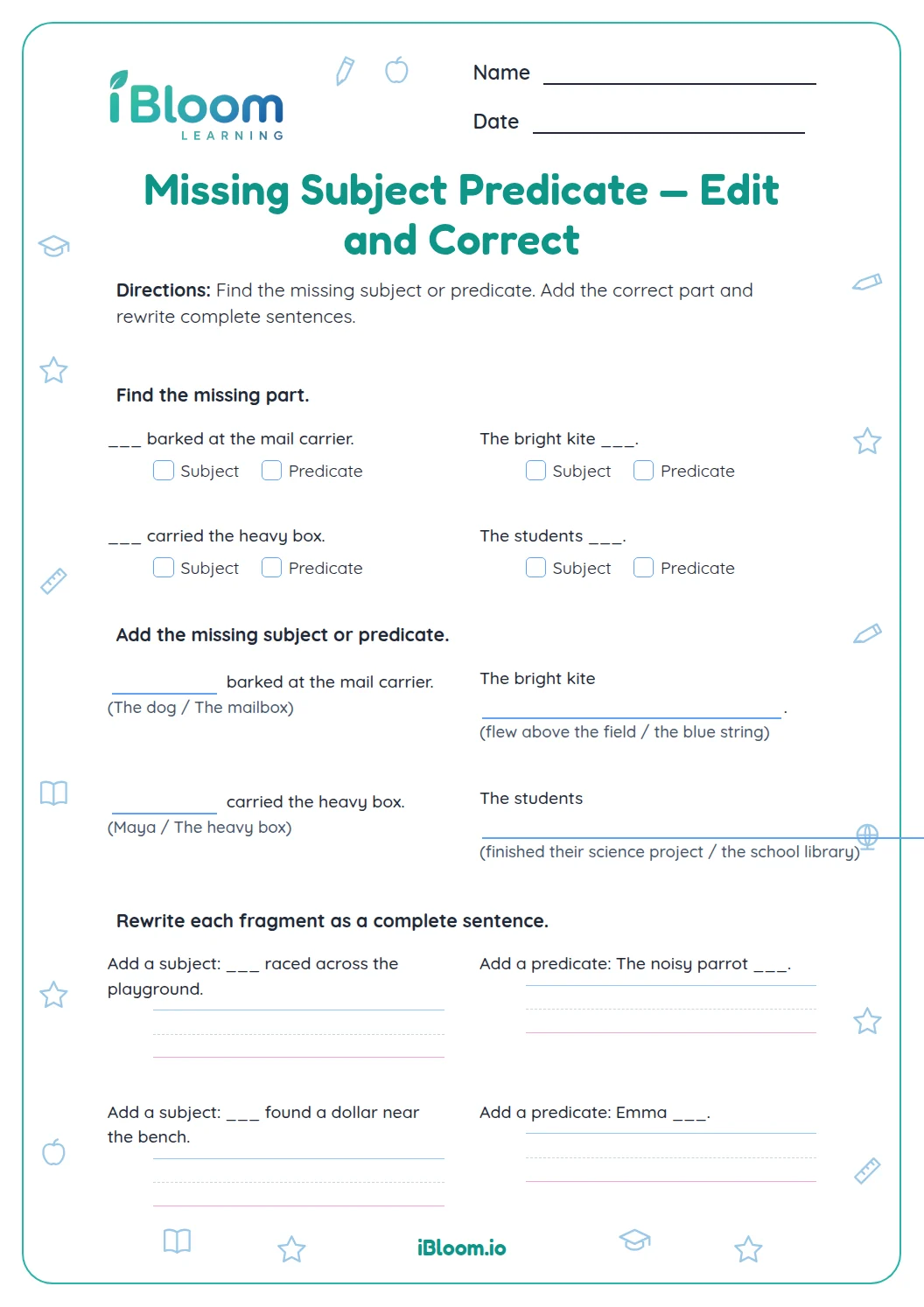
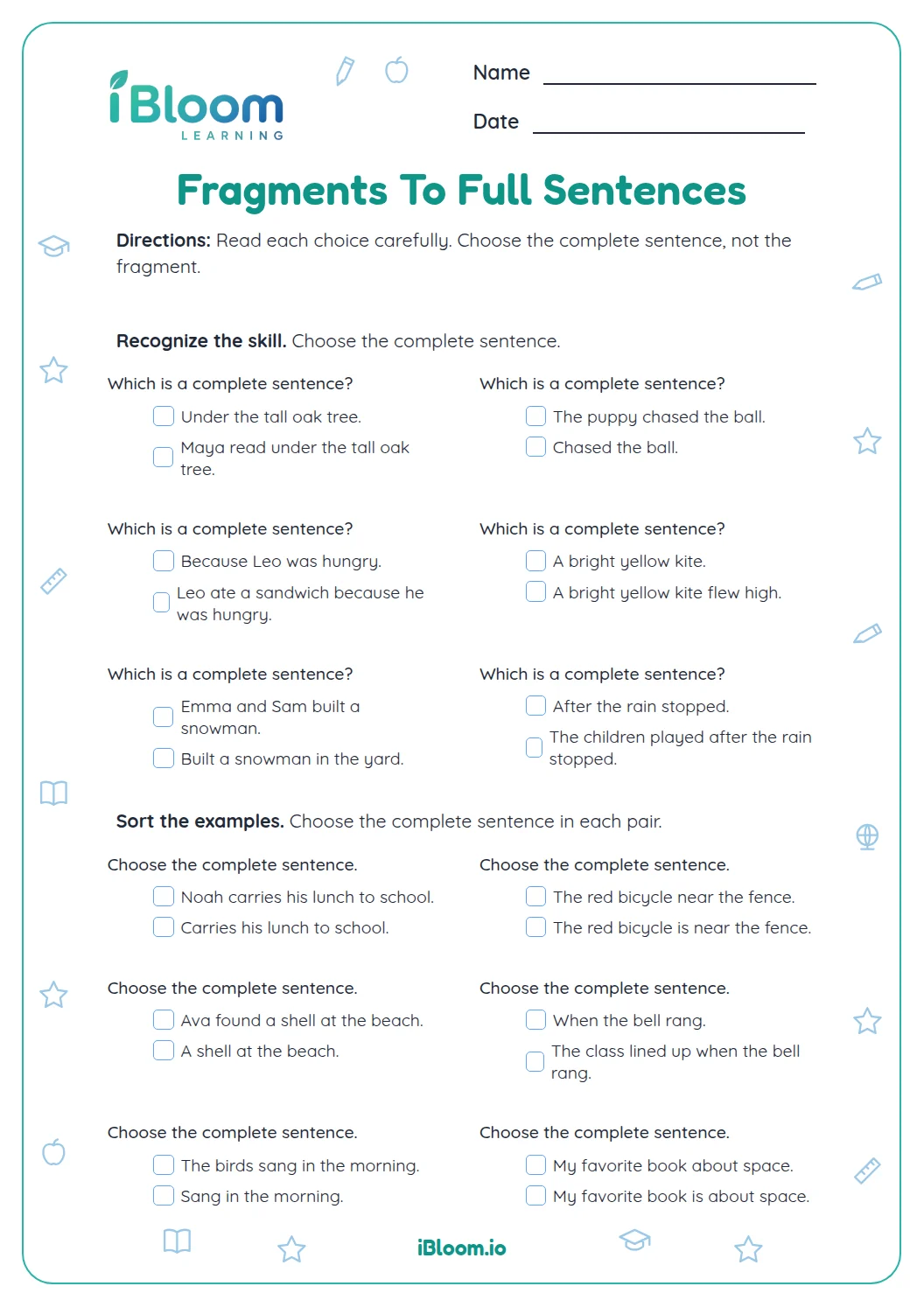
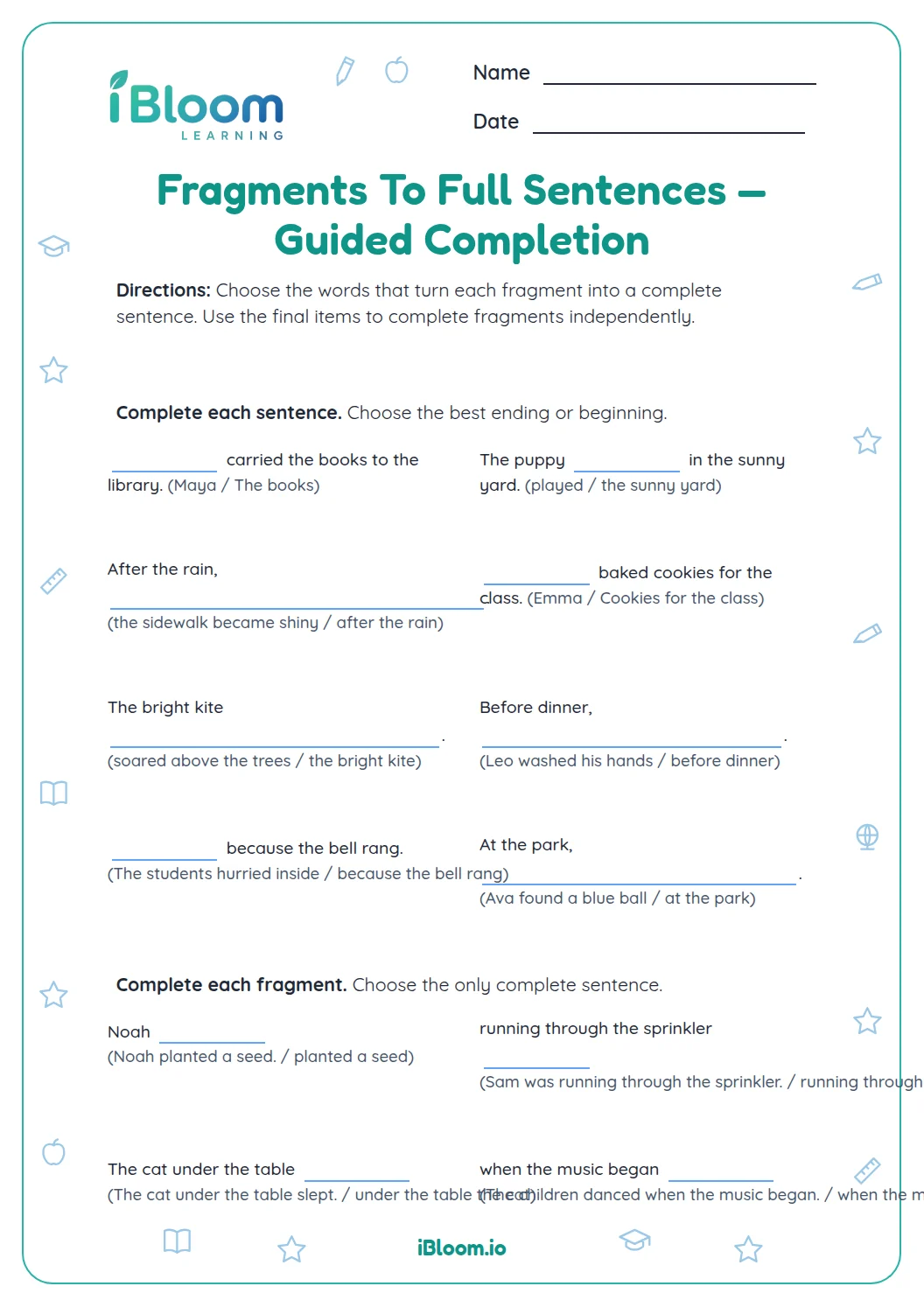
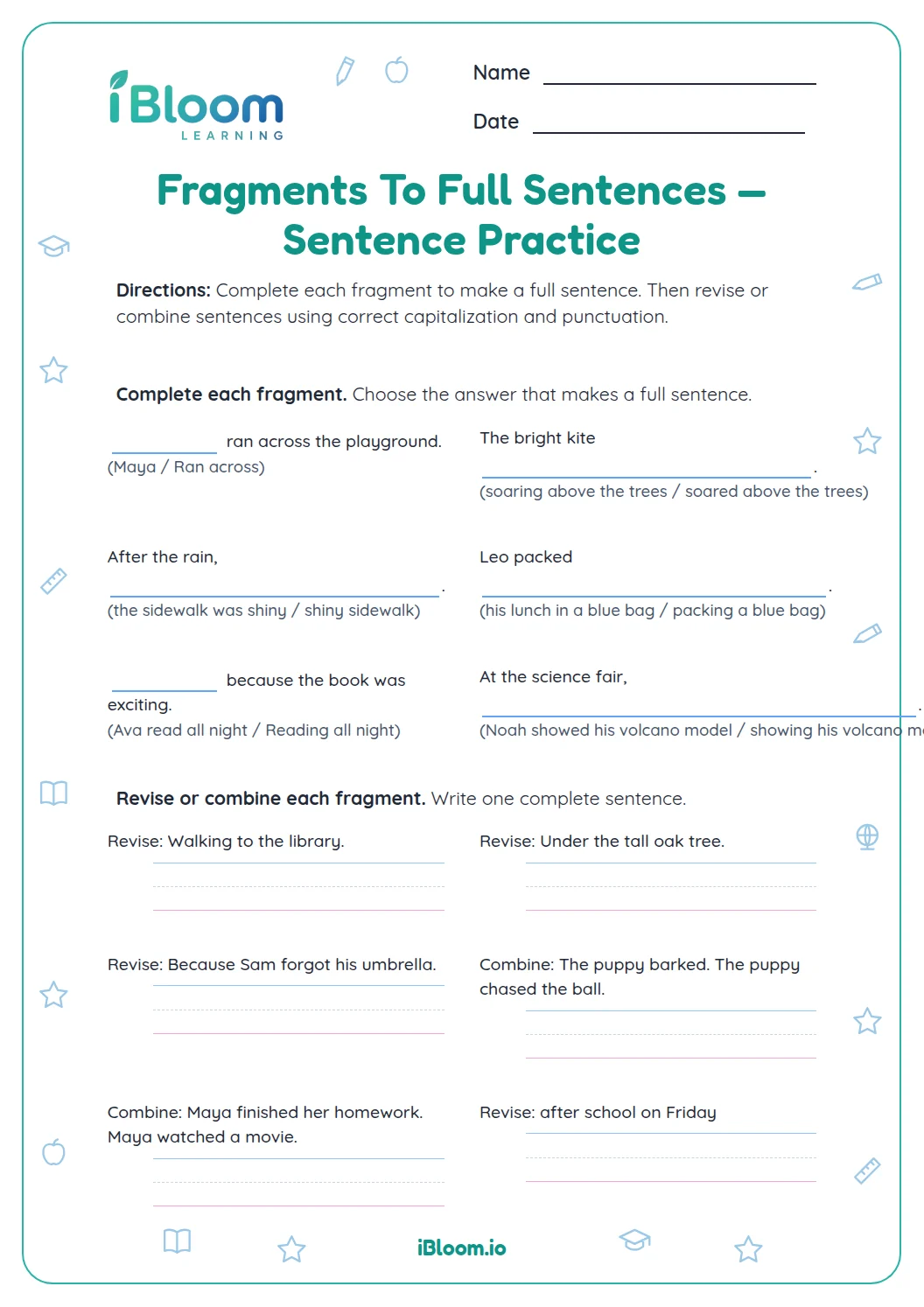
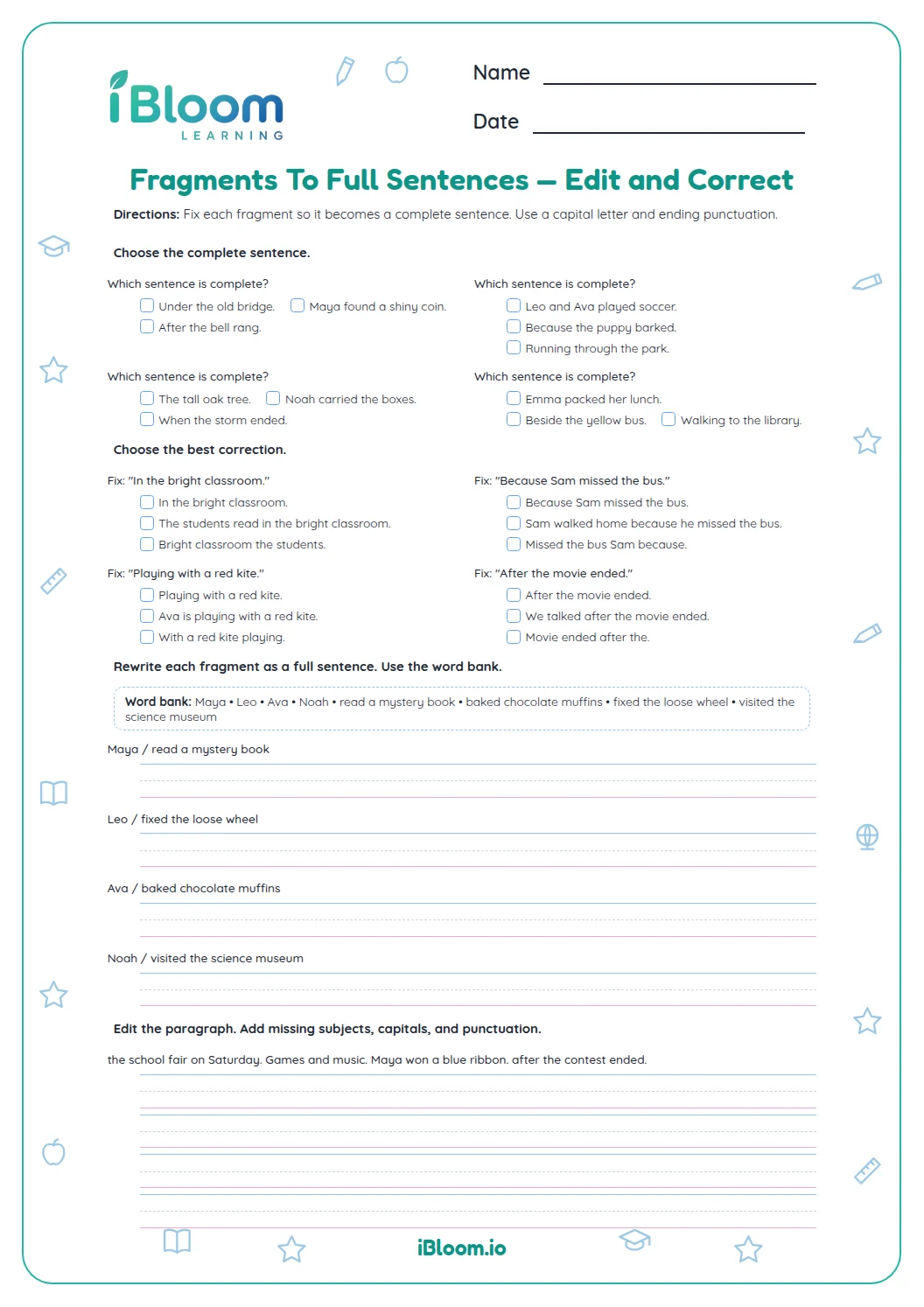
This free printable Grade 4 worksheet guides students from choosing a missing sentence part to writing a complete sentence. Part A supplies two subject choices for each of four sentences. Part B supplies two predicate choices for four more. Part C asks students to combine three pairs of sentence parts; Part D asks them to add their own missing parts in two whole sentences. The work practices Common Core L.4.1f through producing complete sentences and correcting fragments. A separate answer key includes the guided answers and sample independent completions.
Aligned to L.4.1f
How do students choose a missing subject?
The subject tells who or what the sentence is about. In Part A, the words after each blank already give the action or state. Read those words, ask who or what could fit, and try the supplied choices in the sentence.
A whole subject can contain more than one word. “The puppy” and “The sun” are subjects, just as the name “Maya” can be a subject. Keep all the words needed to name the subject clearly.
- 1Question 1: ___ carried the books. (Maya / Quickly)
- 2Maya names who carried the books. Quickly tells how.
- 3Complete sentence: Maya carried the books.
What makes a predicate different from another noun phrase?
A predicate includes a verb and tells something about the subject. In Part B, “played soccer” works after “The children” because played is a verb. “The soccer field” names a place but leaves the sentence without a verb.
A predicate can also tell what a subject is or is like. “Is quiet” completes “The library” even though it describes a state rather than an action. Read the finished sentence aloud to check the whole thought.
How do Parts C and D build sentence writing?
Part C gives a subject and predicate separated by a slash. Students join those words into a complete sentence, replacing the slash with a space. For example, “Emma / packed her lunch.” becomes “Emma packed her lunch.”
Part D asks for two whole sentences: one needs a predicate after Sam, and one needs a subject before flew across the pond. Keep the supplied words, add a sensible missing part, begin with a capital letter, and end with punctuation. The key gives samples; other complete sentences can also be correct.
How to use this worksheet
- 1Review the subject as who or what and the predicate as what the subject does or is.
- 2In Part A, try both choices aloud and write the subject that completes the thought.
- 3In Part B, find the verb in the choice before writing the predicate.
- 4Join the supplied parts in Part C, then add your own missing parts in Part D.
- 5Check the capital, ending punctuation, subject, and predicate in each final response.
Mistakes to check together
The mistake
Choosing “Quickly” as the subject of “carried the books.”
The fix
Ask who carried them. Maya names a person; quickly describes how an action happened.
The mistake
Writing “The children the soccer field.”
The fix
Find the missing verb. “The children played soccer” states a complete thought.
The mistake
Writing only the added words in Part D.
The fix
Include the supplied subject or predicate with your added words to make one whole sentence.
Common Core alignment
Add a missing subject or predicate to turn a fragment into a complete sentence.
On this sheet: Students supply missing sentence parts and write complete sentences from fragments.
Show the official wordingHide the official wording
Produce complete sentences, recognizing and correcting inappropriate fragments and run-ons.*
What to practice next
Make more practice
Further reading
Questions parents and teachers ask
Do students choose answers or write them?
They do both. Parts A and B provide two choices, and students write the missing subject or predicate. Part C asks them to combine three supplied pairs into whole sentences. Part D asks for two whole sentences with their own missing parts, using what they practiced earlier.
Can a predicate describe something instead of an action?
Yes; a predicate can tell what a subject is or is like. In Part B, “The library is quiet” is complete because is is a verb and quiet describes the library. Ask students to find the verb even when the sentence does not describe movement or activity.
What makes “The soccer field” a wrong predicate choice?
It names a place but supplies no verb after “The children.” Combining those two noun phrases leaves the thought unfinished. The choice “played soccer” supplies the action and creates “The children played soccer.” Read both versions aloud so the student can hear which one completes the thought.
Can the final answers differ from the key?
Yes; the two Part D answers are samples. “Sam washed the dishes” works as well as “Sam packed his lunch.” Keep the supplied sentence part and check that the added part makes a sensible, complete sentence with matching subject and verb, a capital letter, and ending punctuation.
How can I check whether a final sentence is complete?
Ask two questions: who or what is it about, and what does it say about that subject? Then locate the verb and read the whole sentence aloud. For “A duck flew across the pond,” A duck is the subject and flew across the pond is the predicate.