




About this worksheet
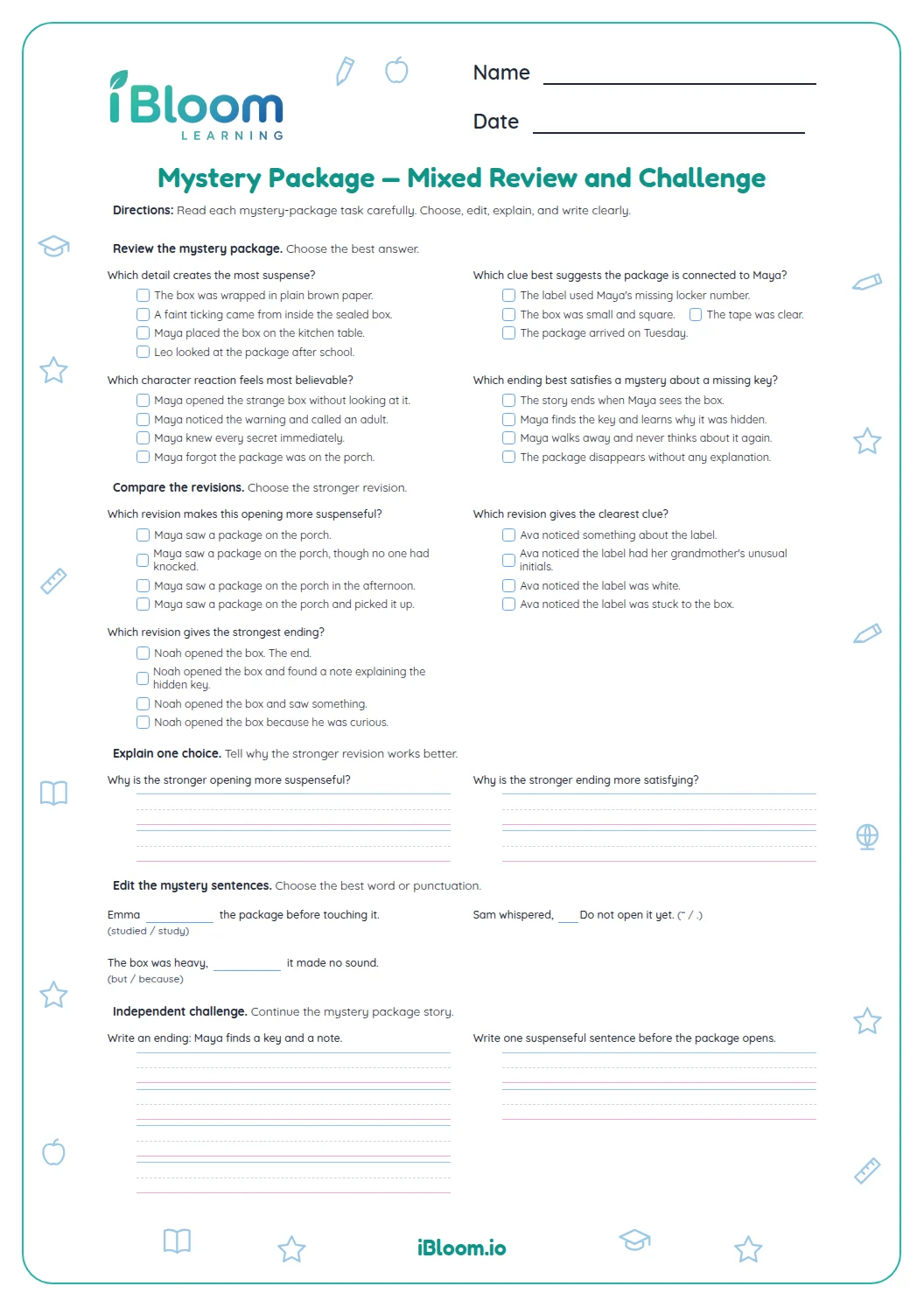
This Grade 5 narrative-writing worksheet guides students through a mystery about an unexplained package. Students choose a character, setting, clue, and story problem, then write focused sentences that introduce the mystery, build suspense, and resolve it. The answer key marks the clue words and gives sample responses for open writing. The page practices orienting readers to a narrative situation, connected to CCSS W.5.3.a.
Aligned to W.5.3.a
What belongs in a mystery plan?
Give the character a reason to notice the package, place it in a specific setting, and pose a question the story will answer. The first four questions ask students to choose story details that fit together.
- 1Who left the package, and why?
- 2This question gives the character a mystery to solve.
How can a clue build suspense?
A precise sound or action can hint that something is unusual without explaining it too soon. In Part B, students circle the word or detail that makes the package feel mysterious.
How can the story reach a satisfying ending?
Introduce the character and package, add a clue and a warning, then state the question the character must solve. The final two responses delay the reveal and give the mystery a clear answer.
How to use the worksheet
- 1Choose a character and a setting that can appear in the same story.
- 2Give the package one clue that raises a question.
- 3Use a specific sound, action, or object to build suspense.
- 4Write one focused sentence for each story prompt.
- 5Make the ending answer the question raised by the package.
Common story-planning slips
The mistake
Adding a clue that never matters to the story.
The fix
Let the clue connect to the question the character solves.
The mistake
Revealing the package contents before suspense builds.
The fix
Let the character notice clues and make a discovery first.
The mistake
Ending without answering the story question.
The fix
Use the final sentence to explain who sent the package or what it means.
Common Core alignment
Writers practice establishing a narrative situation and introducing characters.
Open a narrative by orienting the reader to a situation and narrator or characters.
On this sheet: Open a narrative by orienting the reader to a situation and narrator or characters.
Show the official wordingHide the official wording
Orient the reader by establishing a situation and introducing a narrator and/or characters; organize an event sequence that unfolds naturally.
What to practice next
Make more practice
Further reading
Questions parents and teachers ask
What does the worksheet ask students to write?
Students plan a mystery package story and write six focused responses. They introduce a character and package, add a clue and warning, name the question to solve, build suspense, and write an ending that resolves the mystery. Each choice gives the writer a usable starting point for the same mystery.
How many questions are on the worksheet?
There are 14 questions in three parts. Students first choose story elements, then identify vivid clues, and finally write sentences that develop and resolve a mystery about an unexplained package. These short sentences offer different kinds of sensory and setting clues.
Are there sample answers for the writing prompts?
Yes. The answer key provides a sample response for each open writing prompt. Students may use different characters, clues, dialogue, and endings as long as the sentences follow the prompt and form a coherent mystery. The samples are models; writers can invent a different solution that fits.
How can a writer build suspense?
A writer can reveal one specific clue at a time, show how the character reacts, and leave the central question unanswered for a while. The worksheet prompts students to add a clue, a warning, and a delayed reveal. A warning or unexplained sound can raise a question for the reader.
What makes the ending work?
The ending should answer the question raised by the package and connect to an earlier clue. A clear resolution helps the reader understand who sent it, what it contains, or why it appeared. The final response should resolve the question introduced earlier in the story.