



About this worksheet
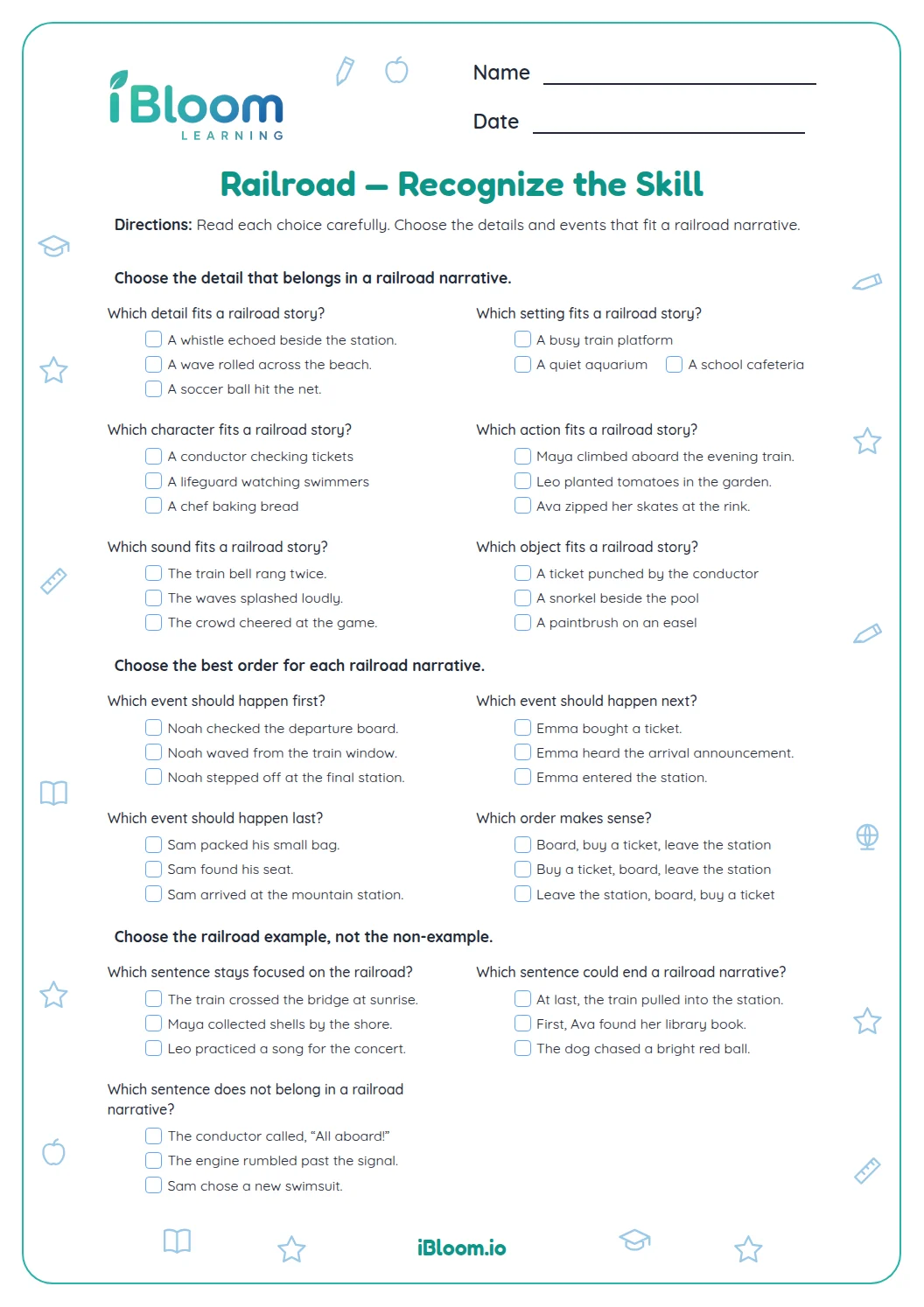
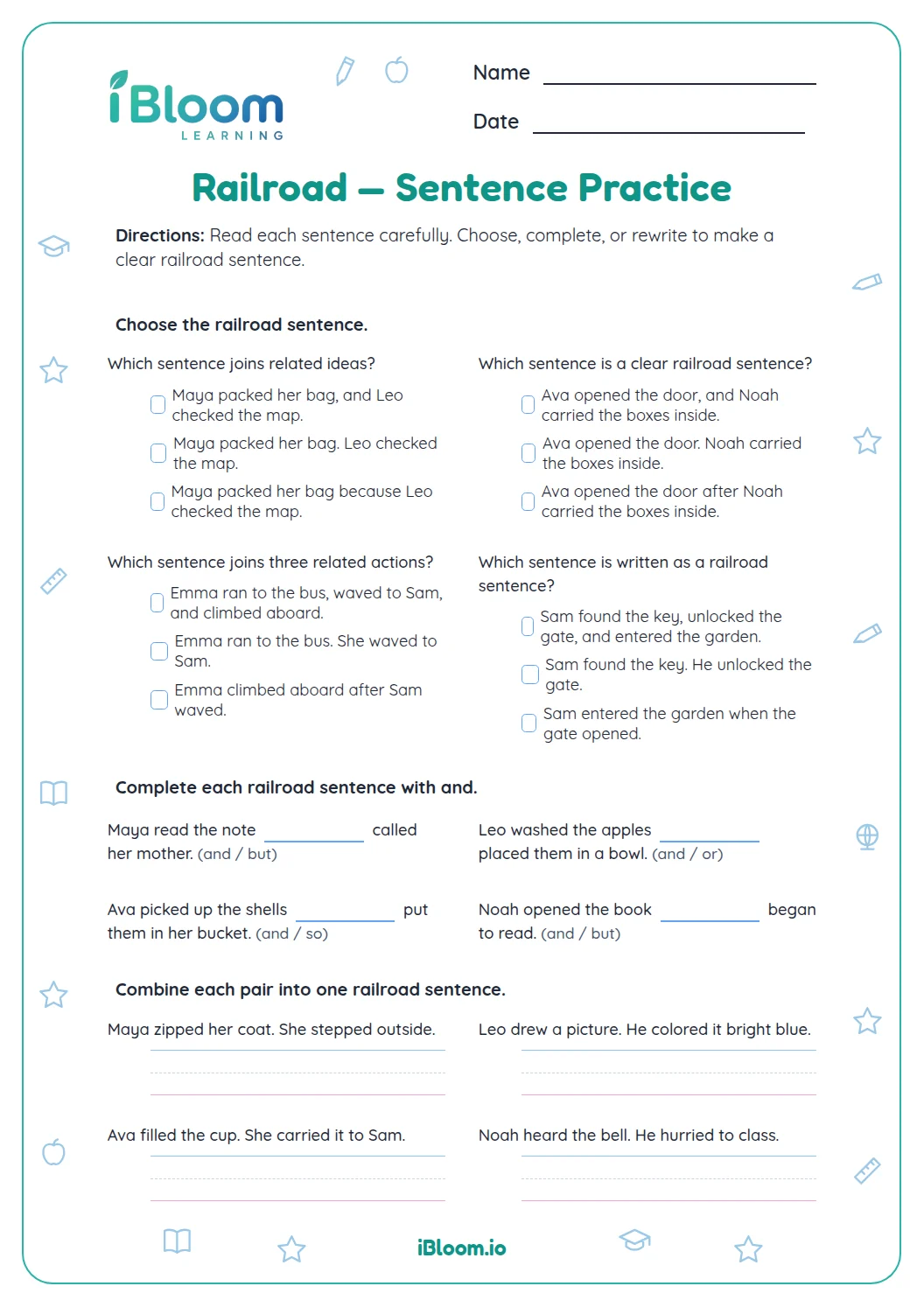
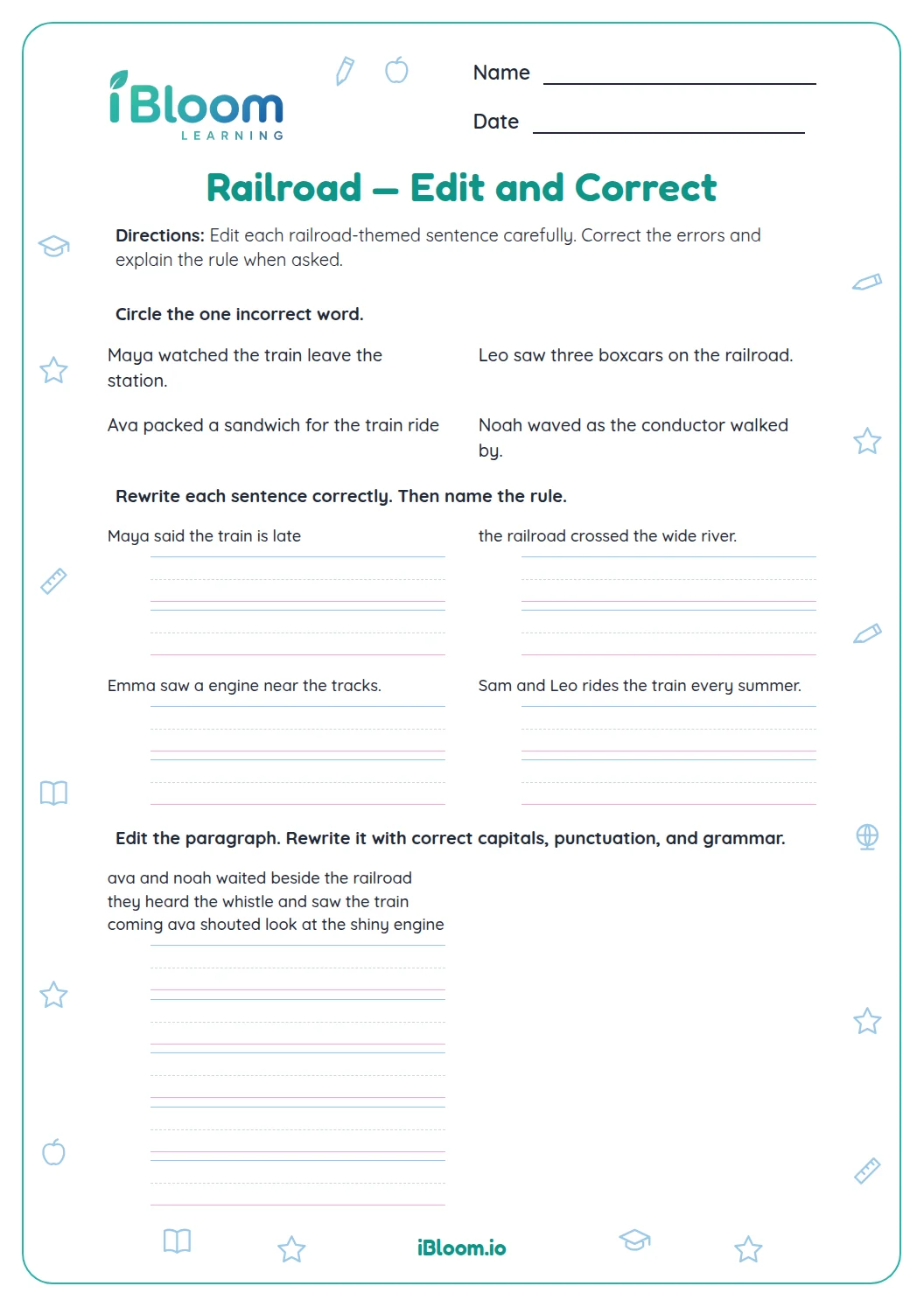
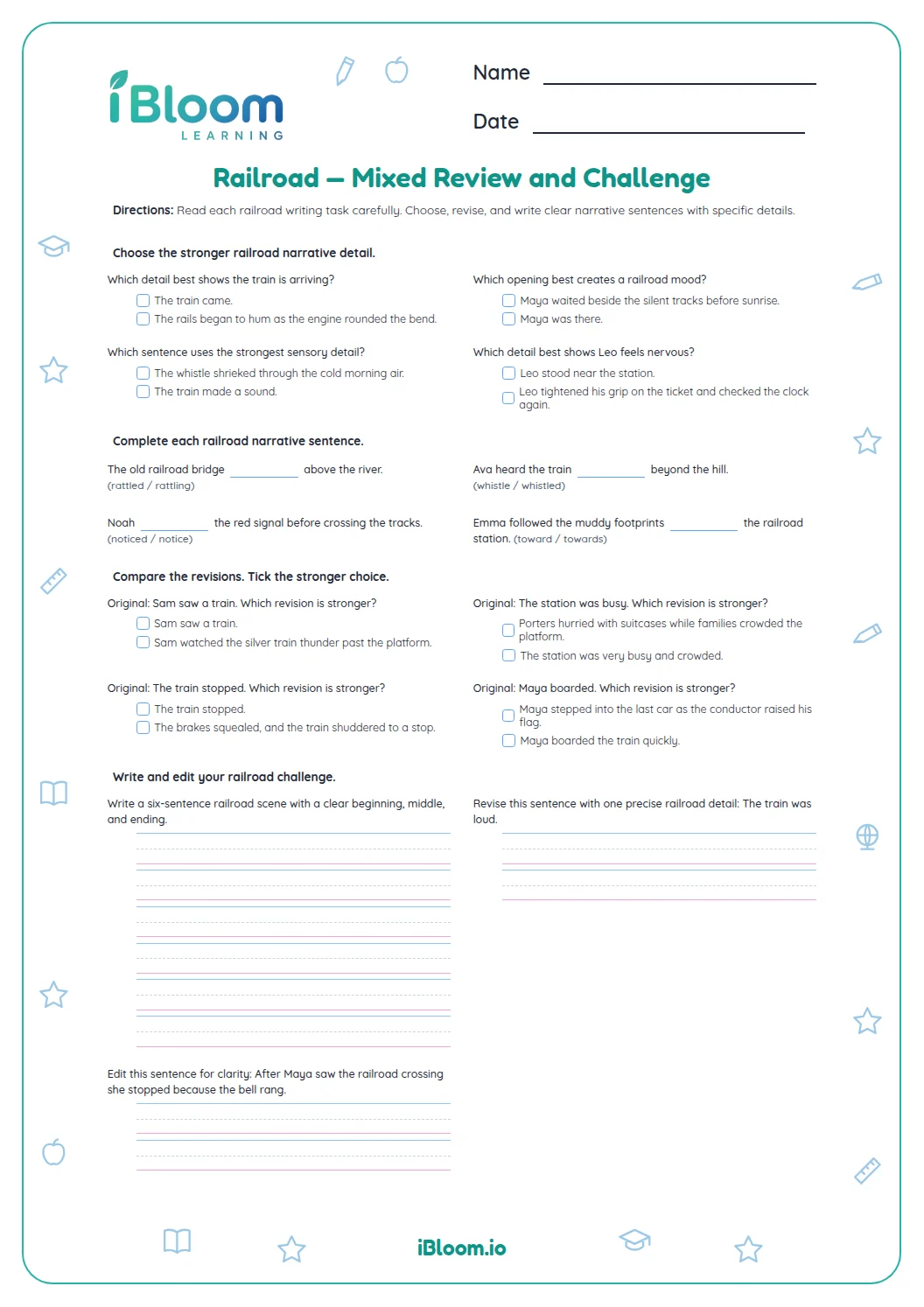
This free Grade 5 printable turns a railroad prompt into a focused narrative-writing sequence. Across 14 questions, students choose a setting and problem, order events, add sensory detail and dialogue, select a safe response, and write a short story. The four parts move from planning to craft choices, a resolution, and independent writing. A separate answer key provides sample selected responses and one possible story. The practice supports Common Core W.5.3 through organized events, descriptive details, and a clear ending.
Aligned to W.5.3
What makes a narrative feel complete?
A narrative introduces a situation, develops events, and ends in a way that follows from what happened. Question 3 offers a branch blocking the track as a problem; question 4 pairs it with alerting a worker. The final writing question invites students to create their own railroad story.
- 1Question 3: a branch blocks the track
- 2Question 4: Maya alerts the worker
- 3Question 10: the train rolls after repair
- 4These events form a problem and resolution
How do details and transitions help a story?
A sensory detail helps readers imagine a place, while a transition signals how events connect. The worksheet asks students to choose a station sound and a transition for a storm. Dialogue choices also let them review how spoken words fit into a sentence.
What should the final railroad story include?
Use a clear beginning, a problem, connected actions, and an ending that resolves the problem. The answer key gives one short sample, but students can invent different characters and events if the story remains coherent and safe.
How to use this worksheet
- 1Read the first choices and select a character, setting, and believable problem.
- 2Put the events in the order they would happen.
- 3Add a sensory detail and a character feeling.
- 4Use a transition or dialogue to connect a turning point.
- 5Draft the beginning, problem, solution actions, and ending in the final prompts.
- 6Read the draft aloud and check that the ending solves the problem.
Common narrative-writing mistakes
The mistake
Listing events without showing how they connect.
The fix
Use time words such as suddenly, later, and finally to signal the sequence.
The mistake
Adding a problem that is never solved.
The fix
Plan the solution before writing the ending, then show the result.
The mistake
Naming a feeling without giving its cause.
The fix
Join the feeling to a story event: “Maya felt worried because the track was blocked.”
Common Core alignment
The prompts organize a narrative around a situation, event sequence, details, and conclusion.
Write an organized narrative with a situation, event sequence, details, and a conclusion.
On this sheet: The planning and writing prompts build a railroad narrative with a clear problem and resolution.
Show the official wordingHide the official wording
Write narratives to develop real or imagined experiences or events using effective technique, descriptive details, and clear event sequences.
What to practice next
Make more practice
Further reading
Questions parents and teachers ask
What is this railroad writing worksheet about?
It guides Grade 5 students through choices for a railroad narrative. They select a setting and conflict, connect events, choose details and dialogue, and finish by writing a short story with a beginning, problem, and ending. A separate answer key includes sample choices and one possible story.
How many questions are on the page?
There are 14 questions in four parts. The first part plans story details, the next builds narrative craft, the third focuses on a helpful action and resolution, and the final prompt asks for a short original story. The worksheet and key each use three pages.
Does the story have to use Maya and the blocked track?
No. Maya and the blocked track are examples that connect several selected-response questions. For the final writing prompt, students may invent another character, railroad event, and solution. Their story should still have connected events and an ending that resolves its problem.
How long does this writing activity take?
Plan for about 30 minutes. Students can answer the planning and craft questions first, then use the final prompt to draft a short story. Some writers may want more time to revise or read their work aloud, especially if they add several events or descriptive details.
What should I look for in the answer key?
The key gives correct choices for the selected-response questions and one sample response for the story prompt. Use the sample to discuss a clear sequence and resolution rather than as a sentence students must copy. Another coherent story can be successful even when its details differ.
How can I help a student who is stuck?
Ask what the character wants, what gets in the way, and who or what can help. Those questions can suggest a beginning, middle, and ending. A sensory detail can help establish the railroad setting, while a transition can show when the next event begins.