





About this worksheet
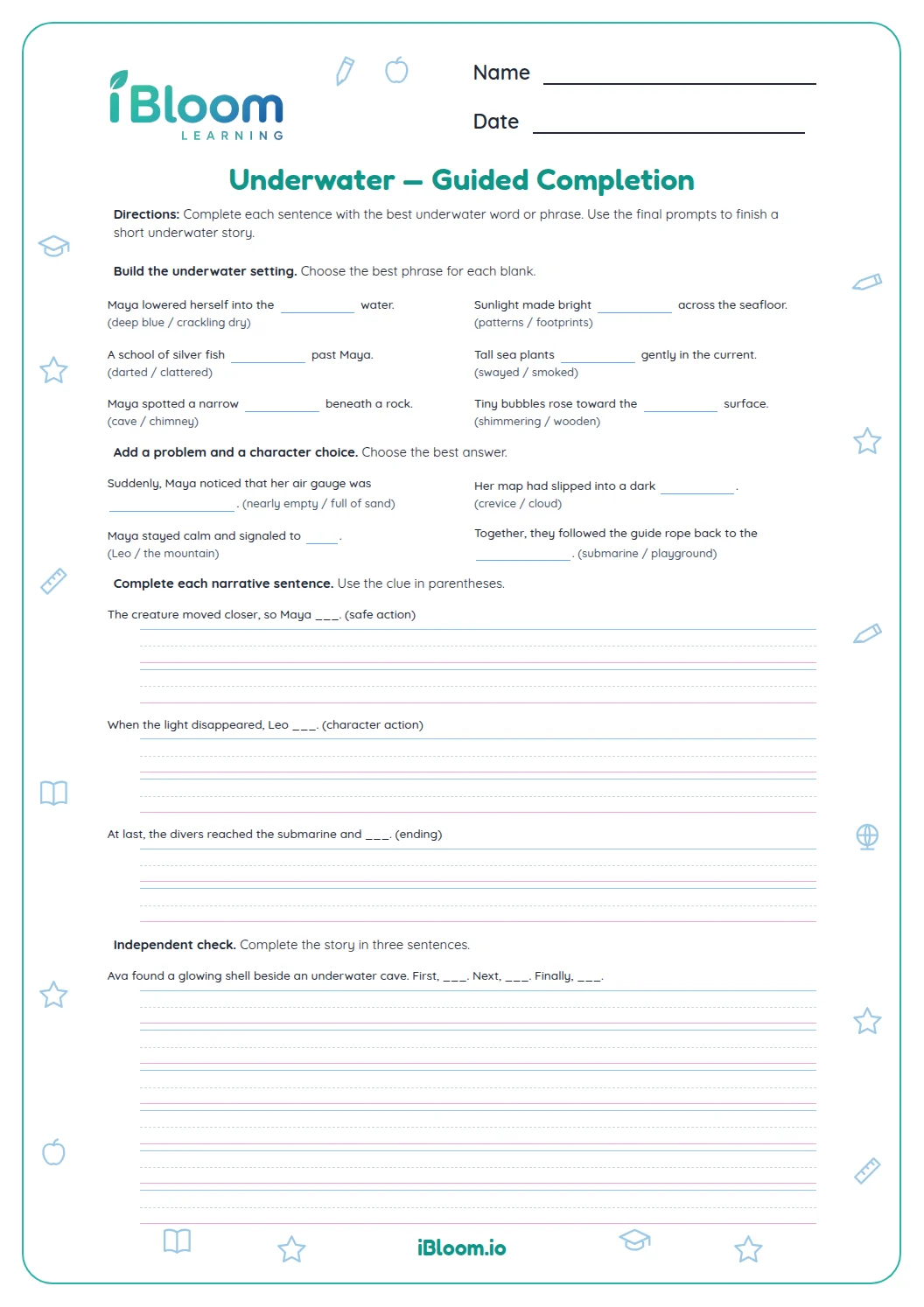
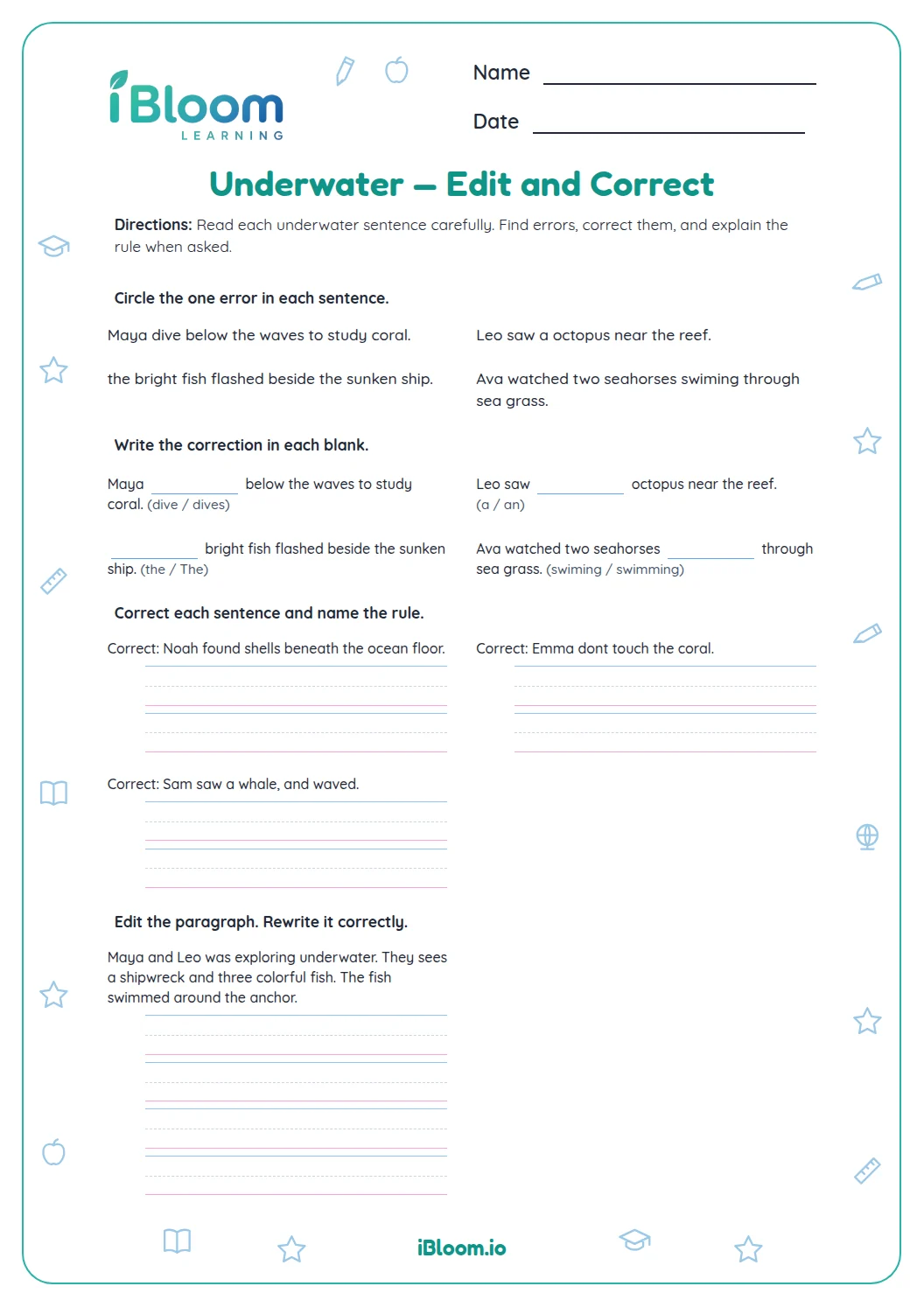
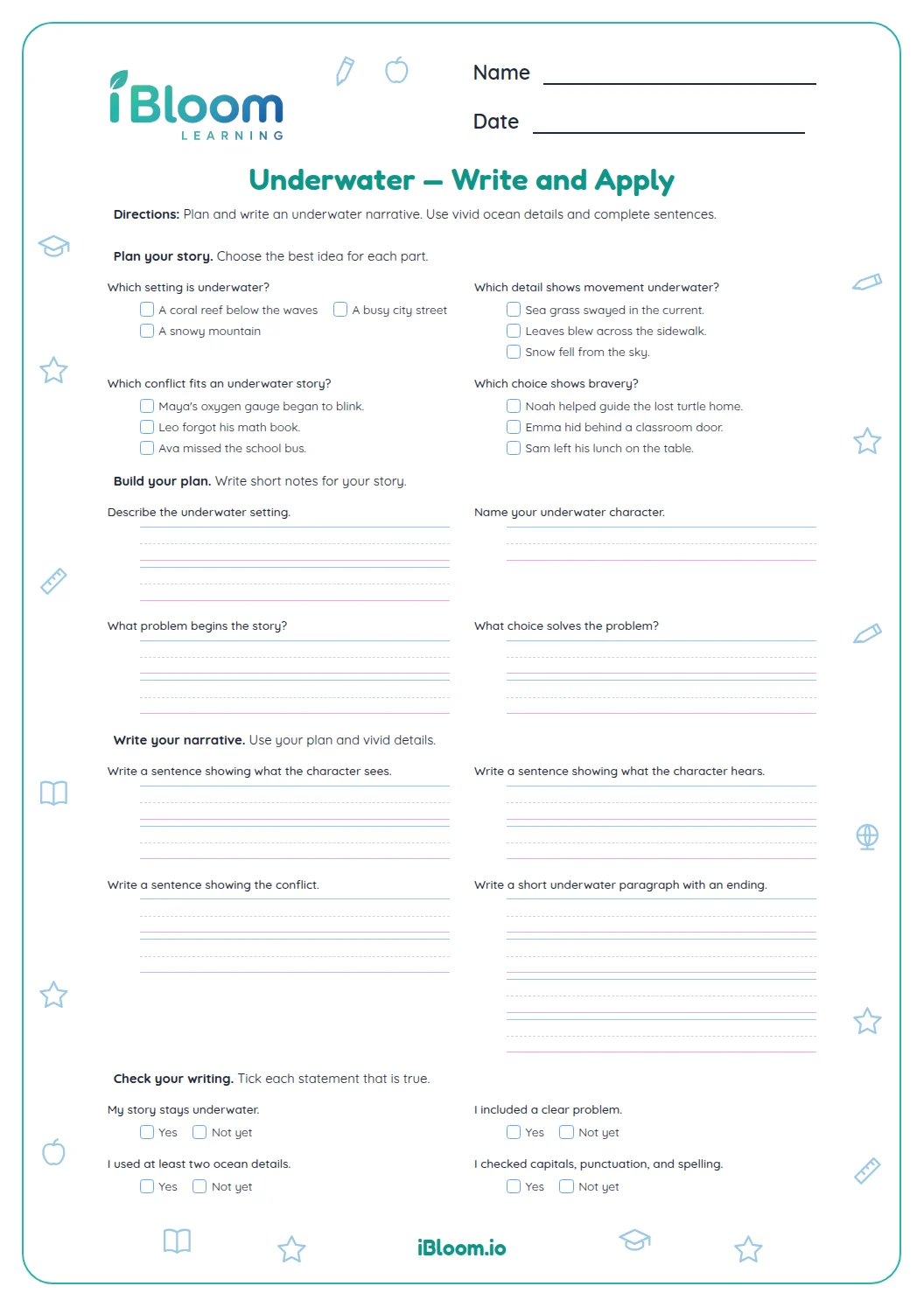
This free Grade 5 worksheet turns an underwater adventure into focused narrative-writing practice. Part A identifies a strong opening, sensory detail, transitions, a character response and an ending. Part B completes transitions that link events. Part C gives students space to revise and write their own scene details, dialogue and endings. The prompts build toward a coherent imagined experience, and the answer key includes examples for open responses.
Aligned to W.5.3
What makes a narrative detail work?
Part A asks students to recognize a strong opening, sensory language, a transition, character response and an ending. Each choice is tied to the underwater story situation.
- A clear opening introduces a character, setting or problem
- Sensory detail adds information beyond a general statement
- A character response shows what the person does or says
How do transitions help a story move?
Part B supplies a transition word that connects two events or ideas. Read both clauses and choose a word that makes their relationship clear.
- Next signals sequence
- So can show a result
- Around and behind clarify a character’s movement
How can you shape your own scene?
Part C invites original sentences and a brief ending. Add details that let the reader follow what Mina or another character sees, hears, says, and does.
- Replace general words with precise details
- Use dialogue to show a character’s thinking
- End with an outcome connected to the problem
How to use this worksheet
- 1Complete the recognition questions and identify what makes each choice effective.
- 2Read both sides of each transition blank before choosing a word.
- 3For the revision item, replace the general word “noise” with a specific sound.
- 4Use action or dialogue to show how a character responds to the underwater problem.
- 5Write an ending that follows from the events and gives the character a clear outcome.
- 6Compare open responses with the sample answers; other effective writing is welcome.
Common mistakes and quick fixes
The mistake
Adding a colorful detail that does not connect to the scene.
The fix
Choose a detail that helps the reader picture the setting, follow the action or understand the character.
The mistake
Using a transition without checking how the two clauses relate.
The fix
Read the sentence aloud and ask whether it shows time, cause or place.
The mistake
Ending the story with a new event instead of resolving the problem.
The fix
Return to the central problem and show what the character does about it.
Common Core alignment
The writing prompts practice developing an imagined experience with narrative technique, detail and event sequence.
Use sequence, descriptive details, dialogue and a fitting ending to develop an imagined experience.
On this sheet: The items ask learners to order events, add sensory detail and dialogue, respond to a problem, and write an ending.
Show the official wordingHide the official wording
Write narratives to develop real or imagined experiences or events using effective technique, descriptive details, and clear event sequences.
What to practice next
Make more practice
Further reading
Questions parents and teachers ask
What story situation frames the questions?
The questions use an imagined underwater research trip in which Mina’s sub has a problem near a reef and a sample case begins to slide. The final prompt also lets students create a different character and opening, so they can apply the same narrative skills to a new scene.
What does Part A ask students to recognize?
Part A focuses on an effective opening, sensory detail, a transition, a character response, and an ending. Each choice relates to the underwater situation and asks students to identify a narrative move that helps develop the scene. The five items check distinct parts of narrative craft.
Are there fixed answers for the writing prompts?
The key gives sample responses for the five open writing questions. Students may use different wording if it follows the prompt and adds a relevant action, detail, or narrative outcome. The samples are models, not the only possible sentences, and students can discuss their choices.
How can a student improve “The sub made a noise”?
Replace the general word “noise” with a specific sound, such as an alarm’s three sharp beeps. A precise detail lets readers imagine what Mina hears and can help move the scene toward her next action. Students may invent another sound that fits the sub.
How long might this worksheet take?
Plan for about 20 minutes. The first two parts contain five choices and four transition blanks, while Part C asks students to write five original responses. A student can complete one part at a time and spend longer developing the final responses.
What can students write after this review?
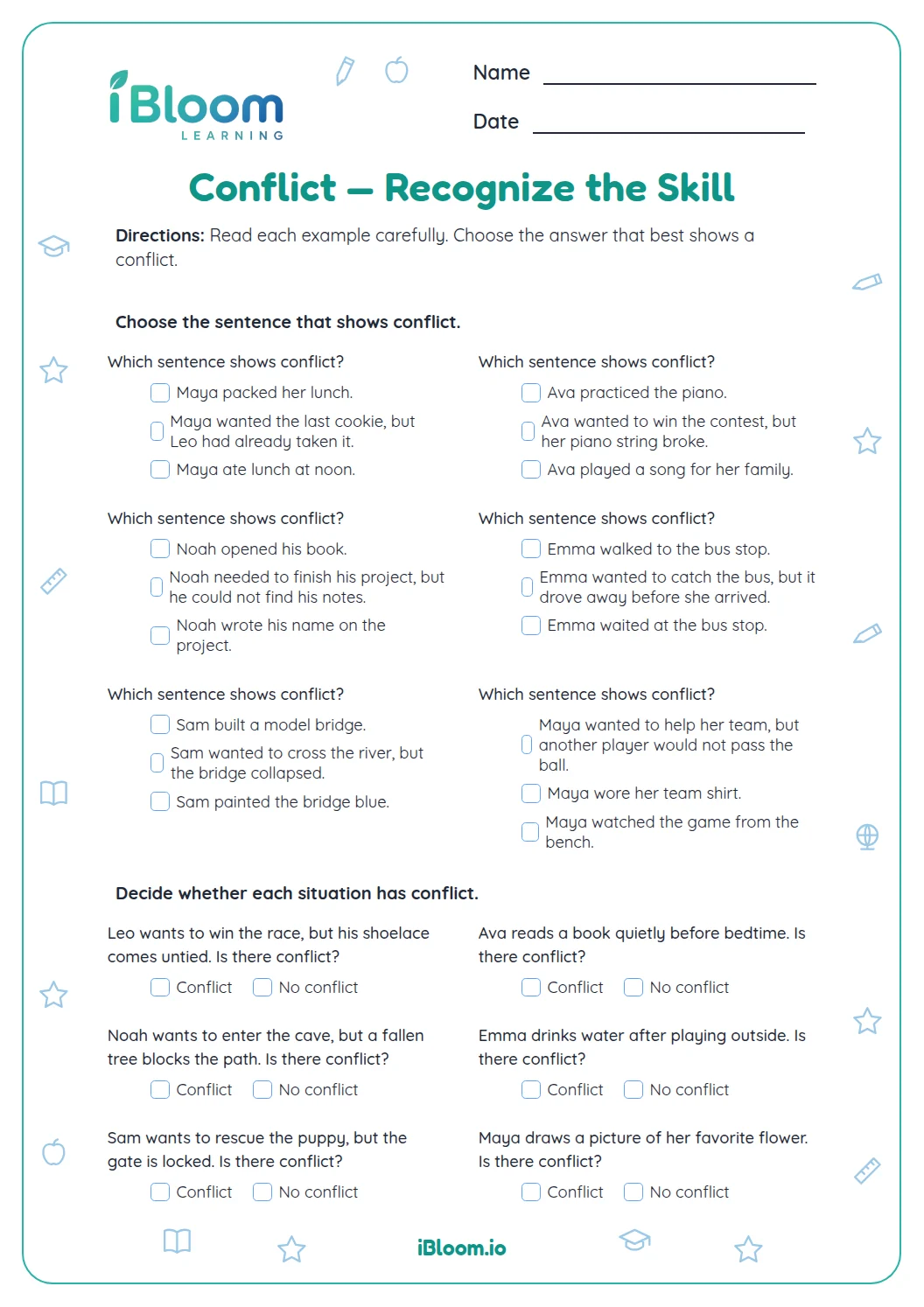
The related conflict and mystery-package prompts provide new story situations for practicing narrative craft. Students can carry over the same habits: introduce a situation, connect events with transitions, use specific detail, and write an ending that follows from the events.