



About this worksheet
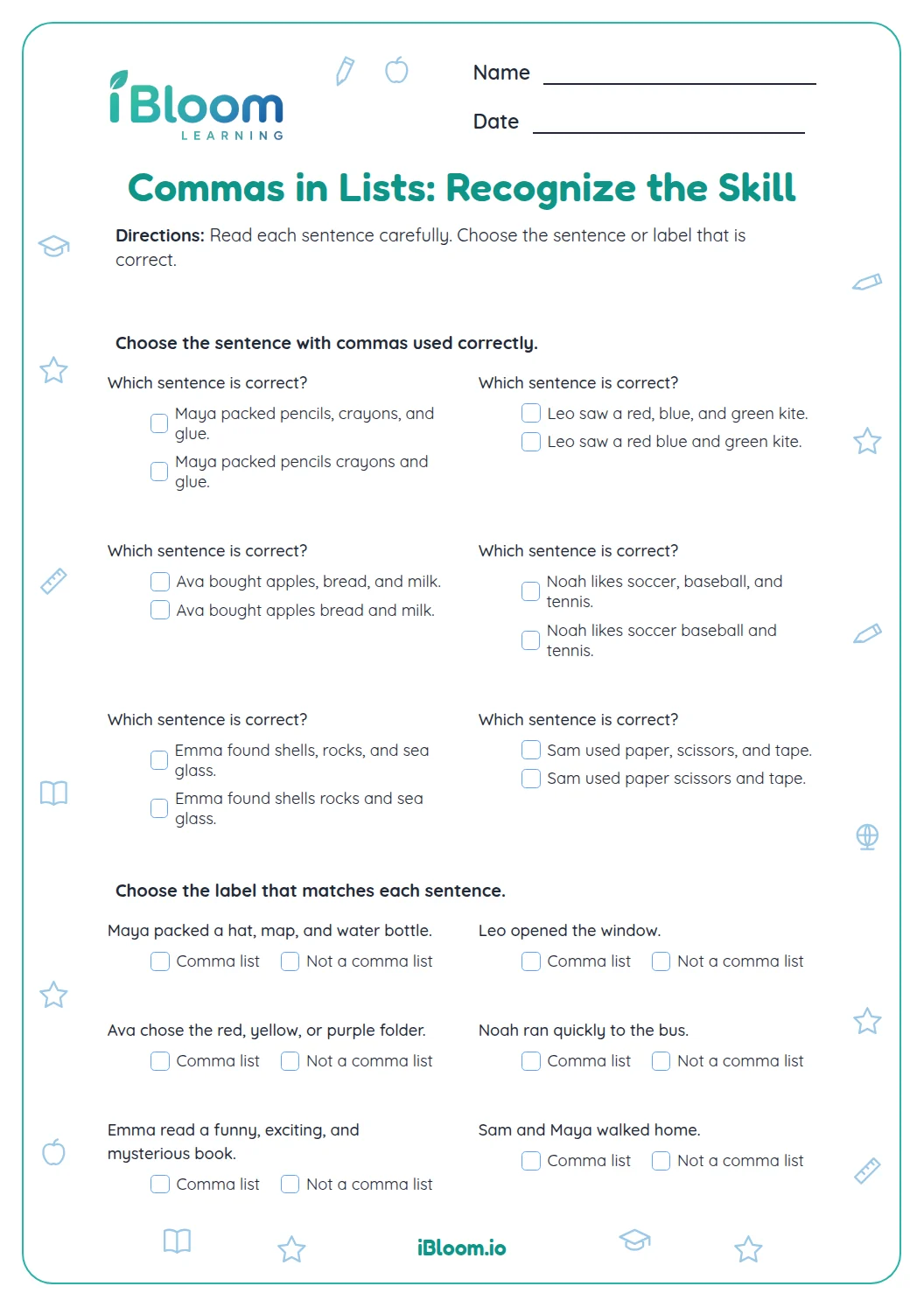
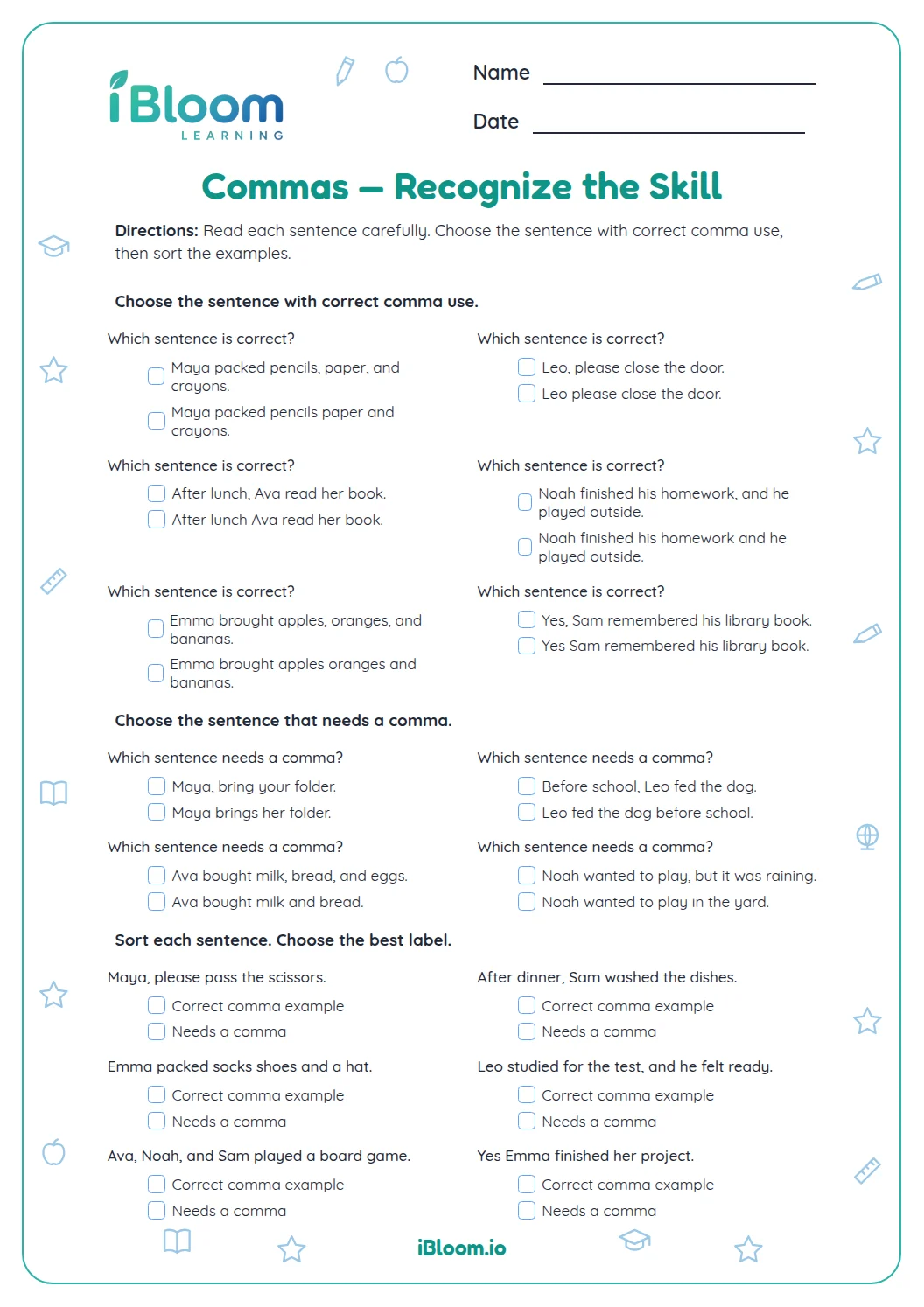
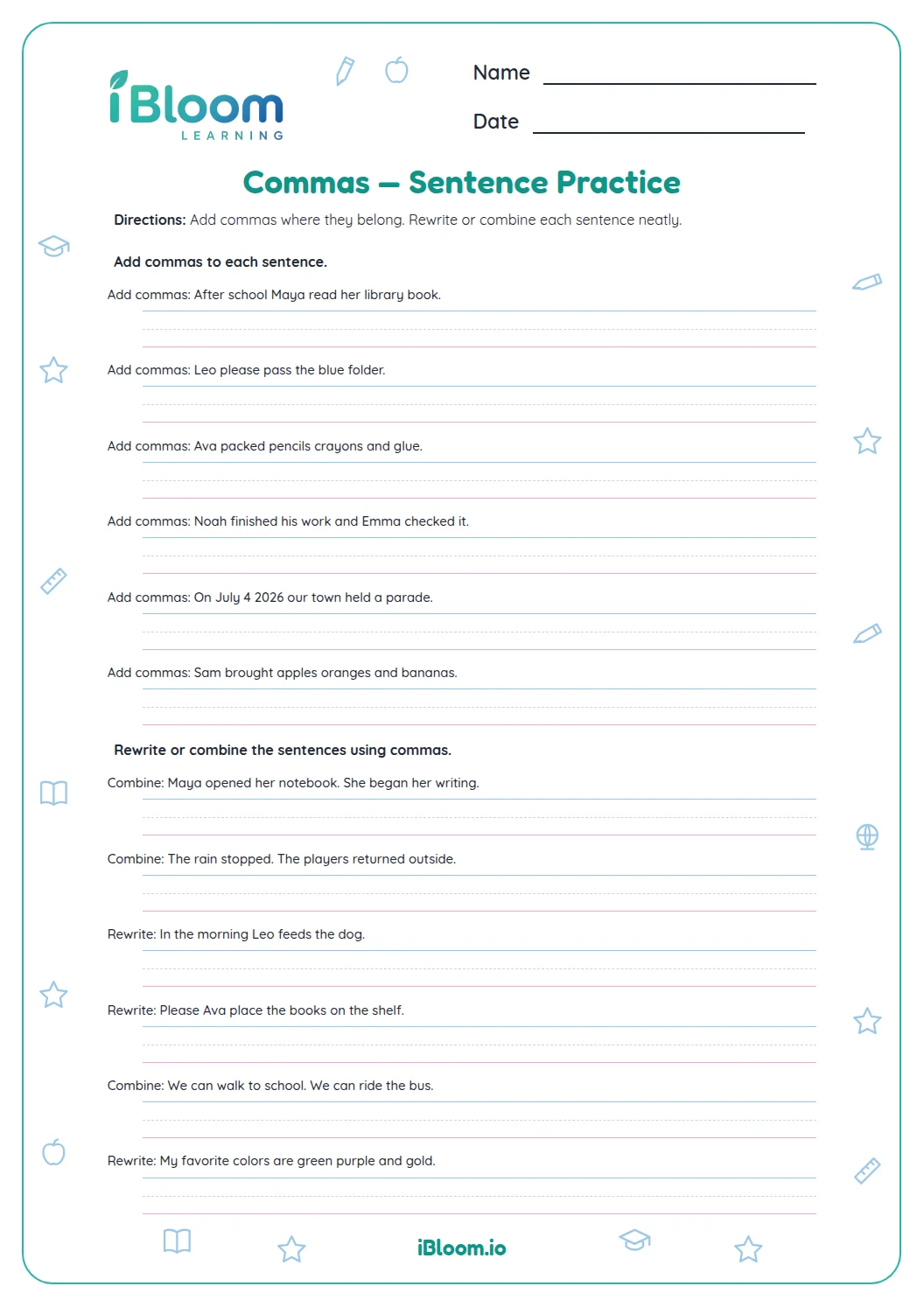
This Grade 5 printable reviews commas in a series in two formats. Students choose the correctly punctuated sentence in six items, then add commas in eight sentences with two-, three-, and four-item lists. The practice follows the serial comma convention and supports CCSS ELA/L.5.2. A separate answer key shows the correct choices and comma positions.
Aligned to L.5.2
How do commas separate list items?
Use a comma between list items. When and introduces the last item, put a comma before and.
- 1The bag holds a map, a snack, and a bottle.
What will students do on the page?
Part A asks students to select a correctly punctuated sentence. Part B gives a blank at each comma position, including lists with two, three, or four items.
- 1Our garden has beans ___ and peas. → Our garden has beans, and peas.
Find each item in the series.
- 1Place a comma after each item except the last.
- 2Read the sentence aloud and check that the list is clear.
Check these common slips
The mistake
Leaving out the comma between the first two items.
The fix
The mistake
Putting a comma after and instead of before the final item.
The fix
Common Core alignment
The practice focuses on conventional punctuation for items in a series.
Use a comma to separate items in a series.
On this sheet: Students identify, add, and edit commas in lists.
Show the official wordingHide the official wording
Demonstrate command of the conventions of standard English capitalization, punctuation, and spelling when writing.
What to practice next
Make more practice
Further reading
Questions parents and teachers ask
Does this sheet use the serial comma?
Yes. In lists ending with and, the examples place a comma before and. Part A asks students to recognize that pattern, and Part B asks them to insert the comma in each listed position. The key follows the same convention throughout.
How many questions are on the worksheet?
Write a comma in each blank that separates one list item from the next. For example, “maps ___ snacks ___ and water” needs two commas: one after maps and one after snacks. The final item does not need a comma after it, so check each boundary.
How should students answer Part B?
Write a comma in each blank that separates one list item from the next. For example, “maps ___ snacks ___ and water” needs two commas: one after maps and one after snacks. The final item does not need a comma after it.
Are all lists the same length?
No. The worksheet includes lists with two, three, and four items. That variety asks students to identify each boundary in the series and place a comma there, including before and when it introduces the final item. The last item has no comma after it.
What does the answer key show?
The key identifies the correct sentence choice in Part A and gives the comma placements for every blank in Part B. Students can compare each comma with the list boundaries and check that the last item has no comma after it.