





About this worksheet
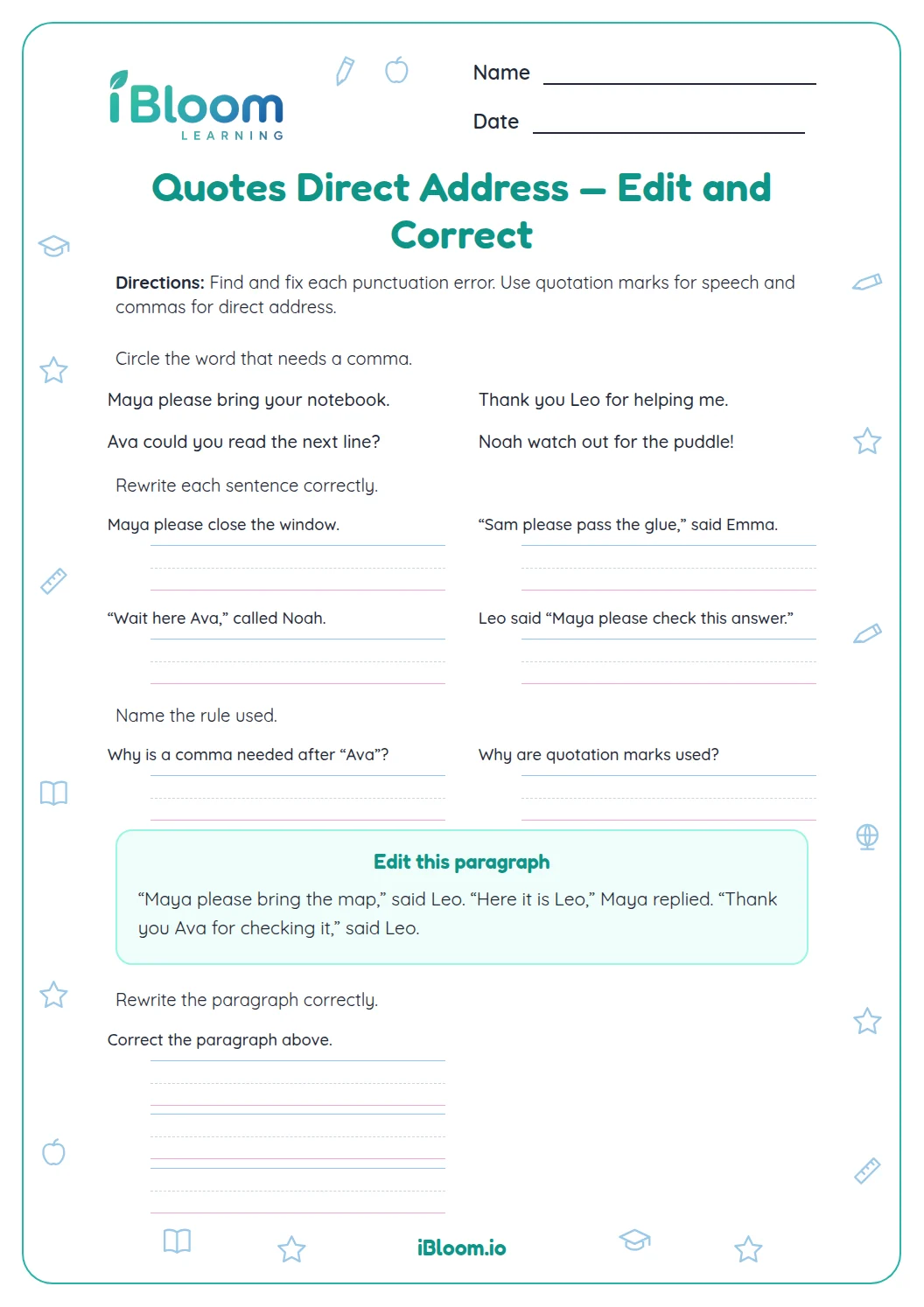
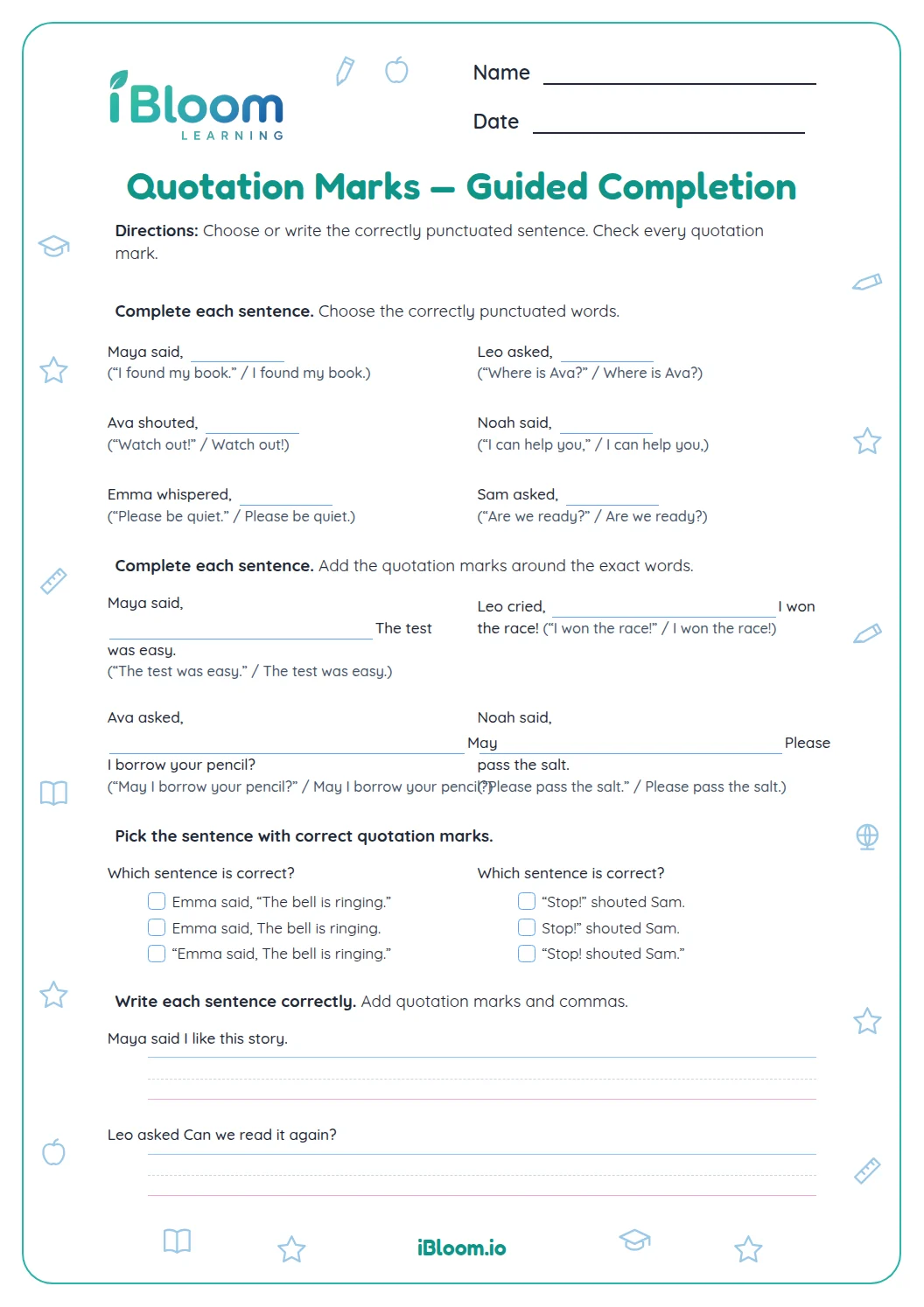
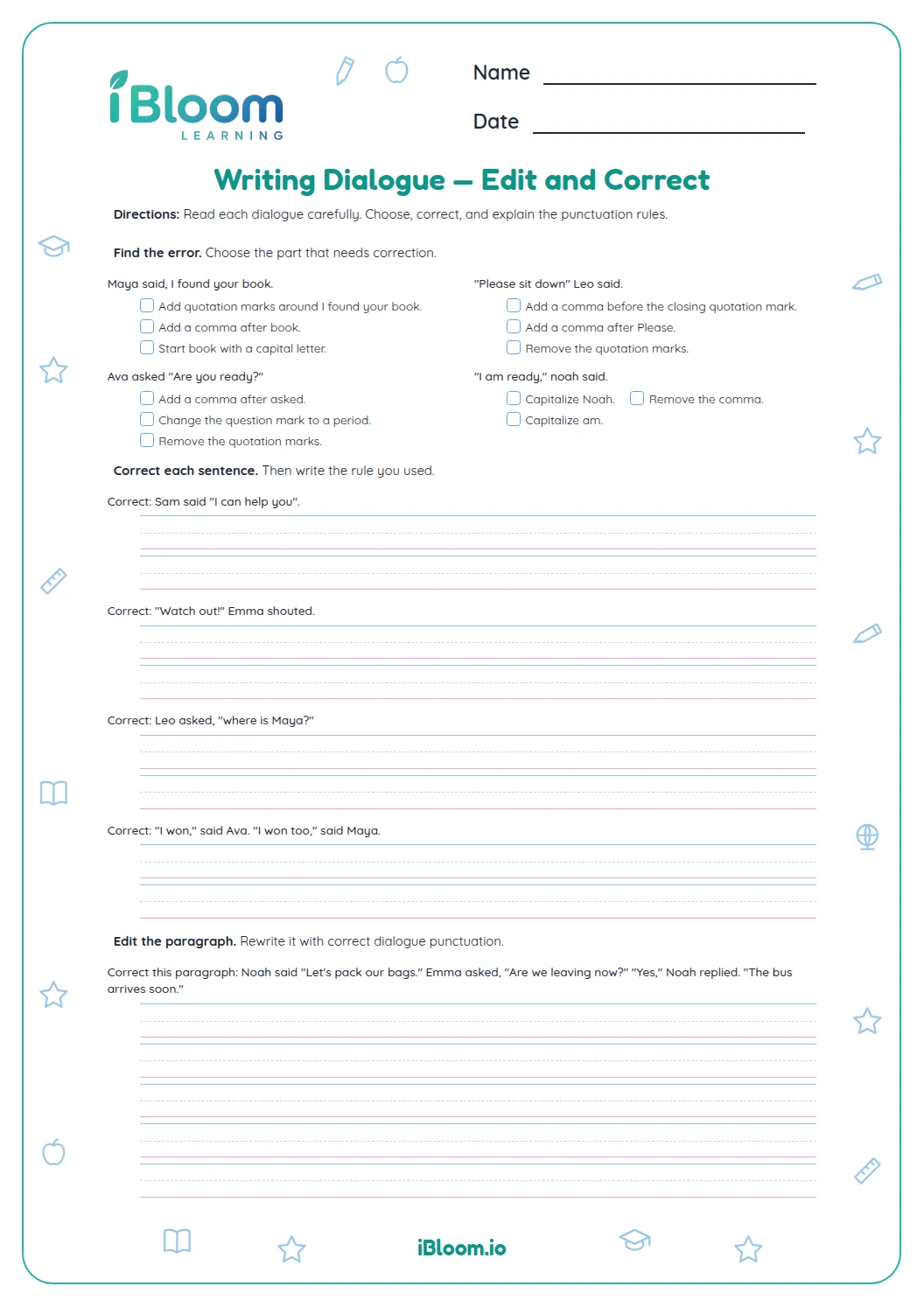
This Grade 5 punctuation printable practices quotation marks, commas in dialogue, and commas for direct address. Sixteen short items ask learners to supply punctuation in complete sentences. The answer key shows each missing mark, and the examples include statements, questions, exclamations, and names spoken to directly.
Aligned to L.5.2
How do commas and quotation marks work in dialogue?
Quotation marks enclose the speaker’s exact words. When a dialogue tag follows a statement, a comma separates the spoken words from the tag and sits inside the closing quotation mark. A question mark or exclamation mark stays inside when it belongs to the spoken words.
- 1“We found the trail___ said Maya.
- 2Insert a comma and closing quotation mark before said: “We found the trail,” said Maya.
Where does a direct-address comma go?
A comma separates the name of the person being spoken to. It follows a name at the start or end of a sentence; when the name falls in the middle, commas go on both sides.
What should a writer check after filling a mark?
Read the whole sentence. Check whether the speaker’s words end with a statement, question, or exclamation, then confirm that the name and speaker tag are outside or inside the quotation marks as intended.
How to complete the punctuation practice
- 1Read each whole sentence to identify the speaker and listener.
- 2Find the exact spoken words and mark where they begin and end.
- 3Choose a comma, question mark, or exclamation point that matches the sentence.
- 4For direct address, locate the name being spoken to and place its comma.
- 5Reread the completed sentence aloud.
- 6Check the punctuation against the separate answer key.
Common punctuation mix-ups
The mistake
Putting the dialogue comma outside the closing quotation mark.
The fix
For a dialogue tag after a statement, place the comma inside the closing quotation mark.
The mistake
Using a comma when the spoken words are a question.
The fix
Keep the question mark inside the quotation marks when the speaker asks a question.
The mistake
Leaving out a comma around a name used in direct address.
The fix
Set the spoken-to name apart with a comma; use one comma before and one after a middle name.
Curriculum alignment
This worksheet gives focused practice with a skill in the Common Core State Standards.
Apply grade-level punctuation conventions in written sentences.
On this sheet: The questions ask learners to apply commas and quotation marks in dialogue and direct address.
Show the official wordingHide the official wording
Demonstrate command of the conventions of standard English capitalization, punctuation, and spelling when writing.
What to practice next
Make more practice
Further reading
Questions parents and teachers ask
Where does the comma go before a dialogue tag?
When a speaker tag follows a statement, the comma goes inside the closing quotation mark. In “We found the trail,” said Maya, the spoken words end with a comma before the closing mark, and said Maya remains outside the quotation marks.
Where does a question mark go in dialogue?
If the spoken words are a question, put the question mark inside the closing quotation mark. In Dad asked, “Are you ready?” the question mark belongs to the quoted question, so it appears before the closing quotation mark.
What is direct address?
Direct address is using a person’s name or title to speak to that person. In “Please bring the map, Maya,” the comma separates Maya from the request. A name in the middle of a sentence is separated with a comma on each side.
How many questions are on this printable?
The worksheet has 16 fill-in punctuation questions in three parts. Most focus on dialogue punctuation, followed by direct-address commas and a short review. The separate answer key lists the punctuation mark needed for every blank so responses can be checked quickly.
What should children do after adding punctuation?
Reread the full sentence and check who is speaking, which words are spoken, and whether the line is a statement, question, or exclamation. Then use the key to confirm that commas and quotation marks enclose the dialogue correctly.