





About this worksheet
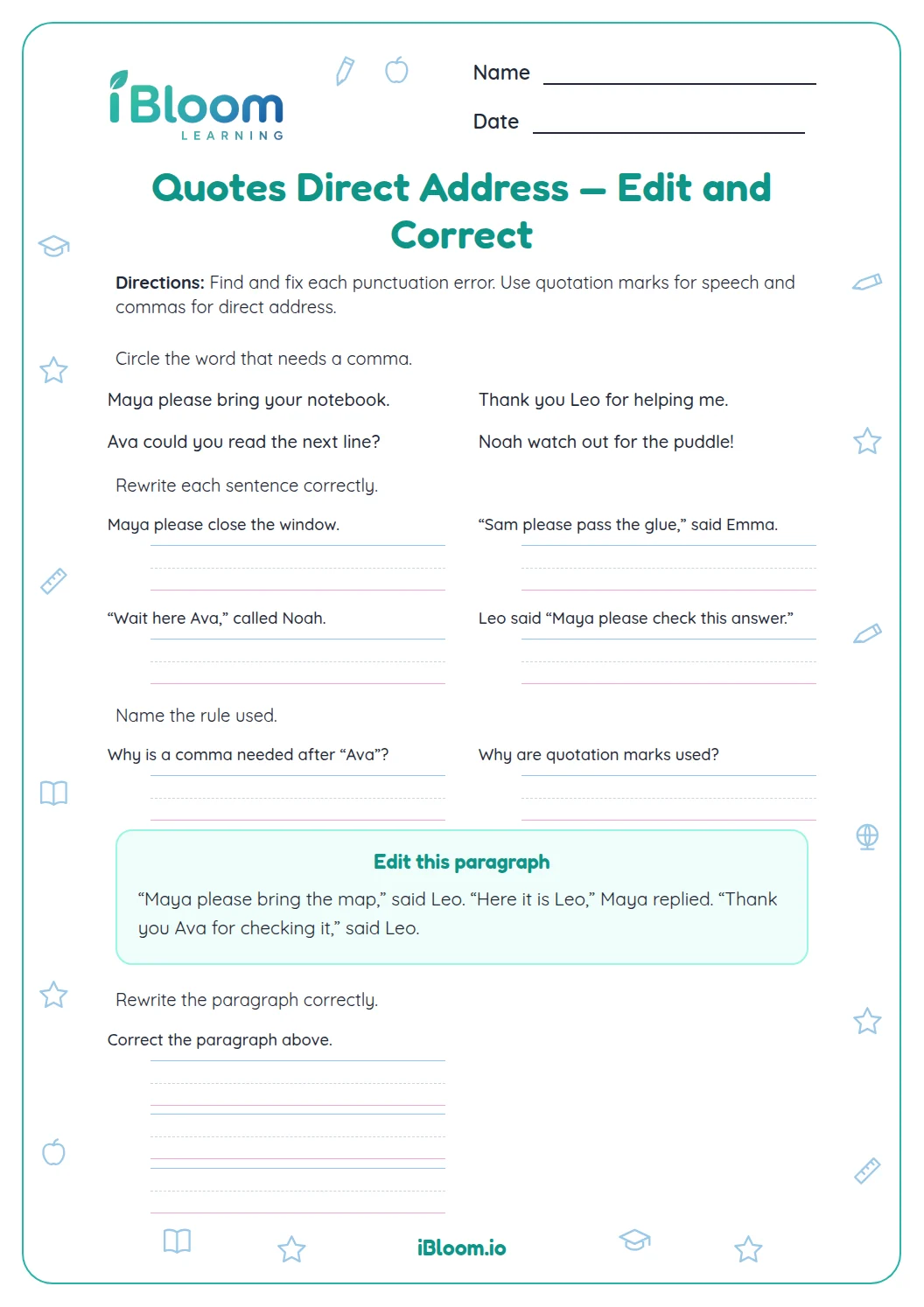
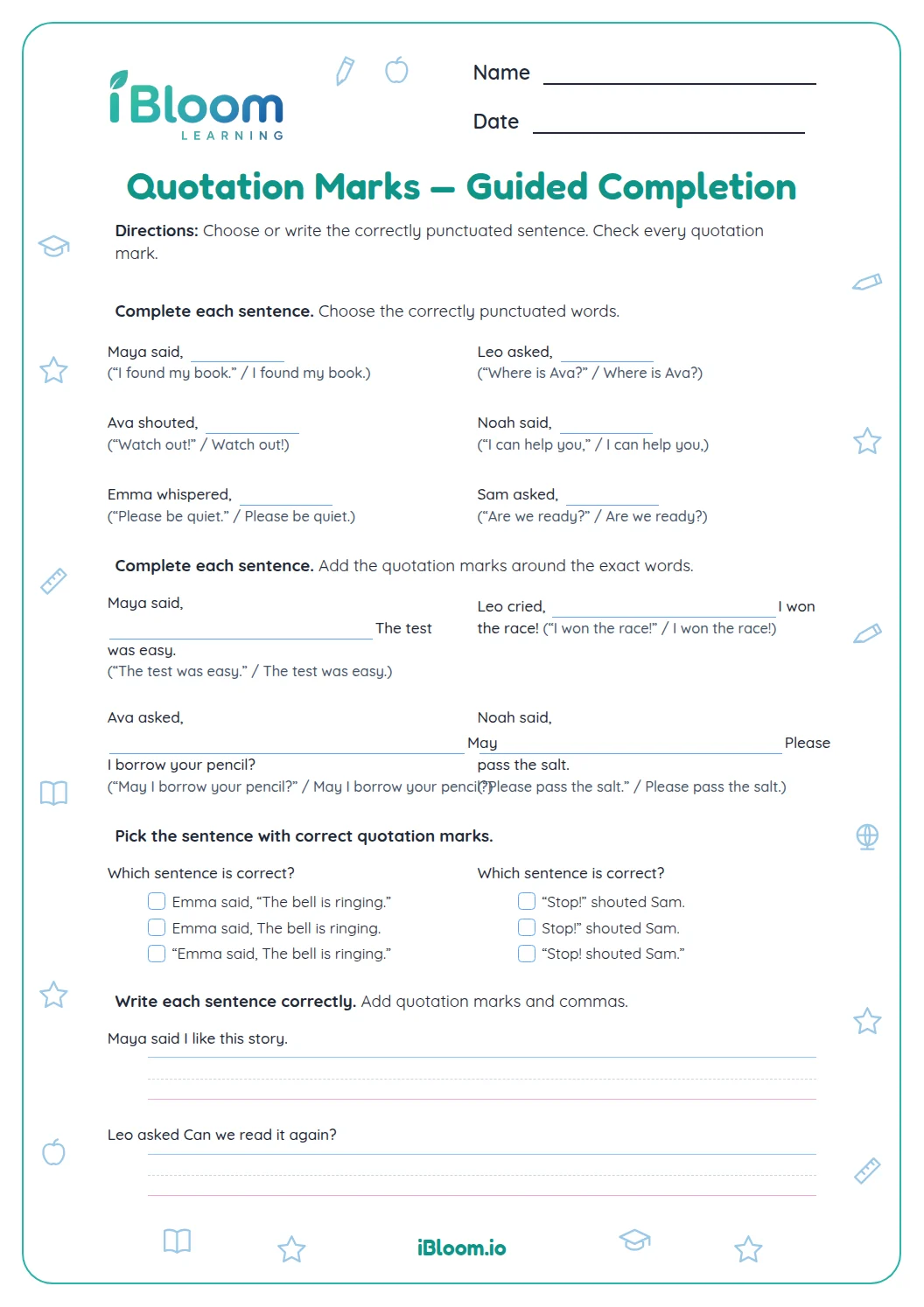
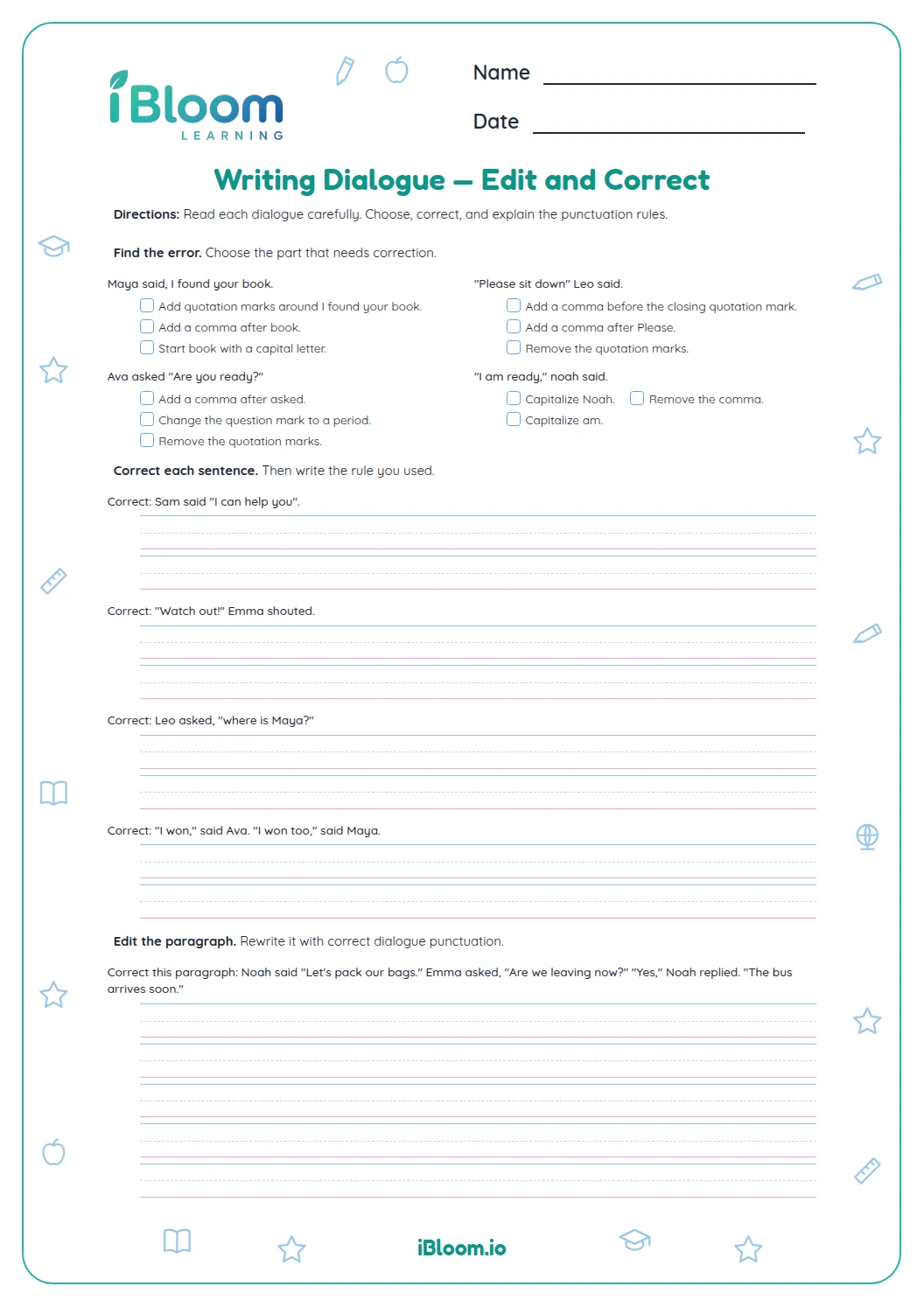
This Grade 5 worksheet practices punctuation in dialogue. Students add missing commas and quotation marks, choose end punctuation that matches a sentence, and write two original responses. Several examples address a listener by name, so students also practice the direct-address comma. A separate answer key includes sample dialogue.
Aligned to L.4.2.b
How do you punctuate dialogue?
Quotation marks enclose the words a speaker says. When a dialogue tag follows, place a comma before the closing quotation mark. A question mark or exclamation point stays with the spoken words.
- 1“Did you see it?” Ana asked.
- 2The question mark stays inside the closing quotation mark.
Where does the direct-address comma go?
Set off the name of the person being spoken to. In “Maya, would you read next?” the comma follows Maya because the speaker addresses Maya directly. A name used as the speaker or listener is not always direct address; check how it functions in the sentence.
What should you include in your own dialogue?
Use quotation marks around spoken words, capitalize the first word, and punctuate the sentence before its dialogue tag. In the second prompt, make one speaker say the other person’s name directly.
How to use this worksheet
- 1Read the whole sentence before filling a punctuation gap.
- 2Place quotation marks around the words that are spoken.
- 3Keep a question mark or exclamation point inside the closing quotation mark.
- 4Use a comma after a name when the speaker is addressing that person.
- 5Reread each original response and check its dialogue tag.
Common mistakes and quick fixes
The mistake
Putting the dialogue tag inside the quote marks
The fix
Close the quotation after the spoken words, then write the tag.
The mistake
Leaving the direct-address name without a comma
The fix
Add a comma right after the name of the person being addressed.
The mistake
Placing a question mark after the closing quote
The fix
Put the question mark inside the quotation marks when the spoken words are a question.
Common Core alignment
This worksheet practices punctuating direct speech.
Mark direct speech with commas and quotation marks.
On this sheet: Questions 1–12 add punctuation to direct speech; the final two ask students to write quoted dialogue.
Show the official wordingHide the official wording
Use commas and quotation marks to mark direct speech and quotations from a text.
What to practice next
Make more practice
Further reading
Questions parents and teachers ask
Where do quotation marks go in dialogue?
Put an opening quotation mark before the speaker’s words and a closing mark after them. If a dialogue tag follows, the comma or end mark belongs inside the closing quotation mark. Questions 1–12 practice these conventions in short lines of speech.
How do you punctuate a dialogue tag?
When the tag follows a statement, put a comma before the closing quotation mark: “I found the trail,” Maya said. The tag begins with a lowercase word unless it starts a new sentence. The worksheet’s answer key shows punctuation for each edited line.
How do you show direct address?
Use a comma to set off the name of the person being spoken to, as in “Maya, would you read next?” The name is part of the spoken words. Questions with names help distinguish direct address from a name identifying the speaker.
Does this page include writing practice?
Yes. The final two questions ask for an original quoted sentence and a short exchange between two speakers. One line must address someone by name. The key gives sample responses; other sentences work when the dialogue and direct-address punctuation are correct.
What is a direct-address comma?
A direct-address comma separates a listener’s name from the rest of the spoken sentence. In “Maya, would you read next?” the speaker is talking to Maya. The page includes several examples and asks students to use a name in their own dialogue.