




About this worksheet
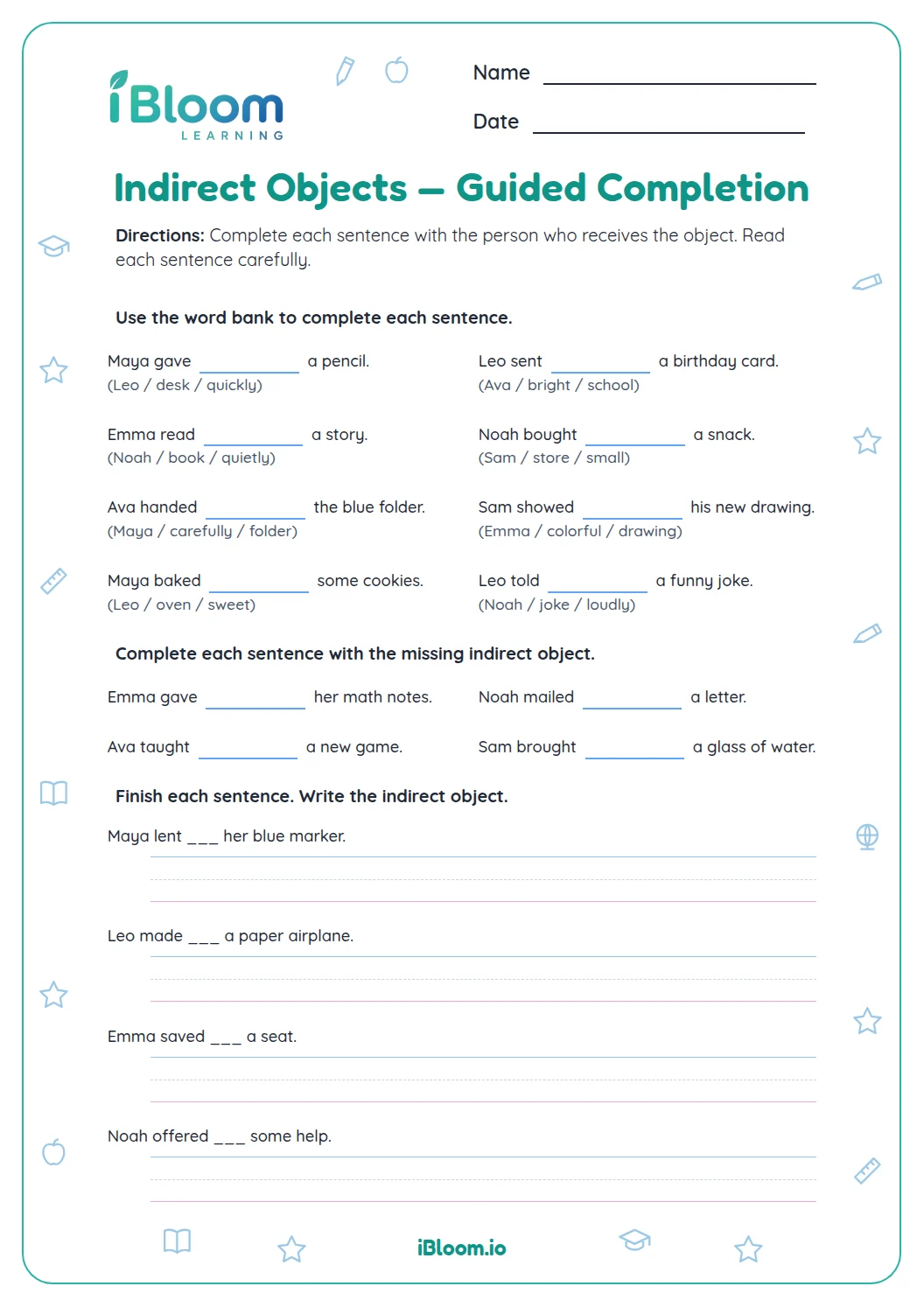
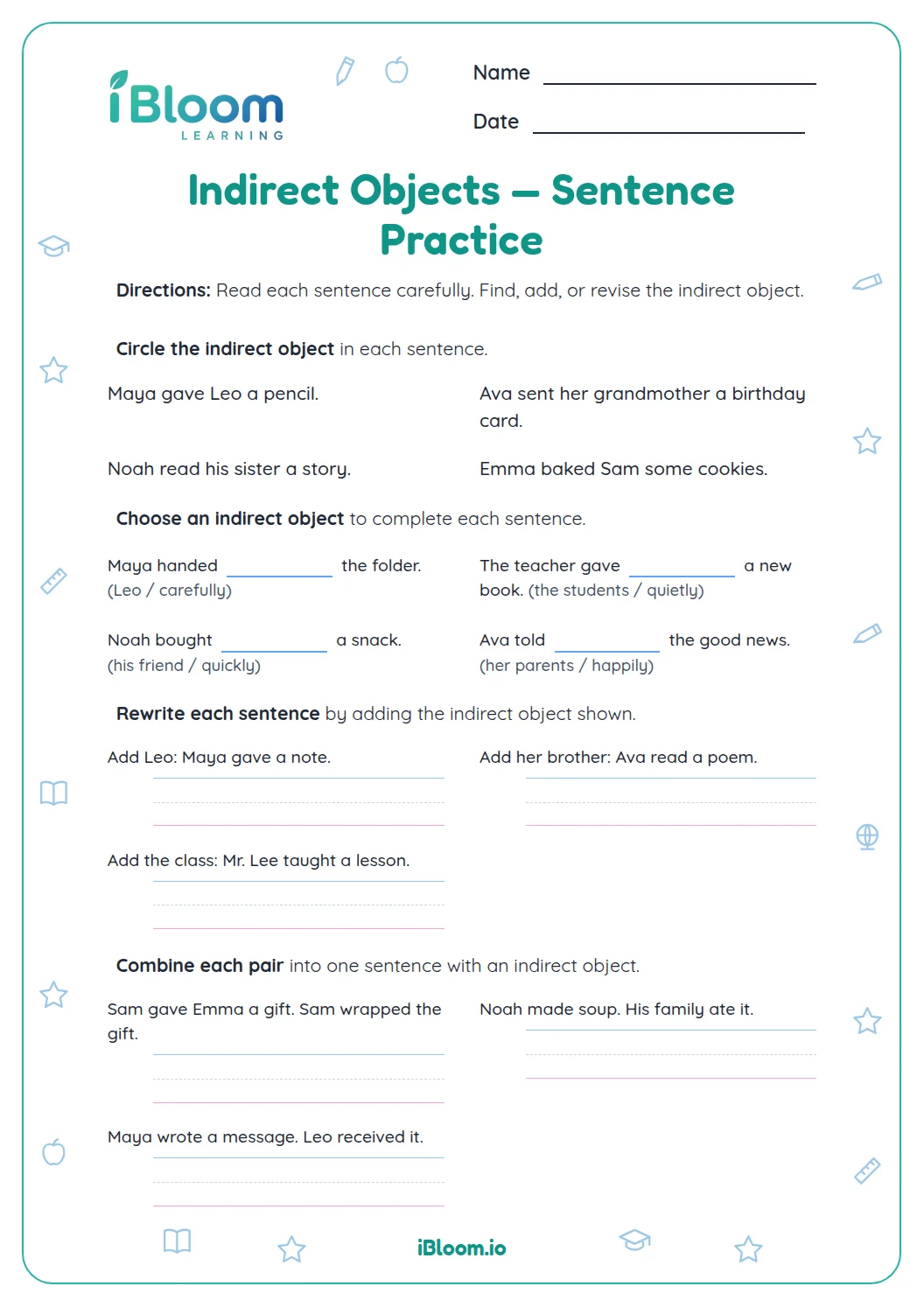
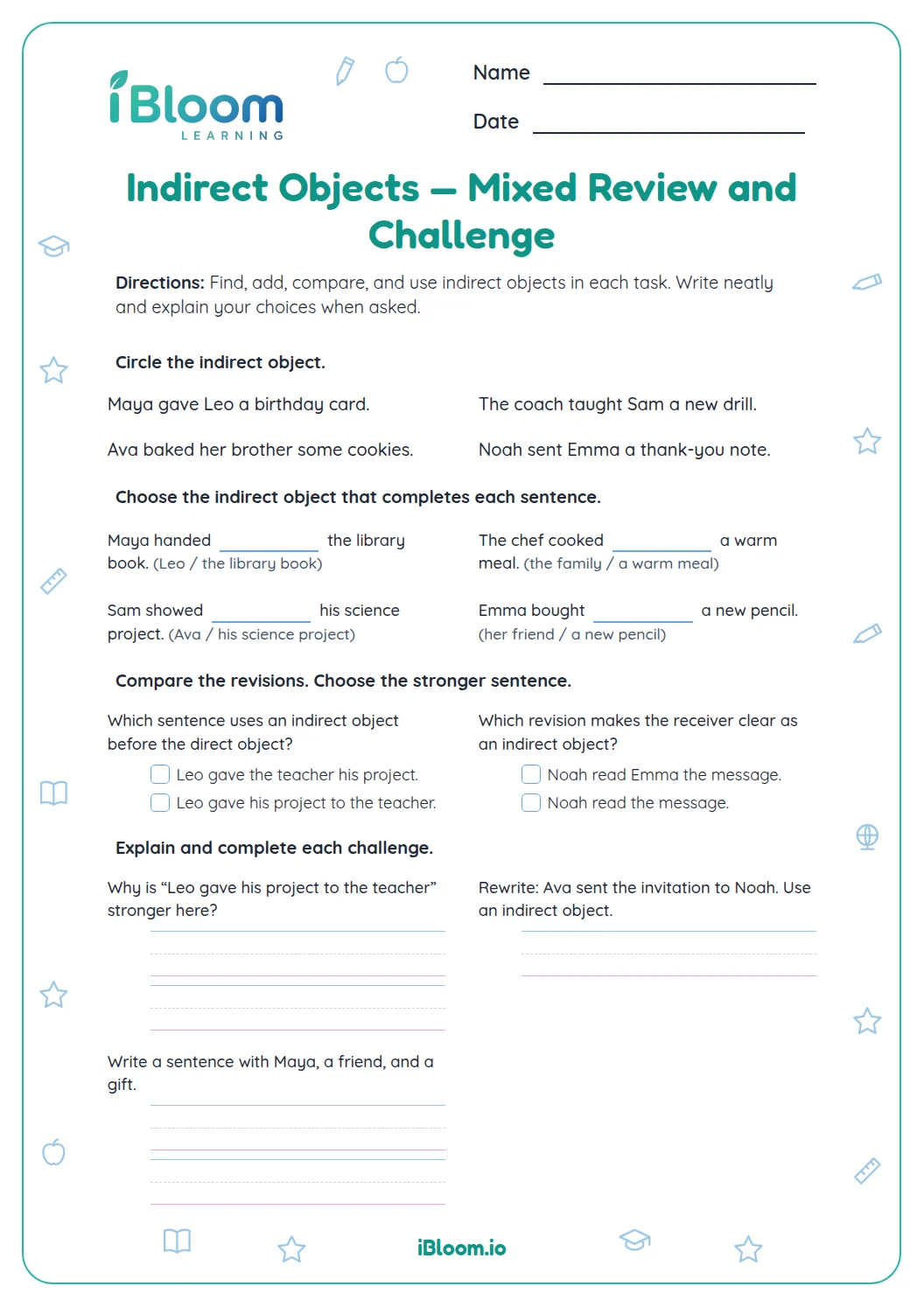
This free Grade 5 grammar worksheet focuses on indirect objects: the people or groups who receive something in a sentence. Students identify the receiver in complete sentences, then revise or complete sentences so the indirect object fits naturally. The 15 questions move from recognition to editing, with a separate answer key for quick checking. The examples use clear verbs such as gave, sent, showed, and taught.
How do you find an indirect object?
First find the verb and ask what was given, sent, baked, or shown. That answer is the direct object. Then ask who received it. The receiver is the indirect object.
- 1Maya gave Luis a note. What was given? A note.
- 2Who received the note? Luis.
- 3Luis is the indirect object.
Can an indirect object be a person or a group?
Yes. A receiver can be a name, a pronoun, or a group of people. In “The coach sent the team a schedule,” the team receives the schedule. In “Dad baked us muffins,” us receives the muffins.
How can you revise a sentence to include an indirect object?
A sentence can put the receiver before the thing received: “Sam sent me a photo.” It can also use a phrase beginning with to or for: “Sam sent a photo to me.” Part C asks students to choose or complete a clear receiver phrase while keeping the meaning.
How to use this worksheet
- 1Read the full sentence before choosing a word.
- 2Ask what the subject gave, sent, baked, taught, or showed.
- 3Ask who received that thing.
- 4Check that an edited sentence keeps the original meaning.
Common sentence-part mix-ups
The mistake
Choosing “note” as the indirect object in “Maya gave Luis a note.”
The fix
“Note” is what was given. Ask who received the note: Luis.
The mistake
Calling the subject the receiver.
The fix
The subject does the action. Find the person who receives the direct object.
The mistake
Writing “The teacher gave a quiz the class.”
The fix
Put the receiver before the thing: “The teacher gave the class a quiz.”
What to practice next
Make more practice
Questions parents and teachers ask
What does an indirect object tell us?
It tells who receives the direct object. In “Dad baked us muffins,” muffins are what Dad baked, and us tells who received them. Students can find it by asking who received the thing named after the verb. That question is a helpful first step.
How is an indirect object different from a direct object?
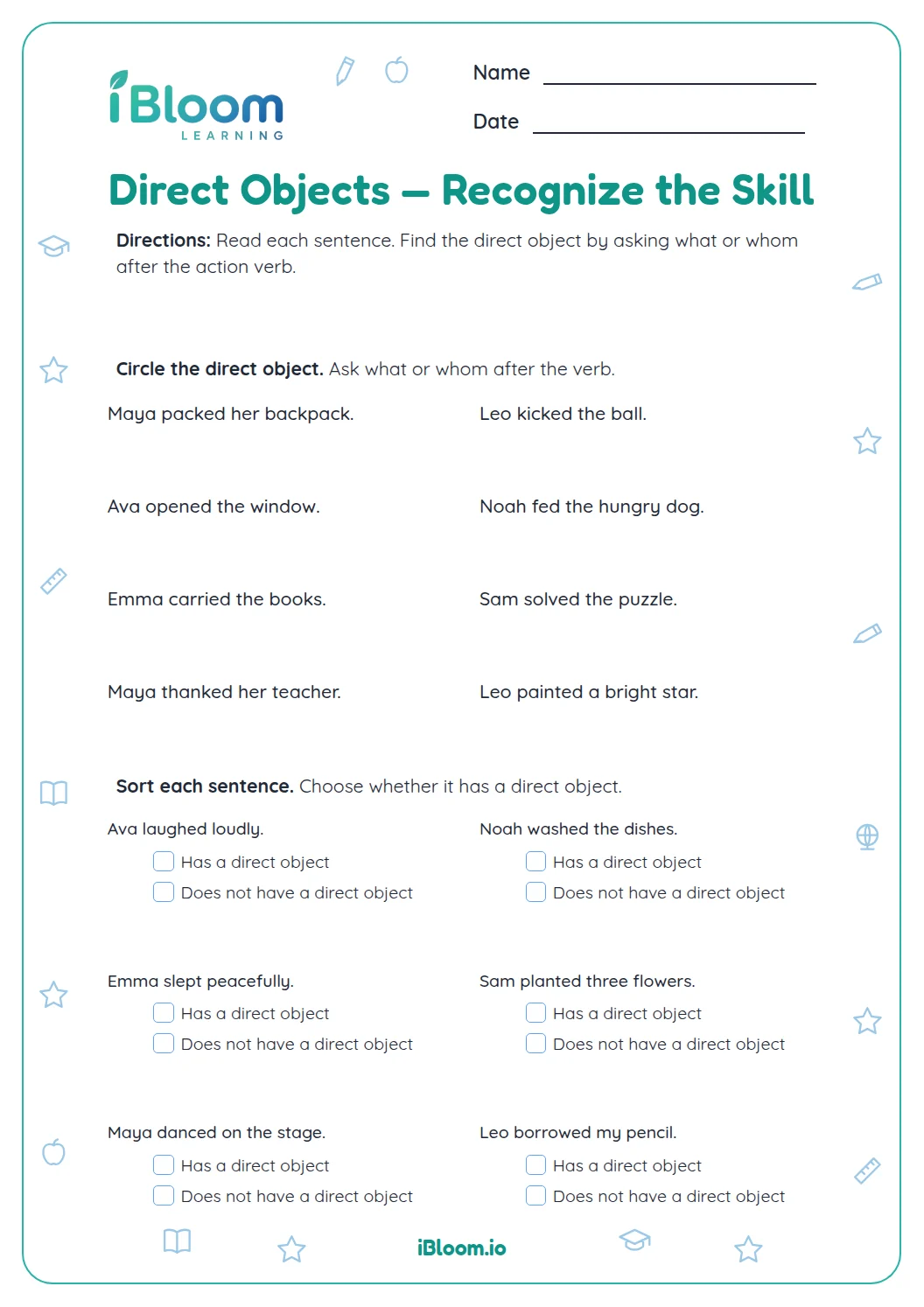
The direct object is the thing acted on or given. The indirect object is the receiver. In “The librarian showed Ana a map,” the map is the direct object and Ana is the indirect object because she received the map.
Can an indirect object be a pronoun?
Yes. Words such as me, us, and them can name a receiver. In “Dad baked us muffins,” us receives the muffins. Part A includes pronouns and nouns so students practice finding both kinds of receivers in sentences. The answer depends on the sentence.
Why does Part C ask students to rewrite sentences?
Rewriting helps students use the receiver in a sentence instead of only spotting it. For example, “Sam sent a photo to me” can become “Sam sent me a photo” while keeping the same meaning and placing the receiver before the thing received.
What should my child do if a sentence has no receiver?
Use the question “to whom?” or “for whom?” after the direct object. If the sentence does not name a receiver, do not add one unless the prompt asks you to complete or revise the sentence. Each item gives the information needed for its task.