




About this worksheet
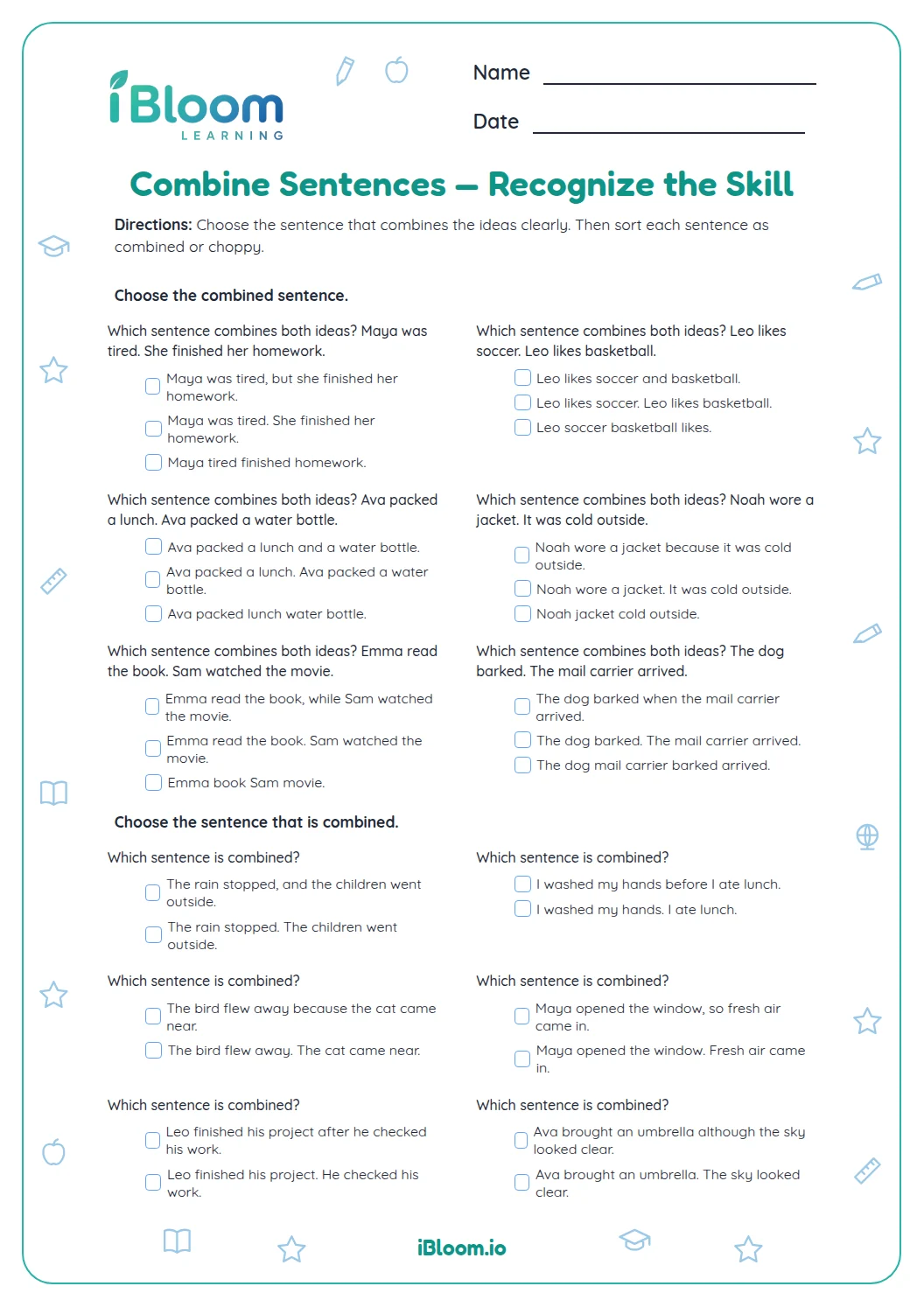
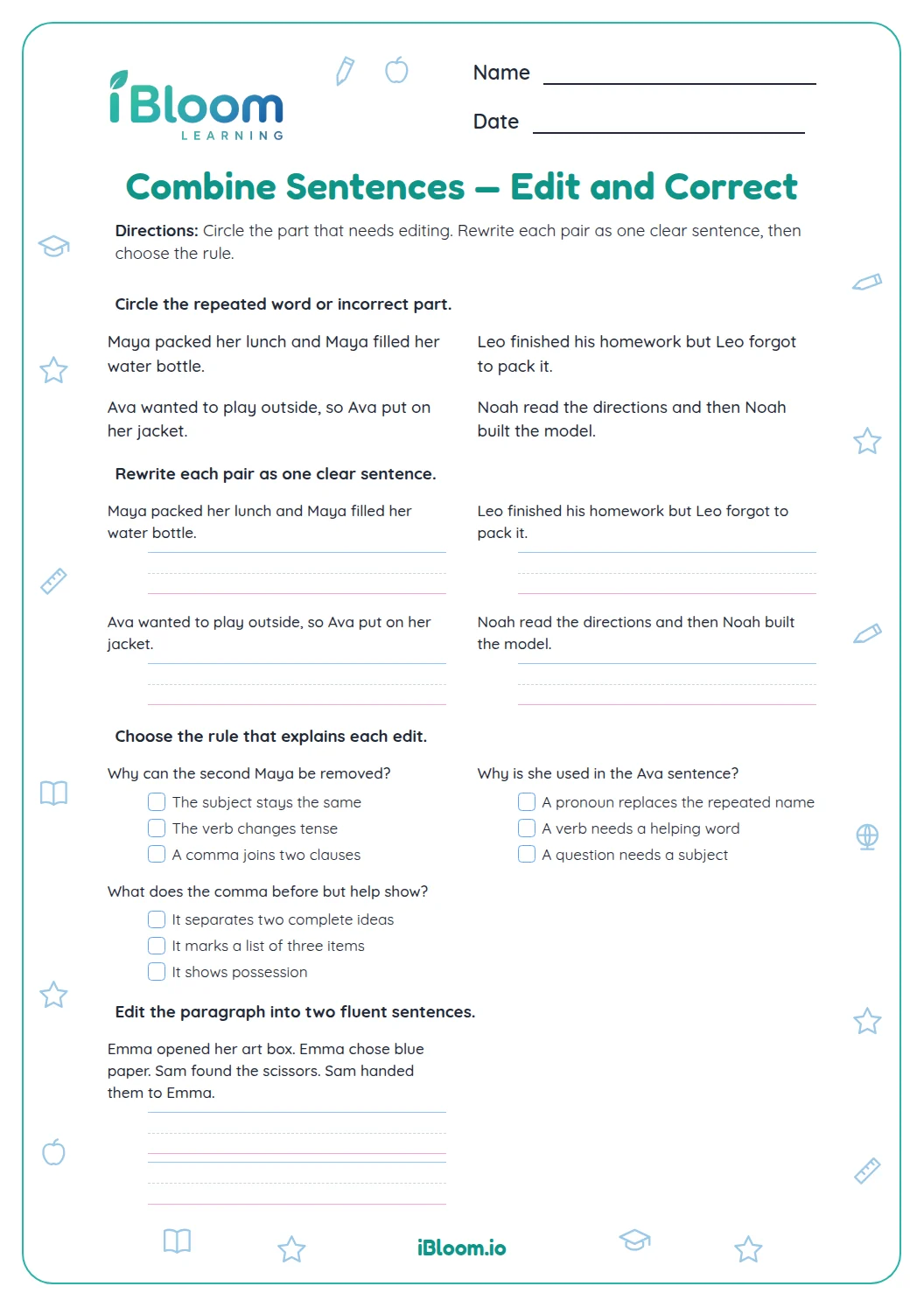
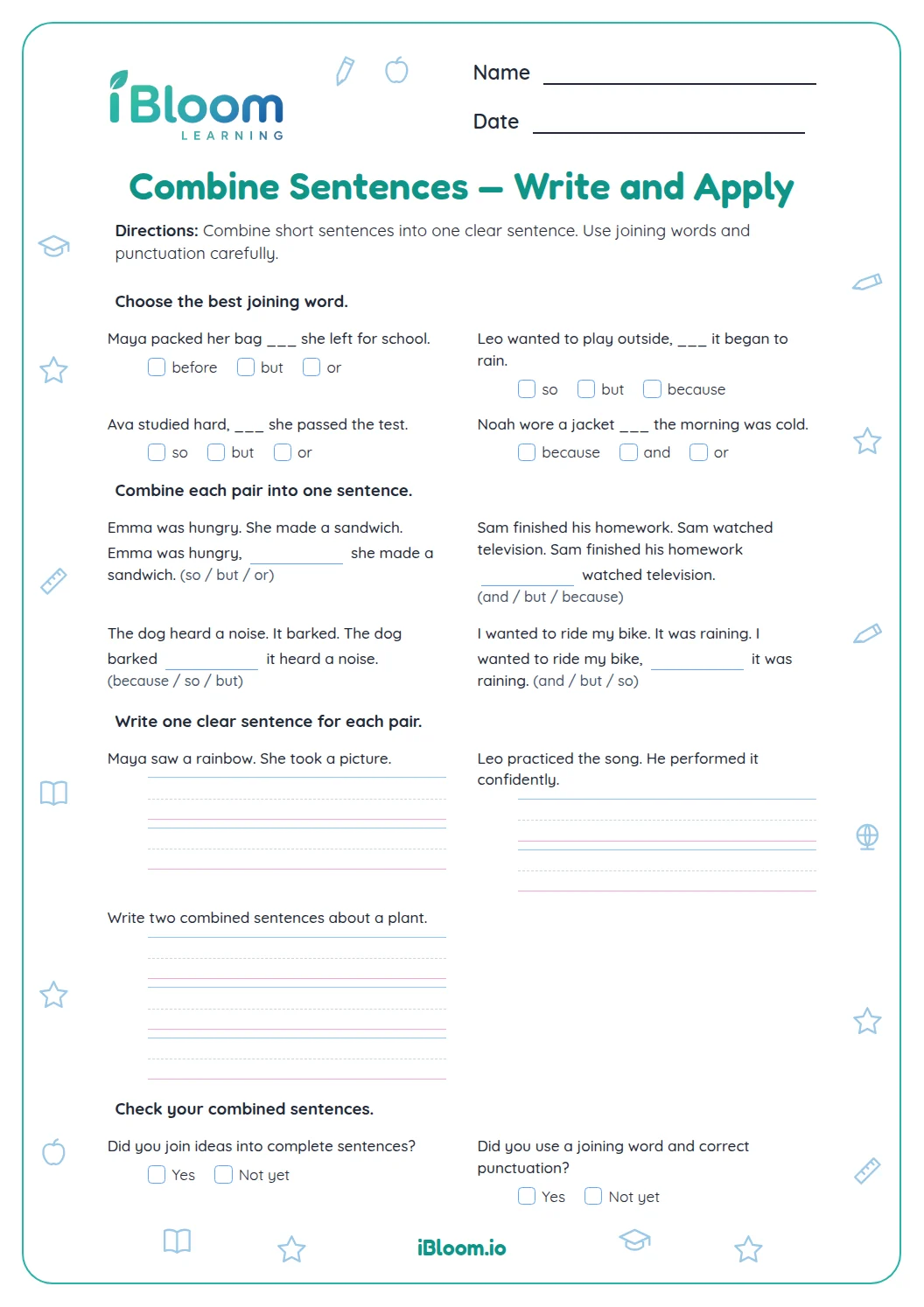
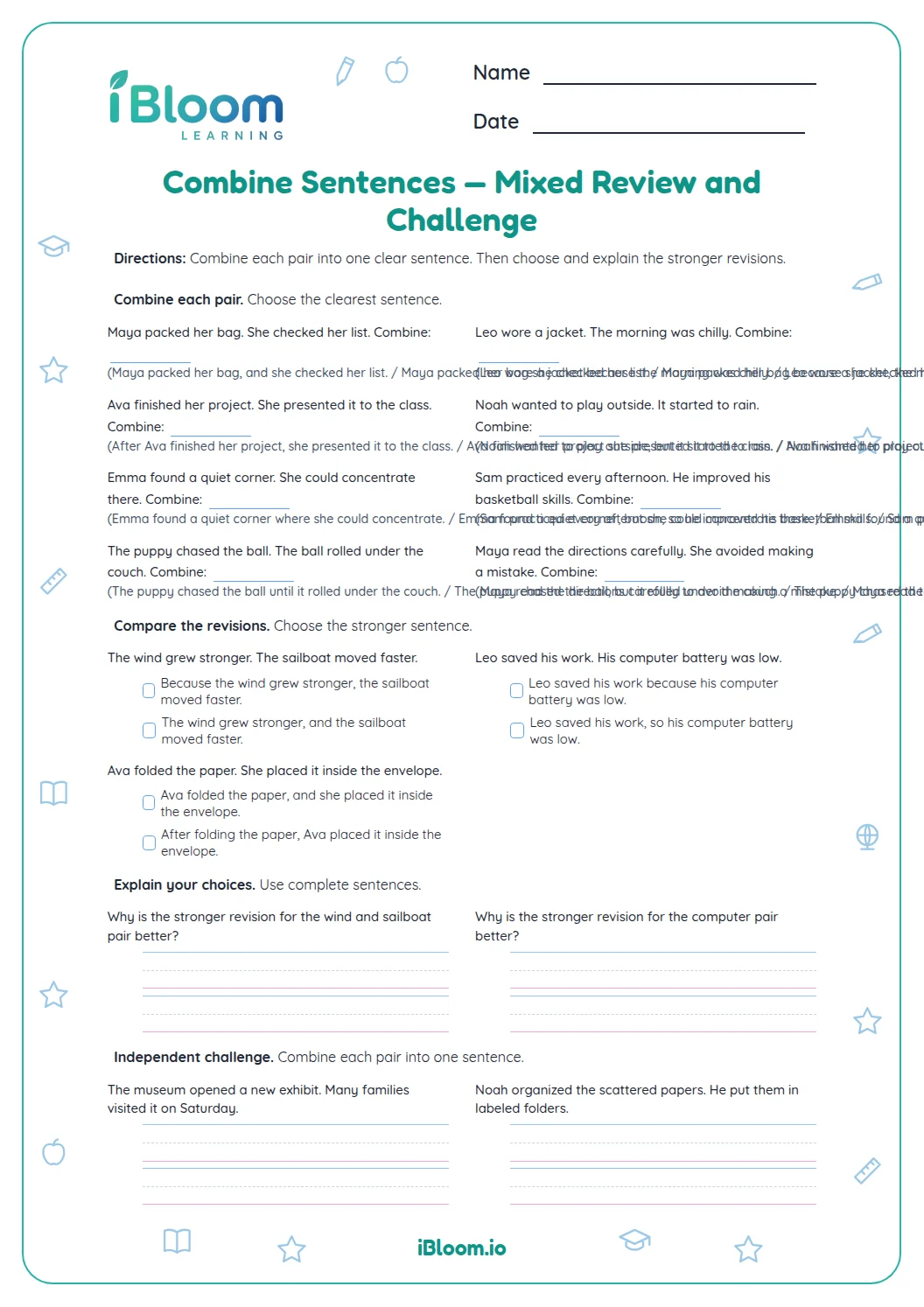
This Grade 5 printable gives students 14 opportunities to combine related ideas into clear sentences. Part A has 12 multiple-choice items where students choose a connector that fits the relationship. Part B asks them to combine two pairs with a connector cue. The answer key marks the choices and gives sample sentences for the written responses.
Aligned to L.5.1.a and W.5.5
What will students practice?
Part A has 12 multiple-choice sentences. Students choose a connector that fits the relationship between the ideas. Part B adds two sentence pairs with connector cues; students combine each pair while keeping both ideas. The answer key marks the choices and offers sample combinations.
- Part A: 12 connector choices with three word options each
- Part B: 2 written sentence combinations
- Sample answers for written responses
How can a connector change a sentence?
Read both clauses and the connector cue. The connector should express the relationship between the ideas, and punctuation should fit the sentence.
- 1The print was tiny. We could read the words. (but)
- 2The print was tiny, but we could read the words.
- 3But signals a contrast; the comma separates the joined clauses.
How does combining sentences help revision?
A combined sentence can show cause, contrast, sequence, or a choice in one clear structure. In Part B, check that the connector keeps the original meaning and that neither idea disappears.
How to use this worksheet
- 1Read the whole sentence pair before filling a blank.
- 2Use the connector printed in parentheses.
- 3Check whether it shows cause, contrast, time, addition, or choice.
- 4For Part B, keep both original ideas in one sentence.
- 5Reread for capitalization, commas, and end punctuation.
- 6Compare with the key; accept a different sentence if it keeps both ideas and uses the requested connector correctly.
Common slips to check
The mistake
Using a connector that changes the relationship between ideas.
The fix
Name the relationship first, such as cause, contrast, or sequence, then use the supplied connector.
The mistake
Dropping one of the original ideas while combining a pair.
The fix
Check that the finished sentence still says both things from the prompt.
The mistake
Leaving out punctuation after an introductory clause.
The fix
When a dependent clause comes first, place a comma before the main clause.
Common Core alignment
Explain how conjunctions function in sentences.
On this sheet: Students use conjunctions to show relationships between ideas in sentences.
Show the official wordingHide the official wording
Explain the function of conjunctions, prepositions, and interjections in general and their function in particular sentences.
Revise writing to make ideas clearer and more effective.
On this sheet: Students revise sentence pairs by combining the ideas with a given connector.
Show the official wordingHide the official wording
With guidance and support from peers and adults, develop and strengthen writing as needed by planning, revising, editing, rewriting, or trying a new approach.
What to practice next
Make more practice
Further reading
Questions parents and teachers ask
How many questions are on the worksheet?
There are 14 questions across the worksheet pages. Students choose a connector in 12 multiple-choice sentences, then combine two sentence pairs with a connector cue. The separate answer key marks the choices and gives sample wording for the written responses, where another clear sentence may also work.
Are there multiple correct ways to combine a sentence pair?
Yes. The sample key shows one clear way to combine each pair, but another sentence can work if it keeps both original ideas and uses the connector named in parentheses. Students should also check that the sentence reads naturally and has the punctuation needed for its structure.
What does Part A teach?
Part A asks students to choose a connector that fits the sentence relationship. The three choices are words, such as because, although, and so. Part B asks students to combine sentence pairs with a connector cue, so they practice both recognizing a fit and writing a complete sentence.
What should students check when combining two sentences?
Students should make sure both ideas from the original pair are still present. Then they can check whether the connector shows the intended relationship, such as contrast with but or sequence with after. A final reread helps catch capitalization and commas.
How can a student use the answer key?
Complete the worksheet first, then compare each blank with the key. For the four written combinations, treat the key as a model rather than the only acceptable wording. If a response differs, check that it preserves both ideas, uses the requested connector, and forms a complete sentence.