




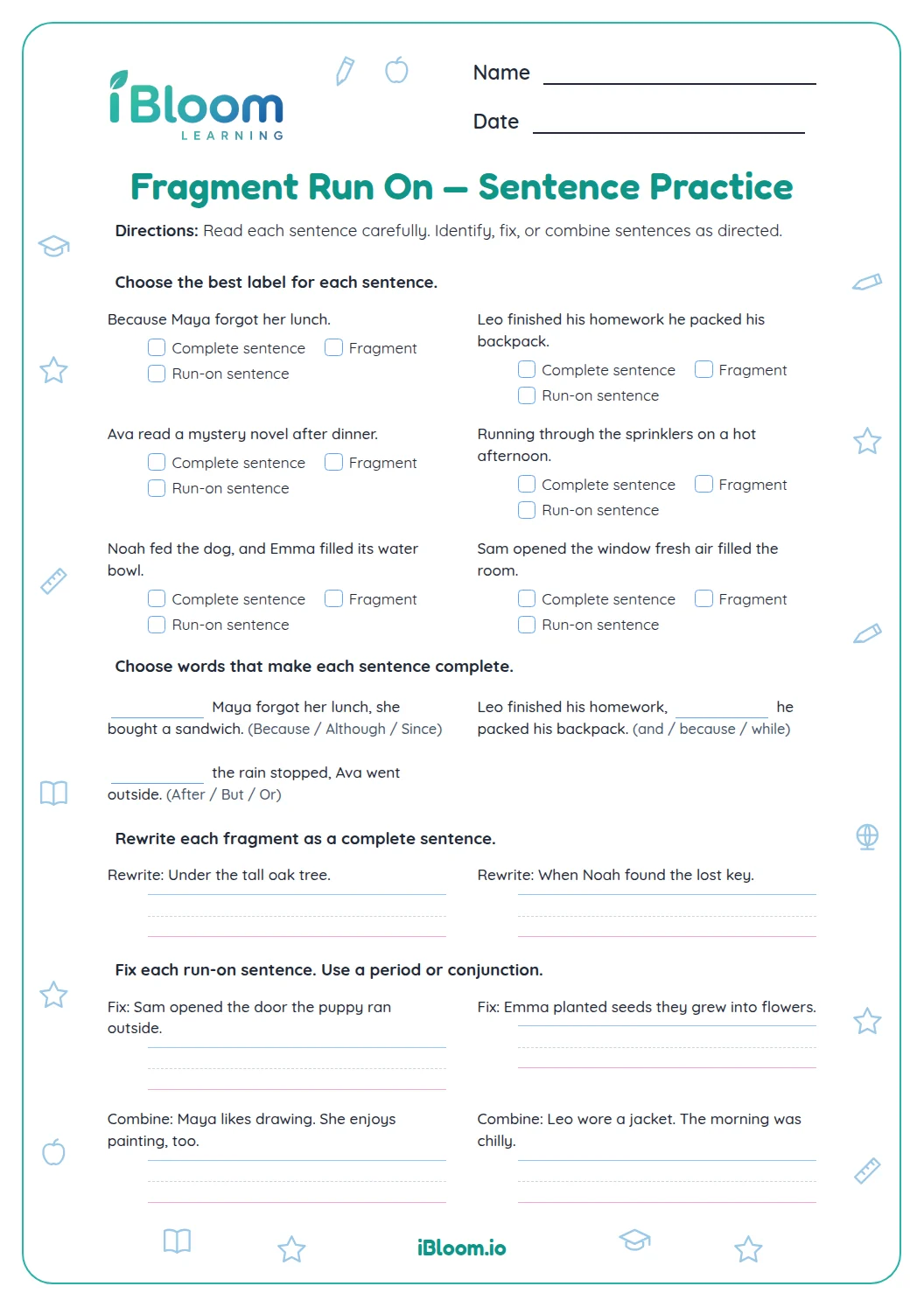
About this worksheet
This Grade 5 grammar worksheet has two parts. Students first identify six sentences as simple, compound, or complex. Then they complete nine sentences with conjunctions such as and, after, because, although, and until. The examples include independent clauses and dependent clauses, and the answer key gives the intended choice for each item.
Aligned to L.5.1.a
What makes a sentence simple, compound, or complex?
A simple sentence has one independent clause. A compound sentence joins two independent clauses, often with a coordinating conjunction such as and or or. A complex sentence has an independent clause and a dependent clause, often introduced by when, although, or because. “When the rain stopped, the team resumed its hike” is complex.
How can a conjunction complete the idea?
Read both sides of the blank and decide how the ideas relate. “The clouds gathered, so the picnic moved indoors” shows a result. “I wanted to read outside, but the wind scattered my pages” shows a contrast. The conjunction should make both grammar and meaning work.
How can the completed sentence be checked?
Reread the whole sentence after choosing a word. Check whether it joins ideas, introduces a dependent clause, or shows a relationship such as cause, time, or contrast. The final item, “After the cake cooled, Sam added the berries,” uses a time clause before the main action.
How to use this worksheet
- 1Read the full sentence, including both sides of any blank.
- 2Count the independent clauses when identifying a sentence type.
- 3Look for a dependent-clause starter such as when or although.
- 4Choose a conjunction that matches the relationship between ideas.
- 5Reread the completed sentence aloud to check its meaning.
- 6Use the key to review choices that change the sentence structure.
Common mistakes and quick fixes
The mistake
Calling a sentence compound because it has a comma.
The fix
Check whether it has two independent clauses joined together.
The mistake
Calling every sentence with and compound.
The fix
Count the clauses; and can join words or phrases inside one clause.
The mistake
Choosing a conjunction that changes the intended relationship.
The fix
Decide whether the ideas show time, cause, result, or contrast first.
Use coordinating and subordinating conjunctions to complete sentence structures.
On this sheet:
Show the official wordingHide the official wording
Explain the function of conjunctions, prepositions, and interjections in general and their function in particular sentences.
What to practice next
Make more practice
Further reading
Questions parents and teachers ask
What is the difference between compound and complex?
A compound sentence joins two independent clauses, each of which can stand alone. A complex sentence combines an independent clause with a dependent clause that cannot stand alone. In “When the rain stopped, the team resumed its hike,” the when-clause depends on the main clause.
How many sentence types does the worksheet include?
The first six questions ask students to identify simple, compound, or complex sentences. The second part has nine completion questions. Students choose a conjunction that makes each sentence grammatical and expresses the intended relationship between the ideas in context.
Can and make a sentence compound?
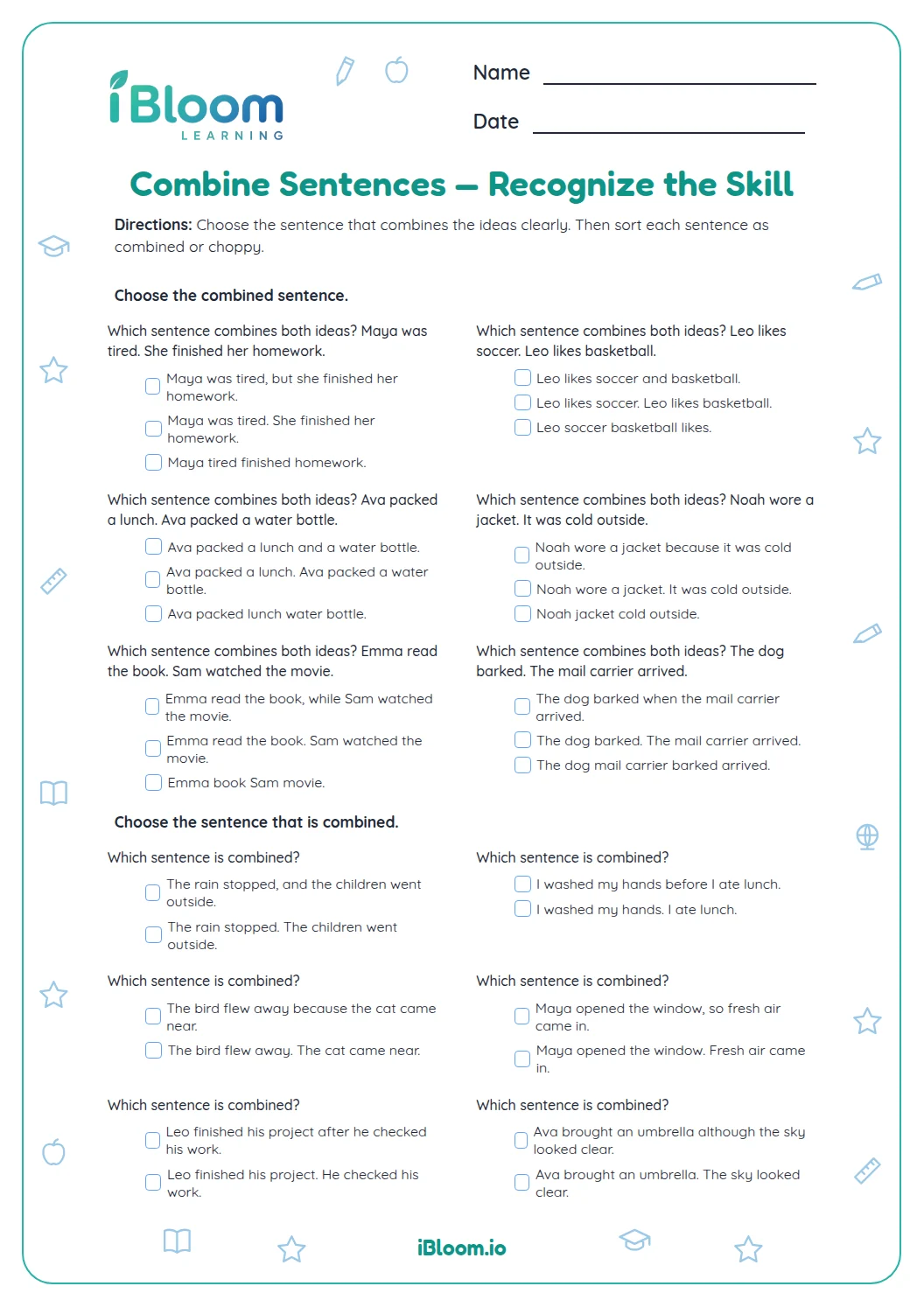
Yes, when and joins two independent clauses. In “Nora packed a lunch, and Eli filled the water bottles,” each side has its own subject and verb and can stand alone. And can also join words or phrases, so the number of clauses matters.
Why does the worksheet ask students to complete sentences?
Choosing a conjunction gives students practice with how ideas connect. Words such as after, because, so, but, and until signal time, cause, result, contrast, or an endpoint. Students should reread the whole sentence to check both meaning and structure.
Are there multiple possible conjunctions for a sentence?
Some sentences can be rewritten with more than one conjunction if the meaning changes. Each item supplies three choices and is written so one choice best fits the intended relationship. The key shows that intended answer; discussing why another option changes meaning can extend practice.
What standard does this worksheet practice?
The worksheet practices CCSS L.5.1.a by having students recognize and complete simple, compound, and complex sentence structures. The identification items focus on clause structure, while the completion items show how conjunctions connect clauses and express relationships between ideas. Students check the full sentence for meaning.