
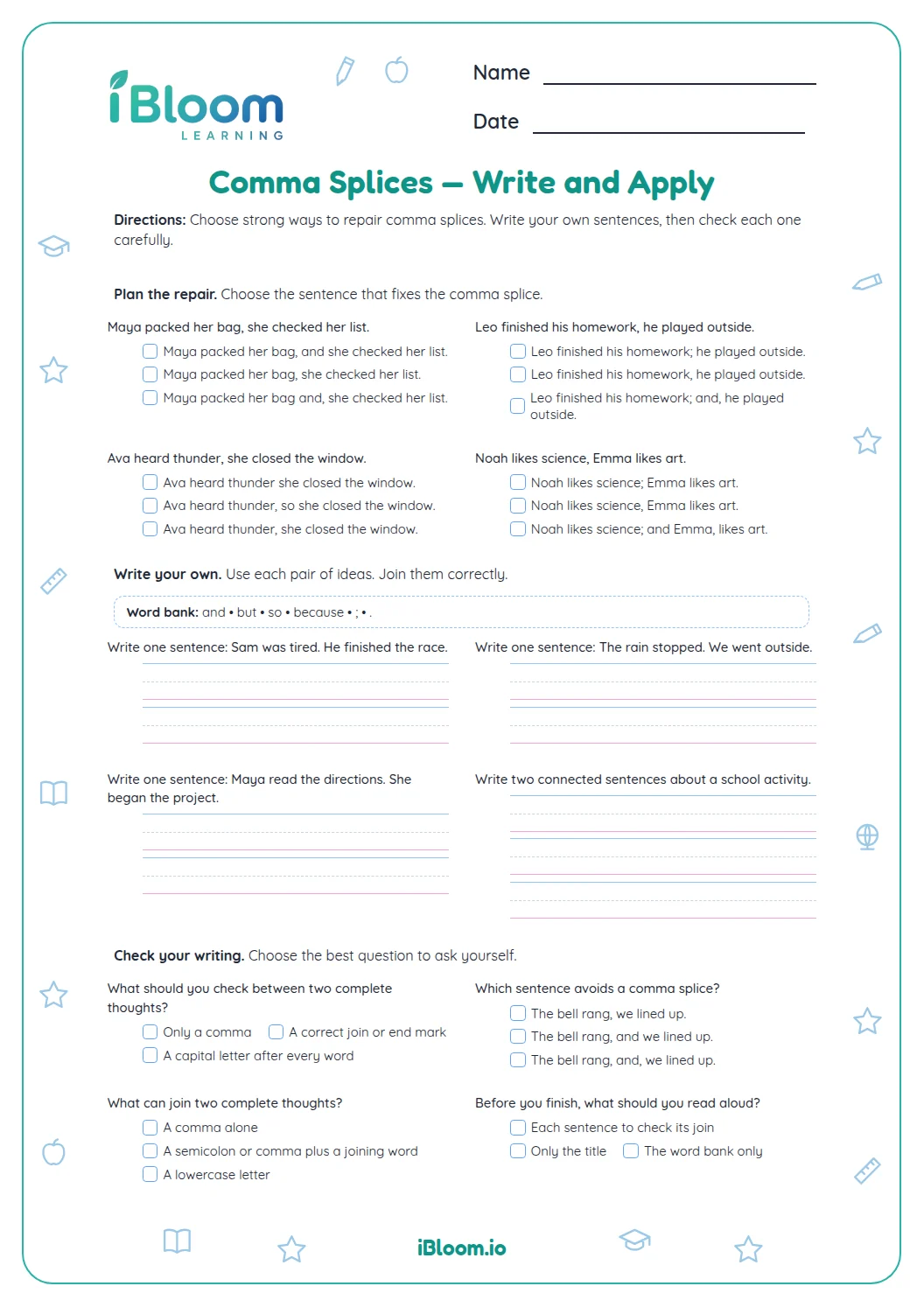
About this worksheet
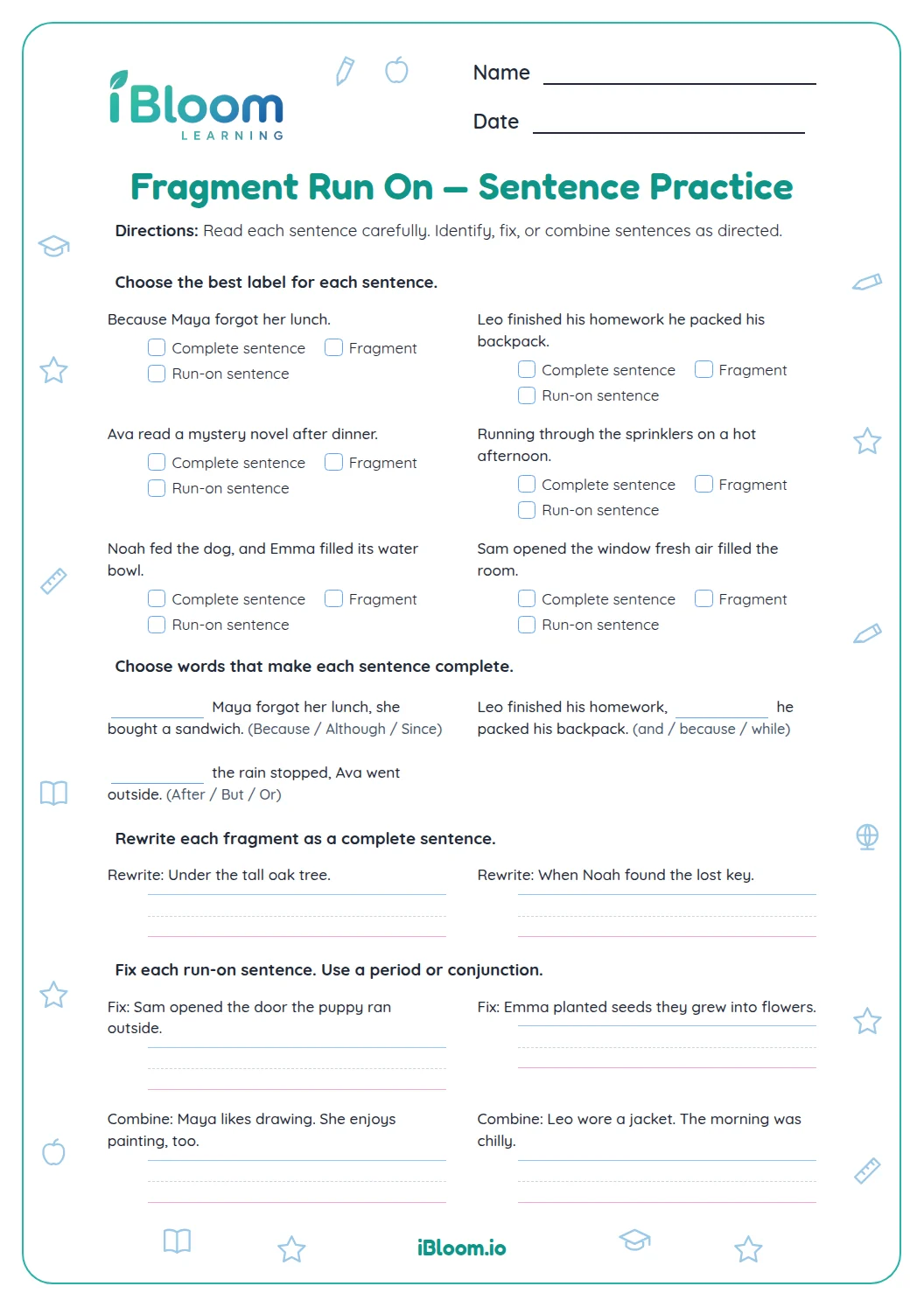
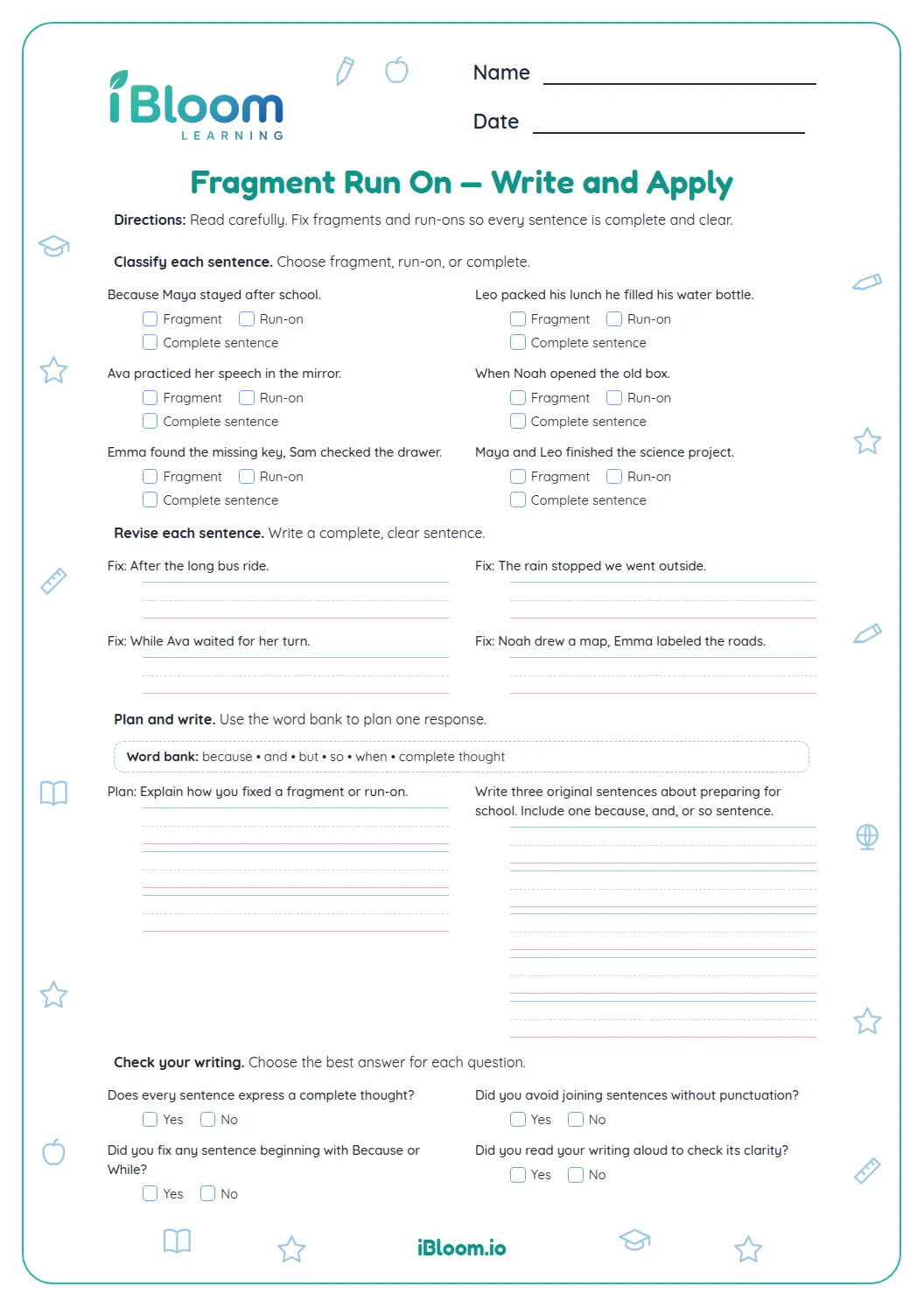
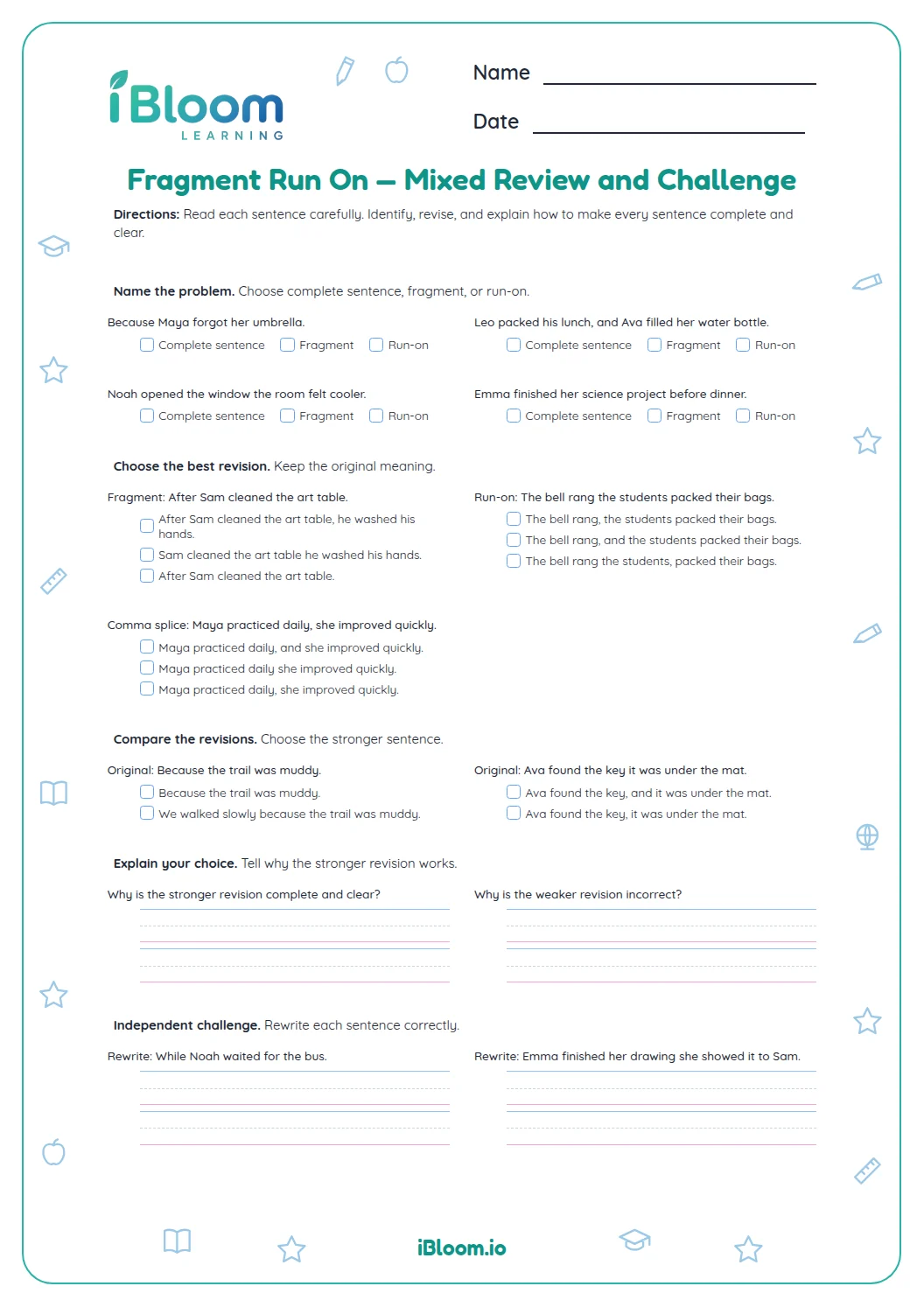
This Grade 5 worksheet gives students 14 choices for recognizing sentence fragments and run-ons and selecting clear repairs. Part A distinguishes complete sentences from errors. Part B focuses on editing: complete a fragment, add a missing sentence part, separate a run-on, or choose correct punctuation. A separate answer key marks each best choice.
Aligned to L.5.1
How can I spot a fragment or run-on?
A fragment is missing a complete thought or a needed sentence part. A run-on joins complete thoughts without appropriate punctuation or a conjunction. Part A asks students to identify and correct examples.
- 1“Rain fell we stayed inside.” is a run-on because both clauses are complete thoughts without a separator.
How do I complete a fragment?
Part B asks students to select edits that add missing sentence parts, separate thoughts, or use punctuation and conjunctions correctly.
- 1For “The lights dimmed the play began,” choose “Lights dimmed. It began.”
How can I check a sentence repair?
Read the selected choice as a complete thought. Check that punctuation separates or joins the clauses correctly and that no fragment remains.
How to use this worksheet
- 1Read the whole sentence and locate its subject and verb.
- 2Decide whether each thought can stand alone.
- 3Choose a repair that completes a fragment or fixes a run-on.
- 4Check punctuation and conjunctions at the clause boundary.
- 5Reread the repaired sentence for meaning.
Check your editing
The mistake
Calling a dependent clause a complete sentence.
The fix
Check whether the clause can stand alone as a complete thought.
The mistake
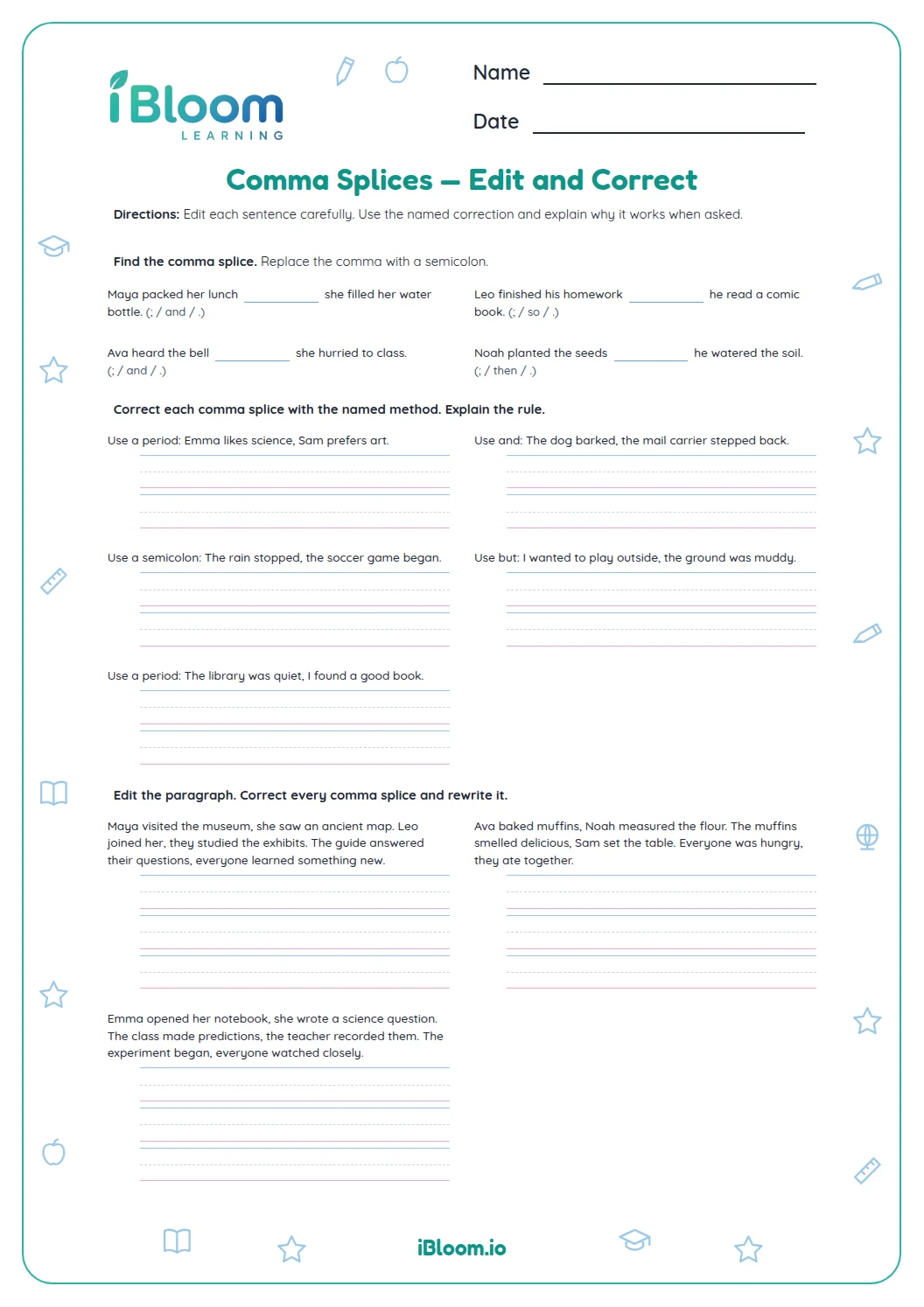
Joining two complete thoughts with only a comma.
The fix
Use a period, or add a conjunction after the comma.
The mistake
Adding words without fixing punctuation.
The fix
Reread the whole revised sentence and mark each clause boundary.
Curriculum alignment
This worksheet practices L.5.1 through the listed tasks.
Edit fragments and run-ons to write complete sentences with clear punctuation.
On this sheet: Students identify and edit incomplete sentences and run-ons, applying standard grammar and punctuation in writing.
Show the official wordingHide the official wording
Demonstrate command of the conventions of standard English grammar and usage when writing or speaking.
What to practice next
Make more practice
Further reading
Questions parents and teachers ask
What is a sentence fragment?
A fragment is a group of words that does not express a complete thought as a sentence. It may be missing a subject, a predicate, or an independent clause. Students identify fragments and choose complete revisions in the second part.
What is a run-on sentence?
A run-on joins complete thoughts without the punctuation or conjunction needed between them. Students choose a correction that separates the thoughts with a period or joins them with a conjunction and appropriate punctuation. Each keyed choice shows the punctuation or sentence part that repairs the error. Read it aloud after checking.
How many questions are included?
The worksheet has 14 multiple-choice questions in two parts. Students identify sentence types, recognize fragments and run-ons, and choose edits that complete or punctuate sentences. Use the answer key after trying each item. Compare the clauses with the keyed repair.
Can students write different corrections?
This sheet asks students to choose the best correction from the listed choices, so each item has one keyed answer. The answer key shows the complete choice and gives a quick way to review sentence boundaries. Each keyed choice shows the punctuation or sentence part that repairs the error.
What should students check after editing?
Students should reread the selected sentence to confirm that it expresses a complete thought. They should also check capitalization and punctuation, especially where two independent clauses meet. Each keyed choice shows the punctuation or sentence part that repairs the error. Then reread the sentence aloud.