

About this worksheet
This free Grade 5 grammar worksheet teaches students to recognize and correct comma splices. They decide whether sentence joins are correct, then complete repairs with a named conjunction or semicolon. The examples use short, everyday situations so attention stays on the punctuation and the two complete thoughts. This practice supports CCSS L.5.1, command of standard English grammar and usage. The separate answer key includes sample edits for the written section.
Aligned to L.5.1
How can you spot a comma splice?
Read the words on each side of the comma. If both sides can stand alone as complete sentences, a comma by itself does not join them correctly.
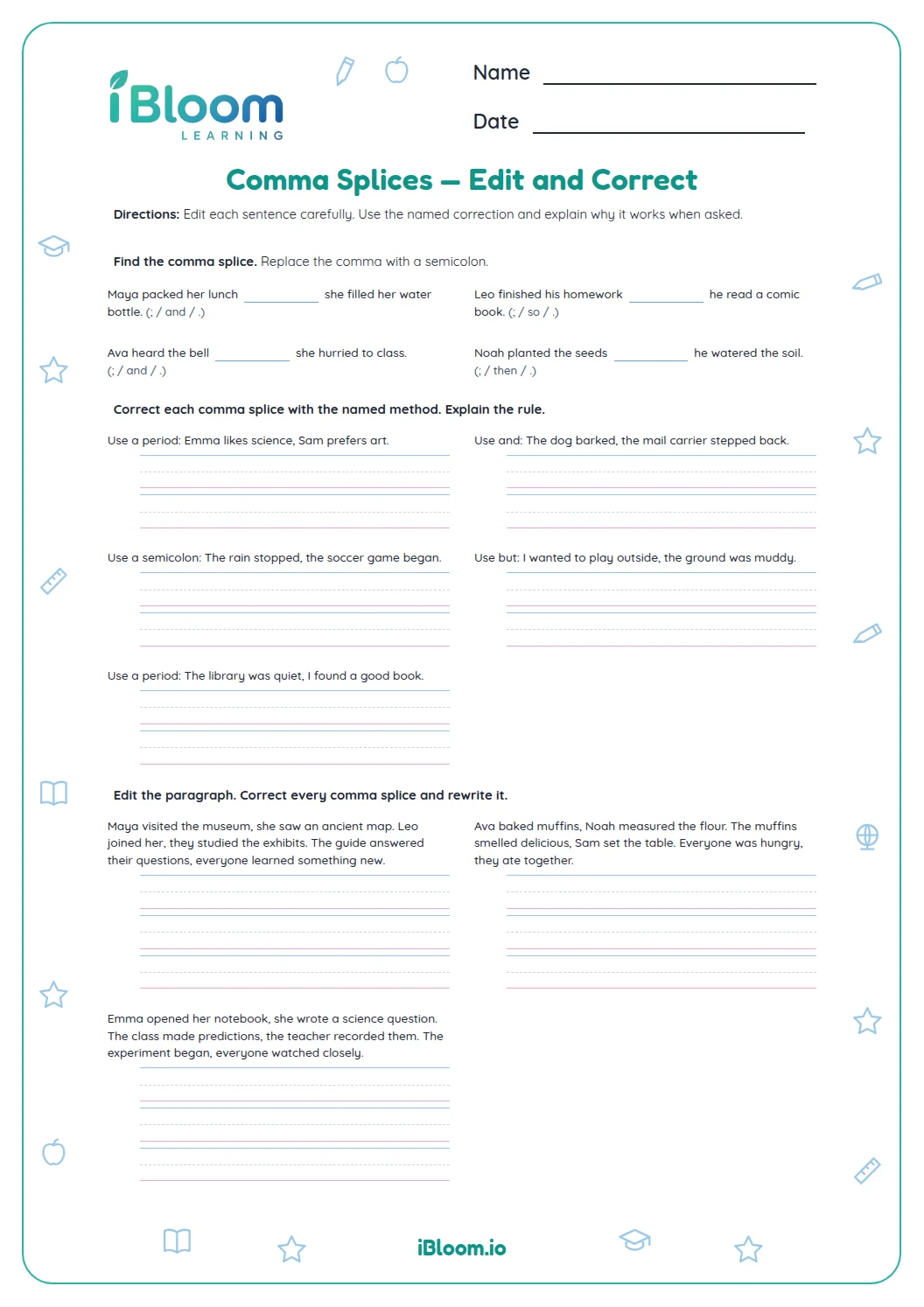
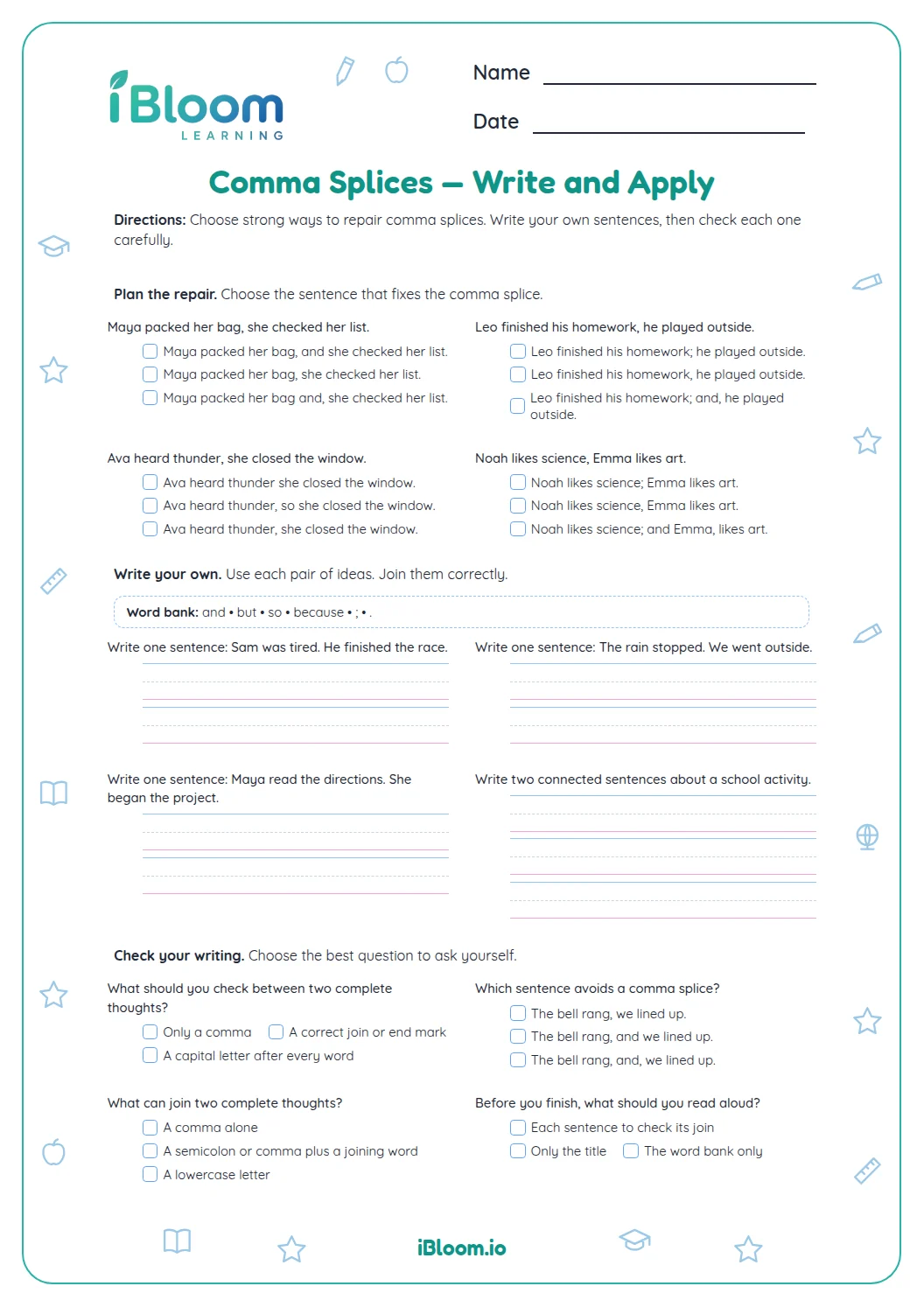
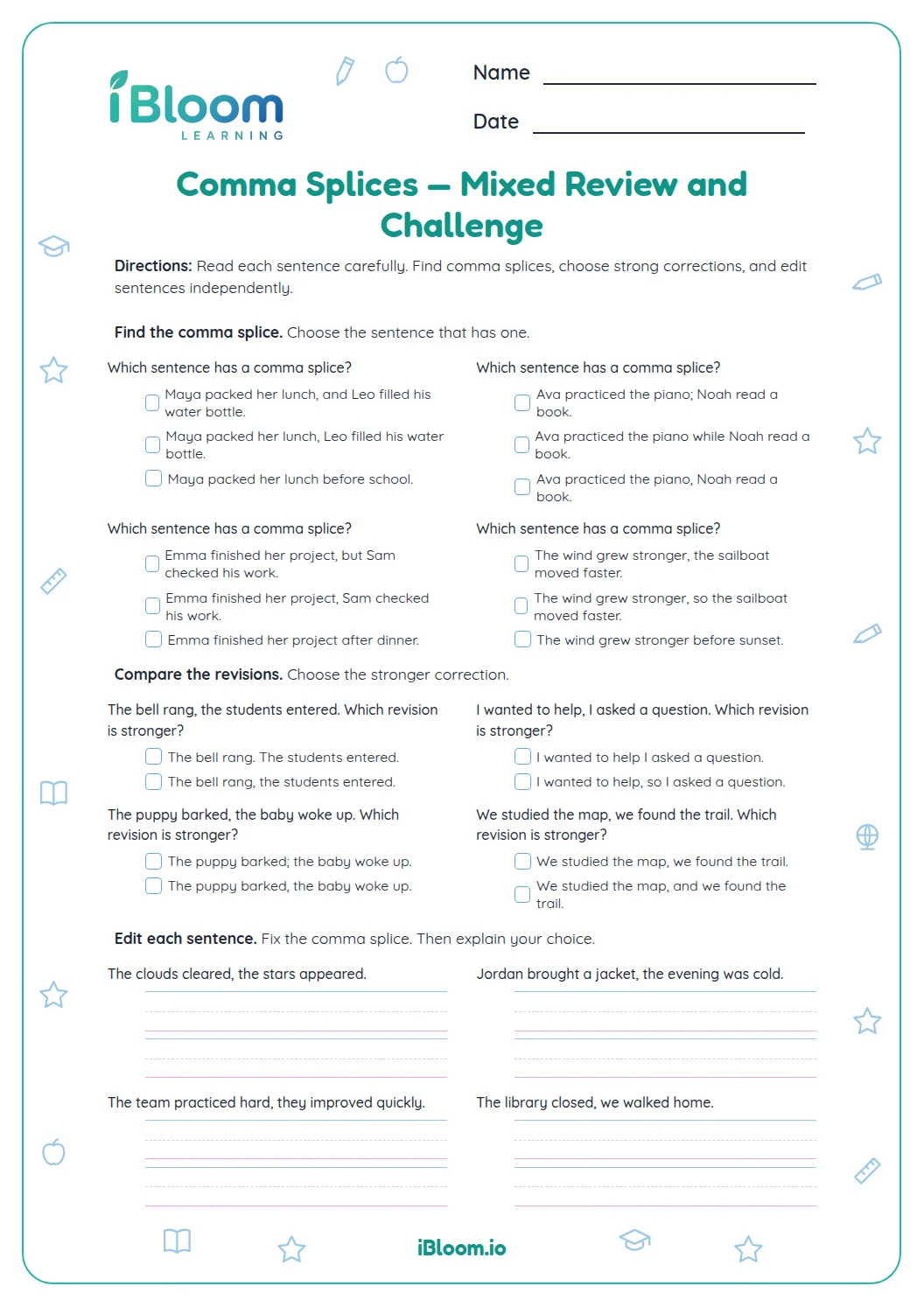
Questions 1–7 distinguish comma splices from correctly joined sentences. Questions 8–14 practice repairing a comma splice with a conjunction or semicolon.
- Find the comma
- Check whether each side is a complete thought
- Notice whether a conjunction follows the comma
How can you repair the comma splice?
Join the ideas with a comma and a coordinating conjunction, or use a semicolon between closely related complete thoughts. Choose the connection that makes sense.
- 1Comma splice: “The clouds gathered, rain began to fall.”
- 2Repair: “The clouds gathered; rain began to fall.”
- 3A semicolon separates the two complete thoughts.
How do you check an edited sentence?
Read the revised sentence aloud. Check that it has the intended meaning and that its punctuation joins the two thoughts correctly. The final repair questions ask students to complete each sentence with the named conjunction or semicolon.
How to use this worksheet
- 1Read each choice from beginning to end.
- 2In Part A, test whether both sides of the comma could be full sentences.
- 3In Part B, look for a conjunction or semicolon that fixes the join.
- 4In Part C, keep both original ideas and repair the punctuation.
- 5Use the answer key to check the written edits.
Common mistakes and quick fixes
The mistake
Thinking every comma between two clauses is wrong.
The fix
Check whether a coordinating conjunction follows the comma.
The mistake
Adding a comma but leaving out a joining word.
The fix
Use comma + conjunction, or a semicolon between the complete thoughts.
The mistake
Changing the meaning while fixing punctuation.
The fix
Keep both ideas and select a conjunction that shows their relationship.
Common Core alignment
This page practices the listed grade-level skill through short, checkable examples.
Recognize and correct sentence errors while applying standard English grammar.
On this sheet: Parts A–C recognize comma splices and correct them by joining two complete thoughts properly.
Show the official wordingHide the official wording
Demonstrate command of the conventions of standard English grammar and usage when writing or speaking.
What to practice next
Make more practice
Further reading
Questions parents and teachers ask
What is a comma splice?
A comma splice happens when a writer joins two complete thoughts with only a comma. For example, “The bell rang, we lined up” has a complete sentence on each side. A comma plus a suitable conjunction or a semicolon can repair the join.
How can I tell if both sides are complete thoughts?
Read each side of the comma as its own sentence. If each side has a subject and verb and expresses a complete idea, the comma alone does not join them correctly. Part A includes both comma splices and correctly joined sentences for comparison.
How many questions are on this worksheet?
There are 14 questions in two parts: seven sentence checks and seven short repairs. Students identify whether a sentence has a comma splice, then complete a correction using the conjunction or semicolon named in the prompt. The worksheet prints on two pages, and the separate key also prints on two pages.
Can a comma ever appear between two complete thoughts?
Yes. A comma can appear before a coordinating conjunction such as and, but or so when it joins two complete thoughts. A semicolon can also separate closely related complete sentences. The key idea is that a comma by itself is not enough.