


About this worksheet
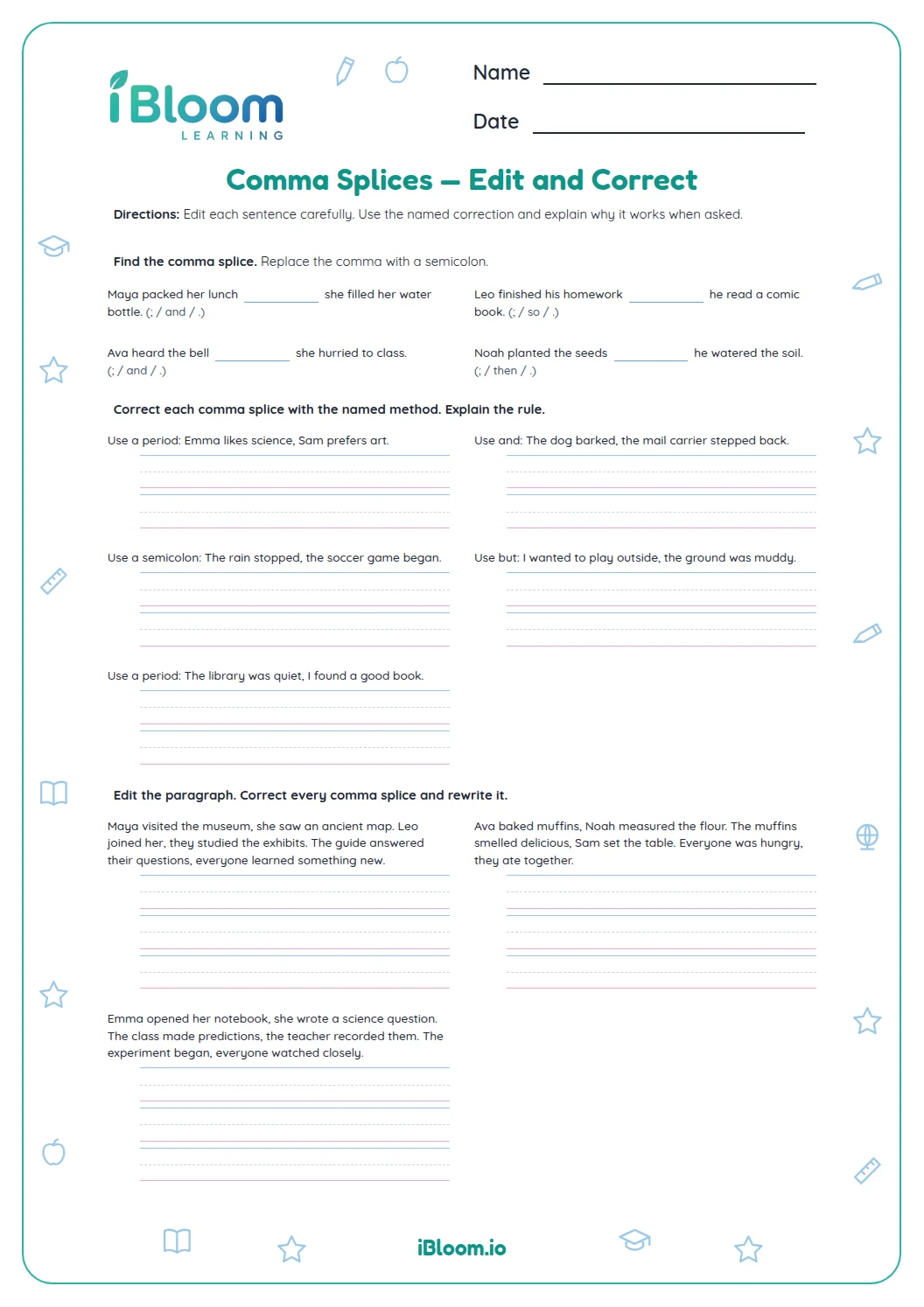
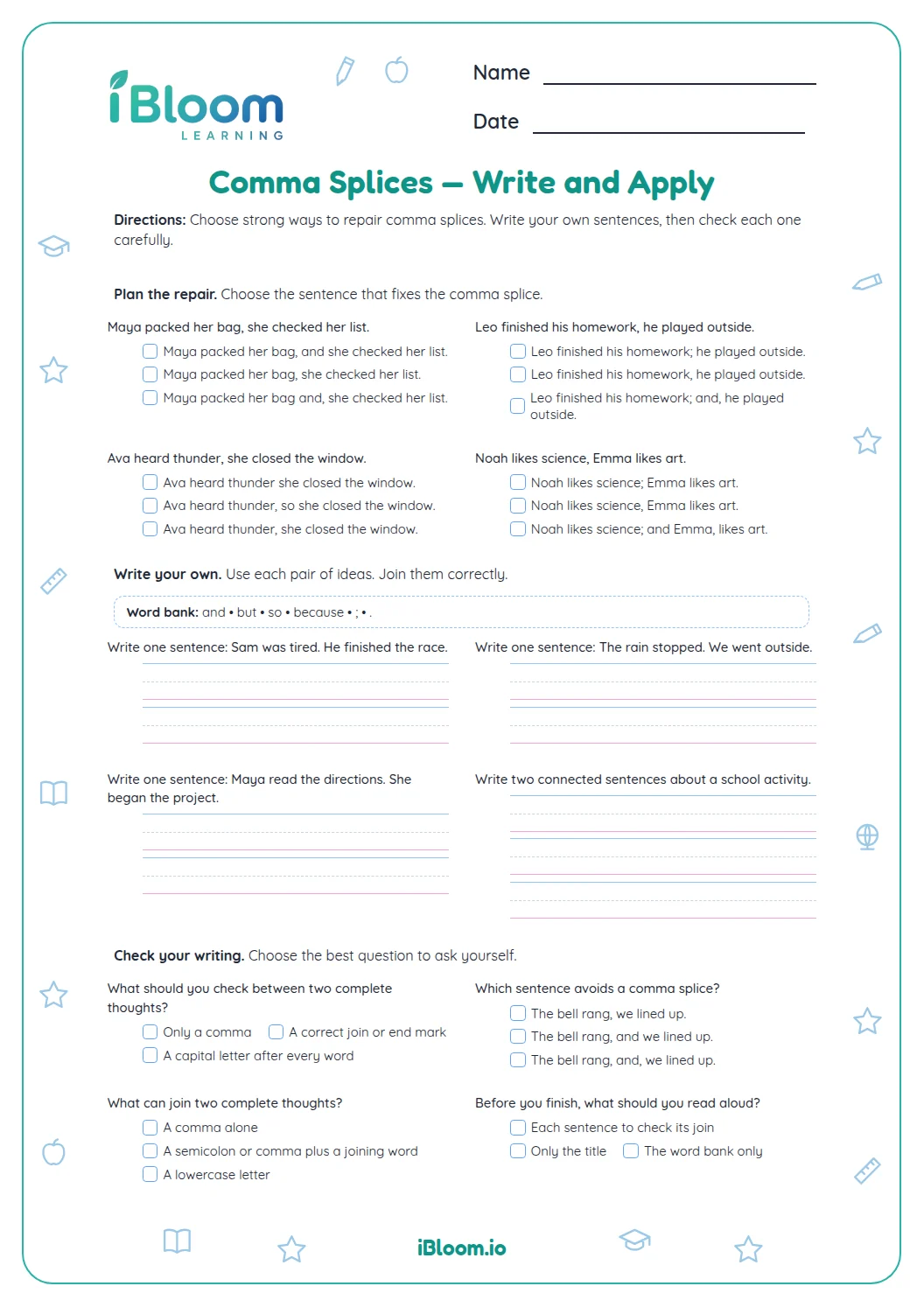
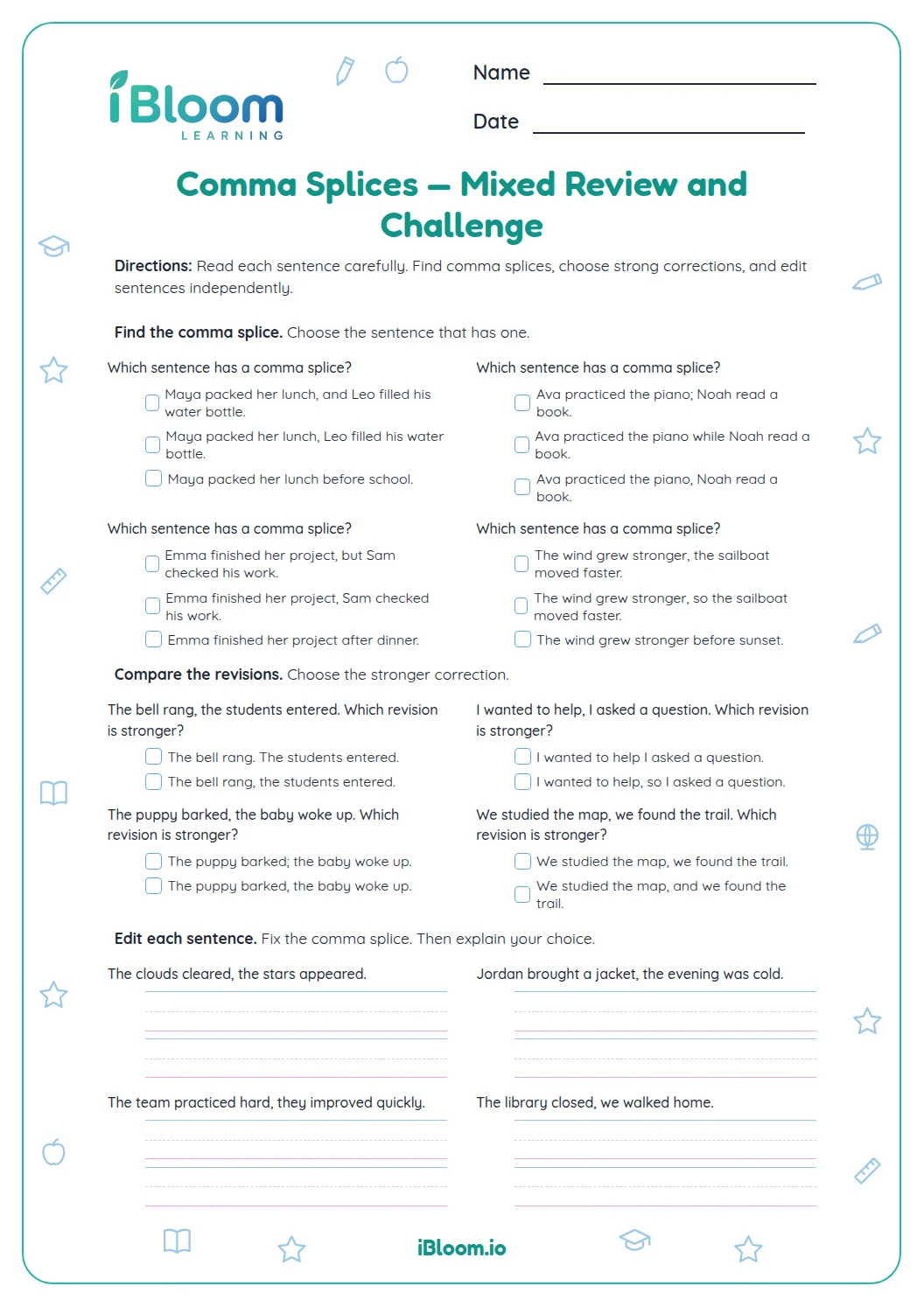
This Grade 5 grammar worksheet gives students 14 guided edits for comma splices. They complete sentences with a coordinating conjunction, period, or semicolon, then rewrite three comma-spliced sentences with a period. It practices combining complete thoughts for clarity, aligned with Common Core L.5.3.a. The answer key shows the intended completion and model rewrites.
Aligned to L.5.3.a
What is on the worksheet?
Fourteen items move from choosing a joining word to adding a sentence boundary and rewriting complete sentences with periods. Students check that both sides of the original comma are complete thoughts and preserve the relationship between them.
Most blanks allow more than one grammatical repair, so the directions and answer key specify a target choice for consistent practice.
- Part A: complete a splice with a conjunction or semicolon
- Part B: choose a period or semicolon as the sentence break
- Part C: complete a splice with a conjunction or semicolon
How do you repair a comma splice?
First, find the subject and verb on each side of the comma. If both sides express complete thoughts, a comma by itself is not enough. Add a coordinating conjunction such as and, but, or so; replace the comma with a period; or use a semicolon between closely related complete thoughts.
Choose the repair that fits the meaning. “I wanted to ride my bike, but my tire was flat” shows contrast, while “The soup smelled good, so everyone asked for a bowl” shows a result.
How to use this worksheet
- 1Read each clause on both sides of the blank.
- 2Follow the part direction to choose the required type of repair.
- 3Check that the joining word fits the meaning or that both sentences stand alone.
- 4Rewrite the three Part C sentences with periods and capital letters.
Common mistakes and quick fixes
The mistake
Keeping only the comma between two complete sentences.
The fix
Test each side by reading it as a sentence; if both stand alone, add a conjunction or stronger punctuation.
The mistake
Adding a conjunction that changes the relationship between ideas.
The fix
Use but for contrast and so for a result; reread the full sentence to check its meaning.
The mistake
Using a semicolon before a dependent clause.
The fix
Use a semicolon only when both sides could stand as complete sentences.
Curriculum alignment
Students combine complete thoughts with punctuation and conjunctions to preserve meaning.
Expand, combine, and reduce sentences for meaning and style.
On this sheet: Students combine two complete thoughts with appropriate conjunctions or punctuation.
Show the official wordingHide the official wording
Expand, combine, and reduce sentences for meaning, reader/listener interest, and style.
What to practice next
Make more practice
Further reading
Questions parents and teachers ask
What is a comma splice?
A comma splice joins two complete sentences with only a comma. For example, “The rain stopped, we went outside” needs a conjunction, a period, or a semicolon. This worksheet gives students practice choosing a repair that keeps both thoughts and makes their relationship clear.
Can a semicolon fix a comma splice?
Yes. A semicolon can separate two closely related complete thoughts, as in “Our team practiced; the coach brought extra balls.” Both sides must be complete sentences. A period also works, while a comma plus a suitable conjunction shows how the ideas relate.
Which conjunction should I choose?
Choose one that matches the meaning. And adds information, but shows contrast, and so can show a result. Reread the complete sentence after adding the conjunction. The punctuation may be correct while the connection between the ideas still sounds wrong.
Which grade is this worksheet for?
This worksheet is written for Grade 5 grammar practice. Students complete 14 sentence edits using conjunctions, periods, or semicolons, then rewrite three sentences with periods and capitalization. A two-page answer key shows the target repair for each item and helps students check their work.
When can a semicolon join two thoughts?
Use a semicolon between two closely related complete sentences. Both sides need a subject and a verb and must make sense on their own. For example, “Maya drew a map; her brother followed it” has a complete thought on each side.