


About this worksheet
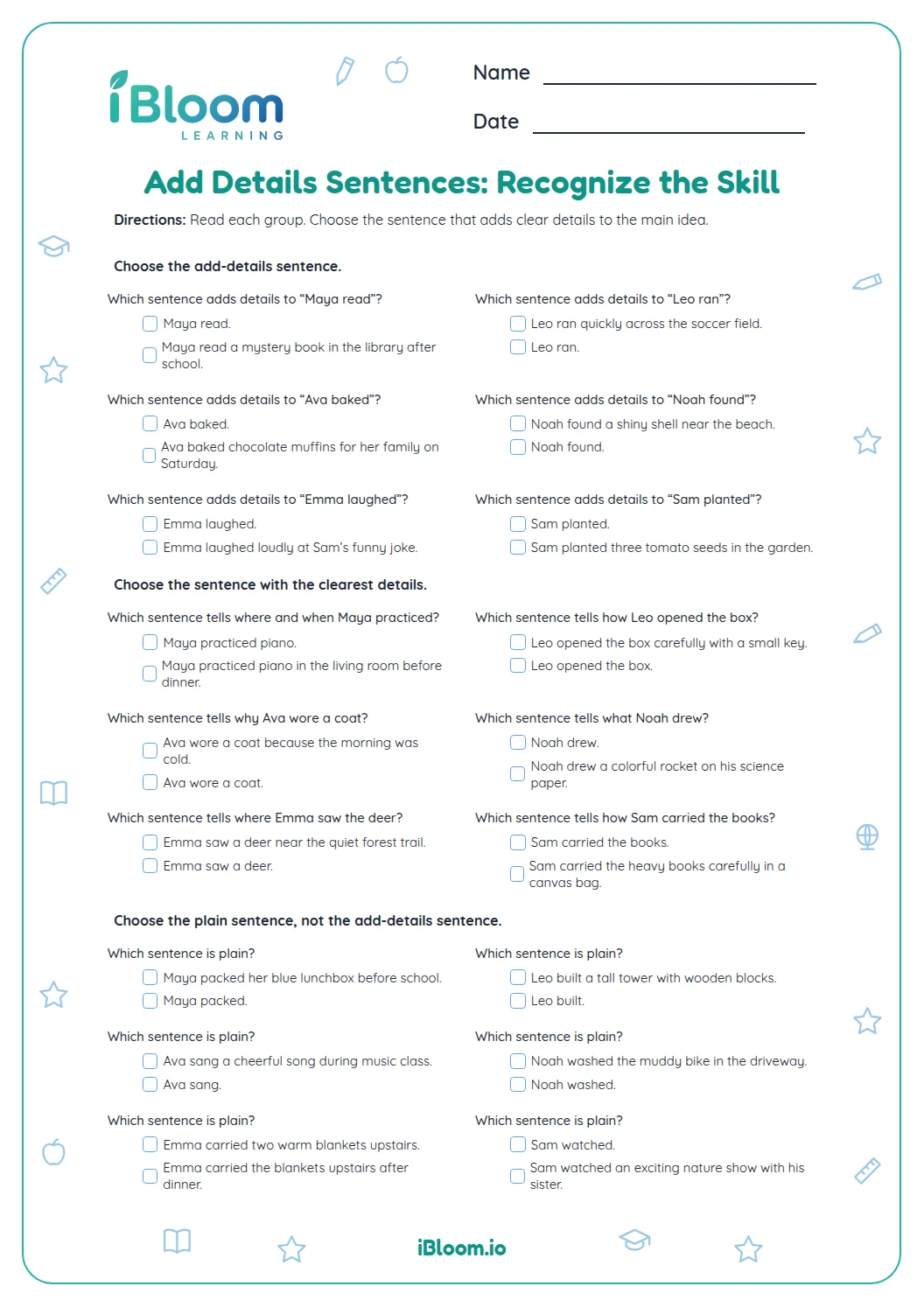
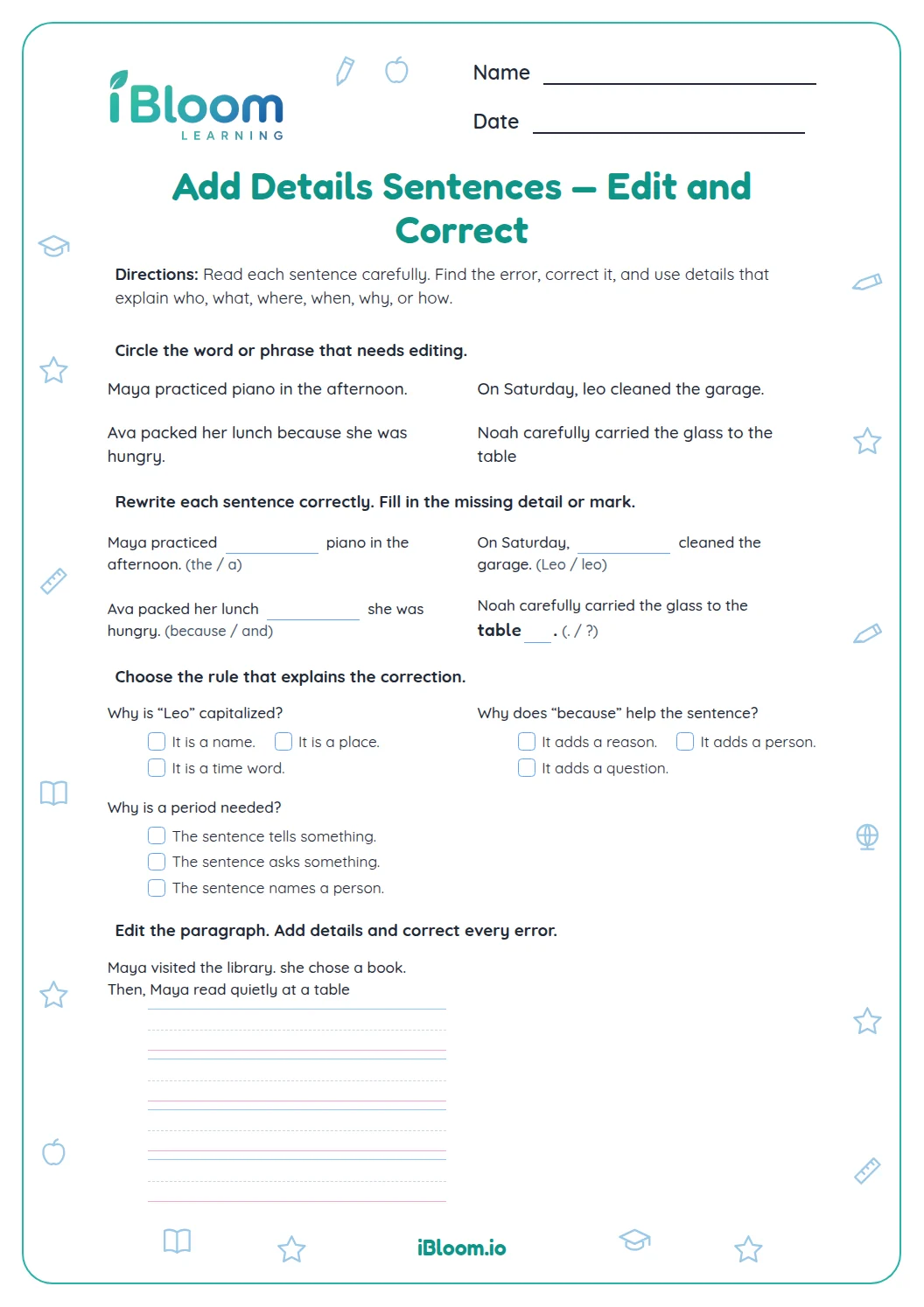
This Grade 5 writing worksheet helps students add useful details to sentences. They choose details that tell when, where, or how, then revise sentences by adding requested information and combining ideas. The final questions ask students to add more than one detail and explain how a detail helps a reader picture a sentence. A separate answer key gives sample responses for open-ended items.
Aligned to W.5.5
Which detail belongs in a sentence?
A useful detail answers a question a reader may have. A time phrase tells when; a place phrase tells where; an adverb or phrase can explain how.
- 1The hikers crossed the bridge. Which detail tells when? “at dawn” answers when; “wooden” describes the bridge.
How can a short sentence grow clearer?
For an open response, add the kind of information named in the prompt and keep the original event. For example, “Add where: Maya practiced piano” can become “Maya practiced piano in the living room.”
- 1“The bell rang” → “The bell rang just before lunch.”
How to use this worksheet
- 1Read the sentence before choosing a detail.
- 2Identify whether the task asks when, where, how, or what kind.
- 3Choose or write a phrase that answers that question.
- 4Read the whole revised sentence for sense and grammar.
- 5For the final item, explain what the detail helps the reader picture.
Common mistakes and quick fixes
The mistake
Adding a detail that answers a different question.
The fix
Match it to the requested kind.
The mistake
Adding unrelated words.
The fix
Keep every phrase connected to the sentence.
The mistake
Writing a fragment.
The fix
Reread the revision as one complete sentence.
Students revise sentences by adding relevant details.
Revise sentences by adding precise details and improving clarity.
On this sheet:
Show the official wordingHide the official wording
With guidance and support from peers and adults, develop and strengthen writing as needed by planning, revising, editing, rewriting, or trying a new approach.
What to practice next
Further reading
Questions parents and teachers ask
What kinds of details do students add?
The first section asks students to identify details that tell when, where, or how, or describe a person or thing. The writing section asks them to revise sentences by adding requested details that make the meaning clearer. Read each choice in the full sentence to check that it answers when, where, or how.
Can writing answers differ from the answer key?
Yes. Several questions ask students to create or revise a sentence, so the key gives sample answers. Another response works if it adds the requested kind of detail and keeps the original sentence’s meaning. A sample can guide the structure, but students may choose another detail that fits the prompt.
How many questions are included?
There are 14 questions: eight choices about which detail fits, four sentence revisions with a requested detail, and two final tasks about adding multiple details and explaining their effect on a reader. The last two questions ask students to apply the detail skill and describe its effect.
What makes a detail useful?
A useful detail answers the question in the prompt and makes the sentence clearer. In “The puppy slept,” a place such as “on a rug” tells where; “after lunch” tells when. The detail should answer the named question; a fitting word can still be the wrong kind.
Does this page include an answer key?
Yes. The separate answer key marks the eight detail choices and gives sample responses for the open writing tasks. Students can compare their sentences with the samples and check whether they added the requested information. Check both the requested detail and the original idea when reviewing a revised sentence.